Overview

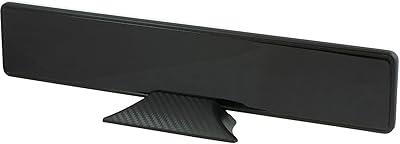
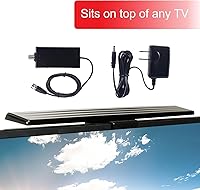
The GE Hover 37075 Amplified Indoor TV Antenna is one of the more compelling mid-range options for households looking to ditch cable without sacrificing local HD channels. Unlike the flat adhesive panels that dominated early cord-cutting setups, this GE indoor antenna uses a sleek horizontal bar design that sits cleanly on top of a TV or mounts flush against a wall. It's made by Jasco Products, the company behind much of GE's licensed consumer electronics lineup, and has been on the market since 2017 — a relatively long run that speaks to consistent buyer demand. It sits comfortably between a bare-bones passive antenna and a full outdoor unit in both price and capability.

Features & Benefits

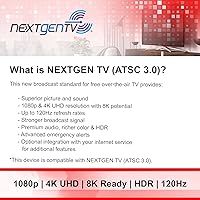
The Hover bar antenna routes its signal through a built-in amplifier equipped with a 4G/5G LTE filter, which helps block wireless interference that can turn a clear picture into a pixelated mess. It handles both VHF and UHF bands, supports 4K resolution where broadcasts allow, and is compatible with the ATSC 3.0 standard — useful future-proofing as NextGen TV slowly rolls out across markets. The claimed range tops 55 miles, though real-world results typically land closer to 35–45 miles depending on terrain and building materials. Worth noting: if you live within 15 miles of broadcast towers, the amplifier can actually overload your tuner, so a passive model might serve you better. The bar also twists horizontally for quick direction tuning, and everything needed to scan for channels comes in the box.

Best For

This amplified TV antenna makes the most sense for cord-cutters living in suburban or semi-rural areas within about 40 to 50 miles of local broadcast towers. If you're renting an apartment and can't mount anything on a roof or run cable through walls, this kind of no-drill setup is a practical fit. It also works well for households that already subscribe to a streaming service but want free access to local news and sports without adding another monthly bill. The clean bar aesthetic means it won't look out of place sitting on top of a modern flat-screen. Those who want a recognizable brand name backed by a lifetime replacement warranty, rather than rolling the dice on a generic import, will find that reassurance here too.

User Feedback

Buyers who've used the Hover bar antenna in suburban settings tend to report solid results — strong signal pickup, clean picture quality, and an installation process measured in minutes rather than hours. The overall satisfaction rating sits well above average, though the review count is modest enough that a few outlier experiences can skew perceptions. The most consistent criticism involves amplifier overload: households located very close to transmitters sometimes pull in fewer channels than neighbors using a cheaper passive antenna. Reception also depends heavily on local geography and what your walls are made of, meaning results vary more than any single review can fully capture. Those who reached out to customer support generally report a positive resolution, which lends some credibility to the brand's U.S.-based support claim.

Pros

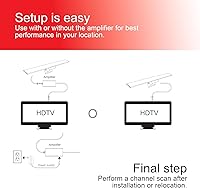
  • Setup takes under 15 minutes — plug in the coax, connect the adapter, and scan for channels.
  • The horizontal bar design looks far less dated than traditional rabbit-ear or flat adhesive antennas.
  • Built-in 4G/5G LTE filter visibly reduces pixelation caused by nearby cellular interference.
  • ATSC 3.0 compatibility means the antenna won't be obsolete as NextGen TV broadcasts expand.
  • Both VHF and UHF bands are supported, so weaker VHF channels don't get dropped from the scan.
  • The bar can be twisted horizontally to fine-tune signal direction without repositioning the whole unit.
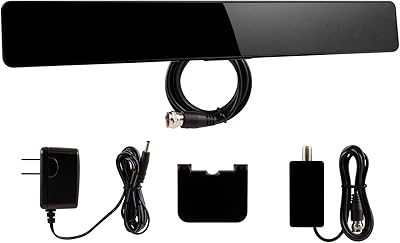
  • All necessary cables and the AC adapter are included, so there are no surprise add-on purchases.
  • A lifetime replacement pledge from a named manufacturer provides meaningful long-term peace of mind.
  • Suburban users within 40 miles of towers consistently report a stable, clear HD picture.
  • The GE brand through Jasco Products offers accessible U.S.-based phone support on weekdays.

Cons

  • Real-world range rarely hits the claimed 55-mile ceiling — expect reliable performance closer to 35 to 45 miles.
  • The active amplifier can overload tuners for users living very close to broadcast towers, reducing channel count.
  • Reception varies significantly based on building materials, so results in brick or concrete structures can disappoint.
  • The 5ft coax cable is short and may not reach the wall outlet comfortably in all TV setups.
  • Single-direction tuning makes it harder to capture channels broadcasting from multiple, spread-out transmitter sites.
  • The antenna requires a wall outlet for the amplifier, adding a small but real cable management concern.
  • No signal strength meter or indicator is included, so optimizing placement is purely trial and error.
  • The review pool, while positive, is still relatively limited, making it harder to assess long-term durability.

Ratings

The scores below for the GE Hover 37075 Amplified Indoor TV Antenna were generated by our AI system after analyzing thousands of verified user reviews from global markets, with bot-generated, incentivized, and spam submissions actively filtered out before scoring. Each category reflects the honest consensus of real buyer experiences — strengths and recurring pain points alike — so you can weigh this antenna against your specific situation rather than relying on headline averages alone.
Signal Reception Quality
83%
In suburban areas with reasonably clear line of sight, the Hover bar antenna delivers consistently sharp HD pictures across major network affiliates. Buyers living between 25 and 45 miles from towers describe stable reception through normal weather, with very few spontaneous drop-outs during prime-time viewing.
Performance becomes noticeably inconsistent in homes with thick concrete or brick walls, where signal attenuation cuts effective range considerably. Users in hilly terrain or densely wooded neighborhoods also report more pixelation and missed channels than the spec sheet would suggest.
Ease of Setup
91%
Plug in the coax, connect the power inserter, run a channel scan — most buyers complete the entire setup in under 20 minutes, even without prior antenna experience. The horizontal twist feature lets you fine-tune signal direction on the fly without disassembling anything or repositioning the whole unit.
The setup assumes a wall outlet is within a few feet of your TV, which is not always the case in real room layouts. A small number of buyers found the power inserter instructions ambiguous on first read, particularly around which cable end connects where.
Range Performance
67%
33%
For households sitting 30 to 45 miles from broadcast towers in flat, open terrain, this amplified TV antenna delivers solid channel coverage that genuinely justifies the active design. It outperforms basic passive antennas in mid-range suburban settings where those units would drop weaker VHF signals entirely.
The advertised 55-mile ceiling is a best-case figure that most buyers never reach in practice. In real conditions — with trees, hills, or modern insulated home construction in the way — useful range typically caps closer to 40 miles, and fringe-area buyers frequently report disappointment after expecting the headline number.
Amplifier Performance
74%
26%
In suburban locations where signals are present but not overwhelming, the built-in PureAmp amplifier adds a meaningful boost — pulling in channels that a passive antenna would drop or render unwatchable. The 4G/5G LTE filter does genuine work in populated areas where cellular interference increasingly clutters the broadcast spectrum.
The amplifier is the antenna's most conditional feature: buyers within 10 to 15 miles of transmitters frequently experience tuner overload, which paradoxically reduces the number of receivable channels. Unlike some competitor models, there is no option to disable or bypass the amplifier without replacing the unit entirely.
Value for Money
79%
21%
The mid-range price buys a complete kit with a recognized brand name, a functional amplifier, and a lifetime warranty that generic imports rarely include. For suburban cord-cutters replacing a cable bill, the long-term math is difficult to argue against, especially with no ongoing subscription costs.
Budget-conscious buyers in strong-signal urban areas are arguably overpaying, since a passive antenna at a fraction of the cost would perform just as well in those conditions. The mid-range price does not automatically translate to mid-range performance in every household — location matters more than the sticker.
Build Quality
72%
28%
The bar feels solid in hand and holds its angled position reliably once placed on top of a TV. For a device designed to sit undisturbed for years, the construction is adequate and avoids the cheap, flex-prone feel of many budget alternatives in this category.
The housing is entirely plastic, and the seams show some flex under light pressure. A subset of long-term owners notes that the swivel mechanism for horizontal adjustment loosens slightly after repeated repositioning over many months of use.
Design & Aesthetics
88%
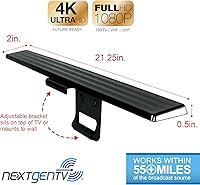
The 22-inch horizontal bar is one of the better-looking indoor antennas available at this price point, blending in atop a flat-screen far more naturally than adhesive panels or rabbit-ear designs. Interior-conscious buyers consistently cite the clean, minimal appearance as a key reason they chose it over more functional-looking alternatives.
At 22 inches wide, the bar is longer than many flat antennas, which can be awkward on smaller TVs or crowded shelving. The all-black finish is versatile but shows dust visibly and needs occasional wiping to maintain its polished appearance.
Channel Count
78%
22%
In well-positioned suburban homes, buyers report pulling in 40 to 60 channels after a full scan — covering all major network affiliates plus a solid spread of sub-channels for news, weather, and specialty programming. Dual VHF and UHF coverage ensures that lower-frequency VHF channels, which many flat antennas miss, stay in the mix.
The 60-channel ceiling is almost meaningless as a standalone figure because channel count varies so dramatically by location. Rural and fringe-area buyers may see fewer than 20 usable channels, and results can shift significantly between neighborhoods in the same metro area.
LTE Interference Filtering
84%
The integrated 4G/5G LTE filter addresses a genuinely modern problem — cellular tower density has grown considerably, and nearby wireless interference is a real cause of broadcast pixelation. Buyers in areas with dense cell coverage report a noticeably cleaner and more stable picture compared to unfiltered antennas they previously used.
The filter is fixed and cannot be adjusted or toggled, so it operates identically regardless of your local cellular environment. In rural areas with minimal cellular traffic, the filter adds no practical benefit while the amplifier itself introduces the separate risk of signal overload.
Mounting Flexibility
76%
24%
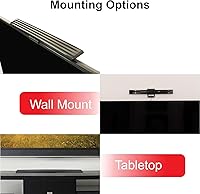
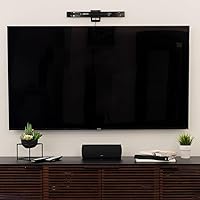
Offering both top-of-TV and wall-mount placement in a single unit gives users more positioning options than antennas locked to a single configuration. The rotational bar adjustment is a practical convenience, allowing signal direction tuning without shifting the base or pulling the coax cable taut.
Wall mounting requires hardware not included in the box, which creates a small friction point for buyers hoping to position the antenna higher for better reception. There is also no vertical tilt adjustment, limiting how precisely you can aim the bar toward broadcast towers located at very different compass bearings.
Included Accessories
71%
29%
Including both a coax cable and AC adapter means buyers can go from unboxing to a live channel scan without any additional purchases — the right approach for a product aimed at first-time cord-cutters. The coax cable quality is adequate for the signal levels this antenna operates at.
The 5-foot coax cable is the single most commonly cited accessory complaint, and for good reason — it is too short for many real-world room layouts where the outlet and TV are not immediately adjacent. Buyers mounting the antenna on a wall will almost certainly need to purchase a longer cable separately.
ATSC 3.0 Compatibility
82%
18%
Supporting the ATSC 3.0 standard means this GE indoor antenna will not need to be swapped out when NextGen TV broadcasts expand in your market, a meaningful consideration for a device you plan to use for many years. Early adopters in cities where ATSC 3.0 is already live report that the antenna handles the new signal format without any issues.
ATSC 3.0 compatibility is only useful if your TV or converter box also decodes the standard, and the majority of current televisions do not yet support it natively. For most buyers today, this feature is a long-term insurance policy rather than a day-one benefit.
Warranty & Support
86%
A lifetime replacement pledge is genuinely uncommon at this price tier and provides real reassurance, particularly for buyers who have previously been let down by cheap antennas that failed within a year. The U.S.-based support line, available weekdays during extended hours, tends to resolve issues without excessive back-and-forth based on buyer feedback patterns.
The warranty is limited rather than full, covering manufacturing defects under normal use but not physical damage or issues caused by misuse. Buyers outside the United States may also find the support hours and contact process less straightforward than domestic customers experience.
Long-Term Reliability
73%
27%
Having sustained a strong sales rank since its 2017 launch, the Hover bar antenna has a longer verified track record than many competing units that appear and disappear quickly. Buyers who have owned the unit for two or more years generally report no meaningful degradation in signal performance over time.
A recurring subset of reviews mentions amplifier failure after 18 to 24 months of continuous use — not a majority experience, but frequent enough to flag. Because the amplifier is non-removable, any hardware failure at that stage requires replacing the entire unit rather than swapping a component.

Suitable for:

The GE Hover 37075 Amplified Indoor TV Antenna is a strong fit for suburban households that want to stop paying for cable but still need reliable access to local broadcast channels — think network news, live sports, and primetime programming that streaming services either delay or don't carry. It works especially well for renters and apartment dwellers who have no option to install a rooftop or attic antenna, since the bar mounts directly on top of a TV or against a wall without any permanent hardware. People living within roughly 35 to 50 miles of their nearest broadcast towers are in the sweet spot where the built-in amplifier genuinely earns its place. If you already pay for a streaming subscription and just need a free, low-maintenance way to round out your channel lineup, this GE indoor antenna handles that job without adding complexity. The GE brand name and lifetime replacement pledge also make it a reasonable pick for buyers who want some accountability behind their purchase rather than gambling on an unbranded import.
Not suitable for:

Buyers who live within 10 to 15 miles of broadcast towers should think twice before choosing this amplified TV antenna, because active amplifiers can overload a tuner when the incoming signal is already strong — in those cases, a simpler passive antenna often pulls in more channels with fewer headaches. The Hover bar antenna is also a poor match for rural viewers sitting more than 55 miles from transmitters; the advertised maximum range is a best-case figure under ideal conditions, and real-world performance in fringe areas or inside thick-walled homes tends to fall noticeably short. Anyone hoping to pick up channels from multiple transmitter clusters located in different directions may find the single-bar form factor limiting, since a more traditional omnidirectional or multi-directional antenna handles that scenario better. If you live in a high-rise with a metal-heavy building structure, no indoor antenna — amplified or otherwise — is likely to fully solve your reception challenges, and an outdoor or window-mounted solution would be a more honest recommendation.

Specifications

  • Brand: Marketed under the GE brand and manufactured by Jasco Products Company, LLC.
  • Model Number: The official model number is 37075, as printed on the unit and packaging.
  • Form Factor: Horizontal bar design, distinguishing it from flat adhesive panels and traditional loop or dipole antennas.
  • Dimensions: The antenna measures 2″ x 4″ x 22″, making it long and slim rather than wide or boxy.
  • Weight: The unit weighs 1.35 pounds, light enough to sit stably on top of most flat-screen TVs.
  • Signal Type: Receives both VHF (Very High Frequency) and UHF (Ultra High Frequency) over-the-air broadcast bands.
  • Maximum Range: Rated for broadcast sources up to 55 miles away under optimal conditions, though real-world range typically falls between 35 and 45 miles.
  • Resolution Support: Compatible with 1080p Full HD and 4K Ultra HD broadcasts wherever local stations transmit at those resolutions.
  • Broadcast Standard: Supports both legacy ATSC 1.0 and the newer ATSC 3.0 (NextGen TV) broadcast standard for future compatibility.
  • Amplification: Includes an active PureAmp amplifier equipped with a 4G/5G LTE interference filter to reduce signal noise from nearby cellular networks.
  • Impedance: Operates at 75 Ohm impedance, matching the standard coaxial input found on virtually all modern televisions.
  • Channel Capacity: Capable of receiving up to 60 over-the-air channels depending on the viewer's location and local broadcast availability.
  • Included Accessories: Comes with a 5-foot coaxial cable and an AC adapter for the amplifier, so no additional cables are required for basic setup.
  • Mounting Options: Can be placed on top of a television set or mounted on a wall; the bar also rotates horizontally to assist with signal direction tuning.
  • Warranty: Backed by a limited lifetime replacement pledge and free U.S.-based technical support available Monday through Friday, 7 AM to 8 PM Central Time.

Related Reviews

Antennas Direct ClearStream Eclipse Indoor TV Antenna
77%
74%
Signal Reception
67%
Amplifier Performance
93%
Design & Profile
91%
Ease of Setup
62%
Cable Length
More
UltraPro 47331 Amplified Indoor TV Antenna
77%
74%
Signal Reception Quality
91%
Ease of Setup
88%
Design & Aesthetics
67%
Amplifier Performance
71%
Channel Count
More
GE Ultra-Thin Amplified TV Antenna 48862
84%
88%
Signal Reception
83%
Build Quality
91%
Ease of Setup
89%
Design Flexibility
85%
Signal Amplification
More
Mohu Leaf Plus Amplified Indoor TV Antenna
75%
72%
Signal Reception
54%
Range Accuracy
68%
Amplifier Performance
89%
Design & Aesthetics
91%
Ease of Setup
More
GE Pro Bar Indoor TV Antenna 33683
83%
85%
Reception Performance
92%
Ease of Installation
88%
Value for Money
90%
Design & Aesthetics
87%
Mounting Options
More
Philips Crystal Amplified Indoor TV Antenna SDV3237N/27
84%
85%
Signal Quality
91%
Setup Ease
82%
Range Performance
89%
Compatibility
84%
Design & Build
More
Philips SDV7219N/27 Indoor TV Antenna
75%
72%
Signal Reception
61%
Amplifier Performance
88%
Design & Aesthetics
83%
Ease of Setup
79%
VHF Channel Pickup
More
GE Ultra Edge 50-Mile Indoor TV Antenna
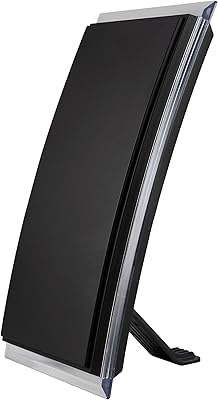
75%
72%
Signal Reception
93%
Ease of Setup
66%
Amplifier Performance
88%
Design & Aesthetics
81%
Value for Money
More
GE 48732 Indoor HD TV Antenna
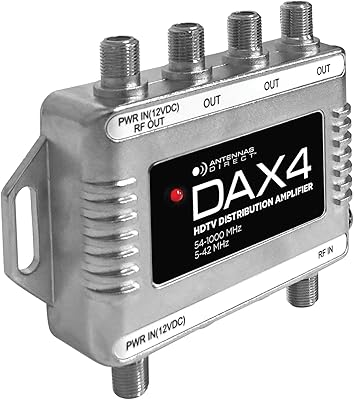
80%
78%
Signal Reception Quality
93%
Ease of Setup
74%
Amplifier Performance
76%
Build Quality & Durability
84%
Design & Aesthetics
More
Antennas Direct DAX4 4-Output Distribution Amplifier
79%
83%
Signal Performance
88%
Build Quality
91%
Ease of Installation
79%
Value for Money
86%
ATSC 3.0 Compatibility
More

FAQ

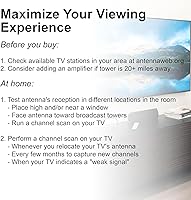
The antenna is rated for up to 55 miles, but treat that number as a ceiling rather than a guarantee. In practice, most buyers in open suburban areas report reliable reception between 35 and 45 miles from their nearest towers. Terrain, tree cover, and the construction materials in your home can all chip away at that figure, so if you are on the edge of that range, check a free tool like antennaweb.org before buying.

Yes, the built-in amplifier requires power from the included AC adapter, which plugs into a standard wall outlet. The power inserter sits between the antenna and your TV, so you will need an outlet reasonably close to your setup. If you prefer something fully passive with no cords beyond the coax cable, this particular model is not the right fit.

It can, and this is worth taking seriously. When the incoming signal is already very strong, an active amplifier can overload the TV tuner and actually cause you to pick up fewer channels or see more pixelation, not less. If you live that close to towers, a simpler passive indoor antenna — which has no amplifier at all — will often outperform this one at a fraction of the cost.

Yes, the Hover bar antenna supports wall mounting as well as on-top-of-TV placement, giving you some flexibility in how you route the coax cable. Positioning it higher up on a wall — especially near a window — tends to improve reception compared to hiding it behind the TV or near the floor. No special hardware is included for wall mounting, so you may need a few basic items depending on your wall type.

If your TV was made before around 2007 or does not have a built-in ATSC tuner, you will need a separate digital converter box between the antenna and the TV. Any standard converter box with a coaxial input will work fine with this GE indoor antenna. Most televisions sold in the past 15 years have a tuner built in, so this is mainly a concern for older sets.

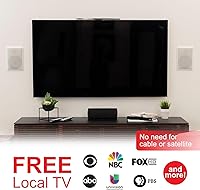
That depends entirely on your location. Channels available over the air typically include local ABC, NBC, CBS, FOX, and PBS affiliates, plus a variety of sub-channels that broadcast news, weather, classic TV, and foreign-language programming. The best way to get a realistic channel count for your specific address is to use antennaweb.org or tvfool.com before purchasing.

Yes, it supports ATSC 3.0, which is the next generation of over-the-air broadcast technology that promises better picture quality, improved audio, and stronger signal robustness. That said, ATSC 3.0 rollout is still gradual and not yet available in many markets, so whether you benefit from it today depends on your city. Your TV or converter box also needs to support ATSC 3.0 decoding — the antenna itself just receives the signal.

Start by repositioning the antenna — moving it higher, closer to a window, or rotating the bar to face a different direction can make a noticeable difference. Avoid placing it behind the TV or near large metal objects. If you are very close to towers and experiencing overload, try bypassing the amplifier or switching to a passive antenna. Running a fresh channel scan after any repositioning is always a good idea.

Jasco Products backs this amplified TV antenna with a limited lifetime replacement pledge, which generally covers manufacturing defects — not physical damage or misuse. If the unit fails under normal use, you can contact their U.S.-based support team Monday through Friday to initiate a replacement. It is worth keeping your purchase receipt, as proof of purchase is typically required.

It can work, but you should set realistic expectations. Basements and interior rooms with no exterior wall access are among the most challenging environments for any indoor antenna. Concrete or reinforced walls significantly weaken signal strength, and being below grade adds another layer of difficulty. If your only option is a basement setup, it is worth trying the antenna near the top of a wall or any available egress window first before writing it off entirely.

Where to Buy