Overview

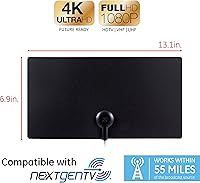
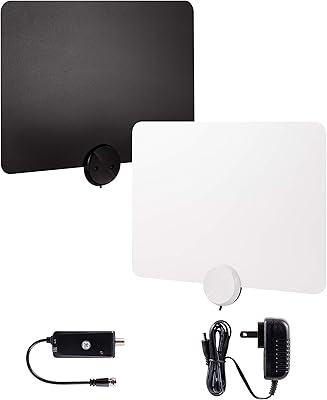
The GE Ultra Edge 50-Mile Indoor TV Antenna is one of the more practical options for households looking to cut the cord without overhauling their budget. Made by Jasco Products Company under the GE license, it carries a brand name most people already associate with reliability. What separates this flat antenna from bulkier alternatives is its slim, reversible panel — black on one side, white on the other — making it easy to blend into most living spaces. Out of the box, you get a 6-foot coaxial cable and a built-in amplifier. Performance, though, is heavily location-dependent, so keep that in mind before assuming the stated range applies to your home.

Features & Benefits

The advertised 50-mile range is best understood as a ceiling rather than a guarantee — most suburban users realistically pull in strong signals within 30 to 40 miles of broadcast towers. The included Pure Amp Technology amplifier does make a genuine difference in marginal signal spots, cutting down on pixelation when the antenna is placed near a window. Supporting both VHF and UHF bands is more useful than it sounds, since PBS affiliates and some local stations still broadcast on VHF frequencies that cheaper single-band antennas miss entirely. The panel mounts on a wall or lays flat, giving you flexibility to experiment with placement. GE also backs it with a lifetime replacement pledge and weekday U.S.-based support.

Best For

This GE indoor antenna suits cord-cutters in suburban or semi-rural areas, particularly those within 30 to 50 miles of a major broadcast market. Apartment dwellers who cannot install rooftop equipment will appreciate how discreet this flat antenna looks propped on a windowsill or tucked behind a TV. It works well for households focused on the major networks — ABC, NBC, CBS, Fox, and PBS — where OTA (over-the-air) reception delivers live local channels at no monthly cost. If you have a 4K or 1080p smart TV and want to supplement streaming with free local news and sports, this is a sensible fit. Deep rural areas or signal-shadowed locations, however, are a poor match.

User Feedback

Buyers consistently highlight how quick and painless setup is — most have channels scanning within minutes — and the slim, neutral design draws genuine appreciation in living room environments. Channel counts in well-situated suburban homes can be impressively high. The recurring complaint, however, centers on range: users sitting beyond 35 miles, particularly in hilly or obstructed terrain, often report weaker results regardless of how carefully they position the antenna. The amplifier earns mixed reactions — noticeably helpful for some, marginal for others. Long-term owners consider build quality solid for the price point. Feedback on the lifetime replacement pledge is mostly positive, though a few buyers found the claims process slower than expected.

Pros

  • Setup takes only a few minutes — plug in, scan, and most users are watching live TV almost immediately.
  • The reversible black and white panel blends into a wide range of room styles without looking out of place.
  • Supports both VHF and UHF bands, so you do not miss local stations that single-band antennas skip entirely.
  • The included amplifier genuinely helps in marginal signal areas, reducing pixelation near windows.
  • Wall-mount or flat-lay options make it easy to experiment with placement until reception improves.
  • Backed by a lifetime replacement pledge, which adds meaningful peace of mind at this price point.
  • U.S.-based weekday support is available if setup goes sideways, a real comfort for less technical users.
  • Compatible with 4K and 1080p displays, delivering a sharp, uncompressed picture on modern TVs.
  • Lightweight at under 13 ounces, so repositioning to chase a better signal is never a hassle.
  • Free access to major network channels means the antenna can pay for itself quickly compared to cable costs.

Cons

  • The 50-mile range figure is a best-case ceiling; many users in real-world conditions top out closer to 30 to 35 miles.
  • Performance varies sharply by geography, making it hard to predict results before you actually try it.
  • The 6-foot coaxial cable can feel short depending on where your TV sits relative to the best signal window.
  • Some users report the amplifier makes little to no measurable difference in heavily obstructed locations.
  • Channel counts can be underwhelming in smaller or rural broadcast markets with limited OTA infrastructure.
  • Thick interior walls, particularly concrete or brick construction, can noticeably weaken reception indoors.
  • A few buyers noted the lifetime replacement process was slower and required more back-and-forth than expected.
  • No signal strength indicator is included, so finding the optimal placement spot involves trial and error.
  • This flat antenna is not a practical substitute for outdoor or attic installations where stronger reception is needed.

Ratings

Our AI rating system analyzed thousands of verified global reviews for the GE Ultra Edge 50-Mile Indoor TV Antenna, actively filtering out incentivized, bot-generated, and duplicate submissions to reflect only genuine buyer experiences. The scores below capture both what this flat antenna consistently gets right and where real-world frustrations emerge across different households and locations. Nothing has been softened — strong points and persistent pain points are weighted equally.

Signal Reception
72%
28%
In suburban areas with clear line-of-sight to nearby towers, most users lock in the major network channels — ABC, CBS, NBC, Fox, PBS — with rock-solid stability. Buyers within 25 to 35 miles of a broadcast market consistently report strong, dropout-free pictures on 1080p and 4K displays.
Beyond the 35-mile mark, results become noticeably inconsistent, and users in hilly terrain or behind thick masonry walls report frequent pixelation. The 50-mile range claim sets expectations that rural and obstructed-location buyers regularly find the antenna cannot meet in practice.
Ease of Setup
93%
This is one of the flattest learning curves of any home electronics product — plug the coaxial cable into the TV, connect the amplifier, and run a channel scan. The vast majority of buyers describe going from opening the box to watching live TV in under ten minutes, even with no technical background.
A small number of users find the 6-foot cable slightly short depending on where their TV sits relative to the nearest window, requiring an extension cable they did not expect to need. The channel scan itself can occasionally miss channels on the first pass, requiring a rescan.
Amplifier Performance
66%
34%
For users sitting in the middle of the reception range — say 20 to 35 miles from towers — the Pure Amp Technology noticeably reduces pixelation on weaker VHF signals and helps pull in channels that would otherwise drop out. Buyers in apartment buildings with interior walls report measurable improvement when the amplifier is switched on.
Users very close to broadcast towers sometimes find the amplifier causes signal overload, paradoxically reducing the number of channels their TV locks onto. In heavily obstructed rural locations, the amplifier provides little meaningful improvement, and some buyers feel its inclusion raises expectations beyond what it reliably delivers.
Design & Aesthetics
88%
The reversible black-and-white flat panel is genuinely practical — not just a marketing talking point — and allows the antenna to blend into both dark entertainment centers and bright white walls without looking out of place. At just 12.6 oz and 13 inches long, it sits neatly on a windowsill or entertainment shelf without dominating the space.
The flat cable connecting the antenna to the amplifier can look a bit untidy if you are mounting the panel on a wall in a visible area of the room. A few buyers also note that the white side yellows slightly over time when exposed to direct sunlight near south-facing windows.
Value for Money
81%
19%
For households that primarily watch major network TV and are situated in good reception zones, the math is compelling — free OTA access to live local channels, sports, and news with no monthly bill attached. The included amplifier and coaxial cable mean there are no hidden accessory costs for most buyers right out of the box.
Buyers who purchase based on the 50-mile range claim and then discover their location delivers inconsistent results tend to feel the value proposition breaks down quickly. For those in challenging locations, a slightly pricier outdoor or attic antenna would have been the smarter long-term investment.
Channel Count
69%
31%
In larger metro broadcast markets — Chicago, Dallas, Atlanta, Los Angeles — users report scanning 40 to 80 or more channels, which far exceeds what most people expect from a free over-the-air antenna. Sub-channels from PBS affiliates and local independent stations are a pleasant discovery for many first-time cord-cutters.
Buyers in smaller or rural broadcast markets may only pull in 10 to 20 channels, making the up-to-150-channel figure feel misleading. Channel count is dictated by what broadcasters transmit in your area, not by the antenna itself — a nuance the packaging does not communicate clearly enough.
Build Quality
74%
26%
Long-term owners generally report that this GE indoor antenna holds up well over 12 to 24 months of continuous use, with no common reports of the coaxial connection loosening or the panel warping. The amplifier unit feels reasonably solid and does not run noticeably warm during extended use.
The coaxial cable included in the box feels thinner than premium third-party options, and a handful of buyers report it developing signal-degrading kinks near the connectors over time. The overall plastic construction, while adequate, does not feel particularly premium when handled directly.
Mounting Flexibility
83%
Having the option to lay the antenna flat or mount it on a wall gives users genuine flexibility to experiment with placement, which matters a lot when chasing better signal. The wall-mounting hardware is included, and buyers who get the antenna higher up near windows consistently report better results than those leaving it flat on a shelf.
The mounting solution is fairly basic — adhesive strips rather than a screw-mount bracket — and some buyers in rentals worry about surface damage when removing it. The antenna cord positioning can also make wall mounting look slightly awkward depending on where your nearest coaxial port is located.
VHF & UHF Coverage
79%
21%
Supporting both VHF (channels 2 to 13) and UHF (channels 14 and above) signal types is a meaningful advantage over cheaper single-band flat antennas, particularly because PBS affiliates and some legacy local stations still broadcast on VHF frequencies. Buyers who previously owned UHF-only antennas often notice they gain additional channels when switching to the Ultra Edge.
VHF reception in particular can be more sensitive to placement and obstructions than UHF, and some users find that repositioning to optimize for one band slightly weakens the other. There is no way to fine-tune or filter by band independently, so the experience is always a compromise based on placement.
Warranty & Support
71%
29%
The limited lifetime replacement pledge is a stronger assurance than most competitors at this price tier, and having a U.S.-based support line staffed during business hours is genuinely helpful for less technical users who hit snags during setup. Several buyers credit phone support with resolving tricky scanning or compatibility issues.
A recurring pattern in user feedback is that the replacement process involves more steps and wait time than the lifetime pledge language implies — getting a replacement unit can take multiple contact attempts. Support hours are weekday-only, which leaves weekend troubleshooters without live assistance.
Compatibility
91%
Works with any television equipped with a coaxial input, which covers virtually every TV sold in the U.S. since the analog-to-digital transition, including all current smart TV platforms. Buyers using it alongside Roku, Fire TV, and Apple TV streaming setups report a smooth experience accessing free OTA channels alongside their apps.
Older televisions without a built-in ATSC digital tuner require a separate tuner box, which is an unexpected additional purchase for owners of legacy displays. The product packaging could be clearer about this limitation, as a small segment of buyers only discovers it after purchase.
Cable Length
58%
42%
For most straightforward setups — TV near a window with the antenna placed on the same side of the room — 6 feet is workable and keeps the installation tidy without excess cable to manage. Buyers who place the antenna on the same shelf as the TV find it more than sufficient.
Six feet is a genuine constraint in larger rooms or situations where the optimal antenna placement window is far from the TV, and this is one of the more common practical frustrations buyers mention. Purchasing a coaxial extension adds a small but unexpected cost and introduces another potential point of signal degradation.
Indoor Obstructions Handling
54%
46%
In modern lightweight construction homes with drywall interiors, the antenna manages to pull through walls reasonably well when placed near an exterior window. Users in newer apartment buildings with standard interior partitions tend to report acceptable performance without needing to do anything special.
Older homes with thick plaster walls, brick construction, or metallic insulation can significantly degrade this flat antenna's reception, and no amount of repositioning fully compensates in the most obstructed cases. Buyers in basement apartments or lower floors of dense urban high-rises consistently report the weakest results.

Suitable for:

The GE Ultra Edge 50-Mile Indoor TV Antenna is a smart pick for cord-cutters living in suburban or semi-rural areas within a reasonable distance of major broadcast towers. Renters and apartment dwellers who cannot install rooftop or external equipment will find the slim, low-profile panel easy to position discreetly on a windowsill or wall without landlord friction. Households that primarily watch major network programming — local news, primetime on ABC, NBC, CBS, Fox, and PBS — get real value here, since OTA (over-the-air) reception delivers those channels in uncompressed HD at no ongoing cost. It pairs especially well with a 4K or 1080p smart TV as a free complement to existing streaming subscriptions, filling in live sports, local weather, and breaking news that streaming often cannot cover. The included amplifier and ready-to-use coaxial cable mean most people are up and running within minutes, no technical background required.

Not suitable for:

Buyers in deep rural areas sitting well beyond 40 real-world miles from the nearest broadcast tower will likely be disappointed, regardless of what the box advertises. The GE Ultra Edge 50-Mile Indoor TV Antenna also struggles in locations with heavy physical obstructions — dense tree cover, hilly terrain, or thick concrete walls can degrade signal significantly even at shorter distances. Dense urban environments with tall buildings creating signal shadows present their own challenges, and the amplifier does not reliably compensate in those cases. Users expecting to replace a cable subscription entirely and receive dozens of niche or regional channels should manage their expectations; the channel count depends entirely on what broadcasters in your specific market transmit over the air. Anyone needing a truly long-range solution, or who has already tried and failed with a comparable flat indoor antenna, would be better served looking at an outdoor or attic-mounted option instead.

Specifications

  • Brand: Sold under the GE brand and manufactured by Jasco Products Company, LLC.
  • Model Number: The item model number is 33678, with ASIN B01HSSAV82 on Amazon.
  • Dimensions: The antenna measures 1.9 x 6.5 x 13 inches, keeping a slim, low-profile footprint.
  • Weight: At 12.6 oz, the panel is light enough to reposition easily without tools.
  • Signal Range: Rated for a maximum reception range of 50 miles from broadcast towers under optimal conditions.
  • Signal Types: Receives both VHF and UHF broadcast frequencies for broader local channel coverage.
  • Resolution Support: Compatible with 4K Ultra HD and 1080p Full HD television displays.
  • Impedance: Operates at a standard 75 Ohm impedance, matching most modern TV coaxial inputs.
  • Amplifier: Includes a built-in Pure Amp Technology amplifier designed to strengthen weak signals and reduce dropout.
  • Cable Length: Ships with a 6-foot coaxial cable for connecting the antenna directly to your television.
  • Channel Capacity: Capable of receiving up to 150 OTA channels depending on local broadcast availability.
  • Panel Design: Features a reversible flat panel with a black side and a white side to suit different room aesthetics.
  • Mounting Options: Can be laid flat on a surface or mounted on a wall using the included hardware.
  • Compatibility: Works with any television or tuner that has a standard coaxial antenna input, including smart TVs.
  • Warranty: Backed by a limited lifetime replacement pledge provided by the manufacturer.
  • Customer Support: U.S.-based technical support is available by phone Monday through Friday, 7AM to 8PM Central Time.
  • UPC: The product UPC is 030878336789, and the GTIN is 00030878336789.
  • Availability: First listed for sale on June 21, 2016, and confirmed as not discontinued by the manufacturer.

Related Reviews
GE Ultra-Thin Amplified TV Antenna 48862
84%
88%
Signal Reception
83%
Build Quality
91%
Ease of Setup
89%
Design Flexibility
85%
Signal Amplification
More
GE Pro Bar Indoor TV Antenna 33683
83%
85%
Reception Performance
92%
Ease of Installation
88%
Value for Money
90%
Design & Aesthetics
87%
Mounting Options
More
Lyrwihn ZDK-Antenna-FY Indoor TV Antenna
73%
91%
Ease of Setup
67%
Signal Reception Quality
61%
Signal Booster Effectiveness
88%
Cable Length & Flexibility
82%
Magnetic Base & Mounting
More
Vragey HD012 Indoor/Outdoor TV Antenna
70%
71%
Signal Reception Quality
88%
Ease of Setup
63%
Amplifier Performance
34%
Range Accuracy vs. Marketing Claims
67%
Build Quality & Durability
More
GE 48732 Indoor HD TV Antenna
80%
78%
Signal Reception Quality
93%
Ease of Setup
74%
Amplifier Performance
76%
Build Quality & Durability
84%
Design & Aesthetics
More
Antennas Direct ClearStream Eclipse Indoor TV Antenna
77%
74%
Signal Reception
67%
Amplifier Performance
93%
Design & Profile
91%
Ease of Setup
62%
Cable Length
More
Forlovv 2800+ Miles TV Antenna
82%
83%
Signal Reception
91%
Value for Money
88%
Setup Ease
76%
Channel Range
85%
Signal Clarity
More
ANTOP AT-211B Indoor TV Antenna
71%
72%
Signal Reception
67%
Amplifier Performance
91%
Ease of Setup
63%
Build Quality
58%
VHF Channel Support
More
Mohu Gateway Indoor TV Antenna
86%
87%
Signal Reception
92%
Setup and Installation
89%
Design and Aesthetics
90%
Value for Money
84%
Durability and Build Quality
More
Amazqi TV Antenna 250 Miles Range
85%
87%
Signal Reception
90%
Ease of Installation
92%
Compatibility with TV Brands
85%
Range Performance
89%
Picture Quality
More

FAQ

Not at all. You plug the coaxial cable into the back of your TV, connect the amplifier, run a channel scan from your TV settings menu, and you are done. Most people are watching live channels within ten minutes, no tools or technical experience required.

The 50-mile figure is a theoretical maximum under ideal, unobstructed outdoor-like conditions. In practice, most indoor users in suburban areas reliably pick up signals within 30 to 40 miles. Walls, building materials, and terrain all reduce effective range, so treat the spec as a ceiling rather than a promise.

Yes, it works with any TV that has a standard coaxial input, which includes virtually all smart TVs sold in the U.S. Just plug the cable into the antenna port, run a channel scan, and your TV will find the available OTA broadcasts automatically.

That depends entirely on what broadcasters transmit over the air in your local market. Most suburban and metro areas carry the major networks — ABC, NBC, CBS, Fox, and PBS — along with several sub-channels. A free tool like AntennaWeb or the FCC’s DTV reception maps can show you exactly what signals are available at your address before you buy.

It is worth trying both ways. In strong signal areas very close to broadcast towers, the amplifier can occasionally cause signal overload and actually reduce channel counts. If you live farther out or behind thick walls, though, leaving it connected typically helps reduce pixelation and dropout.

Higher up and near a window facing the direction of your local broadcast towers tends to give the best results. Avoid placing it behind or inside a metal cabinet, on the floor, or near large electronics that can cause interference. If one spot gives poor results, try moving it a few feet — reception can change noticeably with small adjustments.

You have both options. The antenna can lay flat on a shelf or entertainment unit, or be mounted on a wall using the mounting hardware included in the box. Wall mounting can actually improve reception if it gets the antenna higher and closer to a window.

It covers manufacturer defects and hardware failures under normal use. It does not cover physical damage you cause yourself, and it is worth noting that a few buyers have found the replacement process takes some back-and-forth with GE’s support team. That said, having U.S.-based phone support available on weekdays is a genuine plus compared to many competing products.

Not on its own. If your display is a monitor without a built-in TV tuner, you would need to add a separate OTA tuner or a streaming device with a tuner input. Most televisions sold in the U.S. since 2007 have a built-in ATSC tuner, so this is rarely a concern with modern sets.

It is one of the better choices for that situation. This GE indoor antenna is thin, light, and simple to remove without leaving marks, and the flat-lay option means you can set it on a windowsill without drilling anything. Just keep in mind that upper-floor apartments generally get noticeably better reception than lower floors in dense building environments.