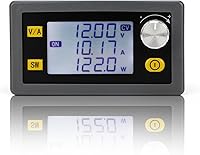
Overview

The DROK CNC 1200W DC Buck Converter is a CNC-machined step-down module aimed at hobbyists and working engineers who need flexible power regulation without spending full bench-supply money. It accepts input voltages from a modest 6V all the way up to 70V, then steps them down to whatever your project demands — up to 60V at 20A continuous. A color LCD screen shows live voltage and current readings, so you're never guessing what's happening downstream. Thermal management comes via a temperature-controlled fan paired with a substantial heatsink, and a one-year warranty gives it a bit more credibility than typical bare-board modules.

Features & Benefits

Seven fixed voltage presets — covering everything from 5V logic rails to a 48V bus — let you dial in common outputs instantly rather than fiddling with a potentiometer every single time. Beyond the presets, full continuous adjustment lets you land on any voltage your circuit needs. The built-in common-mode inductor keeps output ripple low, which genuinely matters when powering microcontrollers or noise-sensitive audio gear. Ten protection modes cover over-voltage, over-current, and over-temperature, plus less common safeguards like timeout and over-capacity. The fan only spins up when temperatures climb, keeping the module quiet during light-load work. The CNC-machined enclosure adds real rigidity without making it awkward on a crowded bench.

Best For

This buck converter suits a specific kind of builder: someone tired of swapping modules every time a project changes voltage requirements. It's a strong fit for solar and battery storage setups, where input voltage can swing widely depending on charge state. E-bike and small EV hobbyists will appreciate the headroom to step down higher pack voltages to whatever a charger or accessory rail demands. Workshop benches benefit from the onboard meter — it removes the need to probe around with a separate multimeter during every test. The DROK step-down module handles multiple voltage standards in a single session well, though buyers needing ultra-tight calibration for precision lab work may want to look elsewhere.

User Feedback

Most owners highlight LCD clarity and fast preset configuration as practical wins that come up repeatedly across reviews. Build quality earns genuine praise too — the machined housing feels noticeably sturdier than comparable bare-board converters at this price tier. On the downside, a notable share of users report the unit running warm during sustained near-maximum loads, raising fair questions about heatsink adequacy for prolonged high-wattage use. A smaller group has flagged the meter display drifting slightly out of calibration over time. The included documentation is thin, which frustrates newcomers trying to configure the protection settings independently. Overall, the unit earns its rating for general-purpose use, but anyone pushing it hard should plan for added airflow.

Pros

  • Seven common fixed voltage presets let you switch between project voltages in seconds, no re-tuning needed.
  • The CNC-machined enclosure feels noticeably more robust than bare-board modules at comparable prices.
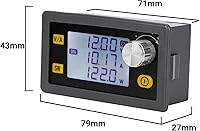
  • Onboard color LCD shows live voltage and current simultaneously, eliminating the need for a separate meter.
  • Wide input voltage tolerance makes this buck converter genuinely versatile across solar, battery, and DC bench sources.
  • Temperature-controlled fan stays off during light use, keeping the workspace quiet during normal bench sessions.
  • Built-in common-mode inductor reduces output ripple, a real benefit when powering noise-sensitive microcontroller projects.
  • Ten protection modes provide a meaningful safety net for unattended charging or battery management applications.
  • Compact, consistent form factor makes it easy to integrate into custom enclosures or panel-mount installations.
  • One-year warranty offers more coverage than most bare-module alternatives in this price category.
  • Fully adjustable output mode covers voltage needs that fall outside the fixed presets without any hardware changes.

Cons

  • Meter calibration can drift over time, requiring periodic rechecks against a trusted reference instrument.
  • The included documentation is sparse — configuring protection thresholds often requires hunting through online forums.
  • Sustained operation near maximum power output generates significant heat; external airflow is strongly recommended.
  • Terminal block and panel alignment inconsistencies have been reported across a subset of units.
  • Protection modes can trigger unexpectedly, with little on-device feedback to indicate which threshold was exceeded.
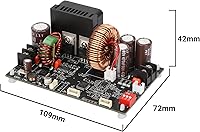
  • The actual depth of the unit is larger than the face dimensions suggest, which can surprise builders mid-enclosure build.
  • Output voltage can sag slightly under heavy load, which matters for applications expecting tight regulation.
  • Fan audibility under high load is noticeable enough to be disruptive in quiet home office or studio environments.
  • No detailed wiring guide is included, leaving less experienced users to figure out safe high-current connections independently.

Ratings

The DROK CNC 1200W DC Buck Converter has been evaluated by our AI system after analyzing verified global user reviews, with spam, bot-submitted, and incentivized feedback actively filtered out before scoring. The ratings below reflect an honest synthesis of real buyer experiences — both the genuine strengths that keep this module in active workshop use and the recurring pain points that prospective buyers deserve to know about upfront.

Voltage Regulation Accuracy
74%
26%
For general hobbyist and workshop use, the regulation holds steady across a wide range of loads. Users powering LED rigs, small motor drivers, or Raspberry Pi setups report consistent and usable output voltages without frequent intervention.
Precision-critical applications expose the limits here. A subset of buyers has noted the output can drift a few tenths of a volt under heavy load or after extended runtime, which matters if you are calibrating sensors or running tight-tolerance electronics.
Build Quality
83%
The CNC-machined enclosure is one of the most praised aspects across reviews. Compared to bare-board modules in the same price range, this unit feels substantially more solid in hand, with clean machining and no loose internal rattles reported by the majority of buyers.
A small number of users found fit-and-finish inconsistencies between units, such as slightly misaligned terminal blocks or uneven panel edges. Nothing catastrophic, but noticeable if you are expecting tight manufacturing tolerances throughout.
Thermal Management
67%
33%
The temperature-controlled fan is a thoughtful design choice — it stays quiet during light-load use, which makes bench work less fatiguing. The heatsink does its job effectively when the module is operating at moderate power levels in reasonably ventilated spaces.
Push this module toward its upper power limits in an enclosed space and heat becomes a real concern. Multiple users report the unit running uncomfortably warm during sustained high-wattage sessions, and a few experienced thermal shutdowns without added external airflow.
LCD Display & Metering
81%
19%
The color LCD is consistently called out as a practical win. Being able to read live voltage and current draw at a glance — without clipping a separate multimeter into the circuit — saves meaningful time during iterative DIY testing and troubleshooting sessions.
Calibration drift is a recurring complaint among long-term users. After several months of use, some buyers find the displayed readings diverging from a calibrated reference meter, requiring periodic manual recalibration to maintain confidence in the readouts.
Preset Voltage Configuration
88%
The ability to snap between seven common fixed voltages instantly is genuinely useful in a multi-project workshop. Builders who regularly work across 12V automotive circuits, 24V stepper motors, and 5V logic rails appreciate not having to re-tune from scratch every time.
The configuration process for setting or modifying presets is not immediately intuitive, and the included documentation offers little help. First-time users often report spending extra time piecing together the workflow from online forums rather than the manual.
Output Ripple & Noise
76%
24%
The common-mode input inductor does make a measurable difference compared to simpler buck converter designs. Users powering audio amplifiers or microcontroller-heavy projects report cleaner behavior than expected from a module at this price point.
It is not a ripple-free supply by any stretch. Users running highly sensitive analog instrumentation or RF circuitry have flagged residual noise as problematic, and a proper bench supply or additional output filtering is still advisable for those use cases.
Protection System
79%
21%
Ten distinct protection modes is genuinely comprehensive for the price tier. Users in solar charging and battery management applications specifically praise the over-voltage and over-current protections for providing a useful safety net during unattended operation.
The protection thresholds are not always clearly documented, and a few users tripped protections unexpectedly during normal operation without understanding why. Better documentation or on-device feedback when a protection mode activates would significantly improve the experience.
Input Voltage Range
86%
The wide input window covering everything from a single 6V lantern battery up to a large lithium pack makes this converter genuinely versatile. Solar hobbyists and battery bank builders in particular value not needing a different module for different source voltages.
At the very top of the input range, a handful of users report the module behaving less predictably. Sustained operation near the 70V ceiling is not something the majority of reviewers have tested thoroughly, so that headroom should be treated with caution.
Ease of Setup
63%
37%
Out of the box, connecting the module and selecting a common preset is straightforward enough for anyone with basic electronics experience. The labeled terminals and visible LCD make initial hookup faster than bare-board alternatives with no display.
Beyond the basics, setup gets frustrating quickly. The manual is sparse to the point of being nearly unhelpful, and configuring the protection parameters or custom voltage curves requires external research. Beginners without prior buck converter experience will face a real learning curve.
Fan Noise
82%
18%
Under light and moderate loads, the fan stays off entirely, which is a genuine quality-of-life benefit during quiet workshop sessions. Most users doing bench testing at partial capacity never hear the fan at all during normal use.
When the fan does kick in under heavier loads, several users describe it as louder than expected for the module size. It is not disruptive in a typical workshop, but in a quiet home office environment it is noticeable enough to be mentioned repeatedly in reviews.
Physical Footprint
84%
The compact face dimensions make it easy to integrate into enclosures or mount on a crowded bench without dominating the workspace. DIY enclosure builders particularly appreciate having a consistent, rigid form factor to design around.
The depth dimension is larger than the face suggests, which has caught a few buyers off guard when fitting it into tight custom enclosures. Always check all three dimensions before committing to a panel cutout or mounting arrangement.
Value for Money
78%
22%
Relative to a traditional adjustable bench power supply with similar voltage and current range, this module costs a fraction of the price. For hobbyists who need flexible power regulation occasionally rather than in a professional daily workflow, that tradeoff is very favorable.
Compared to competing bare-board modules without an enclosure or display, it costs noticeably more. Users who only need fixed 12V or 24V output and have no interest in metering or adjustability will likely feel they are paying for features they will never use.
Warranty & Support
66%
34%
A one-year warranty is better than what most comparable bare modules offer, and DROK has an established enough presence that replacement or refund claims are generally resolved without extended disputes, based on buyer reports.
Post-sale technical support is described as limited by several users. Getting answers to configuration questions or troubleshooting unusual behavior is largely a community-driven effort rather than something DROK's own support channels handle efficiently.

Suitable for:

The DROK CNC 1200W DC Buck Converter is a strong match for DIY electronics builders and workshop hobbyists who regularly work across multiple voltage standards and want one reliable module instead of a drawer full of single-purpose converters. Solar enthusiasts and off-grid builders will find the wide input tolerance particularly practical, since source voltage from panels or battery banks shifts considerably depending on charge state and load. E-bike and small EV hobbyists who need to step down pack voltages to power accessories or conditioning circuits will appreciate the headroom this converter provides without expensive dedicated hardware. Makers who run iterative bench tests benefit directly from the onboard LCD metering — reading live current draw without probing a separate instrument genuinely speeds up troubleshooting. Anyone upgrading from a bare-board module who wants a more durable, enclosed solution without spending full bench-supply prices will find this voltage regulator a meaningful step up in both usability and confidence.

Not suitable for:

The DROK CNC 1200W DC Buck Converter is not the right tool for applications where output precision is non-negotiable. Engineers working on analog instrumentation, precision sensor calibration, or tight-tolerance RF circuits need a regulated supply with verified, stable output — and this unit's documented tendency toward calibration drift over time disqualifies it for that level of rigor. The rated maximum power output is a ceiling under ideal conditions, not a sustained operating target; anyone planning to run this voltage regulator at or near its upper power limits continuously, especially in a warm or enclosed space, should expect thermal challenges that the stock heatsink and fan may not fully resolve without supplemental airflow. First-time builders with no prior experience configuring buck converters should be aware that the documentation is minimal at best, making the initial learning curve steeper than it needs to be. Professional production environments or commercial applications where unit-to-unit consistency and traceable calibration are required should look elsewhere.

Specifications

  • Brand: Manufactured by DROK, a brand focused on DC power conversion modules for hobbyist and engineering applications.
  • Model Number: The unit is identified by model number FBA200707.
  • Input Voltage: Accepts DC input across a wide range from 6V up to 70V, accommodating battery banks, solar panels, and bench sources.
  • Output Voltage: Output is continuously adjustable from 0V to 60V DC, with seven fixed presets at 5V, 9V, 12V, 24V, 36V, 48V, and 60V.
  • Output Current: Maximum continuous output current is rated at 20A under appropriate thermal and wiring conditions.
  • Max Output Power: Peak output power capacity is 1200W, achievable only with adequate ventilation, heavy-gauge wiring, and controlled ambient temperatures.
  • Display: Features a color LCD screen that shows real-time output voltage and current draw simultaneously during operation.
  • Ripple Reduction: An input common-mode inductor is integrated into the design to suppress power supply ripple and deliver cleaner DC output.
  • Cooling System: A temperature-controlled cooling fan paired with a large aluminum heatsink manages heat during moderate to heavy load conditions.
  • Protection Modes: Includes ten protection functions: over-voltage, under-voltage, over-current, over-power, over-temperature, timeout, over-capacity, over-energy, input over-voltage, and input under-voltage.
  • Enclosure: The housing is CNC-machined, providing a more rigid and consistent physical structure than bare-board or open-frame alternatives.
  • Face Dimensions: The front panel measures approximately 4.29″ wide by 2.83″ tall, giving it a compact bench or panel-mount footprint.
  • Unit Weight: The module weighs approximately 10.5 ounces (around 300g), balancing solid construction with reasonable portability.
  • Efficiency: As a switching buck converter topology, typical conversion efficiency falls in the 85–95% range depending on input-output differential and load level.
  • Warranty: DROK provides a one-year warranty from the date of receipt, covering manufacturing defects under normal operating conditions.
  • Noise Operation: The cooling fan operates on a temperature-controlled threshold, remaining off during low and moderate loads to minimize acoustic disruption.
  • Output Type: Provides regulated DC step-down output only; it cannot boost voltage above the input level or produce AC output.

Related Reviews
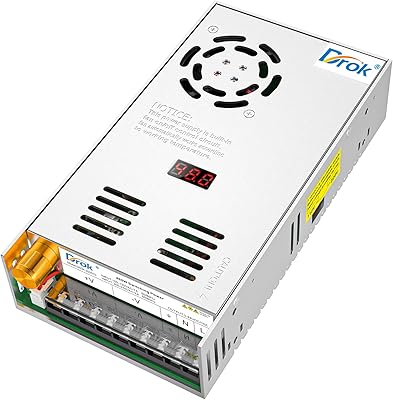
DROK 24V Power Supply 20A 480W DC Buck Converter
85%
88%
Voltage Accuracy
85%
Cooling Efficiency
90%
Ease of Use
86%
Build Quality
91%
Safety Features
More
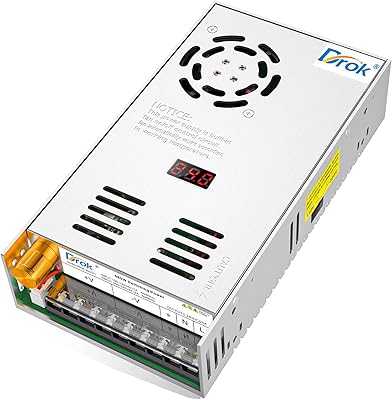
DROK 48V 480W Adjustable DC Power Supply
81%
86%
Voltage Accuracy
91%
Ease of Use
78%
Build Quality
83%
Thermal Management
67%
Fan Noise Level
More
Valefod 48V to 24V 60A 1440W DC to DC Buck Converter
84%
92%
Power Output Performance
89%
Efficiency of Power Conversion
85%
Build Quality and Durability
80%
Ease of Installation
90%
Weather Resistance (IP67)
More
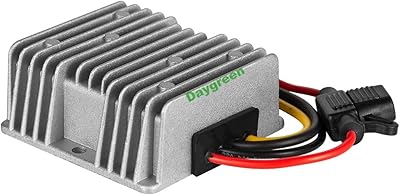
Daygreen A7D1220 20A DC-DC Buck Converter
77%
91%
Output Voltage Stability
84%
Build Quality & Durability
63%
Thermal Management
89%
Waterproofing & Environmental Protection
78%
Ease of Installation
More
Valefod 48V/12V 60A Buck Converter
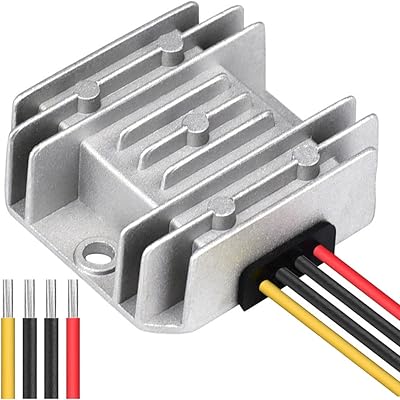
72%
77%
Build Quality
54%
Thermal Management
79%
Output Voltage Stability
86%
Ease of Installation
58%
Sustained Current Delivery
More
Cllena DC84012-3 Buck-Boost Voltage Converter
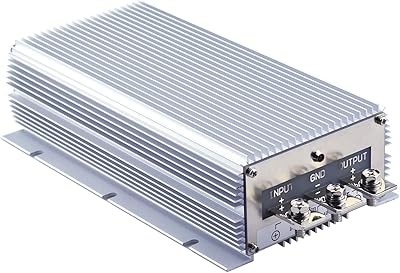
77%
88%
Voltage Stability
91%
Build Quality
86%
Waterproofing
84%
Ease of Installation
67%
Thermal Performance
More
Cllena DC2412-100 24V to 12V Buck Converter
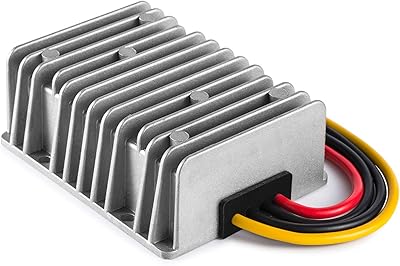
75%
84%
Build Quality
81%
Power Output Reliability
67%
Thermal Management
88%
Waterproofing & Sealing
86%
Conversion Efficiency
More
MGGi 12V to 24V 480W Boost Converter
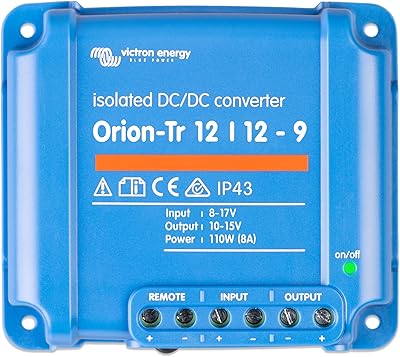
79%
88%
Output Voltage Stability
91%
Waterproofing & Weather Resistance
61%
Thermal Management
89%
Ease of Installation
84%
Build Quality
More
Victron Energy Orion-Tr 12V to 12V DC to DC Converter 9A
85%
89%
Value for Money
91%
Ease of Installation
85%
Build Quality & Durability
90%
Power Conversion Efficiency
88%
Compact Size
More
Victron Energy Orion-Tr DC to DC Converter 48/12-Volt 30A
86%
94%
Ease of Installation
88%
Power Output Reliability
91%
Efficiency/Heat Management
79%
Moisture Resistance
86%
Build Quality/Durability
More

FAQ

You can use this buck converter as part of a battery charging setup, but it is not a dedicated battery charger on its own. It will regulate voltage and limit current, but it lacks built-in charge profiling such as CC/CV termination logic specific to lithium chemistries. Pair it with appropriate charge management circuitry for safe lithium charging.

The preset selection is handled through the front panel controls and the LCD menu system. The process is straightforward once you have navigated it once or twice, but the included manual does not walk you through it clearly. Most users find their footing by referencing setup guides shared in the DROK user community online.

Treat 1200W as a ceiling under ideal conditions, not a comfortable sustained operating target. Running this voltage regulator near maximum output for extended periods generates significant heat, and the stock heatsink and fan may not be sufficient without added airflow. For continuous high-wattage use, plan for external ventilation and use appropriately rated wiring.

Yes, the wide input tolerance is one of the practical strengths of this module. Solar panels and battery banks vary considerably depending on charge state and sunlight conditions, and this converter handles that variability well within its rated input range. Just ensure your peak panel voltage stays within the supported input ceiling.

Out of the box, the meter is reasonably close to accurate for general use. Over time, some users report minor drift, particularly in the current reading. The unit does support recalibration through its settings menu, though the process requires some patience given the limited documentation.

The fan is temperature-controlled, so it only activates when internal temperatures rise above a set threshold. During light or moderate loads in a well-ventilated space, most users report the fan never turning on at all, which keeps the workspace quiet.

At high current loads, undersized wiring is a genuine safety and performance risk. For anything approaching the upper current range, use wire rated for at least 20A or higher — typically 10 to 12 AWG for power runs of moderate length. The DROK CNC 1200W DC Buck Converter does not specify a wire gauge in its documentation, so err on the side of heavier gauge for high-power use.

Yes, and many users do exactly that. The CNC-machined housing gives you consistent dimensions to design around, and the face panel suits standard cutout mounting. Just account for the full depth when planning your enclosure, as it extends further back than the face dimensions alone suggest, and make sure your enclosure allows adequate airflow to the heatsink and fan exhaust.

For most microcontroller and digital electronics projects, the output quality is adequate. The built-in input inductor reduces ripple noticeably compared to simpler modules. That said, for highly noise-sensitive analog audio or RF applications, adding an output filter capacitor or a small LC filter stage is a reasonable precaution given that residual switching noise is still present.

The module includes multiple protection modes designed to interrupt operation before damage occurs, covering scenarios like output over-voltage, overcurrent, and over-temperature. In practice, most users report the protections working as intended for common fault conditions. The main gap is feedback — when a protection trips, the unit does not always make it immediately obvious which threshold was exceeded, so some troubleshooting may be needed to identify the cause.