Overview

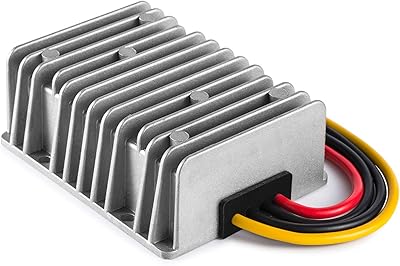
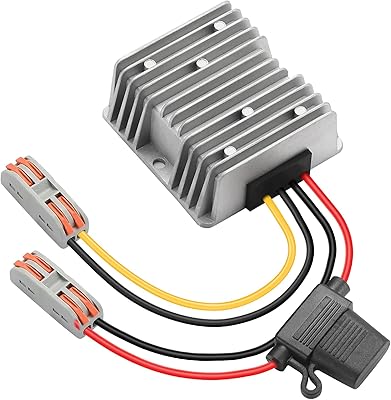
The Cllena DC2412-100 24V to 12V Buck Converter is a fixed-output step-down unit designed for one specific job: letting you run 12V accessories off a 24V battery system without rewiring half your vehicle. That's a real need in commercial trucks, heavy equipment, and fleet vehicles where 24V is the standard battery configuration but most accessories — radios, cameras, lighting, displays — expect 12V. Cllena is a niche brand focused almost entirely on DC power conversion hardware, and this high-current DC converter sits in the capable, workhorse tier of their lineup. It's not adjustable, not multi-purpose — just a robust, sealed unit built to handle serious current loads reliably.
Features & Benefits

What stands out immediately is the raw output capacity — 100 amps continuous at 12V, enough to feed demanding loads like high-powered audio amplifiers, large LED arrays, or multiple LCD screens simultaneously. The converter uses synchronous rectification internally, which translates to real-world efficiency of around 95% at full load and slightly better at half load, meaning less heat generated and less wasted power. The housing is a solid aluminum shell sealed with silicone — genuinely resistant to moisture, dust, and the kind of constant vibration a working truck dishes out daily. It accepts input from 18 to 35V DC, giving it good headroom against voltage swings typical in 24V vehicle systems, while built-in protections against short-circuit, overcurrent, overtemperature, and overload add a meaningful safety layer.

Best For

This step-down converter is a natural fit for operators of large commercial trucks, coaches, and heavy equipment — any platform where the main battery bank is 24V but cab accessories run on 12V. Fleet managers adding dashcams, two-way radios, or GPS monitoring systems will find it particularly useful since it eliminates the need for a separate 12V battery altogether. It also works well for DIY builders wiring high-draw in-cab audio or lighting rigs. On the industrial side, think mobile advertising displays or monitoring screens running off a 24V vehicle bus. Emergency vehicles and off-grid expedition builds where the converter must survive harsh real-world conditions — heat, vibration, and rain exposure — round out the ideal use cases.

User Feedback

Buyers who put this 24V-to-12V buck unit into daily service tend to praise how stable and consistent the output stays under sustained, heavy loads — something cheaper converters notoriously fail at. The build quality draws consistent compliments, with the housing feeling solid and the sealed construction holding up well in real under-cab environments. That said, a few recurring complaints are worth noting. Ventilation matters more than the specs suggest; installers who tucked it into tight, enclosed spaces reported occasional thermal shutdowns during extended high-load runs. Cable gauge is another sticking point — undersizing the wire on a 100A unit is a recipe for problems. Some buyers were also caught off guard by the fixed 12V output and the hard incompatibility with solar panels, inverters, and battery charging applications.

Pros

  • Handles a full 100 amps of continuous output — enough for the most demanding in-vehicle electrical loads.
  • Efficiency ratings of 95% at full load mean minimal wasted energy and less heat buildup during extended runs.
  • The sealed aluminum housing holds up well against moisture, road vibration, and dusty working environments.
  • Wide input range of 18 to 35V DC gives it real headroom against the voltage swings typical in truck electrical systems.
  • Five built-in protection modes cover the most common failure scenarios, adding a meaningful safety layer.
  • Relatively compact for a 1200W unit — fits under a dash or in a cab enclosure without major fabrication work.
  • Fixed 12V output is stable and predictable, which is exactly what most accessories and monitoring systems need.
  • Synchronous rectification keeps the thermal load manageable compared to older linear conversion designs.
  • Straightforward wiring layout makes installation approachable for experienced DIYers and automotive electricians.

Cons

  • Output voltage is fixed at 12V with no adjustment — not usable for electronics requiring other voltages.
  • Thermal shutdowns have been reported when the unit is installed in tight, poorly ventilated spaces.
  • No compatibility with solar panels, inverters, or battery charging applications limits its versatility significantly.
  • At nearly 5 pounds, this 24V-to-12V buck unit is heavier than some competitors at similar power ratings.
  • Requires heavy-gauge wiring to operate safely — an expense and planning burden that budget buyers may underestimate.
  • No indicator lights or display to confirm output voltage or signal fault conditions during operation.
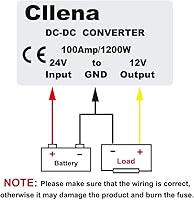
  • Some buyers reported confusion about polarity during installation, suggesting clearer labeling would help.
  • Long-term reliability data from the field is limited given the brand's relatively low market profile.
  • Not suitable for low-draw or occasional-use applications where a smaller, cheaper converter would do the job.

Ratings

The scores below were generated by our AI engine after analyzing verified buyer reviews worldwide for the Cllena DC2412-100 24V to 12V Buck Converter, with spam, bot-generated, and incentivized feedback actively filtered out before scoring. The result is an honest, data-driven picture of how this step-down converter performs in the hands of real tradespeople, fleet operators, and DIY installers. Both the strengths that keep buyers coming back and the friction points that frustrate them are reflected transparently in every category.

Build Quality
84%
Most buyers — especially fleet mechanics and commercial truck installers — comment immediately on how solid the aluminum shell feels compared to cheaper plastic-housed alternatives. The silicone sealing looks and feels professionally executed, and the unit does not rattle or flex when handled. For a working-vehicle application, that first-impression durability counts for a lot.
A small number of longer-term users have noted that the terminal screws can show early oxidation in consistently humid environments, which is a minor but real concern for marine-adjacent or rainy-climate installations. The housing itself holds up well, but the hardware details around the terminals are the weak link in the overall build.
Power Output Reliability
81%
19%
Under sustained, real-world loads — running dashcam systems, cab lighting, and audio equipment simultaneously on a long-haul rig — this 24V-to-12V buck unit delivers a notably stable 12V output without the sag or flicker that plagues lower-rated converters. Buyers powering sensitive electronics like monitoring screens report clean, consistent voltage over hours of continuous use.
A portion of users report occasional output instability when the input voltage dips toward the lower end of the accepted range, particularly during cold engine starts on older trucks. While the protection circuits prevent damage, the brief dropout can cause connected devices to reset — something worth planning around if your load includes anything that does not tolerate interruptions.
Thermal Management
67%
33%
In open or semi-open mounting locations with reasonable airflow, the aluminum housing does a solid job of passively dissipating heat during moderate to heavy loads. Installers who mounted it with clearance on all sides report that it runs warm but not alarmingly hot, even during multi-hour operation at significant load.
This is where the most recurring complaints emerge. Buyers who installed the unit inside enclosed under-dash panels or tight utility boxes reported thermal shutdowns during extended full-load runs, sometimes within 30 to 45 minutes. The unit recovers cleanly after cooling, but the lack of a thermal warning indicator means you often do not know there is a problem until your devices lose power.
Waterproofing & Sealing
88%
The silicone-sealed enclosure performs well in real outdoor and mobile environments — buyers who installed this high-current DC converter in exposed cab locations, on agricultural equipment, and in utility trailers report no water ingress issues even after extended exposure to rain and road spray. For a sealed power unit in a working-vehicle context, the environmental protection is genuinely above average.
There is no published IP rating from the manufacturer, which makes it difficult to assess exactly how much water immersion or pressure the sealing can handle. For most vehicle installs this is a non-issue, but buyers planning truly submersible or pressure-wash-exposed installations should note that the sealing has not been independently certified to any recognized ingress protection standard.
Conversion Efficiency
86%
Running at half load — the condition most real-world installations spend the majority of their time in — the efficiency figures translate into noticeably less heat output and a lighter draw on the source battery than older or less efficient converters. Fleet operators running this unit through daily cycles appreciate the lower thermal burden and reduced strain on the 24V system.
At full 100A load, efficiency drops to around 95%, which means roughly 60W of heat is being generated internally at peak draw — manageable but not negligible. Buyers expecting essentially zero heat loss at full load based on the headline efficiency numbers sometimes express surprise at how warm the unit gets during sustained maximum-output scenarios.
Ease of Installation
71%
29%
For anyone with basic automotive electrical experience, the screw-terminal layout and clear input/output labeling make this a reasonably straightforward install. Experienced DIYers and automotive electricians consistently report getting the unit wired and running within an hour, and the labeled terminals reduce guesswork during the connection process.
Less experienced installers have run into two recurring problems: wiring polarity confusion despite the labels, and underestimating the cable gauge needed for a 100A circuit. The documentation included with the unit is minimal, and there is no in-box guide addressing cable sizing or mounting best practices — gaps that lead to preventable installation errors for buyers new to high-current DC wiring.
Protection Circuits
83%
The multi-layer protection system works as advertised in most reported cases — buyers who accidentally wired loads beyond the rated capacity or briefly shorted output terminals found that the converter shut down without sustaining damage, then resumed normal operation once the fault was cleared. That self-resetting behavior is genuinely valuable in a working-vehicle environment.
The absence of any visual fault indicator is a consistent frustration. When the protection circuits trip, there is no LED, no beep, and no display to tell you what condition was triggered — you simply lose power to your load and have to diagnose manually. For a professional installation on a commercial vehicle, some form of fault signaling would meaningfully improve the user experience.
Input Voltage Tolerance
79%
21%
The 18V to 35V input window handles the full realistic range of a 24V vehicle system well — from a battery at low charge, through nominal operating voltage, up to the elevated charging voltage produced by the alternator under heavy engine load. Buyers on fleet vehicles with variable charging conditions report no dropouts or instability during normal system voltage swings.
The lower threshold of 18V does leave limited headroom for deeply discharged battery scenarios. A handful of buyers using this step-down converter in off-grid or backup power contexts — where the source battery can spend extended time below 20V — noted that the converter cuts out before the battery is fully depleted, which affected their system planning.
Value for Money
74%
26%
Buyers who fully load this converter and run it hard in commercial applications tend to view the pricing as fair for what they are getting — a sealed, high-current unit with real protection circuitry and solid output stability. Compared to equivalent-spec units from more established industrial brands, the relative affordability is frequently cited as a deciding factor.
Buyers who purchased it for lighter-duty or occasional-use applications often feel it is overbuilt and overpriced for their needs. A smaller percentage of buyers also noted dissatisfaction after experiencing thermal shutdown issues, feeling the value proposition weakens if the unit requires careful mounting engineering to perform reliably at full rated load.
Documentation & Labeling
52%
48%
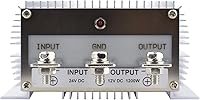
The terminal labels on the unit itself are clear enough for anyone familiar with DC wiring conventions, and the basic compatibility warnings — no solar, no inverters, no battery charging — are printed on the housing rather than buried in a manual, which helps prevent the most common misuse scenarios.
The included documentation is genuinely sparse and represents one of the weakest aspects of the overall package. There is no cable sizing guide, no airflow or mounting clearance recommendation, and no troubleshooting section — all things that would directly reduce the installation errors buyers most commonly report. For a product targeting professional installers, the documentation quality falls notably short.
Long-Term Durability
69%
31%
Buyers who have run this unit in daily commercial truck service for a year or more without issues tend to be genuinely enthusiastic about its durability. Units that were installed correctly — with adequate airflow, proper cabling, and appropriate load sizing — appear to hold up well through the vibration, temperature cycling, and humidity that characterize real working-vehicle environments.
The durability picture is less consistent for buyers who pushed the unit harder or installed it in suboptimal conditions. Reports of premature failure after several months of full-load operation in enclosed, poorly ventilated spaces suggest that long-term reliability is meaningfully dependent on installation quality — which the product itself does little to guide the buyer toward.
Compatibility Clarity
58%
42%
The hard restrictions — no solar, no inverters, no adjustable output, no battery charging — are at least stated clearly on the product listing and partially on the unit itself. Buyers who read carefully before purchasing generally report no compatibility surprises and understand exactly what they are buying.
A meaningful number of negative reviews trace directly to buyers who connected this step-down converter to incompatible sources — particularly solar setups and inverter systems — and damaged the unit as a result. The warnings exist but are apparently not prominent or specific enough to prevent misuse at the point of sale, suggesting the product needs stronger pre-purchase guidance.
Physical Footprint
77%
23%
For a unit pushing 1200W of continuous power output, the physical size is reasonable enough that most experienced installers can find a workable mounting location inside a truck cab or utility enclosure without major bracket fabrication. The form factor is noticeably more compact than equivalent industrial-grade units at similar power ratings.
At nearly 5 pounds and over 12 inches in length, this is not a small device — buyers working with genuinely tight mounting constraints, like motorcycle sidecar builds or compact utility vehicles, have noted that finding a viable location required more planning than expected. The weight also means secure mounting hardware matters more than it would for a lighter unit.

Suitable for:

The Cllena DC2412-100 24V to 12V Buck Converter is purpose-built for anyone working with 24V vehicle electrical systems who needs to power standard 12V accessories without adding a secondary battery. Commercial truck drivers and fleet operators are the most obvious beneficiaries — think long-haul rigs where you want to run a dashcam, CB radio, or in-cab monitor without tapping into a separate power source. Heavy equipment operators, emergency vehicle builders, and transit bus technicians will find this high-current DC converter fits naturally into their electrical planning. DIY enthusiasts wiring up serious in-cab audio systems or large LED lighting arrays on 24V platforms will also appreciate having a converter that doesn't flinch at sustained high-draw loads. If your installation lives somewhere exposed to moisture, road vibration, or dust — which describes most working vehicles — the sealed aluminum housing makes this a genuinely practical choice rather than a gamble.
Not suitable for:

If you are running a solar power setup, working with a PWM or MPPT charge controller, or trying to charge a 12V battery from a 24V source, this step-down converter is the wrong tool — full stop, no workaround. The Cllena DC2412-100 24V to 12V Buck Converter is also not suitable for anyone needing adjustable output voltage, since the 12V output is hardwired and cannot be tuned for sensitive electronics that require precise voltages. Buyers with lightweight or occasional power needs should consider a smaller, less expensive unit, as this converter is overbuilt for low-draw applications and requires thoughtful mounting with adequate airflow to perform reliably. It is also not a fit for stationary or AC-connected systems — it is strictly a DC-to-DC device for mobile or battery-based environments. Anyone uncomfortable with proper cable sizing and basic automotive wiring should get professional help before installing it, since undersized wiring on a 100A circuit is a genuine fire hazard.

Specifications

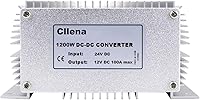
  • Model Number: This unit is identified by model number DC2412-100, manufactured by Cllena.
  • Input Voltage: Accepts DC input anywhere from 18V to 35V, making it compatible with standard 24V vehicle battery systems even under fluctuating charge conditions.
  • Output Voltage: Delivers a fixed 12V DC output with no adjustment capability — the output voltage cannot be changed.
  • Output Current: Rated for 100 amps of continuous current output, suitable for high-draw electrical loads in mobile and vehicle applications.
  • Output Power: Maximum rated output power is 1200W, covering heavy simultaneous loads such as audio amplifiers, LED lighting arrays, and display screens.
  • Efficiency: Achieves approximately 97% conversion efficiency at half load and 95% at full load, minimizing wasted energy and heat generation.
  • Conversion Tech: Uses synchronous rectification technology internally, which contributes to its high efficiency ratings compared to older passive rectification designs.
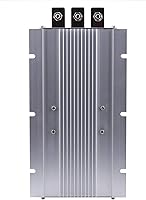
  • Housing Material: The outer shell is constructed from aluminum alloy and sealed with silicone, providing structural rigidity alongside environmental protection.
  • Waterproofing: The silicone-sealed enclosure is rated waterproof and dustproof, suitable for under-cab, engine-bay-adjacent, or other exposed mounting locations.
  • Dimensions: Physical footprint measures 12.1 x 5.9 x 3.9 inches, keeping the unit manageable for cab or under-dash installations despite its high power rating.
  • Weight: The unit weighs 4.9 pounds, which is typical for an aluminum-housed converter in this power class.
  • Protections: Includes five built-in protection circuits covering over-current, over-voltage, over-temperature, short-circuit, and overload conditions.
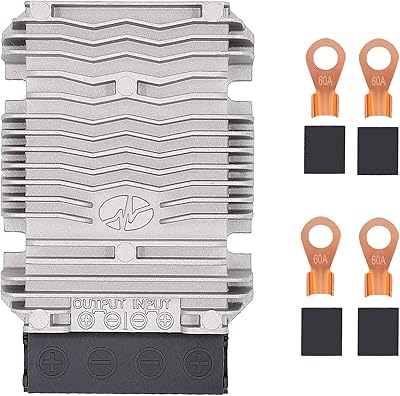
  • Wiring Terminals: Uses clearly labeled screw-terminal connections for both input and output, requiring installer-supplied cabling sized appropriately for 100A loads.
  • Compatibility: Designed exclusively for use with 24V DC battery systems as the power source and 12V DC devices as the load — not compatible with AC power sources.
  • Incompatible Uses: Must not be connected to solar panels, PWM or MPPT charge controllers, inverters, wind turbines, or used as a battery charger.
  • Recommended Cable: Due to the 100A rated current, input and output wiring must be appropriately heavy-gauge to avoid voltage drop and heat buildup in the cables.
  • Ventilation Need: While the housing is sealed, the unit should be mounted in a location with reasonable airflow to prevent thermal throttling under sustained full-load operation.
  • Brand: Manufactured by Cllena, a niche brand specializing in DC power conversion accessories for automotive and mobile applications.

Related Reviews
Cllena DC 9V-40V to 24V 6A Automatic Buck Boost Converter
87%
94%
Performance and Efficiency
91%
Build Quality and Durability
66%
Ease of Installation
93%
Waterproof and Environmental Protection
89%
Versatility and Applications
More
DROK 24V Power Supply 20A 480W DC Buck Converter
85%
88%
Voltage Accuracy
85%
Cooling Efficiency
90%
Ease of Use
86%
Build Quality
91%
Safety Features
More
Valefod 48V to 24V 60A 1440W DC to DC Buck Converter
84%
92%
Power Output Performance
89%
Efficiency of Power Conversion
85%
Build Quality and Durability
80%
Ease of Installation
90%
Weather Resistance (IP67)
More
Daygreen 36V/48V to 12V 20A DC-DC Buck Converter
87%
94%
Power Efficiency
88%
Build Quality & Durability
85%
Ease of Installation
72%
Size & Form Factor
90%
Protection Features
More
MGGi 12V to 24V 480W Boost Converter
79%
88%
Output Voltage Stability
91%
Waterproofing & Weather Resistance
61%
Thermal Management
89%
Ease of Installation
84%
Build Quality
More
Valefod 36V/48V to 12V 60A 720W DC to DC Buck Converter
85%
92%
Value for Money
89%
Performance
90%
Ease of Installation
88%
Build Quality
85%
Safety Features
More
Victron Energy Orion-Tr 12V to 12V DC to DC Converter 9A
85%
89%
Value for Money
91%
Ease of Installation
85%
Build Quality & Durability
90%
Power Conversion Efficiency
88%
Compact Size
More
SDRGEEK 1000W 12V AC to DC Converter
76%
74%
Output Stability
81%
Build Quality
78%
Cooling Performance
83%
Ease of Connection
77%
Value for Money
More
YBBOTT DC 12V 10A Step Down Converter
86%
86%
Performance
92%
Build Quality & Durability
89%
Ease of Installation
72%
Thermals/Heat Management
91%
Protection Features
More
SDRGEEK 12V 600W AC to DC Converter
85%
88%
Power Performance
91%
Cooling Efficiency
75%
Ease of Installation
86%
Build Quality
94%
Safety Features
More

FAQ

No — this is a DC load converter, not a battery charger. It is designed to power 12V devices directly, not to safely charge a battery. Connecting it to a battery for charging purposes can damage both the converter and the battery, so do not attempt it.

At 100 amps, you need serious copper — most experienced installers recommend 2 AWG or larger for runs under a few feet, and 1/0 AWG for longer cable runs to keep voltage drop and heat in check. Undersizing the wire on a high-current circuit like this is a genuine fire risk, so do not cut corners here.

No, it will not — and this is explicitly warned against by the manufacturer. Solar charge controllers and inverters produce voltage characteristics this converter is not designed to handle, and connecting them can permanently damage the unit. You will need a purpose-built solar DC-DC converter for that application.

The sealed, silicone-coated aluminum housing does provide solid protection against moisture and dust, so a sheltered under-hood location is generally fine. The main concern is sustained heat — make sure there is reasonable airflow around the unit, because mounting it in a fully enclosed, heat-saturated spot can trigger thermal shutdowns under heavy load.

There are no indicator lights or a display on this unit, so you will need to verify output with a multimeter after installation. Simply measure across your 12V output terminals with the input connected — you should read a stable 12V. If the reading is significantly off or absent, double-check your wiring polarity and input voltage before assuming a fault.

Yes, that is one of its strengths. With 100 amps available at 12V, you can power multiple loads simultaneously — radios, screens, lighting rigs, and audio equipment — as long as the combined current draw stays within the rated limit. Just make sure your output wiring and any distribution block are also rated appropriately for the total load.

No — the output is fixed at 12V and cannot be adjusted. If you need a different output voltage, this step-down converter is the wrong choice and you would need to look at an adjustable buck converter instead.

The built-in protection circuits will kick in and shut the unit down before damage occurs. Once the fault condition is cleared — meaning you disconnect the short or remove the overloaded device — the converter should recover and resume normal operation. It is a self-protecting design, not a fuse-once situation.

This 24V-to-12V buck unit is built with that reality in mind. The input range spans from 18V all the way to 35V DC, which comfortably covers normal 24V system fluctuations during engine start, alternator charging peaks, and light load conditions. As long as your input stays within that window, the converter will regulate the output cleanly.

Some warmth is completely normal — even at 95% efficiency, a 1200W unit is dissipating meaningful heat during heavy operation. The aluminum housing acts as a passive heatsink, which helps. The unit will get noticeably warm to the touch under sustained full load, but it should not be scalding hot if ventilation is adequate. If you are regularly hitting thermal shutdowns, recheck your mounting location for airflow.