Overview

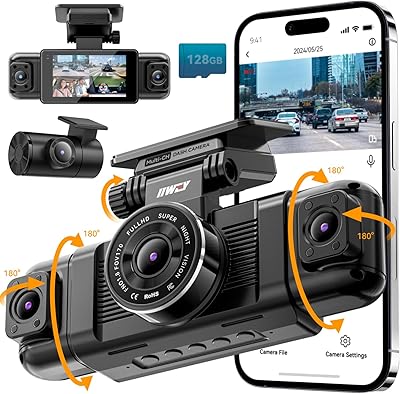
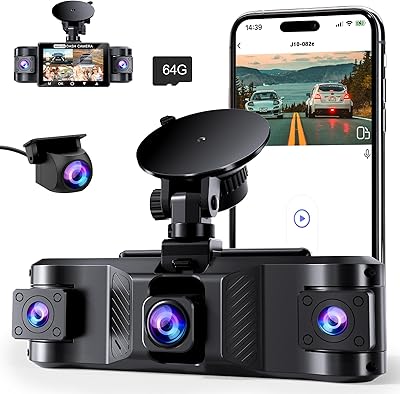
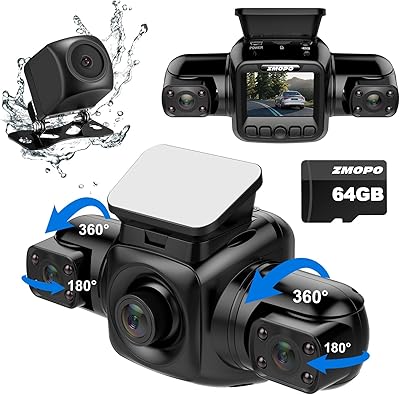
The Driveye D7 4-Channel 360° Dash Cam is a mid-range option that takes a fundamentally different approach from the typical front-and-rear setup — it covers all four angles of your vehicle simultaneously. That distinction matters a lot if you're a rideshare driver, fleet manager, or someone tired of blind spots around their car. Driveye is a relatively young brand, having launched this model in mid-2024, and with around 124 ratings it's still building its track record. The included 128GB card is a genuine convenience that removes one of the more annoying friction points when setting up a new dash cam.
Features & Benefits

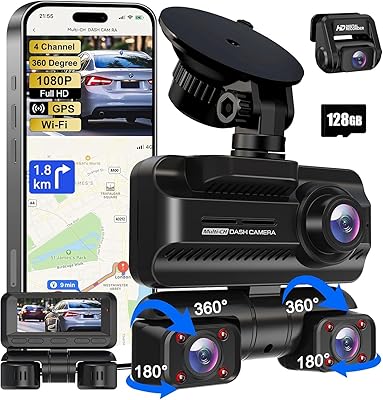
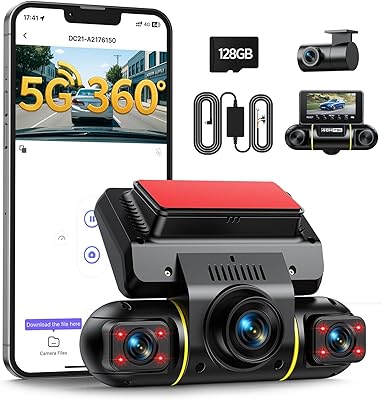
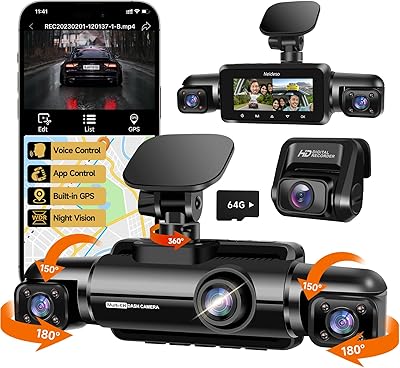
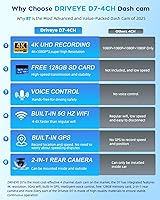
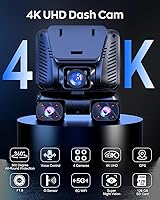
The front camera captures true 4K footage, which makes a real difference when you need to read a license plate after an incident. The rear records in 2K, while the two side cameras each run at 1080p — so the full simultaneous four-channel output lands at 4K plus three 1080p streams, not four 4K feeds. That distinction is worth understanding before buying. The side cameras include infrared night vision for monitoring the cabin in low light, while an F1.8 aperture with WDR handles the front in most conditions. Built-in GPS logs speed and location, and 5GHz Wi-Fi lets you pull footage wirelessly without removing the card.

Best For

This 360° dash cam is most valuable for Uber and Lyft drivers who need interior passenger monitoring alongside road coverage — a combination that's genuinely hard to replicate with a standard two-camera setup. Small fleet operators will appreciate multi-angle incident documentation with no recurring subscription costs attached. The 24-hour parking mode with G-sensor activation also appeals strongly to drivers in dense cities where hit-and-runs and parking lot scrapes are a real concern. If you're stepping up from a basic single-lens cam and want full coverage without hunting for a compatible SD card, this system handles both needs right out of the box.

User Feedback

Buyers consistently praise the front camera's nighttime sharpness, though opinions on the side IR cameras are more divided — infrared black-and-white footage gets the job done but doesn't impress everyone. Installation comes up repeatedly as time-consuming, which is understandable given four cameras and their associated wiring runs. App connectivity works reliably for most users, but a noticeable handful mention occasional Wi-Fi pairing frustrations. Voice control earns lukewarm marks overall — it functions, but many buyers treat it as a bonus rather than something they rely on daily. GPS accuracy and mount stability both score well, though long-term durability through hot summer months remains an open question for newer buyers.

Pros

  • True 4K front camera captures license plates and road detail clearly, even at night.
  • All four camera angles record simultaneously — no choosing which direction to cover.
  • Included 128GB SD card removes a common setup headache right out of the box.
  • Built-in GPS logs speed and location, providing solid supporting evidence in disputes.
  • 5GHz Wi-Fi lets you review footage on your phone without ever ejecting the card.
  • 24-hour parking mode with G-sensor has caught real hit-and-run incidents for buyers.
  • F1.8 aperture with WDR handles varied lighting conditions better than most rivals at this tier.
  • No subscription fees required — all core functionality works offline and locally.
  • Compact form factor keeps windshield obstruction minimal compared to multi-mount setups.

Cons

  • Installing four cameras and routing all cables cleanly can take two to three hours or more.
  • Wi-Fi pairing drops or fails intermittently for a notable share of users.
  • Side cameras switch to black-and-white infrared at night — not the color footage some expect.
  • Voice control is unreliable in noisy environments; many buyers quietly stop using it.
  • No hardwire kit included, which is effectively required for dependable 24-hour parking mode.
  • The brand is new enough that long-term reliability and customer support are still unproven.
  • Mount adhesion can weaken over time in vehicles exposed to significant seasonal temperature swings.
  • Android app stability has been inconsistent for users on older operating system versions.

Ratings

The Driveye D7 4-Channel 360° Dash Cam has been scored by our AI system after analyzing verified buyer reviews from global marketplaces, with spam, bot activity, and incentivized feedback actively filtered out. With roughly 124 verified ratings at the time of this analysis, the sample is modest but consistent enough to identify clear patterns in both satisfaction and frustration. The scores below reflect an honest picture — where this 360° dash cam genuinely delivers and where real buyers have run into friction.
Video Quality (Front Camera)
88%
The 4K front lens is the standout performer in this system. Commuters and rideshare drivers regularly report being able to read license plates clearly even in low-light urban environments, which is ultimately what matters most after an incident on the road.
A few users shooting in extremely bright midday conditions noted occasional overexposure before WDR kicks in. It is not a dealbreaker, but buyers expecting flawless exposure in every scenario may notice it during high-contrast daytime drives.
Side Camera Quality
67%
33%
The infrared side cameras do their core job — capturing usable cabin footage in near-darkness, which is genuinely useful for rideshare drivers monitoring passengers during late-night shifts. License plates of vehicles approaching from side windows are often legible.
The black-and-white IR footage is noticeably lower in perceived quality than the front feed, and some buyers find it underwhelming compared to marketing visuals. In well-lit daytime conditions the color side footage is acceptable, but the gap between front and side quality is hard to ignore.
Rear Camera Quality
74%
26%
The 2K rear camera captures clear enough detail for most incident documentation purposes. Buyers following closely behind in traffic report being able to identify vehicle make, color, and plates without needing to zoom in heavily on the app.
At 2K it sits in a middle tier that some buyers feel could have been pushed to match the front. In heavy rain or at highway speeds, rear footage occasionally loses fine detail that a true 4K rear lens would retain.
Night Vision Performance
82%
18%
Front-camera nighttime performance draws consistent praise — the F1.8 aperture combined with WDR handles poorly lit streets, tunnels, and rainy evenings better than most competitors in this price range. Many users specifically mention this as the reason they kept the unit after testing.
The improvement is largely front-specific. Side infrared night vision switches to black-and-white mode, which works but feels like a separate, older technology running alongside the main camera. Buyers expecting uniform night clarity across all four channels will be disappointed.
Installation & Setup
61%
39%
The included hardware kit covers most of what you need, and the 128GB card being pre-included removes one planning step. Tech-comfortable buyers report a manageable first-time setup, especially if they have experience routing cables behind trim panels.
Four cameras means four cable runs — and that wiring job intimidates a significant portion of buyers. Several reviewers mentioned spending two to three hours on installation, and a few sought professional help. For non-technical users, the setup process is the single biggest friction point with this system.
App & Wi-Fi Connectivity
71%
29%
The 5GHz Wi-Fi connection is faster than older 2.4GHz systems when it works, allowing users to pull and review clips on their phone quickly without ejecting the SD card. Most buyers on both iOS and Android get it working without issues after initial pairing.
A recurring minority of buyers report inconsistent Wi-Fi pairing — sometimes the app loses connection mid-session or requires a restart to reconnect. It is not universal, but frequent enough to mention and frustrating when it happens during time-sensitive footage reviews.
GPS Accuracy
83%
GPS lock is reliable in open areas and suburban driving conditions, with speed and location data logging accurately during normal commutes. For drivers contesting speeding or insurance claims, the GPS trail has held up as useful supporting evidence according to several reviews.
Urban canyon environments with tall buildings can cause occasional signal delays on startup. A small number of buyers report minor speed reading discrepancies at high highway speeds, though this appears to be an edge case rather than a systemic issue.
Voice Control
58%
42%
Voice commands work as advertised for basic tasks — locking a clip after an incident or snapping a photo without taking your hands off the wheel is genuinely convenient when it responds correctly. Buyers who use it regularly tend to stick to two or three commands they trust.
Reliability is inconsistent enough that many buyers stop using it after a few weeks. Road noise, music, or passenger conversation can trigger false commands or cause missed triggers, and the system does not always confirm actions audibly. Most users treat it as a situational feature rather than a core workflow.
Parking Mode
79%
21%
The 24-hour parking mode with G-sensor activation is a meaningful inclusion for anyone parking on city streets or in shared lots. Multiple buyers have captured hit-and-run footage during unattended periods, which validates the feature in real-world conditions.
Parking mode draws continuous power, so buyers without a hardwire kit need to weigh battery drain against coverage time. The unit does not include a hardwire kit in the box, which is an added cost that prospective buyers in urban areas should factor in.
Heat Resistance & Durability
72%
28%
The upgraded heat dissipation design performs noticeably better than baseline dash cams during warm-weather driving. Buyers in southern US states and warm climates report fewer Wi-Fi dropout incidents and thermal shutdowns compared to previous cameras they have owned.
Dashboard surface temperatures in parked vehicles during summer can exceed the tested range in practice, and long-term reliability through multiple hot seasons is still an open question given the product's limited market history. Early adopters will effectively be the durability test group.
Build Quality & Form Factor
76%
24%
The central unit feels reasonably solid for its price tier, and the compact footprint keeps windshield obstruction minimal. The black finish blends into most vehicle interiors without drawing attention, which matters to buyers who prefer a low-profile setup.
The plastic housing does not inspire premium confidence on close inspection, and the windshield mount adhesion drew some concern about long-term hold in temperature-cycling environments. A few buyers reported the mount loosening after several months of summer-to-winter transitions.
Value for Money
81%
19%
For a system that includes four cameras, GPS, 5GHz Wi-Fi, voice control, and a 128GB card in a single purchase, the overall package represents strong value relative to piecing together comparable coverage from separate units. Rideshare drivers in particular find the cost-per-feature ratio compelling.
Buyers who later discover they need a hardwire kit for reliable parking mode, or who want cloud backup features, may find the true cost of ownership creeps up. The D7 is not a loss leader, but it is not a premium product either — managing expectations around long-term support from a newer brand is wise.
Loop Recording Reliability
84%
Loop recording starts automatically on engine ignition and the 1/3/5-minute segment options give buyers useful flexibility for storage management. The G-sensor clip-lock has worked reliably for most users during hard braking or collision events, with locked clips staying protected as expected.
A small number of buyers report occasional file corruption after abrupt power cuts — a minor but notable issue if the camera loses power unexpectedly. Using a quality SD card and ensuring a clean power source largely mitigates this, but it is worth noting for buyers who rely on footage for legal purposes.
Companion App Experience
68%
32%
The app interface is cleaner than many budget-tier dash cam apps and allows GPS track playback alongside video, which buyers find useful for reviewing commute routes or verifying trip details. The layout is intuitive enough that most users figure it out without consulting the manual.
App update frequency and long-term software support from a newer brand are legitimate unknowns. A few users on older Android versions reported stability issues, and feature parity between iOS and Android versions appears uneven based on forum feedback outside the Amazon listing.

Suitable for:

The Driveye D7 4-Channel 360° Dash Cam was clearly designed with rideshare and gig economy drivers in mind — anyone who spends hours behind the wheel with strangers in their back seat will immediately understand the value of having interior side cameras running alongside the road-facing lenses. Uber and Lyft drivers get the kind of all-angle documentation that a standard two-camera setup simply cannot provide, covering both traffic incidents and in-cabin disputes in a single system. Small fleet operators managing a handful of vehicles will also find the D7 compelling, since it delivers multi-angle incident records without any subscription fees or cloud service costs attached. Drivers in dense urban areas who regularly park on the street benefit from the 24-hour parking mode, which has proven its worth for capturing hit-and-run events in real buyer experiences. If you are currently running a basic front-only camera and want a meaningful upgrade in coverage without buying into a complex multi-device ecosystem, this 360° dash cam makes that jump in one purchase, SD card included.
Not suitable for:

The Driveye D7 4-Channel 360° Dash Cam is probably not the right call for buyers who prioritize a quick, hassle-free install — routing four separate camera cables cleanly through a vehicle interior is a genuine multi-hour job, and non-technical users have consistently flagged it as a frustrating experience. Buyers who expect uniform 4K quality across every lens will also be disappointed; only the front camera shoots in true 4K, while the sides run at 1080p in infrared black-and-white at night, which is functional but not visually impressive. If reliable wireless connectivity is non-negotiable for your workflow, the occasional Wi-Fi pairing issues some users experience could be an ongoing irritant. Those living in climates with extreme summer heat should note that while the unit claims strong heat resistance, long-term durability through repeated hot seasons is unproven given how recently this product entered the market. Finally, buyers who want cloud backup, seamless smart-home integration, or the backing of an established brand with a multi-year support track record would be better served looking at more mature alternatives.

Specifications

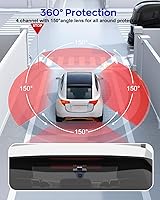
  • Camera Channels: Records simultaneously across four channels: front, rear, left side, and right side, providing complete 360° vehicle coverage in a single system.
  • Front Resolution: The front camera captures true 4K UHD video, delivering the highest detail level in the system for road-facing incident documentation.
  • Rear Resolution: The rear camera records at 2K resolution, balancing storage efficiency with enough detail to identify trailing vehicles and license plates.
  • Side Resolution: Both side cameras record at 1080p and include dedicated infrared LEDs that activate in low-light conditions for black-and-white cabin monitoring.
  • Field of View: Each lens covers a 150° wide-angle field, and the four-camera array combines to deliver full 360° perimeter coverage around the vehicle.
  • Front Aperture: The front lens uses an F1.8 large aperture paired with Wide Dynamic Range (WDR) technology to maintain balanced exposure across varied lighting conditions.
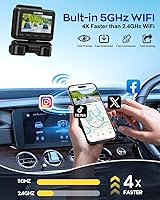
  • Connectivity: Built-in 5GHz Wi-Fi enables wireless app connectivity for footage review, while an integrated GPS module continuously logs driving speed and location.
  • Included Storage: A 128GB microSD card is included in the box, pre-formatted and ready to use immediately after installation.
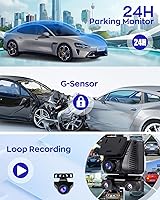
  • Loop Recording: Loop recording segments can be set to 1, 3, or 5 minutes, with the oldest footage automatically overwritten once the SD card reaches capacity.
  • Incident Lock: A built-in G-sensor detects sudden acceleration or impact events and automatically locks the current clip to prevent it from being overwritten during loop recording.
  • Parking Mode: 24-hour parking mode keeps the unit active while the vehicle is unattended, triggering recording when motion or impact is detected.
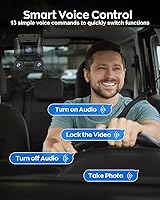
  • Voice Commands: Supports 13 English-language voice commands for hands-free control of functions including video locking, photo capture, and camera view switching.
  • App Compatibility: The companion app is available for both iOS and Android devices and supports GPS track playback alongside synchronized video review.
  • Operating Temperature: Rated for use in ambient temperatures ranging from -22°F to 158°F (-30°C to 70°C), covering most seasonal driving conditions.
  • Dimensions: The central unit measures 2.16 × 3.74 × 3.93 inches, keeping the windshield footprint compact relative to its four-camera output.
  • Weight: The complete unit weighs 1.98 pounds, which is heavier than a standard two-channel dash cam due to its multi-lens housing.
  • Mount Type: Attaches to the windshield via a suction or adhesive mount, with no permanent vehicle modification required for standard installation.
  • Power Input: Powered via the included car charger through the vehicle's 12V accessory or cigarette lighter port; a hardwire kit is not included in the box.
  • In-Box Contents: Package includes the D7 unit, 128GB microSD card, car charger, cable clips, crowbar trim tool, installation tool, and a printed user manual.
  • Availability Date: The D7 first became available in August 2024, making it a relatively recent entry into the 4-channel dash cam market.

Related Reviews

LAMTTO DC21B 360° 4-Channel Dash Cam
81%
88%
Video Quality
85%
Ease of Use
82%
Night Vision Performance
79%
Installation & Setup
75%
App Control Experience
More
Neideso N300 360° 4-Channel Dash Cam
86%
91%
Video Quality
88%
Ease of Installation
89%
GPS and Wi-Fi Functionality
94%
Night Vision Performance
72%
Voice Control Accuracy
More
ZYEIPO Z700 4-Channel 360° Dash Cam
84%
91%
Video Quality
87%
Night Vision Performance
90%
Ease of Setup
82%
Build Quality
88%
GPS Accuracy
More
WHFNRU W6 4-Channel Dash Cam 360° View
82%
88%
Overall Performance
94%
360° View Coverage
90%
Night Vision Quality
72%
Setup and Installation
85%
G-sensor Functionality
More
IIWEY N5
IIWEY N5
74%
83%
Video Quality (Daytime)
67%
Night Vision & Low-Light Performance
89%
Coverage & Field of View
61%
Installation & Setup
69%
App & WiFi Connectivity
More
Ciascy 4K Backup Camera 4 Channel 360 Dash Cam with 10.36″ Quad Split Touch Screen
84%
91%
Image Quality
88%
Ease of Installation
90%
Durability and Weather Resistance
87%
Night Vision Performance
92%
Display Quality
More
Rexing R4 4-Channel Dash Cam
79%
88%
Video Quality
84%
Ease of Use
77%
Parking Mode Performance
60%
Installation Process
89%
Wi-Fi and App Integration
More
Sprleaf D88 4-Channel Dash Cam
86%
88%
Video Quality
92%
Ease of Use
84%
Night Vision Performance
80%
Installation and Setup
85%
Mobile App Experience
More
ZMOPO C4 4-Channel Dash Cam
84%
88%
Video Quality
91%
Night Vision Performance
85%
Ease of Installation
70%
Mobile App Experience
90%
Parking Mode Effectiveness
More
Neideso N700 4-Channel Dash Cam
82%
92%
Video Quality
88%
360° Coverage
87%
Voice Control Functionality
85%
Night Vision Performance
90%
Wi-Fi & App Control
More

FAQ

All four cameras record simultaneously without any switching. The front runs at 4K, the rear at 2K, and both side cameras at 1080p — all capturing at the same time. The combined output is 4K plus three 1080p streams running in parallel, so nothing is missed while another angle is active.

No, a 128GB microSD card comes included in the box. It is pre-formatted and compatible with the system, so you can install the cameras and start recording right away without any additional purchases for storage.

Honest answer: it takes time. Running cables for four cameras cleanly through a vehicle interior typically takes two to three hours even for someone comfortable with basic car work. If you have never tucked cables behind door trim or pillar panels before, it is worth watching a video walkthrough first or budgeting for a professional install. The hardware kit in the box includes a trim removal tool, which helps.

In normal daylight and well-lit conditions, the side cameras record in color at 1080p. The black-and-white mode only activates when the infrared LEDs kick in during low-light situations, such as nighttime driving or a dark parking structure. So color is the default; infrared is the low-light fallback.

Parking mode keeps the Driveye D7 4-Channel 360° Dash Cam active after you turn off the engine, triggering recording when the G-sensor detects motion or impact. However, it draws power continuously, and running it through the standard car charger will drain your 12V socket and eventually your vehicle battery. For reliable overnight parking mode, a hardwire kit that connects to a fused, always-on circuit is strongly recommended — but that kit is not included and needs to be purchased separately.
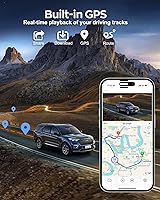
Yes, that is exactly what the built-in 5GHz Wi-Fi is for. You connect your phone to the camera via the companion app, and you can browse, play back, and download clips wirelessly. The 5GHz band is faster than older 2.4GHz systems, so transfers are reasonably quick — though some users do report occasional pairing drops that require a reconnect.

In open road and suburban conditions, GPS performance is solid — speed and location logging work accurately for the vast majority of users. Urban environments with dense tall buildings can cause a brief signal delay on startup, which is common across most built-in GPS modules. For routine commuting and incident documentation purposes, it is reliable enough to be genuinely useful.

It genuinely works in quiet or low-noise environments for basic commands like locking a clip or taking a photo. The problem is that road noise, music, or passengers talking in the cabin can confuse the system or cause missed commands. Most users end up using it selectively for a few trusted commands rather than relying on it as a primary interaction method. Treat it as a useful bonus, not a core feature.

Driveye built the D7 with an upgraded heat dissipation design, and buyers in warm climates do report fewer overheating-related shutdowns compared to budget alternatives. That said, this model has only been on the market since mid-2024, so there is limited data on how it holds up across multiple harsh summers. If you park outdoors in extreme heat regularly, it is worth monitoring the unit during its first hot season to see how it performs in your specific conditions.

It is one of the more thoughtful options available for rideshare use. The side cameras facing the interior passenger area are exactly what Uber and Lyft drivers need for dispute documentation, and having road-facing front and rear cameras in the same system avoids the need to manage multiple devices. The lack of a subscription fee is also a real advantage for drivers watching operating costs. Just budget for a professional install if wiring is not your strong suit — a clean, reliable setup matters more in a working vehicle than in a personal car.