Overview

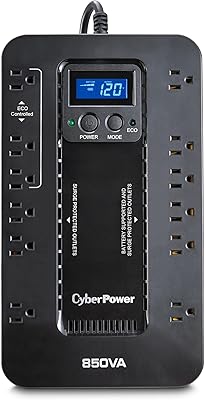
The CyberPower CP900AVR UPS Battery Backup has been a steady presence in the home office power protection market since 2004 — and that longevity says something. This is a mid-range line-interactive UPS built for desktop computers, workstations, and the networking gear that keeps your day running. At 900VA/560W, it can realistically support a typical desktop setup, a monitor, a router, and a modem simultaneously. The mini-tower form factor is compact enough to sit beside a desk without getting in the way. Just set your expectations right: this battery backup is designed to give you enough time for a safe, controlled shutdown during an outage — not to keep your office running for an extended period.
Features & Benefits

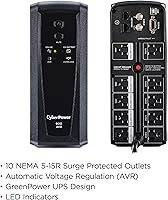
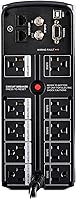
What separates this UPS unit from a basic power strip is its Automatic Voltage Regulation. When voltage dips or spikes, AVR corrects the issue without touching the battery — which matters because unnecessary battery cycling shortens its lifespan. You get 10 outlets total: five with full battery backup and surge protection, five with surge protection only, giving you sensible options for prioritizing your gear. The simulated sine wave output works fine for most desktops and peripherals, but if your PC uses an active-PFC power supply, check compatibility before committing. A three-year warranty that covers the battery itself is rare at this tier, and the included PowerPanel Personal software handles scheduled shutdowns without much fuss.

Best For

This battery backup is a natural fit for home office setups where a desktop PC, modem, router, or NAS needs protection from unpredictable power. If you live somewhere with frequent brownouts or voltage fluctuations, the AVR function alone justifies the investment — you get real power conditioning, not just a battery on standby. It is also a smart pick for anyone who wants a trusted brand without paying extra for features they will likely never use, like an LCD display or pure sine wave output. That said, skip it if you are running servers, audio interfaces, or any equipment with strict power requirements. The CP900AVR covers the essentials cleanly; it does not try to be everything.

User Feedback

Owners consistently highlight the AVR performance as the standout feature — particularly those in areas prone to voltage sags who say the unit has quietly protected their gear for years. Battery replacement gets mentioned as a non-issue, which matters since sealed lead acid batteries do eventually need swapping. On the downside, a handful of users report that the unit runs noticeably warm under heavy load, and the PowerPanel software draws mixed reactions: it works, but the interface feels dated. The five-minute runtime at full load is the most honest limitation — buyers who understand that figure is for graceful shutdowns tend to walk away satisfied. The 4.3-star overall rating reflects a product that does its core job reliably.

Pros

  • Automatic Voltage Regulation protects equipment from brownouts without cycling the battery unnecessarily.
  • The 3-year warranty covering the battery itself is genuinely rare and reassuring at this price tier.
  • Ten outlets split across battery-backed and surge-only give you real flexibility for managing multiple devices.
  • This battery backup has been a proven, continuously available product since 2004 — longevity that speaks for itself.
  • Half-load runtime of around 16 minutes is enough for a graceful shutdown on a typical office setup.
  • Sealed lead acid batteries are user-replaceable, keeping long-term ownership costs manageable.
  • The mini-tower form factor fits neatly beside a desk without demanding floor space.
  • UL certification adds a meaningful layer of safety assurance beyond just the manufacturer's own claims.
  • PowerPanel Personal software handles automated shutdown scheduling without requiring a paid subscription.
  • The $300,000 connected equipment guarantee reflects genuine confidence in the unit's protective capability.

Cons

  • Simulated sine wave output is not compatible with all active-PFC power supplies — check before buying.
  • Full-load runtime of roughly 5 minutes is only useful for shutdowns, not for riding out an actual outage.
  • No LCD display means you cannot easily check real-time load percentage or battery health at a glance.
  • The unit runs noticeably warm under sustained heavy load, which some users find concerning over time.
  • PowerPanel Personal software gets the job done but has an interface that feels well behind modern standards.
  • At 21.8 pounds, moving or repositioning this battery backup is more effort than you might expect.
  • LED indicators are minimal — you get basic status information but no detailed diagnostics without the software.
  • Sealed lead acid batteries will eventually need replacement, adding a future cost that lithium-based alternatives avoid.

Ratings

The scores below are generated by AI after analyzing thousands of verified global user reviews for the CyberPower CP900AVR UPS Battery Backup, with spam, bot activity, and incentivized feedback actively filtered out. The result is an honest, balanced picture that captures what real buyers appreciate most — and where this battery backup falls short. Both the standout strengths and the genuine frustrations are reflected transparently in each category.

Voltage Regulation (AVR)
93%
Users in regions with unstable grid power consistently praise the AVR as the single most impactful feature in daily use. Many report that equipment which previously flickered or rebooted during minor voltage sags now runs without interruption, and they credit this unit specifically for eliminating the problem without any manual intervention.
A small number of users note that while AVR handles moderate fluctuations confidently, extremely erratic or sustained overvoltage events still push the unit onto battery more than expected. This is a minor edge case but worth knowing if your local grid is severely unstable.
Power Protection Reliability
91%
Across years of real-world use, owners report that this battery backup has quietly absorbed surges and outages with minimal fuss, protecting desktops, routers, and NAS drives without a single incident of connected equipment damage. The long-standing product history since 2004 gives buyers a rare level of confidence backed by a deep field record.
A handful of users experienced unexpected battery failures earlier than the three-year warranty window, requiring a replacement claim. While warranty coverage resolved most of these cases, the inconvenience of a sudden failure mid-use was a recurring frustration for affected buyers.
Battery Runtime
58%
42%
For its intended purpose — giving users enough time to save work and shut down cleanly — the runtime at half load is adequate. Users running a PC, monitor, and networking gear at moderate load report having 10 to 14 minutes in practice, which is consistently enough for an orderly shutdown.
At full load the real-world runtime of around 5 minutes is the most common complaint, and buyers who expected longer coverage are frequently disappointed. This unit was never designed for extended outage survival, but the gap between expectation and reality shows up repeatedly in lower-rated reviews.
Outlet Layout & Flexibility
84%
The split between five battery-backed and five surge-only outlets gives home office users a practical way to prioritize what matters most during an outage. Most users find the ten-outlet count generous enough to handle a full desk setup without needing a separate power strip alongside it.
The physical spacing between outlets can make it awkward to fit larger wall adapters or brick-style plugs without blocking adjacent sockets. Several users mention that bulky adapters effectively reduce the usable outlet count below what the spec sheet implies.
Build Quality & Durability
79%
21%
The enclosure feels solid and purposeful rather than cheap, and long-term owners frequently report units that have run reliably for five or more years with only a battery swap needed. The mini-tower form factor is sturdy and holds its position well on a desk without feeling flimsy.
Some users note that the unit runs noticeably warm under sustained heavy load, which raises mild durability concerns over the very long term. The exterior finish also shows scuffs and surface marks more readily than expected for a device typically placed in a fixed location.
Ease of Setup
89%
Out of the box, setup is genuinely plug-and-play — connect the unit, plug in your devices, and it starts working immediately with no configuration required. The right-angle input plug is a practical design detail that makes it easier to position in tight spaces behind a desk.
The included documentation is minimal, and first-time UPS buyers occasionally feel underprepared when it comes to understanding which outlets to use for which devices. A brief printed quick-start guide with a concrete example layout would meaningfully reduce early confusion.
Battery Replacement
82%
18%
Long-term owners consistently highlight the straightforward battery replacement process as a key reason to stick with this platform across multiple battery cycles. Compatible 12V sealed lead acid replacement batteries are widely available from both CyberPower and third-party suppliers at reasonable cost.
The replacement process, while manageable, requires opening the unit and handling moderately heavy battery packs, which some less technically confident users find intimidating without a video guide. CyberPower's official replacement battery pricing is also higher than many third-party equivalents.
Software (PowerPanel Personal)
51%
49%
PowerPanel Personal does deliver on its core promise: automated shutdown scheduling works reliably, and the software successfully communicates with the unit over USB without driver conflicts in most Windows environments. For users who only need basic set-and-forget shutdown automation, it gets the job done.
The interface looks and feels like software from a decade ago, and the user experience compared to modern alternatives is noticeably dated. Mac and Linux support is limited, and several users report that the software occasionally loses communication with the unit after OS updates, requiring a reinstall.
Noise Level
74%
26%
During normal operation on utility power, this UPS unit is effectively silent, which matters for users who keep it on a desk in a quiet home office environment. The transition to battery is smooth enough that many users only notice the switch because of the audible alarm beep rather than any mechanical noise.
The beeping alarm during battery operation is loud and non-adjustable, which several users describe as jarring in a quiet room or during late-night work sessions. There is no option to reduce alarm volume or switch to a visual-only alert mode, which is a genuine quality-of-life gap.
Value for Money
83%
For a line-interactive UPS with genuine AVR, ten outlets, a three-year battery-inclusive warranty, and a $300,000 equipment guarantee, the overall value proposition holds up well against competitors at a similar price point. Buyers who understand what they are paying for — reliable power conditioning and a clean shutdown window — consistently feel the investment was justified.
Buyers who compare it against entry-level standby UPS units without AVR may initially see the price as steep, and those who want pure sine wave output or an LCD display will need to spend more elsewhere. The value equation weakens somewhat for users whose primary need is extended runtime rather than power conditioning.
Warranty & Support
86%
The three-year warranty that explicitly covers the internal battery stands out in a category where one-year battery coverage is standard. The $300,000 connected equipment guarantee adds a meaningful layer of financial protection that competitors at this price tier rarely match.
Customer support response times through official channels can be inconsistent, with some users reporting delays when filing warranty claims. The connected equipment guarantee also comes with usage conditions that not all buyers read before purchasing, leading to occasional claim denials that could have been avoided.
Indicator & Monitoring
62%
38%
The LED indicators cover the basics reliably — power-on status and wiring fault detection are genuinely useful, and the wiring fault alert has helped some users identify grounded outlet problems they were previously unaware of. For buyers who just want a simple status check at a glance, the LEDs are functional.
The absence of an LCD screen means there is no way to see real-time load percentage, input voltage, or remaining battery runtime without installing the software. For users who like to keep an eye on their power environment, this is a meaningful limitation compared to similarly priced models that include a display.
Form Factor & Footprint
78%
22%
The mini-tower design keeps the desk footprint narrow and the profile clean, fitting naturally beside a monitor stand or under a desk without demanding significant space. At 13.7″ deep it is longer than it looks in product photos, but the slim width compensates well in most setups.
Weighing 21.8 pounds, this battery backup is heavier than many buyers anticipate, which makes repositioning it more effort than expected. Users who move their workstation frequently or need to transport the unit find the weight a genuine inconvenience.

Suitable for:

The CyberPower CP900AVR UPS Battery Backup is a practical match for home office workers and small workstation users who want real power protection without overcomplicating things. If your setup includes a desktop PC, an external monitor, a router, and a modem, the 900VA/560W capacity covers that load comfortably. It is especially well-suited for people in areas where brownouts and voltage fluctuations are a regular occurrence — the AVR function actively corrects those issues without pulling from the battery, which keeps your equipment stable day after day. Remote workers who cannot afford unexpected shutdowns mid-call or mid-task will appreciate having a reliable buffer to save work and power down cleanly. Anyone who has lost data or fried a component to a sudden surge will find the peace of mind here well worth the investment.
Not suitable for:

The CyberPower CP900AVR UPS Battery Backup has clear boundaries, and pushing past them leads to disappointment. If you are running a home server, a high-draw gaming rig, or any professional audio or medical equipment, the simulated sine wave output is a genuine concern — devices with active-PFC power supplies can behave erratically or refuse to run cleanly on simulated sine wave. The five-minute full-load runtime is also not a survival tool; it exists solely to let you shut down gracefully, so buyers hoping to ride out longer outages need to look at higher-capacity or extended-battery models. The absence of an LCD display means less visibility into real-time load and battery health, which may frustrate more technically minded users who like to monitor their setup closely. If your power needs are complex or your equipment sensitive, spending more for a pure sine wave unit is the smarter call.
Specifications

  • Capacity: This UPS unit provides 900VA and 560W of power capacity, suitable for running a standard desktop workstation setup.
  • Topology: Line-interactive design actively manages incoming voltage before it reaches connected equipment, offering better protection than standby-only models.
  • Waveform: Outputs a simulated sine wave, which works with most conventional desktop power supplies but may not be compatible with active-PFC power supplies.
  • AVR: Automatic Voltage Regulation corrects minor overvoltage and undervoltage conditions without switching to battery power, preserving battery lifespan.
  • Outlets: Includes 10 total NEMA 5-15R outlets: five with full battery backup and surge protection, and five with surge protection only.
  • Runtime: At half load the battery provides approximately 16 minutes of runtime; at full load that drops to roughly 5 minutes.
  • Battery: Powered by two included 12V sealed lead acid batteries that are user-replaceable when capacity eventually degrades.
  • Input Plug: Uses a NEMA 5-15P right-angle, 45-degree offset plug with a six-foot power cord for flexible positioning near a wall outlet.
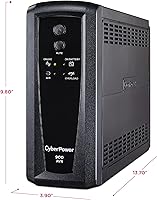
  • Dimensions: The mini-tower measures 13.7″ deep by 3.9″ wide by 9.8″ tall, designed to sit upright beside or under a desk.
  • Weight: The unit weighs 21.8 pounds fully assembled with batteries installed, which is typical for sealed lead acid UPS models in this class.
  • Display: Features LED status indicators for power-on status and wiring fault detection; there is no LCD screen on this model.
  • Warranty: Backed by a 3-year manufacturer warranty that explicitly covers the internal battery, which is uncommon at this price tier.
  • Equipment Guarantee: Includes a $300,000 Connected Equipment Guarantee covering damage to devices properly connected to the UPS under normal use conditions.
  • Management Software: Compatible with PowerPanel Personal software, available as a free download, which supports automated shutdown scheduling and basic power monitoring.
  • Certification: UL certified, confirming the unit has been independently tested and meets established safety standards for electrical equipment.
  • Form Factor: Mini-tower design is intended for vertical placement on a desk or floor surface, keeping the footprint narrow in tight workspaces.
  • Manufacturer: Produced by CyberPower Systems, with this specific model first made available in July 2004 and still actively sold and supported.

Related Reviews

CyberPower CP1000AVRLCD 1000VA UPS Battery Backup
80%
93%
Ease of Setup
88%
AVR Performance
91%
LCD Display Clarity
67%
Battery Runtime
84%
Outlet Layout
More
CyberPower BRG1500AVRLCD2 UPS Battery Backup
86%
88%
Overall Performance
90%
Reliability
68%
Battery Runtime
94%
Ease of Setup
92%
Surge Protection
More
CyberPower CP825AVRLCD 825VA UPS Battery Backup
74%
91%
Voltage Protection
47%
Battery Runtime
83%
Surge Protection
88%
LCD Display
93%
Setup & Ease of Use
More
CyberPower CP2000PFCRM2U 2000VA Rackmount UPS
78%
88%
Value for Money
93%
Pure Sine Wave Output
91%
Short-Depth Form Factor
62%
Battery Runtime
87%
Installation & Setup
More
CyberPower OR2200PFCRT2U 2000VA Sinewave UPS
76%
93%
Power Protection Quality
96%
Pure Sine Wave Output
67%
Battery Runtime
84%
Build & Physical Durability
58%
Installation & Setup
More
CyberPower SL700U 700VA Standby UPS
75%
93%
Ease of Setup
78%
Build Quality
54%
Battery Runtime
88%
Surge Protection
61%
Noise Level
More
CyberPower CP850PFCLCD 850VA UPS Battery Backup
85%
92%
Value for Money
77%
Battery Life and Runtime
88%
Ease of Use and Setup
85%
Build Quality
90%
Surge Protection
More
CyberPower ST425 425VA Standby UPS
77%
88%
Value for Money
51%
Battery Runtime
93%
Ease of Setup
91%
Noise Level
86%
Surge Protection
More
CyberPower CP685AVRG UPS Battery Backup
76%
91%
Voltage Regulation
44%
Battery Runtime
88%
Surge Protection
61%
Compatibility
83%
Value for Money
More
CyberPower EC850LCD 850VA UPS Battery Backup
78%
93%
Ease of Setup
51%
Battery Runtime
81%
ECO Mode Effectiveness
88%
LCD Display
84%
Outlet Layout & Variety
More

FAQ

That depends entirely on how much load you have connected. At full 560W load, you are looking at roughly 5 minutes — just enough to save your work and shut down properly. At half load, around 16 minutes is more realistic. Think of this battery backup as a safety net for a clean shutdown, not a generator replacement.

It depends on your power supply. The CP900AVR uses a simulated sine wave output, which works fine with most standard desktop power supplies. However, if your PC has a high-efficiency or active-PFC power supply — common in modern gaming rigs — there can be compatibility issues. Check your PSU specs before buying, and if active-PFC is confirmed, consider a pure sine wave model instead.

Connect your most critical equipment — desktop PC, monitor, modem, and router — to the five battery-backed outlets so they stay powered during an outage. Use the five surge-only outlets for peripherals like printers, speakers, or phone chargers that do not need battery support but still benefit from surge protection.

It is a fairly straightforward process. The CyberPower CP900AVR UPS Battery Backup uses two standard 12V sealed lead acid batteries that are user-replaceable without any specialized tools. CyberPower and third-party suppliers both sell compatible replacement batteries. Most users who have done it describe it as a simple swap once you locate the battery compartment.
Yes, the AVR feature specifically handles brownouts and voltage fluctuations. When the incoming voltage dips or spikes within a certain range, the unit corrects it automatically without switching to battery power at all. This is one of the more practical daily-use benefits, especially in areas where the grid voltage is inconsistent.

No, the UPS operates completely independently without the software installed. PowerPanel Personal is optional and mainly useful if you want automated PC shutdown when battery reaches a certain level, or if you want to monitor load and battery health from your desktop. It is a free download, but given its dated interface, some users skip it entirely and rely on the LED indicators instead.

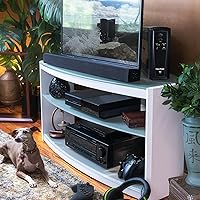
You can plug home entertainment equipment into the surge-only outlets for surge protection, but connecting a TV or AV receiver to the battery-backed outlets is generally not recommended. AV equipment can draw significant and variable power loads, and the simulated sine wave output may not play well with certain power supplies inside that equipment. For dedicated home theater protection, a purpose-built surge protector or a pure sine wave UPS is a better fit.

If that indicator lights up, it means the UPS has detected a problem with the grounding or wiring of the wall outlet it is plugged into — things like a missing ground or reversed polarity. It is a useful alert that flags an underlying electrical issue in your home wiring, and you should have an electrician look at that outlet before continuing to use it.

During normal operation on utility power, the unit is essentially silent. When it switches to battery during an outage, you will hear a periodic beeping alarm, which is standard for UPS units to alert you that you are running on backup power. The fan noise is minimal under light load but can become more noticeable when the unit is working harder.

The warranty is genuinely one of the stronger selling points here. It covers both the unit and the internal battery for three years, which is better than many competitors who cover the battery for only one year or exclude it entirely. The $300,000 connected equipment guarantee is also a real policy, though it requires that you follow proper usage guidelines and that the connected equipment was damaged due to a failure of the UPS itself.

Where to Buy