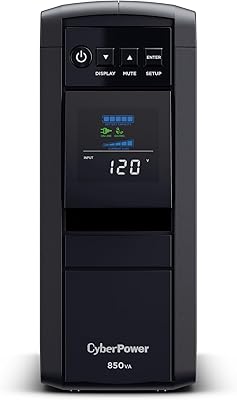
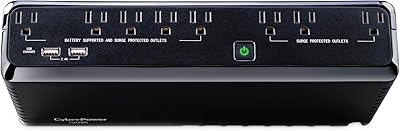
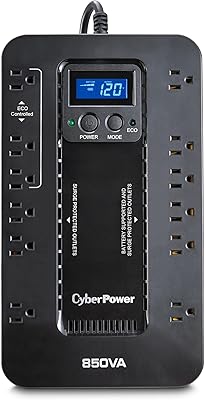
Overview

The CyberPower CP825AVRLCD 825VA UPS Battery Backup has been a steady fixture in the home office power protection market since 2008 — a genuinely long run for any piece of tech. At 825VA and 450 watts of real power, it can comfortably keep a mid-range desktop, a monitor, and a router alive during an outage. Worth noting upfront: this battery backup unit outputs a simulated sine wave, not a pure sine wave. That distinction rarely matters for standard desktop PCs, but if you run audio equipment or a power supply that demands pure sine wave output, look elsewhere. At its mid-range price point, it offers considerably more than bare-bones units typically deliver.
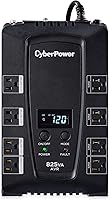
Features & Benefits

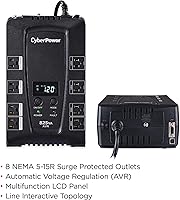
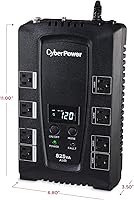
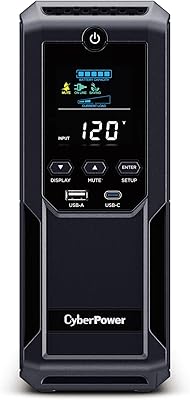
The standout here is Automatic Voltage Regulation, which quietly handles brownouts and voltage swings without ever touching the battery — that alone can meaningfully extend battery lifespan over months of use. The LCD panel is genuinely useful, showing remaining runtime, current load, and battery charge without needing any software open. Eight outlets are split sensibly: four get full battery backup and surge protection, while the other four handle surge protection only — handy for desk lamps or phone chargers that don't need battery support. The compact chassis (3.5 by 11 by 6.8 inches) fits under most desks without fuss, and the included PowerPanel software lets you automate shutdowns if a power cut runs long.

Best For

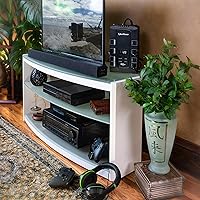
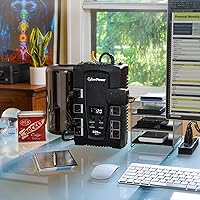
This CyberPower UPS is a natural fit for home office setups where losing power mid-document is a real annoyance — it buys enough time to save your work and shut down properly. It's equally well-suited for keeping networking gear online: routers, modems, and small NAS devices draw relatively little power, so the unit can sustain them far longer than a loaded desktop would allow. If your area experiences frequent voltage dips or surges rather than outright blackouts, the AVR feature handles those silently in the background. It's also a solid pick for anyone wanting an LCD and AVR without paying for a pure sine wave model they probably don't need.

User Feedback

The CP825AVRLCD holds a 4.1-star rating across a large pool of reviews, and the pattern is fairly consistent: buyers appreciate the easy setup, how clearly the LCD reads, and how reliably it handles everyday voltage issues. The complaints are equally consistent. Runtime at full load is roughly one minute — not a flaw so much as a physics reality at this capacity, but buyers expecting longer coverage are often caught off guard. A handful of users with home studio gear reported a faint hum, likely tied to the simulated sine wave output. Long-term owners note that battery degradation becomes noticeable around the two-to-three-year mark, though CyberPower's three-year warranty, battery included, provides meaningful coverage through that window.

Pros

  • Automatic Voltage Regulation handles brownouts without draining the battery, quietly extending overall battery life.
  • The LCD panel gives you a real-time read on load, runtime, and charge level without opening any software.
  • Eight outlets with a smart split — four battery-backed, four surge-only — covers a full desk setup without a separate power strip.
  • Compact chassis fits under or beside a desk without demanding much real estate.
  • A three-year warranty that includes the battery is genuinely rare at this price tier.
  • Setup is plug-and-play; most buyers are up and running in under five minutes.
  • The free PowerPanel software lets you automate safe shutdowns if you step away from your desk during an outage.
  • At half load, runtime stretches to around 13 minutes — plenty of time to wrap up work and power down cleanly.
  • UL certification adds a layer of confidence that cheaper, uncertified units cannot match.
  • A long track record since 2008 and a consistently high sales rank signal real-world reliability over time.

Cons

  • Runtime at full load collapses to roughly one minute — barely enough to shut down, not enough to keep working.
  • Simulated sine wave output can introduce audible hum into sensitive audio equipment or cause issues with certain PSUs.
  • Battery performance noticeably degrades after two to three years of regular use.
  • Replacement batteries are an out-of-pocket cost once the warranty window closes.
  • The six-foot power cord is adequate but limits placement flexibility if your outlet is farther away.
  • PowerPanel software feels dated and lacks the polish of competing management tools.
  • No USB-C outlets, which feels like a missed opportunity given how common USB-C charging has become.
  • The unit emits an audible beep during power events that some users in quiet environments find disruptive.
  • Only four outlets receive battery backup, which may not be enough for users with more complex desk setups.
  • CyberPower customer service responsiveness gets mixed marks in long-term ownership reviews.

Ratings

Our AI-generated scores for the CyberPower CP825AVRLCD 825VA UPS Battery Backup were produced by analyzing thousands of verified global buyer reviews, with spam, bot-submitted, and incentivized feedback actively filtered out before scoring. The result is a transparent breakdown that reflects both what this battery backup unit genuinely does well and where it consistently falls short in real-world use.
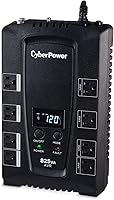
Voltage Protection
91%
The AVR system earns consistent praise from buyers in regions with unstable power grids — many report that brownouts that used to cause unexpected shutdowns or equipment damage simply pass without incident now. Users in older homes with fluctuating line voltage describe this as the single most valuable feature in daily use.
A small number of users note that during severe or rapid voltage swings, the transition to battery can still feel abrupt on very sensitive loads. The protection is strong but not infallible against the most extreme grid instability.
Battery Runtime
47%
53%
For the specific task of safely shutting down a desktop PC and saving open work during a brief outage, the battery does exactly what it promises. Users running lighter loads — a router, a modem, or a small NAS — report getting a genuinely useful stretch of runtime that can outlast short local outages.
At full load, runtime collapses to roughly one minute, which catches a significant number of buyers off guard. Users who expected to keep working through a power cut, rather than just shut down cleanly, frequently express frustration — and this is the single most common complaint across long-term ownership reviews.
Surge Protection
83%
Having eight outlets — four surge-protected even without battery backup — means users can consolidate their entire desk into one protected strip without a separate surge protector. Several buyers mention peace of mind during summer thunderstorm seasons as a direct benefit they notice.
Some users wish the surge-only outlets were more clearly labeled on the physical unit to avoid accidentally plugging critical gear into the wrong bank. There are occasional reports of the unit not surviving a direct, severe lightning-strike-induced surge, though this is the edge of what any consumer-grade device can realistically handle.
LCD Display
88%
Buyers consistently appreciate being able to glance at the unit and know immediately whether the battery is healthy, how loaded the system is, and how many minutes of runtime remain — all without launching any software. It removes the guesswork that plagues simpler UPS units with only LED indicators.
The display is not backlit in a way that is easily readable across a room in bright ambient light, and a few users note the text is small enough to require leaning in. It works well at arm's length but is not designed for monitoring from a distance.
Setup & Ease of Use
93%
Unboxing to fully operational typically takes under five minutes — plug it in, let it charge, connect devices. The right-angle plug on the power cord is a thoughtful design choice that makes installation behind a desk far less awkward than straight-plug alternatives.
The initial battery charge period before first use is not prominently communicated, and a handful of buyers report confusion when the unit beeps during early use before the battery reaches full capacity. A clearer quick-start card would eliminate most of these early friction points.
Battery Longevity
61%
39%
Many buyers get solid performance through the first two years without any noticeable degradation in runtime or reliability. The three-year battery warranty provides real coverage through the period when most lead-acid batteries in this class begin to show wear.
Longer-term owners, particularly those who have kept the unit past the three-year warranty window, frequently report that runtime degrades noticeably and replacement batteries represent a recurring cost. Some users describe the post-warranty battery replacement expense as nearly half the original purchase price, which affects the unit's long-term value proposition.
Noise Level
69%
31%
During normal stable-power operation, the unit is completely silent — buyers using it in bedrooms or quiet home offices report no fan noise or hum under typical conditions. This is a genuine advantage over rack-mount or larger tower UPS units that run cooling fans continuously.
The audible alarm triggered during power events, battery-switching, or low-battery warnings is loud by design and cannot be muted from the unit itself. Users in shared living spaces or light-sleeping households find the repeated beeping during outages significantly more disruptive than they anticipated.
Waveform Quality
58%
42%
For standard ATX desktop power supplies, the simulated sine wave output causes no issues whatsoever, and the vast majority of home office users never encounter any compatibility problems. The output is clean enough for the workloads most buyers are actually running.
Audio interface users and home studio owners report a noticeable hum introduced into their signal chain when connected devices are powered through this battery backup unit. A recurring thread of complaints involves high-efficiency power supplies in newer pre-built PCs behaving erratically on simulated sine wave, which is an important caveat for modern system builders.
Build Quality
76%
24%
The chassis feels solid and appropriately weighted for a device that sits stationary on a desk or shelf — buyers do not describe it as cheap or flimsy. The outlet bank is snug, and plugs seat firmly without wobble.
The all-plastic exterior shows scuffs and scratches over time, and a few buyers note that the LCD housing feels less refined than the rest of the unit. At this price tier the construction is adequate but not premium, and the aesthetic has not been meaningfully updated since the product launched.
Value for Money
79%
21%
The combination of AVR, a real LCD display, eight outlets, UL certification, and a three-year battery warranty at this price tier is hard to match from competing brands. First-time UPS buyers in particular tend to rate the value very highly relative to what basic, display-free alternatives offer.
Buyers who factor in the cost of a replacement battery every three to four years revise their value assessment downward considerably. Those who purchased expecting extended runtime and received only a safe-shutdown window often feel the pricing does not align with their actual use case.
Software (PowerPanel)
54%
46%
The automated shutdown scheduling works reliably when configured properly, and for users who leave their PC unattended, it provides meaningful protection that the hardware alone cannot deliver. Installation is straightforward and the USB connection is plug-and-play on modern operating systems.
The interface feels dated compared to competing UPS management software, and several users report limited functionality on non-Windows systems. The lack of meaningful updates over the years has left features feeling stagnant, and the reporting tools offer little insight beyond what the LCD panel already shows.
Outlet Layout
72%
28%
Eight outlets is a practical count for a full desk setup, and the physical spacing handles standard plugs without issue. Users consolidating a desktop, monitor, router, and a couple of peripherals find the layout naturally fits their needs without requiring a separate power strip.
Wide transformer plugs and bulky power bricks can block adjacent outlets, and the lack of any rotating or angled outlets limits flexibility with awkward adapters. Some buyers note that the battery-backed and surge-only banks are not as intuitively color-coded on the physical unit as they expected.
Warranty & Support
74%
26%
A three-year warranty that explicitly covers the internal battery stands out clearly in this product category, where one-year warranties are the norm. The connected equipment guarantee provides an additional layer of confidence for buyers protecting expensive workstations or networking gear.
Customer service responsiveness gets mixed reviews — some buyers report prompt and helpful warranty claims, while others describe slow response times and difficulty navigating the claims process for the connected equipment guarantee. The warranty is strong on paper but the support experience appears inconsistent in practice.
Form Factor & Portability
86%
The compact footprint is one of the more consistently praised physical attributes — it fits horizontally on a shelf, vertically beside a tower PC, or flat under a desk monitor riser without demanding dedicated space. Buyers upgrading from larger tower UPS units frequently comment on how much less intrusive this unit feels.
The unit is heavier than it looks due to the internal lead-acid battery, which can surprise buyers who try to reposition it frequently. The six-foot cord, while adequate for most setups, limits placement for users with outlets positioned farther than typical from their workstation.

Suitable for:

The CyberPower CP825AVRLCD 825VA UPS Battery Backup is a strong match for home office users whose primary concern is having enough time to save open files and shut down gracefully when the power goes out — not necessarily riding out a long outage. It works especially well for desktop PC setups paired with a monitor and networking gear like a router or modem, where the combined load stays well under the unit's ceiling and runtime stretches meaningfully. People living in areas prone to frequent brownouts or voltage swings will get particularly good value from the built-in AVR, which handles those fluctuations silently without touching the battery at all. It also suits anyone working in a tight space who needs a capable UPS that won't take over the desk or floor. If you want an LCD display, AVR protection, and a solid warranty without stepping into higher-cost territory, this battery backup unit lands in a genuinely practical spot.
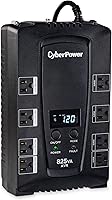
Not suitable for:

The CyberPower CP825AVRLCD 825VA UPS Battery Backup is not the right call for anyone running equipment that demands a pure sine wave power output. Certain high-efficiency power supplies, audio interfaces, and studio monitors can react poorly to simulated sine wave output — expect potential hum or instability if that describes your setup. It is also a poor fit for users who need extended runtime during outages; at a full load, you get barely over a minute of backup, which is enough to shut down but not enough to keep working through a prolonged blackout. Server rooms, small businesses running critical workloads around the clock, or anyone powering medical equipment should look at higher-capacity or pure sine wave alternatives. Buyers hoping to skip battery replacement costs indefinitely should also factor in that performance typically fades after two to three years, and replacement batteries are an added expense once the warranty period ends.
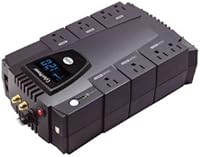
Specifications

  • Capacity: The unit provides 825VA and 450 watts of real power output, suitable for a desktop PC, monitor, and basic networking gear running simultaneously.
  • Topology: Line interactive design actively manages incoming voltage before it reaches connected equipment, reducing wear on both devices and the internal battery.
  • Waveform: Output is simulated sine wave, which works reliably with most standard desktop power supplies but is not recommended for pure sine wave-dependent equipment.
  • Total Outlets: Eight NEMA 5-15R outlets are included: four with full battery backup and surge protection, and four with surge protection only.
  • AVR: Automatic Voltage Regulation corrects brownouts and overvoltages in real time without switching to battery power, helping preserve battery longevity over time.
  • Display: A multifunction LCD panel shows estimated runtime, current battery charge level, and load percentage continuously without requiring any software connection.
  • Runtime: At half load, the battery delivers approximately 13.5 minutes of runtime; at full load, that drops sharply to approximately 1.2 minutes.
  • Battery: One sealed 12V lead-acid battery is included in the box and is fully charged before first use.
  • Dimensions: The chassis measures 3.5″ deep by 11″ wide by 6.8″ tall, keeping the footprint small enough for most desk or shelf placements.
  • Input Plug: Power input uses a NEMA 5-15P right-angle plug on a six-foot cord, which helps manage cord routing behind tight desk setups.
  • Warranty: CyberPower covers the unit and its internal battery for three full years, which is longer than most competitors offer at this price tier.
  • Equipment Guarantee: A connected equipment guarantee of up to $200,000 covers damage to gear plugged into the unit caused by a surge or power event.
  • Management Software: PowerPanel Personal software is available as a free download and enables automated safe shutdowns, power scheduling, and basic energy monitoring from a Windows or Mac PC.
  • Certification: The unit carries UL certification, confirming it has been independently tested and verified to meet established electrical safety standards.
  • Voltage Input: Designed for standard North American household current at 120V, 60Hz — it is not compatible with 220–240V mains without a separate voltage converter.

Related Reviews
CyberPower BRG1500AVRLCD2 UPS Battery Backup
86%
88%
Overall Performance
90%
Reliability
68%
Battery Runtime
94%
Ease of Setup
92%
Surge Protection
More
CyberPower OR2200PFCRT2U UPS Battery Backup
86%
88%
Performance
84%
Setup & Installation
91%
Build Quality
92%
Battery Life
89%
Surge Protection
More
CyberPower CP1000AVRLCD 1000VA UPS Battery Backup
80%
93%
Ease of Setup
88%
AVR Performance
91%
LCD Display Clarity
67%
Battery Runtime
84%
Outlet Layout
More
CyberPower CP900AVR UPS Battery Backup
82%
87%
Power Backup Performance
91%
Ease of Setup
90%
Reliability
56%
Battery Runtime at Full Load
88%
Value for Money
More
CyberPower CP2000PFCRM2U 2000VA Rackmount UPS
78%
88%
Value for Money
93%
Pure Sine Wave Output
91%
Short-Depth Form Factor
62%
Battery Runtime
87%
Installation & Setup
More
CyberPower ST425 Standby UPS Battery Backup
87%
91%
Value for Money
88%
Ease of Setup
93%
Compactness and Space Efficiency
90%
Surge Protection Performance
70%
Battery Runtime
More
CyberPower CP685AVRG AVR UPS Battery Backup
82%
91%
Value for Money
72%
Battery Backup Performance
89%
Surge Protection Effectiveness
93%
Compactness and Design
87%
Ease of Setup
More
CyberPower SL700U 700VA Standby UPS
75%
93%
Ease of Setup
78%
Build Quality
54%
Battery Runtime
88%
Surge Protection
61%
Noise Level
More
CyberPower CP850PFCLCD 850VA UPS Battery Backup
85%
92%
Value for Money
77%
Battery Life and Runtime
88%
Ease of Use and Setup
85%
Build Quality
90%
Surge Protection
More
CyberPower EC850LCD UPS Battery Backup and Surge Protector
84%
88%
Energy Efficiency (ECO Mode)
70%
Battery Runtime
92%
Power Protection Performance
83%
Build Quality & Durability
90%
Usability of LCD Panel
More

FAQ

That depends heavily on what you have plugged in. If you are running a typical desktop, a mid-sized monitor, and a router, you are probably looking at somewhere between five and ten minutes — enough time to save your work and shut everything down cleanly. At the absolute maximum load the unit can handle, runtime shrinks to just over a minute, so this battery backup unit is designed for graceful shutdowns, not extended operation during long outages.

It depends on your system's power draw. Many modern gaming rigs with mid-to-high-end GPUs can pull well over 400 watts under load, which would push this CyberPower UPS close to or beyond its 450-watt ceiling. For a gaming PC, you would want to check your system's actual wattage and consider a higher-capacity unit to get meaningful runtime rather than just a few seconds of protection.

Yes, this is actually one of the better use cases for it. Network switches, routers, modems, and most NAS devices draw relatively little power, meaning the battery can keep them running for a noticeably longer stretch than a full desktop setup would allow. The CP825AVRLCD is a popular choice among home lab and home network users specifically for this reason.

Probably not without some caveats. The simulated sine wave output can introduce a faint hum or interference in audio interfaces, studio monitors, and other gear designed around clean power. If audio fidelity matters in your setup, a pure sine wave UPS is the safer choice. For regular computer and office peripherals, simulated sine wave is perfectly fine.

The LCD panel will display a battery fault or low-capacity warning when the internal battery can no longer hold a proper charge. Most users start seeing degraded performance and shorter runtimes around the two-to-three-year mark under regular use. The three-year warranty covers the battery during that window, so if it fails early, CyberPower should handle the replacement.

AVR — Automatic Voltage Regulation — watches the incoming power from your wall and corrects minor sags or spikes before they reach your equipment. During a brownout, for example, it will boost the voltage back up to a safe level without switching to battery power at all. This keeps the battery in reserve for actual outages and reduces wear on your connected devices over time.

Under normal, stable power conditions, the unit runs silently. When it detects a power event — like switching to battery during an outage — it emits an audible beeping alert. Some users find this useful; others, particularly those in quiet home office environments or shared spaces, find it disruptive. There is no way to disable the alarm entirely from the unit itself.

Yes, that is one of its main practical uses. You can configure the free PowerPanel Personal software to initiate a safe system shutdown after a set number of minutes on battery power, which protects your data even if you are not physically at your desk when the power goes out. It connects via USB and is compatible with both Windows and Mac systems.

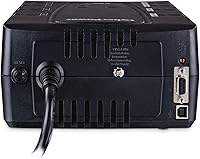
The eight outlets are arranged along the back of the unit — four battery-backed and four surge-only. The spacing between outlets is standard, and wider transformer plugs may block adjacent ports depending on their size, which is a common limitation shared by many UPS models in this form factor. It is worth checking your specific adapters before assuming all eight will be accessible at once.

Yes, that is exactly how a UPS is intended to operate — it stays plugged in, charges its battery, and monitors power continuously in the background. The AVR and surge protection only work when the unit is active. Just keep in mind that lead-acid batteries have a finite lifespan regardless of how gently they are used, so plan for a battery replacement every three to four years as a routine maintenance cost.

Where to Buy