Overview

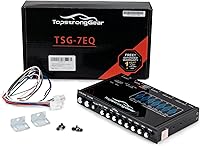
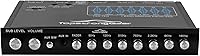
The TOPSTRONGGEAR TSG7EQ 7-Band Car Graphic Equalizer is a half-DIN in-dash unit built for drivers who've outgrown the basic tone controls on their head unit and want something more precise. It occupies half a standard DIN slot, fitting neatly into most single-DIN or double-DIN dash setups without major surgery. TOPSTRONGGEAR focuses on practical, accessible car audio gear, and this car equalizer lands squarely in the mid-range tier. Before you buy, be clear on what it does: this is a signal-shaping tool, not an amplifier. It works between your source and your amp, not instead of one. At a 4.6-star average from 68 buyers, first impressions from the community are solid, if not yet definitive.
Features & Benefits

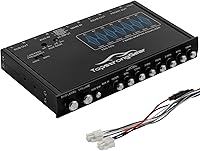
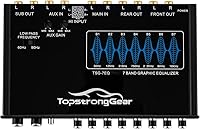
The TSG7EQ runs its EQ across seven bands — from 50 Hz at the low end up to 16 kHz — with each band adjustable by up to 12 dB in either direction. That gives you real control: enough to pull back a boomy bass note or brighten a dull tweeter without resorting to guess-and-check. The 8-volt RCA outputs are the standout spec here. A higher output voltage means a cleaner signal handoff to your amplifier, and less background hiss over longer cable runs. The high-level speaker inputs are just as useful in practice — if your factory unit has no RCA jacks, you tap directly into the speaker wires instead. There is also a selectable low-pass filter at 60 or 90 Hz, a front-panel subwoofer level knob, and fader control built right in.

Best For

This in-dash graphic EQ makes the most sense for a few distinct situations. The clearest case is the driver stuck with a factory head unit that has no EQ worth speaking of — and no desire to rip out the entire dashboard to replace it. The high-level inputs make this install possible without a separate converter. It is also a strong pick for anyone feeding an external amplifier, since that elevated RCA output keeps the signal chain quieter. Subwoofer users will appreciate having a dedicated crossover point right at the faceplate rather than buried inside an amp menu. And for someone building out a system over time, adding a standalone EQ at this stage is a smart, modular approach that keeps future upgrades flexible.

User Feedback

Owners of the TSG7EQ fairly consistently report two wins: improved tonal clarity once the bands are dialed in, and a smoother-than-expected install for those coming from a factory wiring setup. The high-level input path in particular gets credit for making the connection feel relatively plug-and-play. The blue illumination is a point of mild division — some buyers appreciate how it ties into their existing lighting, while others find it looks a little behind current interior trends. More pointed criticism focuses on the physical controls: a few reviewers have noted that the knobs feel light and somewhat loose, raising questions about longevity. The included documentation also comes up in negative feedback, specifically for being sparse when it comes to wiring diagrams. Performance, however, rarely comes up as a complaint.

Pros

  • Seven individually adjustable EQ bands let you shape bass, midrange, and treble with a precision most factory head unit EQs cannot match.
  • The 8-volt RCA output is notably high for this price range, meaningfully reducing background noise when feeding an external amplifier.
  • High-level speaker inputs remove the need for a separate line output converter, simplifying installs on factory-wired vehicles considerably.
  • A selectable low-pass filter at either 60 Hz or 90 Hz makes dialing in a subwoofer crossover point quick and hardware-free.
  • The front-panel subwoofer level knob gives you real-time bass adjustment without navigating any amplifier menus.
  • Front 3.5mm aux and RCA aux inputs with adjustable gain make connecting a variety of external audio sources straightforward.
  • The half-DIN form factor fits most standard dash openings, keeping the physical installation manageable for the majority of vehicles.
  • Buyers consistently report a noticeable improvement in audio clarity and tonal definition after spending time tuning the bands.
  • Built-in fader control and an independent master volume handle daily operation without requiring any additional hardware.
  • A one-year warranty offers reasonable coverage for a mid-range car audio component at this price level.

Cons

  • Physical knobs and faders feel lighter and looser than expected, raising legitimate questions about how they hold up with regular use.
  • The included installation manual is thin on detail, leaving less experienced installers without reliable guidance on signal routing.
  • Blue illumination divides buyers on aesthetics — it can look dated or mismatched against the interior lighting of newer vehicles.
  • As a signal processor only, the TSG7EQ adds no amplification and requires a separate amp to make any meaningful difference in output.
  • There is no digital tuning, app connectivity, or preset memory, so every adjustment is analog and must be set by ear each time.
  • Long-term durability of the faceplate controls remains an open question, with too few multi-year owners to draw firm conclusions.
  • Vehicles without a free half-DIN mounting slot will need an adapter bracket or custom work, adding cost and installation time.
  • At this price tier, build finish takes a back seat to function, which may disappoint buyers accustomed to higher-end unit construction.
  • Gain controls on the aux inputs carry no numbered position markings, making it difficult to reliably recreate a previously dialed-in setting.
  • With fewer than 70 reviews available, it is hard to draw confident conclusions about performance consistency across a wide range of vehicle types.

Ratings

The scores below were generated by AI after analyzing verified buyer reviews for the TOPSTRONGGEAR TSG7EQ 7-Band Car Graphic Equalizer from global markets, with bot-generated, spam, and incentivized feedback actively identified and excluded from the dataset. Each category rating reflects what real owners reported after living with this in-dash graphic EQ — both the aspects that consistently impressed and the friction points that kept surfacing across multiple review sources. Where the TSG7EQ earns strong marks the data supports it, and where it falls short, that is reflected honestly in the scores.
Sound Quality Improvement
84%
Across verified reviews, the most consistent praise centers on how noticeably the sound improves after even a basic tuning session. Buyers coming from flat factory systems report a real sense of clarity — cleaner highs, more defined bass, and a midrange that stops sounding boxed in. It delivers on its core promise.
The improvement is real, but it does not come automatically — buyers who skip careful band adjustment often report underwhelming results. The unit also cannot compensate for poor speaker placement or weak amplification; it reshapes the signal, not the hardware. Setting realistic expectations upfront matters here.
Build Quality
61%
39%
The chassis itself feels solid enough for a half-DIN unit, and the faceplate holds its position in the dash without complaints. For a mid-range component, the overall fit in the dash opening is generally tidy, and the unit does not feel like it will rattle loose on rough roads.
The recurring pain point is the individual knobs and sliders, which multiple reviewers describe as feeling lighter and less precise than expected. A few buyers noted the controls feel somewhat loose even out of the box, which raises concern for long-term reliability in a vibration-heavy environment like a car cabin.
Installation Ease
78%
22%
Buyers using the high-level speaker inputs — particularly those stuck with non-removable factory head units — consistently call out how straightforward the connection process turned out to be. Not needing a separate line output converter saves both money and steps, and the included half-DIN mounting hardware covers most standard install situations.
The instruction manual is a consistent weak point; several reviewers flagged it as too sparse to guide a clean install without referencing outside resources. For buyers newer to car audio wiring, the lack of detailed signal routing diagrams adds friction that should not exist at this price point.
Value for Money
82%
18%
When buyers add up what they get — seven adjustable bands, 8-volt RCA outputs, high-level inputs, a dedicated subwoofer crossover, and fader control — the feature-to-price ratio holds up well against competing options. For someone building a modular car audio system on a budget, it checks more boxes than most alternatives at this tier.
The trade-off is build quality: buyers are clearly getting functional performance at the expense of premium materials and control feel. If long-term durability is the priority, the value equation becomes less straightforward — spending more upfront on a better-built unit might cost less in frustration over the years.
RCA Output Performance
88%
The 8-volt maximum RCA output is the standout spec that separates this unit from cheaper competitors, and real-world users back it up. Buyers running it into external amplifiers report a noticeably cleaner signal with less background hiss than they experienced with lower-output sources, particularly over longer cable runs to a trunk-mounted amp.
This strong output performance requires everything downstream to be properly matched — an amplifier input set incorrectly can introduce distortion rather than eliminate it. There is also no on-board clipping indicator, so buyers without experience setting amplifier gain structure may not extract the full benefit without some careful trial and error.
High-Level Input Utility
86%
For the specific problem it solves — connecting to a factory system without RCA outputs — the high-level input implementation is well-regarded. The variable gain adjustment lets users dial in input sensitivity to match their head unit's output level, which reduces the risk of distortion right at the source before the signal even reaches the EQ stage.
Buyers unfamiliar with setting input gain correctly may introduce clipping if sensitivity is pushed too high. The lack of detailed documentation covering this specific adjustment is a missed opportunity, given that incorrect gain structure at this stage defeats the purpose of the high-quality RCA output further downstream in the chain.
EQ Band Precision
81%
19%
Seven bands with a plus-or-minus 12 dB swing per center frequency gives users enough control to address real acoustic problems in a car cabin — taming a harsh 6 kHz peak from a dome tweeter, for example, or adding warmth at 125 Hz to compensate for thin factory speaker placement. Most buyers find this more than adequate.
Fixed center frequencies mean you cannot target every specific acoustic problem; if your cabin has a resonance sitting between two bands, you can only approximate the correction. There is no parametric option or bandwidth control, so the adjustment curve is broad rather than surgical — fine for most listeners, limiting for audio purists.
Subwoofer Integration
79%
21%
Having both a dedicated subwoofer RCA output and a front-panel level knob covers the two things subwoofer users need to adjust most often. The selectable low-pass filter at 60 or 90 Hz removes the need to rely entirely on the amplifier's built-in crossover, and buyers adding their first powered sub find this setup approachable.
Only two low-pass filter frequency options means you cannot fine-tune the crossover point to precisely match your subwoofer and enclosure type. Enthusiasts who have worked with parametric crossovers or DSP units will find this binary choice limiting, though for most casual listeners it provides a workable and convenient starting point.
Aux Input Flexibility
74%
26%
Having both a front 3.5mm jack and a rear RCA aux input with variable gain covers two common connection scenarios without requiring adapters. The front jack is convenient for daily phone connections during a commute, while the rear RCA input suits a permanently wired secondary source like a dedicated media player.
Neither input supports digital audio or Bluetooth, which is an increasingly common expectation — buyers wanting wireless connectivity must handle that separately at the head unit level. The 3.5mm jack's faceplate position can also make cable access awkward depending on how the unit sits within the dash cutout.
Fader & Volume Control
73%
27%
Built-in fader control is a convenience most buyers appreciate, particularly in multi-zone setups where front and rear speaker balance matters. Having an independent master volume knob on the faceplate means adjusting output level without reaching back to the head unit, which is a small but genuinely useful daily-use advantage.
Operating two separate volume controls — one on the head unit and one on the EQ — can cause confusion and requires calibration to avoid distortion in the gain chain. Some users find the interaction between the master volume and the EQ output level unintuitive at first, especially without clear documentation to reference.
Illumination & Interface
66%
34%
The blue backlit controls are consistently readable at night, which matters during late-night driving when dashboard visibility is the primary concern. Buyers who installed it in vehicles with blue or cool-white interior lighting report that it integrates reasonably well without drawing attention as an obvious aftermarket addition.
Drivers in modern vehicles with amber, red, or white LED instrument clusters frequently describe the blue glow as looking dated or mismatched against the rest of the interior. There is no brightness adjustment or lighting color option available, so buyers whose dash does not naturally complement blue illumination simply have to accept the look.
Documentation Quality
53%
47%
The physical installation hardware — brackets, screws, and mounting components — comes complete and handles most standard DIN slot configurations without sourcing additional parts. For buyers already familiar with car audio wiring conventions, the unit's connections are logical enough to work through independently without relying on the manual.
The written manual is a repeated complaint across reviews: buyers describe it as thin, vague, and short on the wiring diagrams that a clean car audio install genuinely needs. First-time installers in particular report spending time on car audio forums hunting for information that should have been included in the box from the start.
Fit & Compatibility
77%
23%
The half-DIN form factor is broadly compatible with standard single-DIN and double-DIN dash openings, and the included brackets cover most common install scenarios without extra hardware. Buyers across a range of vehicle types — from sedans to SUVs — report that the physical fit in the dash opening is clean and secure.
Vehicles without a free half-DIN slot — including many modern cars with fully integrated infotainment clusters — require an adapter panel or custom mounting work that the included hardware does not address. Compact or imported vehicles with non-standard dash sizing add another layer of compatibility research buyers should complete before purchasing.
Signal-to-Noise Ratio
83%
Users running this unit between a factory head unit and an external amplifier consistently report cleaner audio than they experienced before — less hiss at idle, quieter backgrounds during soft musical passages. The 8-volt output plays a significant role, as a stronger line-level signal gives the amp more to work with relative to its own internal noise floor.
If gain structure is set incorrectly anywhere in the chain — input sensitivity too high or amp gain too aggressive — the EQ can amplify noise rather than reduce it. Buyers with existing alternator whine or ground loop issues should also know this unit does not include dedicated noise isolation circuitry, so electrical interference may persist.

Suitable for:

The TOPSTRONGGEAR TSG7EQ 7-Band Car Graphic Equalizer is best matched to drivers who feel limited by the flat, coarse tone controls on a factory or basic aftermarket head unit and want genuine band-by-band tuning without pulling the entire stereo out of the dash. It is especially well-suited to vehicles where the head unit is integrated into the dashboard and cannot be swapped, since the high-level speaker inputs allow a direct connection to existing factory wiring without needing a separate line output converter. Anyone feeding a standalone external amplifier will benefit from the 8-volt RCA output, which delivers a strong enough signal to keep noise levels low even across long cable runs to a trunk-mounted amp. Those adding a powered subwoofer will find the front-panel level knob and selectable low-pass crossover a practical, menu-free way to integrate bass into their system. Budget-conscious builders growing their car audio setup one component at a time will appreciate that this in-dash graphic EQ delivers real tuning capability at an accessible price point.
Not suitable for:

The TOPSTRONGGEAR TSG7EQ 7-Band Car Graphic Equalizer is the wrong choice for anyone expecting it to function as an amplifier or drive speakers on its own — it is a signal processor and must sit upstream of a proper amp to produce any meaningful change in output volume or power. Drivers who already own a modern aftermarket head unit with a capable built-in EQ, digital signal processor integration, or app-based tuning will likely find that adding this car equalizer layers complexity onto a setup that does not need it. Buyers who prioritize premium tactile quality and long-term build durability should be aware that owner feedback points to some concerns about control feel at this price tier, and the gap between functional performance and physical finish is real. If your vehicle has no available half-DIN mounting slot, the installation will call for an adapter bracket or custom work that adds both cost and effort. Finally, installers who depend on thorough written documentation should know that the included manual has drawn criticism for lacking the wiring detail that a clean car audio install often requires.
Specifications

  • Form Factor: Half-DIN (1/2 DIN) chassis is designed to fit most standard single-DIN and double-DIN dash openings using the included installation brackets and hardware.
  • EQ Bands: Seven fully adjustable graphic equalizer bands provide independent tonal control across the audible frequency spectrum.
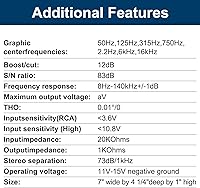
  • Frequency Centers: Band center frequencies are fixed at 50 Hz, 125 Hz, 320 Hz, 750 Hz, 2.2 kHz, 6 kHz, and 16 kHz.
  • EQ Range: Each of the seven bands can be boosted or cut by up to 12 dB, for a total swing of 24 dB per band.
  • RCA Output: Maximum RCA output voltage reaches 8V across front, rear, and dedicated subwoofer output channels.
  • RCA Channels: Three sets of gold-plated RCA outputs are provided: front stereo, rear stereo, and a subwoofer channel with independent level control.
  • Front Input: A 3.5mm stereo aux jack on the faceplate accepts direct input from phones, tablets, or portable media players.
  • Aux Input: A rear-panel 2-channel RCA auxiliary input includes variable gain adjustment to match incoming signal levels from external sources.
  • Speaker Inputs: High-level speaker inputs with variable gain allow direct connection to factory speaker wire outputs, eliminating the need for a separate line output converter.
  • Low-Pass Filter: A selectable low-pass filter offers two crossover frequency settings, 60 Hz or 90 Hz, for routing filtered bass signal to the subwoofer output channel.
  • Subwoofer Level: A dedicated subwoofer output level knob is mounted on the front faceplate for real-time bass adjustment without menu navigation.
  • Fader Control: Built-in front-to-rear fader control allows balance adjustment between front and rear RCA output channels from the faceplate.
  • Master Volume: An independent master volume control operates separately from the source head unit, giving additional output level adjustment at the EQ stage.
  • Illumination: All front-panel controls are backlit in blue for consistent visibility during nighttime or low-light driving conditions.
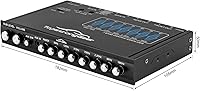
  • Dimensions: The packaged unit measures 9.29 x 5.47 x 2.05 inches and weighs 1.5 pounds.
  • Warranty: The unit is covered by a 1-year manufacturer warranty from the date of original purchase.

Related Reviews
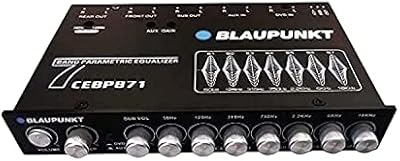
Blaupunkt CEBP871 7-Band Car Audio Graphic Equalizer
86%
89%
Sound Quality
91%
Ease of Installation
85%
Customization Options
87%
Input Versatility
82%
Build Quality
More
NVX XEQ7 7-Band Graphic Equalizer
86%
87%
Sound Performance
92%
Ease of Installation
90%
Bass Control
83%
Build Quality
88%
Connectivity Options
More
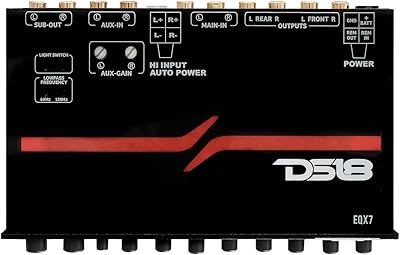
DS18 EQX7 7-Band Graphic Equalizer
85%
88%
Sound Quality
90%
Bass Performance
82%
Ease of Installation
85%
Build Quality
87%
Frequency Range
More
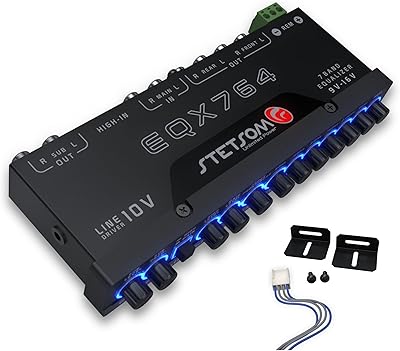
Stetsom EQX764 7-Band Car Audio Equalizer
85%
91%
Sound Quality Enhancement
89%
Ease of Installation
93%
Bass Control
85%
Frequency Band Flexibility
88%
Output Channels
More
Clarion EQS755 7-Band Car Audio Equalizer
85%
89%
Sound Quality
85%
Connectivity Options
92%
Ease of Installation
87%
Build Quality
90%
Subwoofer Control
More
Gravity GR-EQ9 7-Band Graphic Equalizer
82%
89%
Sound Quality
85%
Ease of Installation
90%
Bass Control
80%
Build Quality
82%
User Interface
More
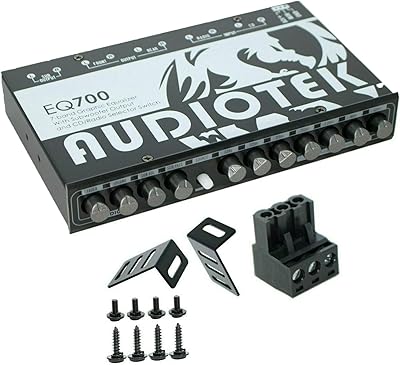
Audiotek AT-EQ700 7 Band Car Audio Equalizer
85%
91%
Bass Control
84%
Ease of Installation
87%
Sound Quality
85%
Compatibility with Audio Devices
92%
Customizability (Frequency Bands)
More
PRV AUDIO EQ7-15 7 Band Graphic Equalizer
83%
91%
Sound Performance
85%
Ease of Installation
80%
Build Quality
88%
Ease of Use
92%
Value for Money
More
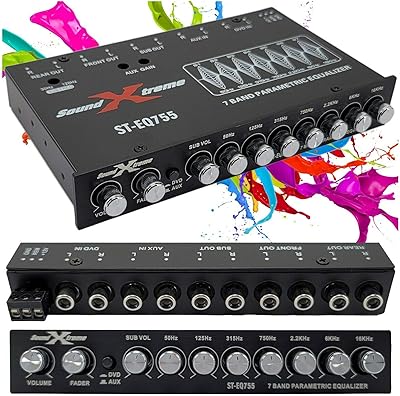
SoundXtreme ST-EQ755 Car Audio Equalizer
73%
83%
Sound Improvement
81%
Value for Money
74%
Installation Experience
78%
Preamp Output Quality
58%
Build Quality
More
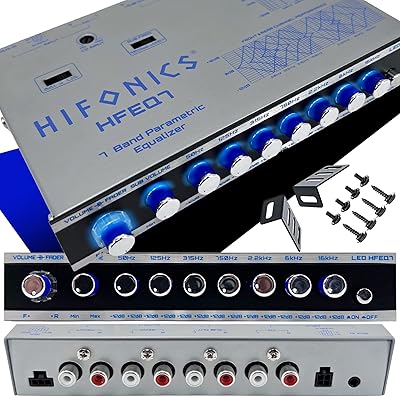
Hifonics HFEQ7 7-Band Pre-Amp Car Audio Equalizer
85%
88%
Sound Quality
94%
Ease of Installation
90%
Bass Control
85%
Build Quality
91%
Value for Money
More

FAQ

Yes, and this is actually one of the more practical reasons to choose this unit. The high-level speaker inputs let you connect directly to your existing factory speaker wiring, so there is no need to buy a separate line output converter. You tap into the speaker wires behind the head unit, feed that signal into the EQ, and then route the processed output to your amplifier. It is a cleaner solution than many buyers expect at this price point.

It changes the sound, not the volume. This is a signal processor, not an amplifier, so it does not add any power to your system. What it does is reshape the audio signal before it reaches your amp, letting you boost certain frequency ranges and pull back others. If you need more output volume, that still requires a dedicated amplifier downstream.

Most budget-tier equalizers max out around 4 volts on their RCA outputs, and even decent aftermarket head units typically land between 4 and 5 volts. A higher output voltage gives your amplifier a stronger, cleaner input signal to work with, which in real-world terms translates to a lower noise floor and less background hiss — especially noticeable over longer cable runs between the EQ and a trunk-mounted amp. It is a spec worth paying attention to in a system that includes an external amplifier.

The low-pass filter controls which frequencies get routed to your subwoofer output. Setting it to 60 Hz means only very deep bass tones pass through, which gives you tight, focused low-end without much mid-bass bleed into the subwoofer channel. At 90 Hz, a broader range of low frequencies comes through, which can sound fuller but may overlap with your main speakers more. The right setting depends on your subwoofer, the enclosure size, and how your main speakers handle the lower midrange.

You need an amplifier in the signal chain. The TSG7EQ is designed to process and output a line-level or high-level signal, not to drive speakers directly. Think of it as sitting between your audio source and your amplifier rather than replacing either one. Without an amp downstream, you will not get usable audio from the RCA outputs.

If you have wired an amplifier or run RCA cables before, this should be manageable. The high-level inputs simplify things considerably when working off a factory stereo, since you do not need to reroute wiring all the way to the head unit itself. The one consistent piece of feedback from owners is that the included instructions are on the thin side, so having a wiring diagram specific to your vehicle or a reference from an online car audio forum nearby during the install is a smart precaution.

It can be a reasonable choice, provided you are clear on what role it plays. The most important thing to understand going in is that it is an EQ and signal processor, not an amplifier — you will still need a separate amp to power your speakers. That said, adding a proper standalone EQ early in a build actually makes sense, because it gives you tuning flexibility as you expand the system later. Just set honest expectations about the physical build quality of the controls at this price tier.

It really depends on your interior. In vehicles that already use blue accent lighting or have a cooler-toned instrument cluster, it tends to blend in well enough. In cars with warm amber, red, or white LED dash lighting, the blue backlight can read as slightly mismatched or dated. It is not a dealbreaker by any means, but if interior visual consistency matters to you, it is worth considering before you buy.

These inputs are generally intended to be used one at a time rather than simultaneously. The front 3.5mm jack is best suited for quick plug-in use from a phone or portable device, while the rear RCA aux input works better for a permanently wired secondary source with its own dedicated gain setting. Refer to the manual for how input switching is handled on this specific unit, as behavior can vary between analog EQ designs.

Within the first year, the manufacturer warranty should cover functional defects, so document your purchase and reach out to the seller or TOPSTRONGGEAR directly. A few owners have noted the physical controls feel lighter than expected, so handling the knobs with care rather than forcing them is a sensible precaution from day one. For issues that arise after the warranty period, repair options will depend on the brand's support availability at that time, so keeping your purchase receipt is worthwhile.