Overview

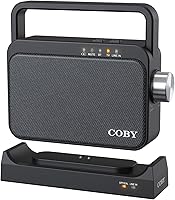
The Coby CSTV130 Wireless TV Speaker is built around a straightforward idea: what if you could control your own volume without ever touching the main TV remote? The system has two parts — a base unit that plugs into your television, and a portable speaker you keep close to you. That independence matters most to seniors, hard-of-hearing users, and couples who've spent years negotiating the remote. Positioned in the mid-range assistive audio category, this wireless TV speaker isn't trying to replace your home theater setup. It's a personal listening companion, focused on making dialogue clear and comfortable from across the room.
Features & Benefits

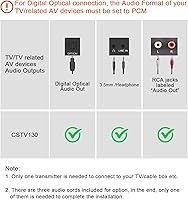
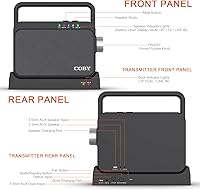
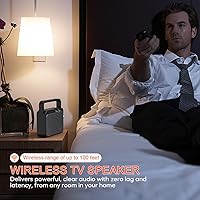
The wireless range here is genuinely useful — up to 100 feet means you can walk to the kitchen without missing a word. Battery life runs up to 8 hours on a single charge, and recharging is easy via the dock base or Micro USB port. The base supports both optical and AUX inputs, so it works with virtually any TV in your home. A built-in headphone jack lets you switch to private listening instantly. Touch controls keep things simple for anyone who finds small buttons difficult. As a bonus, the Coby listener also pairs with smartphones as a standard Bluetooth speaker when you want it to.

Best For

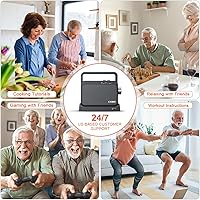
This personal TV audio companion makes the most sense for anyone who has ever been asked to turn the TV down — or up — by someone else in the room. Seniors dealing with age-related hearing changes will find it practical, as will anyone with moderate hearing loss who wants a personal audio boost without a clinical device. It also suits shared living situations where one person prefers higher volume late at night. That said, if you're after rich, dynamic sound with meaningful bass response, this isn't the right fit. It's built for clear dialogue delivery, not performance audio.

User Feedback

Among the nearly 500 ratings, the most consistent praise focuses on how well this wireless TV speaker resolves household volume disagreements — a frustration that sounds trivial until you've lived with it nightly. Setup gets generally positive marks, though a fair number of buyers mention being briefly stumped by a translucent plastic cap covering the optical port that must be removed before the cable seats correctly. Speech clarity earns solid marks across the board, but nobody's praising the bass depth, which is fair given what it's designed for. A small share of users mention occasional connectivity drops — worth acknowledging, though far from a widespread complaint.

Pros

  • Lets you control your own TV volume independently without touching the main remote or disrupting others.
  • The 100-foot wireless range covers most single-floor homes comfortably, including kitchen and hallway use.
  • Works with both optical digital and standard AUX outputs, making it compatible with older and modern TVs alike.
  • Eight hours of battery life is enough for a full day of casual TV viewing on a single charge.
  • Touch-sensitive volume and mute controls are easy to operate for users with reduced grip strength or dexterity.
  • A built-in headphone jack allows completely private listening without any additional hardware or pairing steps.
  • The dock-charging base keeps the speaker topped up passively overnight — no cables to fiddle with each time.
  • Doubles as a Bluetooth speaker for phones and tablets when not in TV mode, adding everyday versatility.
  • Setup is straightforward enough for users who are not comfortable with technology, with minimal steps required.
  • Comes with the optical cable included, so most buyers can get started without an extra trip to the store.

Cons

  • The charging time matches the battery life hour-for-hour, leaving no room for a quick top-up when needed.
  • The optical port ships with a translucent protective cap that is easy to miss and causes unnecessary setup confusion.
  • Wireless signal can degrade noticeably in homes with thick walls or multiple obstacles between base and speaker.
  • Plastic construction feels lightweight in a way that reads fragile rather than portable — not built for rough handling.
  • Touch controls are occasionally too sensitive, triggering accidental volume changes when repositioning the speaker.
  • Bluetooth mode audio quality is average and unlikely to satisfy users accustomed to dedicated wireless speakers.
  • Some units show inconsistent connectivity, with intermittent audio dropouts reported at the edges of the usable range.
  • TVs with fixed-volume optical outputs can limit the speaker's maximum volume regardless of the device's own settings.
  • The instruction manual does not clearly flag the optical port cap removal step, which is the most common setup frustration.
  • At its price tier, the overall build and finish do not fully match what competing options offer for similar or less cost.

Ratings

The scores below for the Coby CSTV130 Wireless TV Speaker were generated by our AI rating engine after analyzing verified purchase reviews from buyers worldwide, with spam, bot-submitted, and incentivized feedback actively filtered out. Each category reflects a synthesis of real user experiences — the genuine praise and the honest frustrations — so you can make a well-informed decision before buying. Both what works well and what falls short are represented here with equal weight.
Wireless Range & Freedom
88%
Most users confirm the 100-foot range holds up well in typical single-floor home layouts. The ability to walk to the kitchen, use the bathroom, or settle into a recliner without losing audio is the single most appreciated aspect of this listener — it's the core promise, and it largely delivers.
A minority of buyers report signal degradation when walls or furniture interrupt the line of sight, particularly in older homes with dense construction. The range claim holds best in open-plan spaces; smaller apartments with thick interior walls may see noticeable drop-off.
Dialogue Clarity & Speech Intelligibility
83%
For its intended purpose — making TV dialogue clear and easy to follow — the Coby listener performs solidly. Users with moderate hearing loss consistently report hearing conversational speech without straining, which is exactly the benchmark this category of device should meet.
The speaker is tuned for voice clarity, not audio richness, so music, sound effects, and cinematic audio come across as flat. Buyers who expected a well-rounded listening experience were occasionally disappointed, though that expectation may not align with the product's actual purpose.
Setup & Ease of Use
79%
21%
The majority of buyers — including those who are not particularly tech-savvy — describe the initial setup as straightforward. Connecting the base to the TV via optical or AUX and powering on the speaker is a process most users complete without consulting customer support.
The single most common friction point is a translucent plastic cap covering the optical port on the base that must be removed before the cable fits. It is easy to miss, and several users spent considerable time troubleshooting a connection problem that was solved by removing a small piece of protective plastic.
Battery Life & Charging
74%
26%
Eight hours of continuous playback comfortably covers a full evening of TV watching, and most users do not need to think about charging more than once a day. The dock-based recharging is convenient — simply placing the speaker back on its base overnight keeps it ready.
The charging time is also approximately 8 hours, which creates an inconvenient 1:1 ratio of use to recharge time. A handful of users who forgot to dock it overnight found themselves without audio mid-day, and the long charge time means there is no quick top-up option.
Volume Control & Touch Interface
81%
19%
The touch-based volume and mute controls are a practical choice for the target audience. Seniors with arthritis or reduced hand strength benefit from not having to press down mechanical buttons, and the mute function is responsive enough for quick use during commercials.
Touch controls can feel overly sensitive in some units, with accidental volume adjustments reported when users pick up the speaker or adjust its position. There is no tactile feedback, which can make it difficult to confirm an action without looking at the device.
Connectivity Options
82%
18%
Supporting both optical digital and 3.5mm AUX inputs means this personal TV audio companion works with an unusually wide range of televisions — from older sets without digital audio outputs to the latest smart TVs. That flexibility reduces the risk of a compatibility mismatch on purchase.
There is no HDMI ARC support, which is becoming a standard output on modern TVs. Users whose television lacks a dedicated optical or AUX output may need an adapter or splitter, which adds complexity and an extra purchase that was not anticipated.
Headphone Jack Utility
77%
23%
The built-in 3.5mm headphone jack is a genuinely useful addition. Late-night viewing without disturbing a sleeping partner becomes entirely practical — plug in a pair of wired headphones and the speaker functions as a dedicated personal amplifier with full volume control at arm's reach.
The headphone output volume level has been described as inconsistent across units, with some users finding it underpowered relative to expectations. The jack also disables the speaker output when plugged in, which is standard behavior but occasionally surprises users who expected simultaneous output.
Bluetooth Speaker Mode
68%
32%
As a secondary Bluetooth speaker for smartphones or tablets, this wireless TV speaker is competent enough for casual podcast or audiobook listening. Pairing is generally stable, and the convenience of having a dual-purpose device is appreciated by users who want flexibility.
Bluetooth audio quality is average at best, and switching between TV audio mode and Bluetooth mode is not always intuitive. Users expecting the same quality they get from a dedicated Bluetooth speaker at a similar price point will likely be underwhelmed by this mode specifically.
Build Quality & Portability
71%
29%
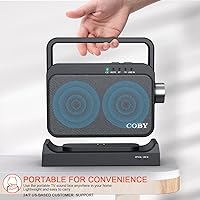
At 2.1 pounds with a compact footprint, the speaker is light enough to move between rooms without effort. The build feels solid enough for daily tabletop use, and the dock base provides a stable home for charging that keeps countertop clutter minimal.
The plastic housing does not feel premium for the price, and a few users noted the device felt fragile compared to competitors. The speaker is not ruggedized in any way — it is strictly an indoor, careful-handling product, and any accidental drop from a table poses real risk.
Value for Money
66%
34%
For buyers who genuinely need a dedicated TV listener for hearing assistance, the value case is reasonable — the combination of wireless range, battery life, and dual input support covers the basics competently. Users who needed this solution specifically describe it as money well spent.
At its price point, competition from brands with better audio tuning and more refined hardware is real. Buyers expecting build quality or sound richness proportional to the cost may feel the pricing is slightly ambitious, particularly when cheaper alternatives exist with comparable wireless performance.
Connectivity Stability
63%
37%
For most users in standard home environments, the connection between the base and speaker remains stable through typical TV-watching sessions. Users who stay within a single room or open living area report few to no interruptions during normal use.
A recurring thread in negative reviews involves intermittent audio dropouts, particularly when the speaker is moved to another room or placed at the outer edge of the rated range. While not a majority complaint, it appears consistently enough to suggest some unit-to-unit variability in wireless stability.
Compatibility with Older TVs
84%
The inclusion of a standard AUX input makes this one of the more accessible wireless TV speakers for households that have not upgraded to a modern smart TV. Users with older flat panels or even tube-style sets with audio outputs confirmed successful connection without adapters.
Some older TVs have fixed-volume optical outputs, meaning the TV itself controls signal level rather than the speaker — a few users discovered that their TV's audio output was too quiet at the source, limiting how loud the personal speaker could actually go.
Instructions & Documentation
58%
42%
The core setup steps are covered adequately in the included documentation, and the optical input cable is included in the box, which removes one potential barrier. Users who followed the guide step-by-step generally completed setup without issue.
The instruction manual does not prominently warn users about the optical port's protective plastic cap, which is the single most common source of setup confusion. A clearer callout — or even a sticker on the device itself — would eliminate a frustration that appears repeatedly across reviews.

Suitable for:

The Coby CSTV130 Wireless TV Speaker was built for a specific problem, and it solves that problem well — making TV audio personally accessible without forcing everyone in the room to sit at the same volume. It is an especially practical choice for seniors experiencing age-related hearing decline who want to stay engaged with their favorite shows without relying on closed captions or asking family members to tolerate uncomfortably loud audio. Couples and roommates with mismatched hearing sensitivity will find it a genuine quality-of-life improvement for shared living spaces. Anyone with limited mobility who wants sound to travel with them — from the couch to the kitchen and back — will appreciate the 100-foot wireless range in a typical home layout. It also works well as a gifted solution: easy enough to set up for a less tech-savvy parent or grandparent, and practical enough that it will actually get used daily rather than sitting in a drawer.

Not suitable for:

The Coby CSTV130 Wireless TV Speaker is not the right pick for buyers approaching it as a general-purpose audio upgrade or a home theater enhancement. If your primary concern is sound quality — dynamic range, bass response, or the kind of immersive audio that makes action films feel cinematic — this personal TV audio companion will disappoint; it is tuned for voice clarity, not sonic richness. Audiophiles, music listeners, and anyone who judges a speaker by how it handles a full soundtrack rather than a dialogue scene should look elsewhere at this price point. The build quality, while functional, does not feel particularly durable, so it is a poor fit for households with young children or environments where the device might be handled roughly. Users whose television lacks both optical and AUX outputs will face compatibility hurdles, and those living in dense, multi-wall homes may find the wireless range less reliable than advertised. If late-night charging is not a realistic habit, the slow 8-hour recharge time could also become a daily inconvenience.
Specifications

  • Brand & Model: Manufactured by Summit Electronics under the Coby brand; model number CSTV130.
  • Dimensions: The speaker unit measures 2.09″ deep, 8.27″ wide, and 6.89″ tall.
  • Weight: The complete unit weighs 2.1 pounds, making it light enough to move between rooms without effort.
  • Audio Inputs: The base station accepts both a digital optical (TOSLINK) input and a 3.5mm AUX input for broad TV compatibility.
  • Wireless Range: The wireless connection between the base and speaker supports a range of up to 100 feet in open conditions.
  • Battery Life: A fully charged battery provides up to 8 hours of continuous audio playback.
  • Charging Time: A full recharge takes approximately 8 hours, completed via the dock base or a Micro USB cable.
  • Power Source: The speaker is powered by a built-in rechargeable lithium-ion battery; the base station connects to mains power via the included AC adapter.
  • Output Power: The speaker delivers a maximum audio output of 10 watts.
  • Driver Size: Audio is produced through a 53mm dynamic driver.
  • Audio Mode: The unit operates in stereo with a 2.1 surround sound channel configuration.
  • Connectivity: Wireless communication uses Bluetooth technology for both the TV audio link and the standalone Bluetooth speaker mode.
  • Controls: Volume, mute, and playback functions are managed via touch-sensitive controls on the speaker unit.
  • Headphone Jack: A 3.5mm headphone output is built into the speaker, allowing standard wired headphones to be plugged in directly.
  • Compatible Devices: Beyond televisions, the speaker is also compatible with smartphones, tablets, MP3 players, and desktop computers via Bluetooth.
  • Water Resistance: This unit is not waterproof or water-resistant and is intended strictly for indoor use.
  • Mounting Type: The speaker is designed for tabletop use and rests on a flat surface or in its charging dock — no wall mounting required.
  • In the Box: The package includes the speaker unit, charging base, AC power adapter, and an AUX cable.
  • Warranty: The product comes with a manufacturer warranty provided by Summit Electronics.
  • Certifications & UPC: The unit carries UPC code 643620020661 and was first made available in December 2020.

Related Reviews

SEREONIC BT-200 Wireless TV Speaker
79%
88%
Dialogue Clarity
91%
Ease of Setup
83%
Wireless Range & Stability
86%
Audio Latency
74%
Battery Life
More
ChairSpeaker CS3 Wireless TV Speaker System
78%
88%
Dialogue Clarity
91%
Ease of Setup
86%
Wearing Comfort
71%
Chair Compatibility
67%
Wireless Reliability
More
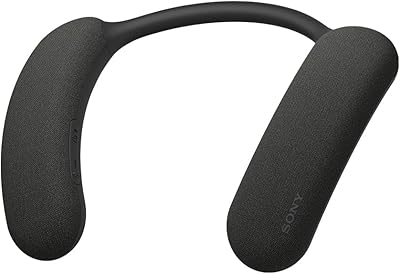
Sony BRAVIA Theater U Wearable Speaker
71%
88%
Wearing Comfort
74%
Sound Quality
71%
Spatial Audio Performance
91%
Battery Life
83%
Bluetooth Stability
More
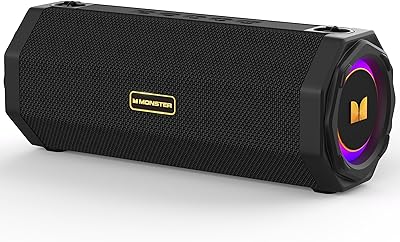
Monster S200 Portable Bluetooth Speaker
73%
82%
Bass & Low-End Output
61%
Sound Clarity & Midrange
79%
Volume & Loudness
86%
Bluetooth Connectivity
84%
Waterproof Performance
More
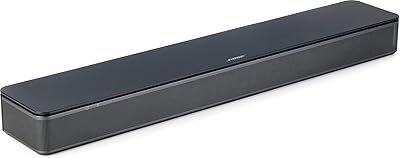
Bose TV Speaker
Bose TV Speaker
83%
93%
Dialogue Clarity
96%
Setup Simplicity
91%
Compact Design
88%
Build Quality
64%
Bass Performance
More
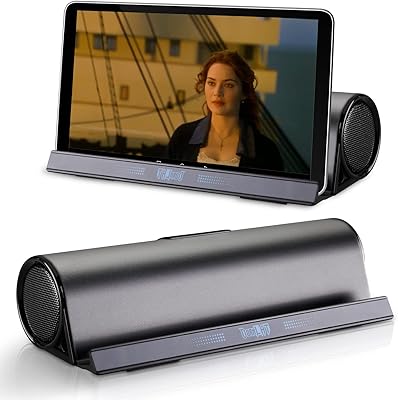
DORNLAT Portable Bluetooth Phone Stand Speaker
72%
83%
Value for Money
61%
Sound Quality
86%
Stand Functionality
88%
Portability & Size
67%
Battery Life
More
Skullcandy Terrain Portable Bluetooth Speaker
77%
88%
Waterproofing Reliability
79%
Bass & Low-End Performance
67%
Overall Volume & Loudness
83%
Battery Life
91%
Portability & Form Factor
More
Cleer Scene Portable Bluetooth Speaker
70%
74%
Sound Quality
81%
Bass Performance
71%
Battery Life
43%
Charging Speed
88%
Waterproofing
More
JIAHAYAU 40W IPX7 Portable Bluetooth Speaker
75%
91%
Volume & Loudness
88%
Waterproof Reliability
83%
Battery Life
74%
Sound Quality
71%
Bass Performance
More
ANSTEN AS60 Wireless TV Headphones
80%
93%
Ease of Setup
88%
Wireless Range & Stability
91%
Audio Latency
84%
Comfort & Wearability
71%
Sound Quality
More

FAQ

No, your TV does not need Bluetooth at all. The base station connects directly to your TV using the included optical cable or a standard AUX cable, and the wireless signal travels between the base and the portable speaker. Your TV's own wireless capabilities are irrelevant to how this system works.

This is actually a very common first-time issue. The optical port on the base ships with a small translucent plastic cap covering the lens to protect it during shipping. It blends in easily and is simple to miss. Gently pull that cap off before inserting the cable, and it should seat properly. The same cap may be present on the cable end as well.

Yes, that is essentially the core use case this product was designed for. The base connects to your TV's audio output and sends sound to the portable speaker independently, so the main TV volume can stay at whatever level everyone else is comfortable with while you listen at your own preferred level nearby.

The rated range is 100 feet, which works well in most open living spaces. In practice, range can be reduced by walls, furniture, and other wireless signals in the home. Within a single-floor open-plan home, most users stay comfortably connected; moving to a different room through multiple walls may show some signal degradation.

Yes, the speaker has a built-in 3.5mm headphone jack. Plugging in any standard wired headphones will route the audio through them directly, which makes late-night viewing completely private without needing a separate adapter or wireless headphone system.

The Coby CSTV130 Wireless TV Speaker can be charged by placing it back on its dock base, which also acts as its home station. Whether you can use it while docked depends on the unit; most users in this product category treat charging as an overnight routine rather than a mid-session activity, given the 8-hour recharge time.
Unfortunately, this wireless TV speaker does not support HDMI ARC, so if your television has no dedicated optical or AUX audio output, you will need an HDMI audio extractor to pull the audio signal out and feed it into the base. That adds an extra step and an additional purchase, so it is worth checking your TV's back panel before buying.

It is primarily optimized for voice clarity — meaning dialogue, news broadcasts, and spoken-word content come through cleanly. Music and cinematic audio with heavy bass or wide dynamic range will sound fairly flat by comparison. If TV dialogue is your main priority, it does the job well; if music listening is equally important to you, the audio tuning here may not satisfy.

The speaker can pair with a smartphone or tablet via standard Bluetooth pairing — activate pairing mode on the speaker and connect from your device's Bluetooth settings. Switching back to TV audio mode will depend on the speaker's mode button; the two functions are designed to be used alternately rather than simultaneously.

It is one of the more practical gift options in this category precisely because the setup is minimal and the daily use is simple — dock it to charge, pick it up to watch TV, adjust volume with a touch. The main setup step worth doing for them in advance is removing the optical port cap and confirming the connection to their TV, which removes the one common point of confusion before they ever use it.

Where to Buy