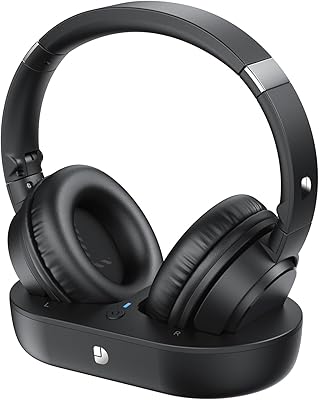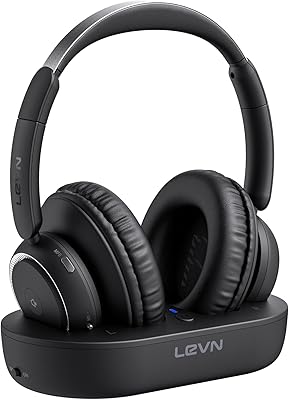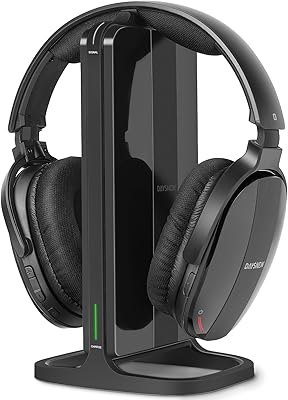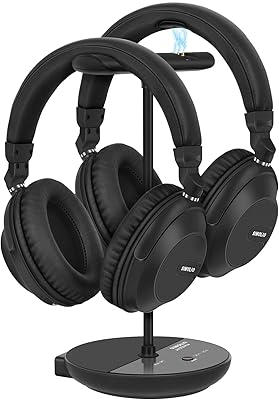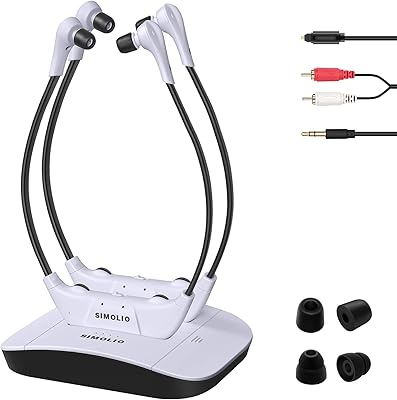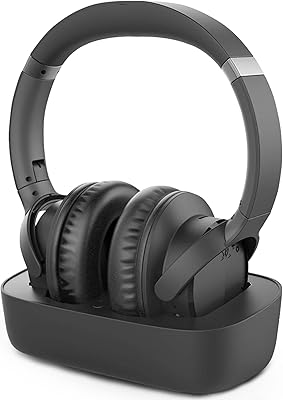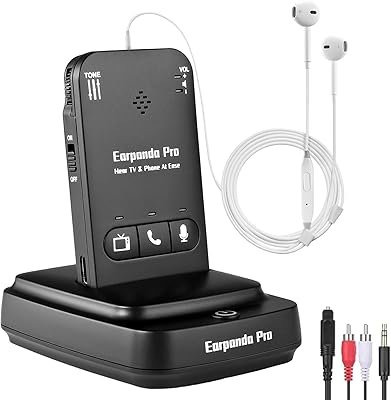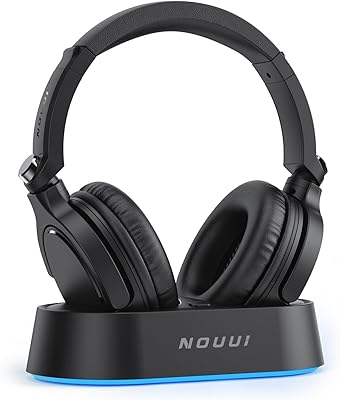
Overview

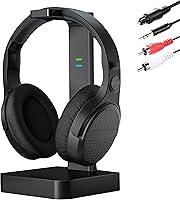
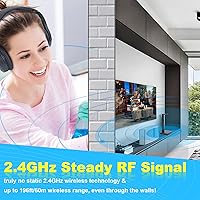
The ANSTEN AS60 Wireless TV Headphones take a straightforward approach to a common household problem: how do you watch TV at your own volume without bothering everyone else in the room? Unlike most wireless headphones that rely on Bluetooth, this RF headset operates on 2.4 GHz RF technology, which means virtually no audio lag and no fiddly pairing process — just plug the dock into your TV and they connect automatically. The dock itself doubles as the transmitter, so there is only one box to deal with. It works with optical, RCA, and 3.5mm AUX outputs, covering most TVs sold in the last two decades.

Features & Benefits

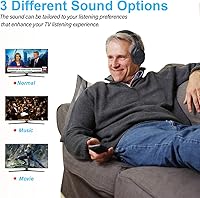
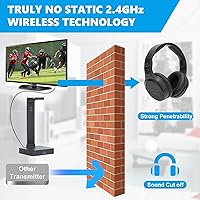
The 197-foot wireless range is genuinely useful — it reaches comfortably through walls into adjacent rooms, so stepping into the kitchen mid-episode is no longer a problem. Three built-in audio modes (Musical, Movie, and Normal) let you adjust the sound character depending on what you are watching, though the differences are subtle rather than dramatic. At just 6 oz, the ANSTEN set is noticeably lighter than many competing over-ear models, and the memory foam ear pads hold up well during long viewing sessions. Battery life sits at around 10 hours per charge, with the dock handling recharging in roughly three hours. One important note: TVs with HDMI-only output are not supported.

Best For

These wireless TV headphones are a natural fit for anyone who struggles to hear dialogue clearly at a volume that would not wake the rest of the house. Hard-of-hearing viewers in particular tend to get a lot of value here — personal volume control alone makes a real difference. They also suit anyone whose TV lacks Bluetooth but has an optical or RCA port, which covers a huge number of older flat-screens. The plug-and-play setup is a genuine strength for people who do not want to troubleshoot apps or device menus. If you are buying for an elderly parent or grandparent, the simplicity and light weight make this a practical, low-frustration choice.

User Feedback

With over 1,300 customer reviews and a 4.4-star average rating, this RF headset has clearly found a dedicated audience. Most positive feedback highlights the hassle-free setup and the signal holding steady through walls — two things that matter most for everyday TV use. On the downside, a handful of buyers report occasional audio cut-outs, and there is no battery indicator to warn you before power runs out. Sound quality is consistently described as clear and functional for TV dialogue, but expectations should stay grounded — this is not an audiophile-grade headset. A few users also note the charging dock connection can loosen with repeated use over time.

Pros

  • Virtually zero audio lag makes lip sync tight during TV watching — a clear advantage over most Bluetooth alternatives.
  • Plug-and-play setup requires no app, no Bluetooth menu, and no pairing process — just power on and they connect.
  • At 6 oz, the ANSTEN set is noticeably lighter than most competing over-ear wireless models.
  • Memory foam ear cushions hold up well during two to three hour viewing sessions without significant heat buildup.
  • The 197-foot wireless range covers large living rooms and even adjacent rooms without signal dropping.
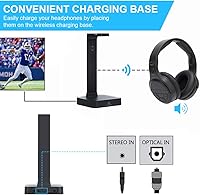
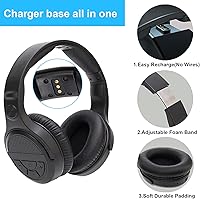
  • One dock handles both transmission and charging, keeping the setup tidy and cable-light near the TV.
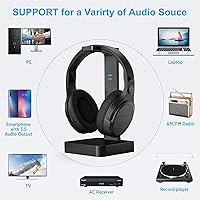
  • Works with optical, RCA, and 3.5mm AUX outputs, covering the majority of TVs made in the last two decades.
  • Ten hours of battery life comfortably covers multiple evenings of use before the headphones need recharging.
  • Hard-of-hearing users consistently report that dialogue is clear and easy to follow at moderate personal volumes.
  • A strong 4.4-star average across over 1,300 verified reviews points to a reliably positive ownership experience for most buyers.

Cons

  • No battery level indicator means the headphones cut out mid-show without any advance warning.
  • The charging dock connection can loosen over time, leading to unreliable charging after several months of daily use.
  • Occasional audio cut-outs have been reported by some users, particularly in homes with dense walls or interference-heavy environments.
  • TVs with only HDMI ARC audio output are entirely unsupported — a hard incompatibility that affects a growing number of newer sets.
  • Sound quality is adequate for speech but falls noticeably short for music or cinematic audio with complex layers.
  • The three DSP audio modes are subtle enough in practice that some users question whether they make a meaningful difference.
  • No carry case or travel-friendly folding mechanism limits use to stationary home environments only.
  • The headband lacks padding on the underside, which becomes uncomfortable for users with larger heads during longer sessions.

Ratings

The ANSTEN AS60 Wireless TV Headphones have been evaluated by our AI rating system after processing thousands of verified global buyer reviews, with spam, bot-submitted, and incentivized feedback actively filtered out. The scores below reflect where this RF headset genuinely delivers and where real users have run into frustrations — no padding, no marketing spin.

Ease of Setup
93%
Buyers consistently describe the setup as one of the easiest they have encountered in this category. You plug the dock into your TV audio output, power it on, and the headphones connect — no app, no Bluetooth menu, no pairing codes. For older adults or less tech-savvy users, this alone is a deciding factor.
A small number of users with less common TV configurations reported confusion about which cable to use. The instructions could be clearer about AUX versus optical priority, and the lack of any on-screen guidance means trial and error is sometimes involved.
Wireless Range & Stability
88%
The roughly 197-foot range holds up well in real home environments — users frequently mention being able to walk into the kitchen or a nearby hallway without signal dropping. For a single-story home or apartment, this range is more than adequate for daily use.
Some buyers in multi-story homes or properties with dense concrete walls report occasional signal interruptions. A handful of reviews note that the connection can briefly cut out when crossing certain room thresholds, which becomes noticeable during quiet dialogue scenes.
Audio Latency
91%
This is where 2.4 GHz RF technology earns its keep over Bluetooth. The vast majority of users report that lip sync between audio and video is tight, with no perceptible lag during normal TV watching. For news, sports, and drama, this makes a meaningful practical difference.
A minority of reviewers noticed very slight sync drift during extended sessions or when the signal occasionally weakened. It is not a widespread issue, but it is worth noting that RF is not completely immune to latency — it just handles it far better than most Bluetooth alternatives.
Comfort & Wearability
84%
At 6 oz, these wireless TV headphones are noticeably lighter than bulkier competing models, and users who wear them for two to three hours at a stretch consistently report minimal fatigue. The memory foam ear pads get specific praise for not creating heat buildup during long evening viewing sessions.
People with larger heads note that the headband can start to feel snug after extended wear. The ear cups are also not the deepest, so those with larger ears may find the foam pressing against them rather than fully surrounding them.
Sound Quality
71%
29%
For its intended purpose — hearing TV dialogue clearly at a comfortable personal volume — this RF headset does the job well. The three audio modes give users a simple way to add a bit of bass for movies or keep things neutral for news and talk shows.
This is not a headset for music enthusiasts or anyone expecting rich, layered audio. Bass response is modest, soundstage is narrow, and the DSP modes, while useful, produce fairly subtle differences. Buyers coming from premium headphone brands will find the sound quality underwhelming.
Battery Life
79%
21%
Ten hours of continuous use covers most evening viewing habits comfortably, and placing the headphones back on the dock between sessions keeps them charged without any manual effort. For users who watch one or two hours per night, a full charge can last several days.
There is no battery level indicator on the headphones themselves, which means the power cuts out without warning — an annoyance during a tense scene. The three-hour recharge time is also on the slower side compared to some newer competitors in this price range.
Build Quality
67%
33%
The overall construction feels adequate for everyday home use. The headband has enough flex to adjust without feeling fragile, and the earcups rotate to a flat position for storage. Most buyers who use these daily report no structural issues over the first several months.
The charging dock connection point is a recurring concern in longer-term reviews — the port can loosen with repeated docking and undocking. The plastic housing also feels somewhat hollow, and a few users report the headband padding compressing and thinning noticeably after several months of regular use.
TV Compatibility
86%
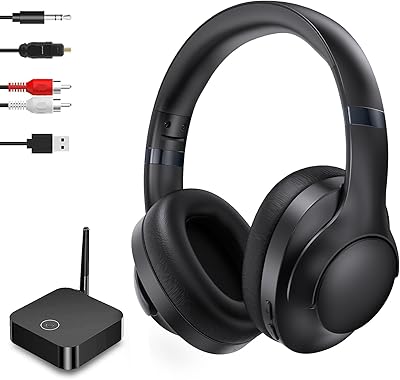
Support for optical, RCA, and 3.5mm AUX covers a wide range of TVs, including older models that lack any smart connectivity. The included optical and RCA-to-3.5mm cables mean most buyers can get started without sourcing additional accessories.
TVs with only HDMI ARC output are not supported, which is an increasingly common configuration on newer budget smart TVs. This is a hard incompatibility that has caught some buyers off guard, and it is not always clearly communicated at the point of purchase.
Value for Money
82%
18%
At its price point, the ANSTEN set competes well on the features that matter most to its target audience — range, comfort, and simple connectivity. For a buyer whose primary need is personal TV audio without disturbing others, the cost-to-utility ratio is reasonable.
Buyers who also want quality music listening, Bluetooth flexibility, or a premium feel will find better-suited options in the same price bracket. The value proposition is specific: if your use case matches, it is solid; if it does not, the money is better spent elsewhere.
Weight & Portability
88%
Being one of the lighter over-ear wireless headsets in this category is a genuine advantage for the target audience. Users who previously gave up on wireless headphones due to neck or ear fatigue frequently cite the low weight as the reason this one actually gets used daily.
The design is clearly optimized for stationary home use, not portability. There is no carry case, the folding mechanism is basic, and the headphones are not intended for outdoor or travel use — which is not a problem for most buyers, but limits versatility.
Audio Mode Usefulness
63%
37%
Having a dedicated Movie mode that adds a small amount of spatial width is a thoughtful inclusion for home theater use. Switching between modes is a single button press, which is simple enough for any user to manage without looking at the headset.
The practical difference between the three modes is subtle enough that several reviewers question whether they are meaningfully distinct. Some buyers describe the Musical and Normal modes as nearly identical in practice, suggesting the DSP implementation is fairly conservative.
Charging Dock Design
74%
26%
The combined transmitter and charging dock is a clever space-saving concept — one device handles both functions, and the headphones are always ready when lifted from it. Placement near the TV feels natural, and the dock does not require a separate power adapter beyond the included USB cable.
The dock itself feels lightweight and can shift easily on smooth surfaces. The headphone cradle connection loosens for some users over time, and a few buyers have reported that the dock stopped charging reliably after several months, requiring repositioning to maintain contact.
Dialogue Clarity
87%
Clear, intelligible speech reproduction is really the core promise of these wireless TV headphones, and this is where user satisfaction is highest. Hard-of-hearing buyers in particular report that TV dialogue is crisp and easy to follow at moderate personal volumes without needing to crank the output.
At higher volume levels, some users notice a slight harshness in certain voice frequencies — sibilance becomes more pronounced on certain types of microphones. This is a minor concern for most users, but those with sensitivity to high frequencies may notice it during extended watching.
Headband Adjustability
72%
28%
The adjustable headband accommodates a fairly wide range of head sizes, and the extension clicks are firm enough that the fit does not shift during normal movement. Most users find a comfortable position within a few seconds of putting them on.
The adjustment increments are relatively coarse, meaning some users fall between two settings without a perfect fit. The lack of any cushioning on the underside of the headband is also noted by users with longer wearing sessions, particularly those without much hair as a buffer.

Suitable for:

The ANSTEN AS60 Wireless TV Headphones are a well-matched choice for anyone whose primary goal is personal TV audio without disrupting the rest of the household. They are particularly well-suited to hard-of-hearing adults or seniors who need to run their own volume higher than is practical on shared speakers — the plug-and-play setup means no technology frustration, and the light weight makes them genuinely wearable for a full evening. Households where schedules differ and one person watches late-night TV while others sleep will find this RF headset solves a real domestic problem without requiring any technical know-how. The broad input compatibility — optical, RCA, and 3.5mm AUX — also makes these wireless TV headphones a strong fit for anyone with an older television that lacks smart connectivity or Bluetooth output. If you are buying as a gift for an elderly parent or someone recovering from surgery who spends long hours watching TV, the comfort-focused design and simple operation make this a practical, low-risk choice.

Not suitable for:

The ANSTEN AS60 Wireless TV Headphones will disappoint buyers who prioritize audio fidelity or want a versatile headset that works across multiple devices via Bluetooth. If your TV uses only HDMI ARC for audio output — which is increasingly common on newer budget smart TVs — this RF headset is simply incompatible, full stop, and no adapter workaround changes that. Music listeners expecting rich bass, wide soundstage, or studio-quality detail will find the sound output functional at best. The lack of a battery indicator is a genuine usability gap for anyone who relies on the headset throughout the day, since the power cuts off without any warning. Those who travel frequently or want a single headset for both home TV use and commuting will also find the design too bulky and dock-dependent for that kind of flexibility. Finally, buyers who prefer the convenience of Bluetooth — switching between a phone, tablet, and TV without swapping cables — should look elsewhere, as this headset is built around one dedicated transmitter and one purpose.

Specifications

  • Model Name: The headset is officially designated the AS60, manufactured by ANSTEN.
  • Wireless Technology: Operates on 2.4 GHz RF (radio frequency) technology, not Bluetooth, for low-latency audio transmission.
  • Operating Range: Rated for up to 197 ft (approximately 60 m) of wireless range in open conditions.
  • Connection Inputs: Compatible with three audio output types: digital optical (TOSLINK), RCA, and 3.5mm AUX.
  • HDMI Support: Does not support HDMI or HDMI ARC audio output; a TV must have optical, RCA, or AUX to work with this headset.
  • Battery Life: Provides up to 10 hours of continuous audio playback on a full charge.
  • Charge Time: Fully recharges in approximately 3 hours when placed on the included dock using the provided USB adapter.
  • Battery Type: Contains a built-in, non-detachable lithium polymer rechargeable battery.
  • Weight: The headset weighs 6 oz (approximately 170 g), which the manufacturer states is around 25% lighter than comparable models.
  • Ear Design: Over-ear form factor with memory foam ear cushions designed to reduce sound leakage and improve long-session comfort.
  • Audio Modes: Features three selectable DSP modes — Musical, Movie, and Normal — switchable via a single button on the headset.
  • Driver Type: Uses dynamic drivers for audio reproduction.
  • Charging Dock: The included dock serves dual purpose as both the wireless RF transmitter and the headphone charging cradle.
  • Included Cables: Package includes one optical (TOSLINK) cable and one RCA-to-3.5mm adapter cable; a 3.5mm-to-3.5mm audio cable is not included.
  • Wired Fallback: A 3.5mm headphone jack on the headset allows wired use with compatible devices when wireless is not needed.
  • Bluetooth Support: Bluetooth connectivity is not supported; the headset is designed exclusively for 2.4 GHz RF operation.
  • Noise Control: Provides passive sound isolation through the over-ear closed-back design; no active noise cancellation is present.
  • Water Resistance: Not rated for water or moisture resistance; should be kept away from liquids.
  • Power Supply: The transmitter dock is powered via a micro-USB connection using the included AC adapter; use of other USB power sources is not recommended by the manufacturer.
  • Dimensions: The headset measures approximately 8.66 x 3.94 x 11.42 inches in its default position.

Related Reviews
ROSIDA TH11 Wireless Headphones for TV
85%
88%
Audio Quality
92%
Comfort and Fit
91%
Battery Life
94%
Ease of Setup
85%
Connectivity
More
Dytole TV001 Wireless Headphones for TV
86%
88%
Sound Quality
90%
Comfort & Fit
94%
Battery Life
85%
Ease of Setup
76%
Bluetooth Range
More
Avantree Ensemble Wireless Headphones for TV Watching
85%
88%
Sound Quality
91%
Battery Life
84%
Comfort and Fit
93%
Ease of Setup
89%
Connectivity Options
More
Earpanda Pro TV Headphones Wireless for Seniors
87%
85%
Sound Quality
92%
Ease of Use
88%
Comfort
90%
Wireless Range
80%
Battery Life
More
SIMOLIO SM-824D2 Wireless TV Headphones
86%
91%
Sound Clarity
88%
Comfort & Fit
85%
Battery Life
90%
Wireless Range
92%
Latency/Sync Performance
More
LEVN LE-HS018 Wireless Headphones for TV
84%
92%
Battery Life
88%
Ease of Setup
84%
Audio Quality
78%
Comfort for Extended Use
91%
Connection Stability
More
SIMOLIO 737D Plus Wireless TV Headphones
86%
89%
Sound Quality
85%
Comfort and Fit
78%
Setup and Installation
91%
Battery Life
92%
Range and Connectivity
More
Daysnew DB100 Wireless Headphones for TV Watching
85%
91%
Comfort for Long Sessions
88%
Wireless Range
94%
Ease of Setup
89%
Audio Sync
85%
Battery Life
More
NOUUI NU-TV002 V2 Wireless TV Headphones
80%
91%
Ease of Setup
88%
Audio Sync & Latency
86%
Battery Life
79%
Charging & Docking Base
67%
Wearing Comfort
More
Joanbro IR Wireless Headphones for uConnect VES, 2 Channel Car DVD Headphones
86%
88%
Audio Quality
90%
Comfort & Fit
85%
Battery Life
91%
Ease of Setup
87%
Portability & Storage
More

FAQ

Unfortunately, no. The ANSTEN AS60 Wireless TV Headphones require your TV to have a digital optical (TOSLINK), RCA, or 3.5mm AUX audio output. If your TV only offers HDMI or HDMI ARC for audio, this headset will not be compatible without an external audio extractor device.

No, and this is one of the more appreciated aspects of this RF headset. Because it uses a dedicated 2.4 GHz RF transmitter rather than Bluetooth, the headphones and dock stay linked automatically. Just power them on and they connect — no pairing screens, no searching for devices.

The included dock is designed for use with a single headset. Using two headsets simultaneously would require a second transmitter and dock unit, and even then audio sync between two separate RF systems is not guaranteed.

The main practical reason is audio latency. Bluetooth introduces a small but sometimes noticeable delay between the video on screen and the audio in your ears, which can make lip sync feel slightly off. RF technology keeps that delay extremely tight, so dialogue and picture stay in sync. There is also no pairing process to manage, which makes RF simpler for everyday use.

Honestly, this RF headset does not include a battery indicator light or any low-battery warning signal, which is one of the more common complaints from buyers. The audio will simply cut out when the battery is depleted. Getting into the habit of docking the headphones between uses is the most reliable way to avoid being caught mid-show.

Yes. There is a 3.5mm headphone jack on the headset that allows wired connection to any device with a standard 3.5mm audio output. Keep in mind that a 3.5mm-to-3.5mm audio cable is not included in the box, so you would need to have one on hand.

Most buyers who wear glasses report that the memory foam ear cushions are soft enough to reduce pressure along the arms of the frame compared to firmer ear pads. That said, any over-ear headset will create some contact with glasses arms during extended wear, and comfort will vary depending on the frame style and head shape. It is worth keeping the return window in mind if you plan to use them for several hours at a time.

Yes, the dock needs to remain powered while you are using the headphones because it is actively transmitting the audio signal to the headset. The manufacturer specifically recommends using the included USB adapter connected to a wall outlet rather than a TV USB port, as some TV USB ports do not provide consistent enough power for reliable transmission.

They hold up reasonably well through interior walls — many users report using these wireless TV headphones while moving to an adjacent room or kitchen without losing the signal. Thick concrete or brick walls can cause more interference, but for typical residential drywall construction, the range is generally reliable.

You can connect them to any device that has a 3.5mm, optical, or RCA output, which includes many desktop computers and some laptops. However, most smartphones and tablets do not have optical or RCA outputs, and the 3.5mm headphone jack has been removed from many modern phones. For those devices, a wired connection with your own 3.5mm cable is the only option, and Bluetooth connectivity is not available on this headset at all.