Overview

The BTECH GMRS-PRO GMRS Two-Way Radio is one of the few handhelds that genuinely earns its premium price tag by packing GPS, Bluetooth, and serious GMRS capability into a single rugged unit. Most walkie-talkies force you to choose between range and features — this GMRS handheld refuses that trade-off. Before purchasing, though, one critical detail deserves attention: an FCC GMRS license is legally required to transmit on these frequencies, and many buyers overlook this step entirely. As for the advertised 100-mile range, those numbers are only achievable with repeater infrastructure in place. In open terrain without repeaters, real-world coverage is considerably shorter — worth setting expectations upfront.

Features & Benefits

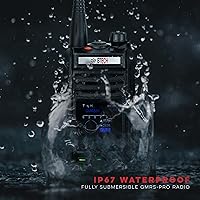
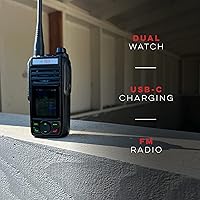
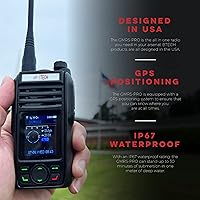
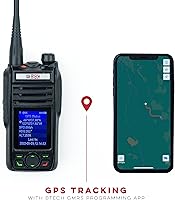
What separates this GMRS handheld from a standard radio is the depth of its capability. The IP67-rated housing means it can survive a dunking — submersible up to one meter for 30 minutes — and shrug off dust without hesitation. Built-in GPS lets you share your live location and pinpoint coordinates with other GMRS-PRO users, no cell signal needed, while the onboard compass and speedometer add genuine utility in the backcountry. Bluetooth pairs with any HFP-compatible headset or vehicle audio system, keeping your hands free on the trail or behind the wheel. You also get NOAA weather alerts, dual-band scanning across VHF and UHF, and 180 channels across six programmable banks — all manageable via a dedicated smartphone app, even offline.

Best For

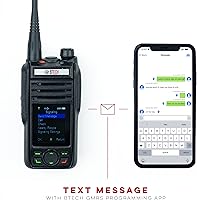
The GMRS-PRO is purpose-built for people who spend real time in remote environments. Overlanders and convoy groups will appreciate the hands-free Bluetooth and off-grid texting for coordinating across vehicles without constant voice interruptions. Backcountry hikers benefit from the GPS and messaging tools when cell coverage vanishes entirely. Search and rescue teams or large event coordinators will find the repeater support and custom channel configuration practical for managing wide-area operations. If you run on a GMRS repeater network, the split-tone support and unlimited editable channels make this two-way radio one of the more capable options available. It also serves as a strong upgrade for anyone frustrated by the limits of basic FRS bubble-pack radios.

User Feedback

Owners consistently praise the build quality and GPS accuracy, with many noting the Bluetooth connection holds reliably across a range of compatible headsets. Where buyers hit friction is the initial setup — the app and channel programming carry a learning curve that can frustrate users expecting plug-and-play simplicity. Battery life draws mixed marks too; running GPS and Bluetooth simultaneously can drain the 2600 mAh cell faster than expected on long days out. Range feedback is predictably variable — solid in open spaces, noticeably shorter through dense forest or hilly terrain without a repeater. On value, most owners feel the feature-to-price ratio holds up well against competing GMRS handhelds, though a handful find the complexity hard to justify for casual weekend outings.

Pros

  • IP67 waterproofing holds up to real field abuse — rain, river crossings, and dusty trails included.
  • Built-in GPS with live location sharing works without any cellular connection, a genuine backcountry advantage.
  • Bluetooth hands-free operation pairs reliably with compatible headsets for safe, voice-free communication while driving or riding.
  • Off-grid text messaging lets groups coordinate silently without clogging shared voice channels.
  • 180 programmable channels across six banks give serious GMRS users room to organize without compromise.
  • NOAA weather alerts are built in, eliminating the need to carry a separate weather receiver on expeditions.
  • Selectable power output lets you conserve battery on short-range comms and open up to full power when needed.
  • The companion app handles firmware updates and channel programming from a smartphone, even offline.
  • Dual-band scanning across VHF and UHF makes this a capable monitoring radio beyond its core GMRS function.
  • Build quality earns consistent praise from users who have put the radio through genuinely harsh conditions.

Cons

  • Initial channel setup and app configuration carry a steep learning curve that frustrates less technical buyers.
  • Battery drains noticeably faster when GPS and Bluetooth run simultaneously on long days out.
  • The 100-mile range claim only applies with repeater infrastructure — simplex range in wooded terrain is far shorter.
  • Off-grid texting and GPS sharing are exclusive to GMRS-PRO users, making the feature useless in mixed-device groups.
  • At 11 ounces with a tall profile, it is a heavy and bulky carry compared to more compact handhelds.
  • FCC GMRS licensing is a legal requirement before transmitting, and many buyers overlook this step until after purchase.
  • Not all Bluetooth headsets are compatible — HFP protocol support is required, which rules out many popular options.
  • Manual channel programming without the app is tedious and not well-documented for newcomers to GMRS radio.

Ratings

The BTECH GMRS-PRO GMRS Two-Way Radio earns its place as one of the more talked-about handhelds in the serious outdoor communication space, and the scores below reflect what real buyers actually experience in the field. Our AI has analyzed verified global user reviews, actively filtering out incentivized, bot-generated, and low-signal feedback to surface honest patterns. Both the standout strengths and the genuine frustrations are represented here without softening either side.
Build Quality & Durability
91%
Owners repeatedly describe the housing as feeling genuinely solid — not just ruggedized in a marketing sense. The IP67 rating holds up in real use: users report dropping it in streams, using it in heavy rain, and coming away without issues. For a device meant to live on a belt clip in demanding outdoor environments, the physical build inspires confidence.
A handful of users note the unit feels slightly bulky compared to slimmer handhelds, which can become uncomfortable on longer hikes. Some have flagged that button feel, while sturdy, lacks the tactile precision of higher-end professional radios in the same tier.
GPS Accuracy & Location Sharing
88%
Real-world GPS performance earns strong marks from overlanders and backcountry users alike. The ability to share live coordinates with other GMRS-PRO users over radio channels — without any cellular connection — is a practical capability that sets this handheld apart from most competitors in its class.
GPS lock time on cold starts can be sluggish, particularly under dense tree canopy. A few users also report minor coordinate drift in heavily shaded canyons, which is a known GPS limitation but worth noting if precision navigation is critical to your use case.
Bluetooth Performance
84%
Pairing with HFP-compatible headsets and vehicle audio systems works reliably for most users, and hands-free communication in a moving vehicle or on an ATV trail is genuinely useful once set up. Bluetooth stability during sustained use gets broadly positive marks across verified reviews.
The HFP protocol limitation means not every popular Bluetooth headset is compatible — a point that catches some buyers off guard. A small but consistent group of reviewers report intermittent drops when the radio is stored in a jacket pocket or pack with significant signal obstruction between the device and headset.
Range & Signal Clarity
72%
28%
In open terrain — desert flats, open water, ridge-to-ridge — users report solid performance well beyond what basic FRS radios deliver. Connecting through a GMRS repeater extends coverage dramatically, and the split-tone support makes that repeater access smooth for users already on an established network.
The advertised 100-mile range figure creates expectation problems. In wooded terrain or hilly environments without repeater infrastructure, real-world simplex range is considerably shorter — sometimes just a few miles. Users who did not research the repeater dependency beforehand tend to be disappointed.
App & Channel Programming
63%
37%
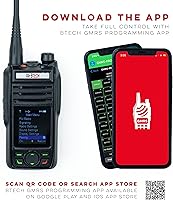
For users comfortable with radio programming, the companion iOS and Android app is a genuine improvement over manually stepping through menus. Offline functionality is a practical touch, and being able to update firmware from a phone is convenient for those who use the radio regularly and want to stay current.
This is consistently the most cited pain point across reviews. The learning curve is steep for anyone without a radio background, and the initial channel setup process is not intuitive. Several buyers describe spending hours on configuration before getting the unit to operate as expected, and customer support response times draw criticism during that process.
Battery Life
67%
33%
Under moderate use — voice communication with GPS active but Bluetooth off — the 2600 mAh battery gets through a full day in the field without issue. Users on shorter day trips or those who manage feature usage thoughtfully report comfortable endurance.
Running GPS and Bluetooth simultaneously accelerates drain noticeably, and heavy scanning adds further load. Users on multi-day expeditions without access to charging report needing to manage usage carefully or carry a backup power solution, which is an added consideration at this price point.
Off-Grid Texting
82%
18%
The ability to send short text messages and share GPS coordinates over GMRS channels with no cellular infrastructure is a standout capability that resonates strongly with search and rescue users and convoy coordinators. It fills a real communication gap that voice-only radios cannot address.
Off-grid texting only works between GMRS-PRO units, so its usefulness depends entirely on your group also using the same radio. Mixed-device groups get no benefit from this feature, which limits its practical value for users who coordinate with people using different handhelds.
Audio Output & Speaker Quality
77%
23%
The 2W speaker is loud enough to be heard clearly over moderate trail noise and wind, which matters when the radio is clipped to a pack strap rather than held to the ear. Audio clarity on received transmissions gets generally positive marks from users in good signal conditions.
At the speaker's upper volume range, some distortion creeps in — a minor but noticeable issue in quiet environments. A few users also find the speaker placement on the unit makes it harder to hear clearly when the radio is holstered or facing away from the user.
NOAA Weather Alerts
86%
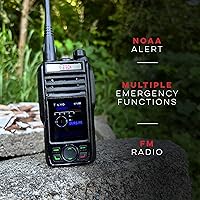
Automatic weather alert reception is reliably functional and gets specific praise from users in storm-prone regions and open-water environments. Having weather monitoring built into the same device used for communication removes the need to carry a separate weather radio on longer expeditions.
NOAA alert audio can be jarring at high volume during quiet moments, and the alert override behavior catches some users off guard. The feature works as designed, but new users often need to spend time understanding alert settings before they feel comfortable with how it integrates into normal operation.
Water & Dust Resistance
93%
IP67 protection at this tier is not uncommon, but the GMRS-PRO's implementation holds up in user-reported real-world tests consistently. Users describe using it confidently in driving rain, river crossings, and dusty desert conditions without degradation in performance.
The IP rating is certified for static submersion — not for prolonged underwater use or high-pressure water jets. A small number of users exposed the unit to conditions beyond the spec and reported seal issues, which is a user error scenario but worth clarifying for buyers who assume IP67 means unlimited water exposure.
Channel Flexibility
89%
180 channels across six banks gives serious GMRS users room to organize frequencies for different use cases — one bank for local repeaters, another for simplex contacts, another for monitoring — without running out of space. The 390-plus CTCSS and DCS tone options make private channel setup practical across large groups.
Managing 180 channels without the app is genuinely tedious via manual controls alone. Users who lose access to a paired device or have app compatibility issues on older smartphones find channel management frustrating, and the manual programming documentation could be more accessible for newcomers.
Value for Money
74%
26%
Buyers who fully utilize the GPS, Bluetooth, texting, and repeater features tend to view the pricing as reasonable relative to what comparable feature sets would cost across multiple separate devices. For dedicated GMRS users, the consolidation of tools is a real financial argument.
For occasional or casual users, the price is harder to justify — particularly if they never engage with the more advanced features. Buyers who primarily want a reliable voice radio for weekend trips can find capable alternatives at a lower price point, making the value proposition dependent on how extensively the feature set is actually used.
Size & Portability
69%
31%
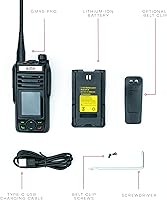
The build density is reasonable given everything packed inside, and the included accessories make day-one field use practical. Users who prioritize capability over compactness accept the form factor as a fair trade-off for what the radio delivers.
At 11 ounces and standing 11 inches tall, this is not a light or compact radio by any measure. Ultralight hikers and packraft users who count every gram find the size prohibitive, and the unit does not slip easily into a standard pants pocket the way smaller handhelds do.
FCC Licensing Clarity
58%
42%
BTECH includes clear language in product documentation about the FCC GMRS license requirement, and the licensing process itself is straightforward once buyers know it exists. Users who arrived informed report no friction on this front.
A recurring theme in negative reviews is buyers discovering the license requirement after purchase — not because BTECH hides it, but because it gets overlooked during the buying process. The license fee and application step, while modest, creates frustration for buyers who expected to use the radio out of the box without any additional steps.

Suitable for:

The BTECH GMRS-PRO GMRS Two-Way Radio was built for people who spend serious time in remote environments and need communication tools that can keep up with them. Overlanders and 4x4 convoy groups will get immediate value from the hands-free Bluetooth, off-grid texting, and real-time GPS coordinate sharing — capabilities that make coordinating a moving convoy practical without constant voice traffic. Backcountry hikers and trail runners who venture beyond cell coverage will appreciate having GPS navigation, messaging, and weather alerts consolidated into a single device rather than spread across multiple gadgets. Search and rescue volunteers and large-event field coordinators benefit from the repeater support and deep channel customization, which allow organized, interference-free communication across wide operational areas. If you are already active on a GMRS repeater network, the split-tone support and flexible channel programming make this handheld a natural fit. In short, buyers who will genuinely push the hardware — using it in rain, mud, heat, and remote terrain — are exactly the audience this radio was engineered for.
Not suitable for:

The BTECH GMRS-PRO GMRS Two-Way Radio is not the right choice for every buyer, and being honest about that saves a lot of post-purchase frustration. Casual weekend users who want a simple walkie-talkie to grab and go will find the setup process disproportionately complex for their needs — the app, channel programming, and configuration options are genuinely powerful, but they demand time and patience to get right. Buyers who are not prepared to obtain an FCC GMRS license before transmitting will also hit a legal and practical wall immediately, as the radio cannot be used on GMRS frequencies without one. Ultralight backpackers counting every gram will struggle to justify 11 ounces and a tall form factor when smaller, lighter options exist for basic voice communication. Anyone expecting 100-mile range in the woods without a repeater network in place will be disappointed — real-world simplex coverage in dense terrain is a fraction of the advertised maximum. And if your group uses a mix of different radio brands, the off-grid texting and GPS sharing features become useless, since they only work between GMRS-PRO units.
Specifications

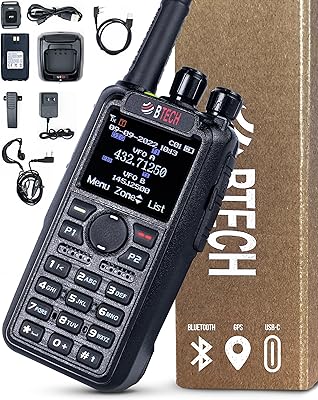
  • Dimensions: The radio measures 3″ deep by 3″ wide by 11″ tall and weighs 11 ounces.
  • Power Output: Transmit power is user-selectable across three levels: 1W, 3W, and 5W, allowing battery conservation on short-range communications.
  • IP Rating: The unit carries an IP67 certification, meaning it is fully dust-tight and can withstand submersion in up to 1 meter of water for 30 minutes.
  • Battery: A 2600 mAh lithium-ion battery is included and provides a full day of moderate use, though simultaneous GPS and Bluetooth operation reduces endurance.
  • Channels: The radio supports 180 memory channels organized across 6 banks of 30 channels each, fully programmable via the companion app or manual controls.
  • Bluetooth: Bluetooth audio is supported using the HFP (Hands Free Protocol), making it compatible with HFP-enabled headsets and vehicle audio systems.
  • GPS: An integrated GPS module enables real-time location tracking, coordinate sharing over GMRS channels, and onboard compass and speedometer functions.
  • Display: The radio uses an LCD display to show channel, frequency, signal, and navigation data in the field.
  • Audio Output: The built-in speaker delivers up to 2W of audio output, loud enough to be heard clearly in moderate ambient outdoor noise.
  • Operating Temp: The GMRS-PRO is rated to operate reliably in temperatures ranging from -5°F to +140°F, covering most real-world field environments.
  • CTCSS & DCS: Over 390 CTCSS and DCS tones are supported, including split-tone configurations for full GMRS repeater compatibility.
  • Scanning Rate: The radio scans at a rate of 30 channels per second, enabling fast monitoring across a wide channel list.
  • Channel Spacing: Channel spacing of both 12.5 kHz and 20 kHz is supported to accommodate standard GMRS frequency assignments.
  • RX Coverage: In receive-only mode, the radio can monitor FM broadcast, VHF, and UHF bands beyond its GMRS transmit range.
  • Frequency Stability: Frequency stability is rated at ±2.5 ppm, ensuring consistent and accurate channel alignment during operation.
  • Sensitivity: Receiver sensitivity is rated at 0.16 µV at 12 dB SINAD, indicating strong weak-signal reception performance.
  • Intermodulation: Intermodulation immunity is rated at 65 dB or greater, reducing interference from strong nearby signals in congested RF environments.
  • Warranty: BTECH provides a 1-year warranty for products purchased through authorized channels, with US-based customer support available.
  • Licensing: An FCC GMRS license is legally required to transmit on GMRS frequencies; the license is not included and must be obtained separately before use.
  • App Compatibility: The companion programmer app is available for both iOS and Android and supports channel editing, firmware updates, and offline map access without an internet connection.

Related Reviews
BTECH DMR-6X2 PRO Two-Way Radio
87%
88%
Performance & Signal Quality
91%
Bluetooth Functionality
85%
GPS & APRS Features
83%
Battery Life
92%
Build Quality & Durability
More
BTECH GMRS-20V2 20W Mobile Two-Way Radio
83%
91%
Performance & Range
93%
Durability & Waterproofing
74%
Ease of Use
70%
Setup & Programming
82%
Battery Life
More
BTECH UV-PRO Dual Band Two-Way Radio
79%
86%
Build Quality
88%
Waterproofing & Durability
78%
Bluetooth App Integration
81%
APRS & GPS Performance
67%
Range & Signal Clarity
More
Midland MXT115VP3 GMRS MicroMobile Radio
76%
78%
Transmission Range
84%
Audio Clarity
81%
Repeater Functionality
76%
Ease of Installation
79%
Build Quality
More
Wouxun KG-805G GMRS Two Way Radio
81%
88%
Battery Life
91%
Water Resistance
75%
Communication Range
85%
Portability
70%
Ease of Use
More
BAOFENG BF-F8HP PRO 7th Gen Tri-Band Radio
78%
88%
Transmission Power & Range
91%
Tri-Band Frequency Coverage
83%
Build Quality & Durability
79%
Weather Resistance (IP54)
67%
GPS Functionality
More
BTECH GMRS-V2 5W 200-Channel GMRS Radio
83%
91%
Build Quality
88%
Ease of Use
94%
Weather Resistance
75%
Range Performance
85%
Programming with CHIRP
More
Motorola T803 Two-Way Radio
83%
84%
Range Performance
88%
Battery Life
78%
Bluetooth Functionality
90%
Build Quality & Durability
85%
Ease of Use
More
Motorola DLR1060 Business Two Way Radios
85%
92%
Battery Life
88%
Ease of Use
75%
Range
87%
Build Quality
90%
Portability
More
Motorola T470 Talkabout Two Way Radios
84%
88%
Range Performance
91%
Ease of Use
85%
Build Quality & Durability
83%
Weather Resistance
80%
Battery Life
More

FAQ

Yes, and this is the single most important thing to know before buying. Transmitting on GMRS frequencies requires a valid FCC GMRS license. The application process is straightforward and covers your entire immediate family, but you need to complete it before legally operating the radio. You can listen and receive without a license, but you cannot transmit.

The advertised 100-mile figure applies only when using GMRS repeater infrastructure — not in direct radio-to-radio communication. In dense forest or hilly terrain on simplex mode, you should realistically expect a few miles at best. Open terrain without obstructions will give you more, but setting expectations around 3 to 5 miles in typical backcountry conditions is more accurate than the headline number.

Yes, completely. The GPS function uses satellite signals just like a dedicated GPS unit — no cell service or Wi-Fi needed. You can track your own position, share coordinates with other GMRS-PRO users over the radio channel, and use the onboard compass and speedometer entirely off-grid.

It depends on the headset. The GMRS-PRO uses the HFP (Hands Free Protocol) for Bluetooth audio, which is common in headsets designed for phone calls rather than music streaming. If your headset supports HFP, it should pair and work. If it only supports A2DP (common in music-focused headsets), it will not be compatible. Check your headset specs before assuming it will work.

Honest answer: it takes patience, especially if you are new to GMRS radio programming. The companion app makes the process significantly more manageable than doing everything manually, but the channel structure, tone settings, and repeater configurations involve a learning curve. Budget a few hours for the initial setup, and consult the BTECH documentation and online GMRS communities — both are genuinely helpful resources.

No. The off-grid texting feature only works between units running the same GMRS-PRO platform. If your group is using a mix of radio brands, the text messaging and GPS coordinate sharing features will not function across devices. For mixed groups, voice communication over a shared GMRS channel remains the practical option.

On moderate voice use with GPS active and Bluetooth off, the 2600 mAh battery will comfortably last a full day for most users. Running GPS and Bluetooth simultaneously draws more power, and heavy scanning accelerates drain further. On multi-day trips without charging access, managing which features you keep active will make a noticeable difference in how long the battery lasts.

Yes, for basic voice communication. GMRS is a standardized frequency band, so this radio can transmit and receive voice with any other GMRS radio on a shared channel. The advanced features like off-grid texting, GPS sharing, and certain repeater configurations are proprietary and only work between GMRS-PRO units, but standard voice interoperability across brands is fully supported.

The IP67 rating means it is built to handle both. It can be fully submerged up to 1 meter deep for 30 minutes and is completely sealed against dust. Heavy rain, stream crossings, and wet hands are not a concern under normal field use. That said, IP67 is a certification for static submersion under controlled conditions — it is not rated for high-pressure water jets or prolonged deep submersion.

No, and that is genuinely useful for off-grid use. The companion app for iOS and Android works offline for channel programming and accessing maps. Firmware updates can also be managed through the app. You do not need a live internet connection on your phone while in the field to make configuration changes to the radio.