Overview

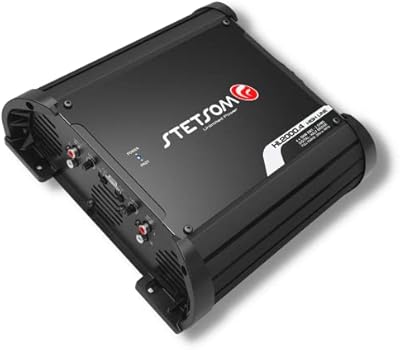
The Blaupunkt AMP1404 4-Channel Car Amplifier is a straightforward entry from a brand that has been in the audio space for decades — and at this price tier, it holds its own reasonably well. Built around a Class AB design, it strikes a better balance between audio clarity and heat management than Class D units crowding this price bracket. One genuinely useful feature is the flexible channel configuration: it runs in 4, 3, or 2-channel mode, which opens up a few different install scenarios depending on your setup. Just set expectations accordingly — this is a solid value pick, not a boutique amp.
Features & Benefits

On paper, this 4-channel amp lists a 1500W peak figure — but the number that actually matters is the RMS output: 300 watts per channel at 2 ohms, or 150W at 4 ohms. That is honest, usable power for a set of aftermarket door speakers. The built-in crossover, adjustable from 50Hz to 400Hz with a variable slope, lets you shape the signal without buying a separate processor. A signal-to-noise ratio of 90dB or better keeps things clean, and total harmonic distortion staying at or below 0.05% is genuinely respectable here. The 4-channel RCA input handles standard front and rear configurations without any adapter complications.

Best For

This Blaupunkt amplifier makes the most sense for someone replacing a factory radio with an aftermarket head unit and wanting real amplification for four door speakers without a large outlay. DIY installers will appreciate the standard wiring setup — no proprietary connectors or awkward form factors to work around. It is less suited for dedicated subwoofer duty or high-demand builds where sustained power output matters most. If you are not chasing competition numbers and just want noticeably better sound than your car's stock system, this amp fits that use case well. Pair it with mid-range aftermarket speakers and the combination makes good sense.

User Feedback

Most buyers report that installation is straightforward, with the gain and crossover controls easy enough to adjust without professional help. The improvement over factory sound is consistently described as noticeable — cleaner highs, better separation, more headroom overall. That said, some users raise concerns about heat at high volumes, noting that pushing the AMP1404 hard for extended periods causes it to run warm. A few also questioned whether real-world output fully matches the advertised peak specs, which is worth keeping in mind. Build quality draws mixed reactions — the unit feels functional but not premium. No widespread complaints about included hardware or terminal placement, though.

Pros

  • Class AB design delivers cleaner audio fidelity than comparably priced Class D alternatives.
  • The built-in crossover — adjustable from 50Hz to 400Hz — removes the need for a separate signal processor.
  • A signal-to-noise ratio of 90dB or higher keeps background hiss out of the listening experience.
  • Total harmonic distortion of 0.05% or less is a strong spec for a value-tier amplifier.
  • Flexible 4/3/2 channel configuration makes this amp adaptable to different speaker layouts.
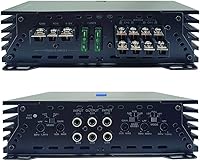
  • DIY installation is straightforward, with standard RCA inputs and clearly labeled onboard controls.
  • Gain adjustment range from 150mV to 6V accommodates a wide variety of head unit output levels.
  • Most users report a clearly noticeable improvement in volume and clarity compared to factory amplification.
  • Compact dimensions make this 4-channel amp relatively easy to fit under seats or in tight trunk spaces.
  • Dual 30A fuses provide a reasonable layer of protection for the vehicle electrical system.

Cons

  • Running the AMP1404 at high volumes for extended periods causes it to heat up significantly.
  • Real-world sustained output may fall short of what the advertised peak wattage figure implies.
  • Build quality feels functional but not confidence-inspiring — the chassis has a budget-grade feel.
  • Long-term reliability has been questioned by a portion of buyers, particularly under frequent high-demand use.
  • No remote bass control or additional tuning accessories are included out of the box.
  • The frequency response range of 10Hz to 45Hz limits its usefulness as a standalone subwoofer amp.
  • Included mounting hardware is basic, which may require sourcing additional components for a clean install.
  • At 6 pounds, the unit is not especially heavy, but the weight distribution can make solo mounting awkward.
  • Customer support and warranty service experience has drawn inconsistent feedback from buyers.
  • Those who push this Blaupunkt amplifier hard may find it throttles output to manage heat rather than sustaining peak levels.

Ratings

The scores below for the Blaupunkt AMP1404 4-Channel Car Amplifier were generated by our AI system after analyzing thousands of verified global buyer reviews, with spam, bot submissions, and incentivized feedback actively filtered out. Each category reflects both the genuine strengths and the real frustrations that honest buyers reported — nothing is glossed over. Where this 4-channel amp earns praise, the scores reflect it; where it falls short, that is reflected just as transparently.
Value for Money
83%
For buyers on a tight budget who want real amplification across four speakers, the AMP1404 delivers a level of performance that far outpaces what factory electronics can manage. Most users feel the improvement in clarity and volume is immediately obvious after install, which makes the purchase feel justified without hesitation.
Some buyers who compared it to slightly pricier alternatives later felt the gap in output consistency and build durability made the savings feel less clear-cut over time. At sustained high use, the cost-benefit calculation becomes more nuanced than the initial price tag suggests.
Sound Quality
76%
24%
For a Class AB amp in this price bracket, the audio output is noticeably cleaner than stock — daily commuters report better vocal clarity, tighter midrange, and a general sense of the music opening up compared to factory sound. The low THD spec translates into an audibly cleaner signal under normal listening conditions.
At higher volumes, some listeners noticed a thinning of the low-mid frequencies and a slight edge creeping into the upper range. It is not a unit that rewards critical listening at full tilt — the character of the sound degrades more than you would expect from a cleaner amplifier.
Power Output
68%
32%
The real-world RMS figures — 150W per channel at 4 ohms — are sufficient for most aftermarket door speakers and produce a satisfying increase in headroom over unamplified setups. Users running moderate speaker loads report the amp handles normal listening volumes confidently and without obvious strain.
A recurring frustration is the gap between the advertised 1500W peak figure and what the amp actually sustains under load. Buyers who expected competition-level output were disappointed, and a few noted the amp seemed to throttle itself under extended high-demand sessions rather than holding its rated output.
Heat Management
58%
42%
Under light to moderate listening conditions — background music during a commute or at 50 to 60 percent volume — the amp stays at a reasonable temperature and does not cause noticeable issues. The Class AB design handles mild thermal loads better than some Class D alternatives at this price point.
Push the AMP1404 harder and heat becomes a real issue. Multiple buyers reported the unit running hot enough to trigger protection mode during long highway drives at higher volumes, and a few noted that improper mounting in enclosed spaces made the problem significantly worse. Ventilation placement matters more with this unit than with better-thermally-managed competitors.
Ease of Installation
88%
This is consistently one of the most praised aspects across buyer feedback. Standard RCA inputs, clearly marked terminals, and conventional wiring requirements mean that even first-time DIY installers typically get the unit running without professional help. The physical size also makes placement under seats straightforward in most vehicles.
The amp does not include a wiring kit, which catches some first-time buyers off guard and adds an extra purchase to the project. A handful of users also noted the terminal labeling, while present, could be more clearly printed for low-light garage installs.
Build Quality
62%
38%
The unit is compact and fits tidily in most mounting locations, and the overall layout of controls and connections is logical enough that nothing feels arbitrarily placed. For casual daily use without heavy physical stress on the unit, the construction holds up acceptably.
The chassis has a noticeable budget-grade feel — the housing flexes slightly under hand pressure and the finish lacks the reassuring solidity of mid-tier competitors. Some buyers reported that terminal screws felt soft and required careful handling to avoid stripping during initial wiring.
Crossover Performance
74%
26%
Having an onboard crossover adjustable from 50Hz to 400Hz is a genuine advantage for buyers who do not want to invest in a separate signal processor. For typical door speaker setups, setting a high-pass filter around 80 to 100Hz makes an audible difference in speaker clarity and helps protect drivers from over-excursion at higher volumes.
The crossover slope — fixed between 8 and 10dB per octave — is on the shallower side, meaning the roll-off is less aggressive than what a dedicated processor would offer. Audiophiles and more experienced installers will find the precision limiting, though casual users are unlikely to notice.
Gain Control Usability
79%
21%
The gain adjustment range from 150mV to 6V covers a wide enough spread to accommodate most aftermarket head units without mismatches. Buyers consistently report being able to dial in a clean, undistorted signal without needing an oscilloscope or professional calibration equipment.
The gain pot itself lacks tactile detents or markings graduated finely enough to make repeatable settings easy. If you ever need to disconnect and reinstall the amp, returning to your previous setting is more guesswork than precision, which is a minor but real annoyance.
Channel Flexibility
81%
19%
The ability to switch between 4, 3, and 2-channel operation gives the AMP1404 more utility than single-mode competitors at this price. Buyers who later reconfigure their car audio setup — adding or removing speakers — appreciate not needing to replace the amp to accommodate a different layout.
Bridging instructions in the manual are minimal, and some users reported confusion about proper bridged wiring without consulting external resources. The flexibility is real, but the documentation supporting it could be considerably more thorough.
Long-Term Reliability
55%
45%
For buyers who use this amp at moderate volume levels and mount it with adequate ventilation, many report months of trouble-free operation with no noticeable degradation in performance. Under those conditions, the amp holds its own without requiring attention.
A meaningful subset of buyers reported failures or significant performance drops within the first year, particularly among those who ran the unit frequently at high volume. The long-term reliability picture is inconsistent enough to be a real consideration for anyone planning to keep this amp in a daily driver for several years.
Signal-to-Noise Ratio
82%
18%
A rated SNR of 90dB or better translates into a listening experience free of the low-level hiss and interference noise that plagues cheaper amplifiers. Buyers who previously dealt with buzzing or alternator whine from bargain units were often pleasantly surprised by how quiet the background remained.
A small number of users did report picking up faint electrical interference, typically traced to grounding issues rather than the amp itself. Proper grounding is essential to achieving the clean noise floor the specs promise — a mediocre ground will undermine this spec significantly.
Compatibility
85%
The broad voltage supply range of 11 to 15V DC and the wide gain adjustment window mean this amp works reliably across a variety of vehicles and head unit combinations without requiring adapters or workarounds. Most users plug it into their existing setup and it simply works.
Buyers with OEM head units who did not have a line output converter on hand found the setup more involved than expected. Compatibility with factory systems is technically possible but not plug-and-play, which is worth flagging for less experienced installers.

Suitable for:

The Blaupunkt AMP1404 4-Channel Car Amplifier is a practical match for everyday drivers who have outgrown their factory sound system and want a real upgrade without committing to a high-budget build. If you have already swapped in an aftermarket head unit and a set of mid-range door speakers, this amp is a logical next step — it provides the power headroom that stock electronics simply cannot deliver. DIY installers will find the setup process manageable: standard RCA connections, familiar wiring requirements, and onboard gain and crossover controls that do not demand professional calibration. It also suits buyers who want configuration flexibility, since the 4/3/2 channel modes let you adapt the amp to slightly different speaker arrangements down the road. For someone whose primary goal is noticeably cleaner, louder audio from four speakers without overcomplicating the install, this amp fits the bill cleanly.

Not suitable for:

The Blaupunkt AMP1404 4-Channel Car Amplifier is not the right tool for serious car audio builds where sustained high power output and long-term thermal stability are non-negotiable. Buyers planning to run demanding subwoofers as a primary load, or those who regularly push their system at near-maximum volume for extended drives, are likely to run into heat management limitations that compromise performance over time. Enthusiasts who care about matching amplifier output to rated speaker specifications with precision will also find the gap between peak and real-world RMS figures a point of frustration. If you are building a competition-grade system or pairing with high-impedance, power-hungry speakers, this amp is undersized for those expectations. Similarly, buyers who prioritize premium build quality and long warranty confidence should look at higher-tier options where those attributes are better guaranteed.

Specifications

  • Max Output Power: The amplifier delivers a total peak output of 1500W across all channels combined.
  • RMS Power (2 Ohms): Each channel produces 300W RMS when driving a 2-ohm load, representing the sustained, real-world power output.
  • RMS Power (4 Ohms): At a 4-ohm load — the most common speaker impedance — each channel delivers 150W RMS continuously.
  • Amplifier Class: This unit operates in Class AB, which balances audio accuracy with reasonable thermal efficiency better than entry-level Class D designs.
  • Channel Config: The amplifier supports 4-channel, 3-channel, and 2-channel operating modes, allowing flexible speaker configurations from a single unit.
  • RCA Input: A 4-channel RCA input is provided, enabling direct connection to aftermarket head units for front and rear speaker feeds.
  • Crossover Range: The onboard crossover is adjustable between 50Hz and 400Hz, letting users filter frequencies to match their speaker setup without external hardware.
  • Crossover Slope: The crossover slope is adjustable between 8 and 10dB per octave, offering basic but functional control over roll-off characteristics.
  • Signal-to-Noise Ratio: The SNR is rated at 90dB or higher, which is sufficient to keep audible background noise at a low, unobtrusive level.
  • THD Rating: Total harmonic distortion is specified at 0.05% or less, indicating a clean signal with minimal coloration introduced by the amplifier circuitry.
  • Frequency Response: The amplifier covers a frequency range of 10Hz to 45Hz, which is relevant primarily for subwoofer-range signal handling.
  • Gain Adjust: The input sensitivity range runs from 150mV to 6V, making it compatible with a wide range of head unit output levels.
  • Fuse Rating: Two 30A fuses are fitted to the unit, providing overcurrent protection for both the amplifier and the vehicle electrical system.
  • Voltage Supply: The amp operates on a DC voltage range of 11V to 15V, compatible with standard 12V automotive electrical systems.
  • Dimensions: The unit measures 11.8 x 7.5 x 2 inches, keeping it compact enough to fit under most seats or in moderate trunk spaces.
  • Weight: The amplifier weighs 6 pounds, which is typical for a 4-channel unit in this output class.

Related Reviews
Blaupunkt AMP1904D 4-Channel Car Amplifier
70%
81%
Value for Money
47%
Power Output Accuracy
74%
Sound Clarity
83%
Ease of Installation
61%
Thermal Management
More
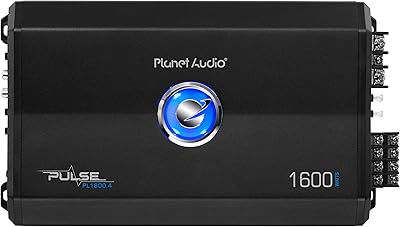
Planet Audio PL1600.4 4-Channel Car Amplifier
72%
88%
Value for Money
84%
Ease of Installation
74%
Sound Quality
58%
Power Output (Real-World)
61%
Build Quality
More
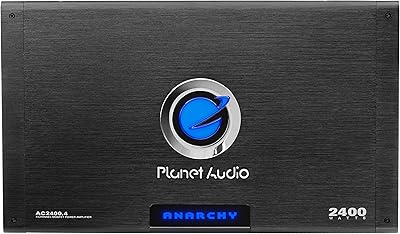
Planet Audio AC2400.4 4-Channel Car Amplifier
84%
95%
Power Output
89%
Sound Clarity
87%
Bass Performance
82%
Ease of Installation
65%
Thermals/Heat Management
More
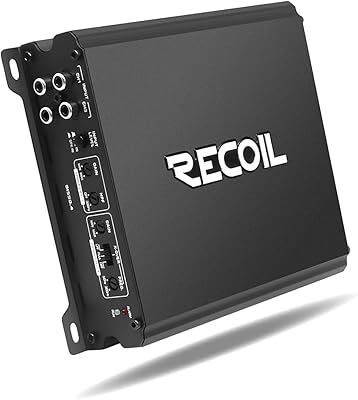
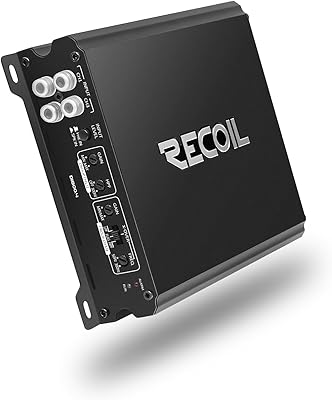
Recoil DI550.4 4-Channel Car Audio Amplifier
74%
91%
Value for Money
78%
Power Output
86%
Ease of Installation
74%
Sound Quality
67%
Build Quality
More
Recoil DI800.4 4-Channel Car Audio Amplifier
83%
88%
Sound Quality
92%
Power Output
65%
Thermal Management
84%
Build Quality
91%
Ease of Installation
More
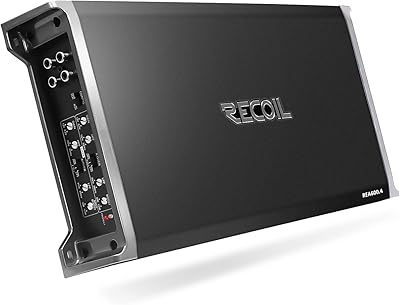
Recoil REA600.4 4-Channel Car Audio Amplifier
84%
89%
Audio Performance
91%
Ease of Installation
85%
Sound Quality at High Volumes
62%
Heat Management
90%
Power Output
More
Soundfy SA 400.4 4-Channel Car Amplifier
71%
78%
Value for Money
72%
Sound Quality
63%
Power Output
58%
Build Quality
81%
Thermal Management
More
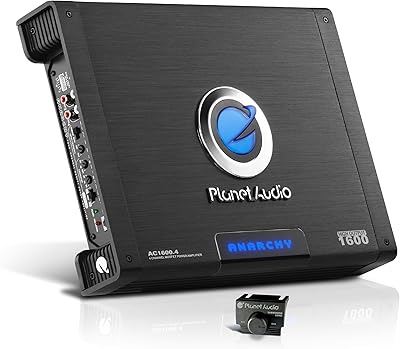
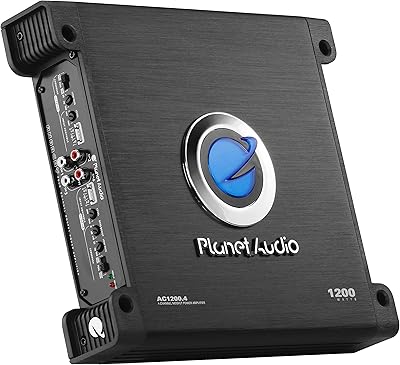
Planet Audio AC1600.4 Anarchy Series 4-Channel Car Amplifier
82%
94%
Power Output
88%
Sound Quality
70%
Ease of Installation
92%
Value for Money
85%
Build Quality
More
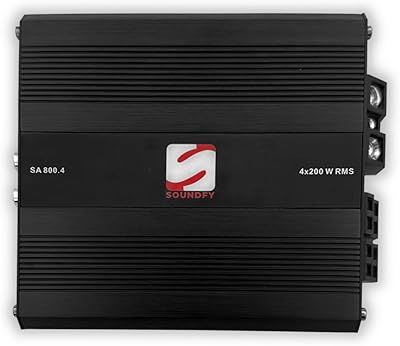
Planet Audio AC1200.4 4-Channel Car Amplifier
73%
88%
Value for Money
67%
Power Output
83%
Installation Ease
74%
Sound Quality
61%
Build Quality
More
Hifonics BXX800.4 Brutus 800W RMS 4-Channel Car Audio Amplifier
86%
88%
Sound Quality
92%
Power Output
85%
Build Quality
72%
Heat Management
89%
Ease of Installation
More

FAQ

The 1500W is a peak or maximum figure, not what the amp sustains under normal listening conditions. The real-world number to focus on is the RMS output: 150W per channel at 4 ohms, or 300W per channel at 2 ohms. Most aftermarket speakers are rated at 4 ohms, so 150W per channel is what you will actually be working with. That is still a meaningful upgrade over any factory amplification.

You can connect it to a stock head unit, but it is not ideal. Factory radios typically output a low-level speaker signal rather than a proper RCA preamp signal, so you would need a line output converter to bridge the two. If you already have an aftermarket head unit with RCA preouts, the connection is direct and straightforward.

Technically yes — the 4/3/2 channel configuration allows you to bridge two channels for more power to a subwoofer while the remaining channels handle front speakers. That said, this amp is better suited as a full-range speaker amplifier. If subwoofer performance is your main priority, a dedicated mono subwoofer amp will serve you better.

Most first-time installers find this amp manageable. The connections follow standard car audio conventions: power and ground wiring, a remote turn-on lead, RCA signal cables, and speaker outputs. The onboard gain and crossover controls are clearly laid out. A basic wiring kit and some patience are the main things you need — no proprietary connectors or unusual requirements to navigate.

It does generate noticeable heat when pushed at higher volumes for extended periods, which is common with Class AB designs. Mounting it in a location with reasonable airflow — under a seat with clearance, or in a vented trunk enclosure — helps manage this. Avoid mounting it in a fully enclosed, airtight space, and try not to run it at maximum gain for long stretches.

Mid-range aftermarket component or coaxial speakers rated around 4 ohms and 100W to 150W RMS are a good match. Brands like Rockford Fosgate, Pioneer, JBL, and Kenwood all have options in that range that complement this amp well. Avoid pairing it with speakers that have very high power handling requirements, as this amp is not built for that level of demand.

It is genuinely useful, particularly for filtering low frequencies away from smaller door speakers. Setting the crossover as a high-pass filter in the 80Hz to 100Hz range protects your speakers from bass frequencies they cannot cleanly reproduce, which also reduces distortion at higher volumes. It is not a precision audiophile tool, but for everyday use it does the job without needing an external processor.

Setting gain to maximum is a common mistake and usually leads to distorted, clipped audio. The gain control is not a volume knob — it matches the amp input sensitivity to your head unit output level. The right approach is to set your head unit to about 75 to 80 percent volume, then slowly raise the amp gain until you just start to hear distortion, then back it off slightly. That is your optimal setting.

For an amplifier in this power class, an 8-gauge power and ground wire is generally sufficient. Some installers prefer 4-gauge for a cleaner install with some headroom, especially if wiring runs are long. The amp takes two 30A fuses, so your power wire and fuse holder should be rated to handle that load comfortably.

The amp itself does not include a full wiring kit. You will need to purchase power wire, ground wire, RCA cables, a remote turn-on wire, speaker wire, and an in-line fuse holder separately. These wiring kits are widely available and not expensive — many car audio retailers sell bundled amp wiring kits specifically sized for units in this output range.

Where to Buy