Overview

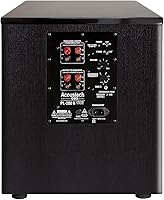
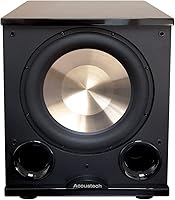
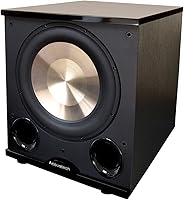
The BIC America PL-200 II 12-inch Powered Subwoofer has earned a quiet but consistent following among home theater builders who want genuine bass performance without spending flagship money. Its defining traits are a front-firing 12-inch driver paired with a BASH amplifier — a technology designed to run cool and efficient while still delivering dynamic, low-distortion output. The cabinet sits on the floor and isn't small, but the dual flared ports give it real flexibility in where you can position it. This isn't a boutique sub, but it competes seriously in its tier.
Features & Benefits

The BASH amplifier — short for Bandwidth Allocated Subwoofer Headroom — is a hybrid design that blends switching and linear amplification. In practice, it means the amp runs efficiently and stays cool even during extended listening sessions, while still having enough headroom for sudden loud bass transients. The 12-inch poly-injected woofer digs down to 21 Hz, which is genuinely deep — you'll feel it in action scenes and bass-heavy tracks, not just hear it. Dual flared front ports reduce port noise and allow positioning away from walls. Adjustable crossover controls make blending it with your main speakers reasonably straightforward.

Best For

This BIC subwoofer makes the most sense for someone building or upgrading a 5.1 home theater in a medium-sized room — a living room or dedicated viewing space up to around 2,000 square feet. It handles cinematic bass with ease and also tracks well with music, whether that's the tight punch of hip-hop or the textured low end of acoustic jazz. People stepping up from a soundbar or a cheap entry-level sub will notice an immediate, obvious difference. The front-port design is especially practical for anyone who can't push the cabinet flush against a wall.

User Feedback

Owners of the PL-200 II consistently point to its bass depth and clarity as the standout quality — many say it outperforms expectations at its price point. Build quality draws more mixed reactions: the cabinet feels solid and well-constructed, but the overall fit and finish is less refined than pricier competitors. A recurring concern is the crossover calibration process; dialing in the right blend with a given set of speakers takes patience, and first-time subwoofer buyers occasionally find it frustrating. On placement, owners confirm the front-port design genuinely works well away from walls, which rear-ported subs simply cannot match.

Pros

  • Bass extension reaches genuinely low frequencies, delivering physical impact during action scenes and bass-heavy tracks.
  • The BASH amplifier runs cool even during long sessions, reducing heat-related wear over years of use.
  • Front-firing dual ports allow flexible room placement, including positions away from walls where rear-ported subs struggle.
  • Buyers upgrading from a soundbar describe the performance difference as immediate and obvious.
  • Adjustable crossover controls give enough range to blend well with both bookshelf and floor-standing speakers.
  • Wired RCA connectivity works with virtually every AV receiver on the market without compatibility headaches.
  • This powered sub handles both cinematic bass and musical low-end with reasonable versatility across genres.
  • Long-term owners frequently report years of reliable operation without component failure.
  • The cabinet does not rattle or resonate at high volumes, which is a common weakness in cheaper alternatives.

Cons

  • Crossover calibration has a real learning curve — first-time subwoofer owners often misconfigure it and blame the hardware.
  • Cabinet finish and driver materials look and feel below average for the price when examined up close.
  • No wireless input or app control, which feels dated compared to similarly priced newer competitors.
  • Port noise and some cabinet vibration can appear when the volume dial is pushed to its upper limits.
  • The physical footprint is larger than many buyers anticipate, making discreet placement in small apartments difficult.
  • Stereo-only music setups without a dedicated LFE output require extra configuration effort to integrate cleanly.
  • Very large rooms expose the limits of the amplifier, with bass presence becoming noticeably thinner.
  • The crossover dial lacks precise markings, making it hard to reliably return to a previously dialed-in setting.

Ratings

The BIC America PL-200 II 12-inch Powered Subwoofer has been evaluated using AI-driven analysis of verified buyer reviews collected globally, with spam, bot-generated, and incentivized submissions actively filtered out. The scores below reflect a realistic composite of real ownership experiences — covering everything buyers love about this powered sub and the friction points they actually run into. Nothing has been smoothed over; the strengths and the frustrations are both represented honestly.
Bass Depth & Extension
91%
Buyers are consistently impressed by how low this sub reaches in real listening conditions. During action films and bass-heavy music tracks, the low-frequency extension is tangible — felt as much as heard — which is genuinely uncommon at this price tier.
In very large rooms above roughly 2,500 square feet, the sub can start to sound thin at the lowest frequencies. A few users noted that pushing it hard in expansive spaces reduces the sense of effortless depth it delivers in medium-sized rooms.
Amplifier Performance
87%
The BASH amplifier stays impressively cool during long movie nights and extended listening sessions, which owners appreciate. Its headroom during sudden dynamic peaks — explosions, drops in electronic music — is strong, with little audible strain or compression.
Some buyers who switched from class-D amplified subs felt the BASH design sounds slightly less punchy on very fast bass transients. It is a subtle difference, but more experienced listeners do occasionally flag it in comparisons.
Value for Money
88%
Relative to what comparable wattage and driver size cost from other brands, the PL-200 II consistently lands in the sweet spot. Buyers upgrading from soundbars or budget subs describe the jump in quality as immediately and obviously worth the spend.
Buyers comparing it against a handful of newer competitors at a similar price point sometimes feel the feature set is aging. There is no wireless connectivity and no app control, which some buyers factor into their value assessment.
Build Quality
74%
26%
The cabinet itself feels dense and well-constructed — it does not rattle or resonate at high volumes, which is a common failure point on cheaper subs. The overall impression when you first unbox it is of something sturdy and purposefully made.
The driver surround and cabinet finish are functional rather than premium. Several buyers noted that up close, the materials look and feel a tier below the asking price, especially when compared side-by-side with higher-end alternatives in a store setting.
Placement Flexibility
83%
The dual front-port design is a genuine practical advantage. Buyers in furnished living rooms who cannot keep the sub far from walls report that it performs without the boomy, one-note bass that plagues rear-ported subs in similar positions.
Despite the front-port flexibility, the cabinet footprint is not small. A few apartment owners found the physical size harder to tuck away than expected, even when the acoustic placement options were satisfactory.
Setup & Calibration Ease
61%
39%
For buyers with prior subwoofer experience, the adjustable crossover and volume controls are intuitive and give enough range to blend well with a wide variety of satellite speakers. Getting a good result does not require any external equipment.
First-time subwoofer owners frequently mention frustration during the crossover calibration process. Without guidance, it is easy to set the crossover point too high, resulting in muddy bass that gets blamed on the sub rather than the settings.
Sound Clarity & Definition
79%
21%
Acoustic bass lines in jazz recordings and lower-register cello passages come through with reasonable definition — it does not just produce a wall of undifferentiated low-end noise. Music listeners specifically call this out as a strength versus cheaper competitors.
At very high volume levels, some buyers report a slight looseness in the bass — notes blend together rather than staying tight and articulate. This is most noticeable on fast bass guitar runs or quick electronic kick patterns.
Crossover Adjustability
72%
28%
The onboard crossover range is wide enough to work with both large floor-standing speakers and smaller bookshelf satellites. Buyers running 5.1 setups with varied speaker sizes appreciate having real control rather than a fixed crossover point.
The crossover dial itself lacks fine-grained markings, making it difficult to return to a specific setting if you adjust it experimentally. A few buyers with receivers that also handle crossover settings found the interaction between the two controls confusing.
Volume & Dynamic Range
84%
The PL-200 II gets genuinely loud without sounding stressed at moderate-to-high volume levels. Buyers using it for movie nights in mid-sized rooms say it fills the space convincingly during action-heavy content without pushing the amp into obvious distortion.
At the very top end of the volume dial, a small number of buyers noticed increased port noise and some cabinet vibration. Staying below maximum output largely eliminates the issue, but it does put a practical ceiling on the loudest listening levels.
Low-Frequency Impact (LFE)
86%
Connected to the LFE channel output of an AV receiver, this powered sub handles movie soundtracks with real authority. Explosions, rumbling engines, and scored bass swells all translate with physical presence that owners describe as a meaningful upgrade from passive solutions.
A small number of buyers using two-channel stereo setups without a dedicated LFE output found integration less straightforward. The sub is clearly optimized for home theater use, and music-only stereo systems require more careful configuration to get a natural result.
Heat Management
89%
Extended four-hour movie marathons and all-day background music sessions produce almost no heat buildup on the cabinet exterior. The BASH amplifier design runs noticeably cooler than many class-A/B designs in comparable subs, which gives owners genuine confidence in long-term reliability.
There is no active cooling or ventilation feedback, so users have no way to monitor amplifier temperature during heavy use. While overheating has not been a widespread complaint, the lack of any thermal indicator means issues would not be obvious until they escalate.
Aesthetic & Form Factor
63%
37%
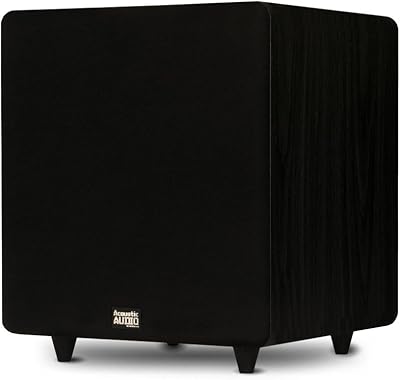
The all-black rectangular cabinet is neutral enough to blend into most living room and home theater setups without drawing attention. Buyers who want a sub that disappears visually rather than becoming a focal point appreciate the understated styling.
The industrial, boxy appearance does not suit every room aesthetic. Buyers with modern or minimalist interiors frequently mention that the sub looks out of place, and the absence of any design refinement makes it feel more utilitarian than premium.
Long-Term Reliability
77%
23%
Many owners have reported using the PL-200 II reliably for several years without component failure. BIC America has a track record in the subwoofer category, and the limited warranty offers some reassurance for buyers concerned about longevity.
A subset of longer-term owners have reported amplifier channel issues after several years of heavy use. These cases are not the majority experience, but they appear with enough regularity in reviews to be worth noting for buyers planning a permanent installation.
Compatibility with AV Receivers
82%
18%
Wired connectivity via RCA inputs is universally compatible with virtually every AV receiver on the market. Buyers pairing it with mid-range Denon, Yamaha, and Onkyo receivers report clean, reliable signal transfer without any grounding or noise issues.
The absence of any wireless input or auto-sensing standby calibration means buyers who want a fully automated setup experience will find it more manual than modern competitors. It works, but it demands a more hands-on approach to configuration.

Suitable for:

The BIC America PL-200 II 12-inch Powered Subwoofer is an excellent fit for home theater builders who want real, room-filling bass without crossing into premium price territory. It performs best in medium-sized rooms — think a dedicated viewing space or a living room where movies and music share equal billing — where its 12-inch driver can pressurize the space convincingly. Buyers stepping up from a soundbar or a flimsy entry-level sub will notice an immediate and obvious improvement in how bass-heavy content feels, not just sounds. The front-port design is a legitimate practical advantage for anyone working with a furnished room where pulling the cabinet away from the wall is not realistic. Music listeners who move between genres — hip-hop, electronic, acoustic, cinematic scores — will appreciate that this powered sub handles varied bass character reasonably well rather than excelling at only one type. It also integrates cleanly with virtually any AV receiver via standard wired RCA, making it a low-friction addition to an existing 5.1 system.
Not suitable for:

Buyers with large, open-plan spaces should think carefully before committing to the BIC America PL-200 II 12-inch Powered Subwoofer, as it can start to lose authority and depth in rooms that push past roughly 2,500 square feet. Audiophiles who prioritize cabinet finish and premium materials will likely find the build quality underwhelming up close — it is engineered to perform, not to impress visually. Those expecting a plug-and-play experience with no calibration effort may also be disappointed; getting the crossover blend right with your existing speakers takes patience, and first-timers can easily end up with muddy, indistinct bass if they rush the setup. Buyers who want wireless connectivity, app control, or automatic room-correction features will find the PL-200 II behind the times — it is a wired, manual-adjustment sub in an era where many competitors offer smarter integration. If you are building a high-end two-channel stereo setup rather than a surround system, there are better-matched options available at a similar price point.

Specifications

  • Driver Size: The subwoofer uses a 12-inch poly-injected long-throw woofer with a high-power magnet and extended excursion surround for deep, controlled bass movement.
  • Amplifier Type: A built-in BASH (Bandwidth Allocated Subwoofer Headroom) amplifier powers the driver, combining switching and linear amplification for efficient, low-distortion output.
  • Continuous Power: The amplifier delivers 250 watts RMS of continuous power, providing stable output during extended listening sessions without thermal throttling.
  • Peak Power: The BASH amplifier is rated at 1,000 watts peak, giving the sub sufficient headroom to handle sudden dynamic bass transients without audible strain.
  • Frequency Response: The PL-200 II covers a frequency range of 21 Hz to 200 Hz (±3 dB), making it capable of reproducing the deepest bass notes in both music and film soundtracks.
  • Port Design: Dual flared front ports reduce port turbulence and allow the cabinet to be positioned away from walls without the bass bloat typical of rear-ported designs.
  • Dimensions: The cabinet measures 19.5″ deep by 17.25″ wide by 14.85″ tall, making it a mid-sized floor-standing unit suited to living rooms and dedicated theater spaces.
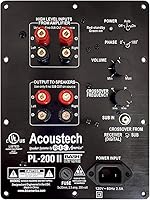
  • Connectivity: Input is via wired RCA connection, compatible with the subwoofer output (LFE) or stereo preamp outputs found on virtually all AV receivers.
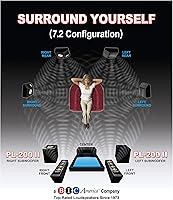
  • Surround Config: The unit is designed for use in 5.1 and similar multi-channel surround sound configurations as the dedicated low-frequency effects channel speaker.
  • Crossover Control: An onboard adjustable crossover control allows users to set the frequency at which the subwoofer takes over from the main speakers, enabling blending across varied speaker setups.
  • Volume Control: A dedicated onboard volume dial lets users calibrate the subwoofer output level independently of the AV receiver, providing fine-grained control over bass balance.
  • Mounting Type: The PL-200 II is a floor-standing unit and is not designed for wall or ceiling mounting; it sits directly on the floor with a stable rectangular base.
  • Power Source: The subwoofer is powered by a standard corded electric connection and does not support battery or wireless power operation.
  • Driver Material: The woofer cone is constructed from poly-injected material, chosen for its stiffness-to-weight ratio, which helps maintain accurate cone motion at high excursion levels.
  • Color & Finish: The cabinet is finished in black with a utilitarian rectangular profile designed to blend into standard home theater and living room environments.
  • Wireless Support: This powered sub has no built-in Bluetooth, Wi-Fi, or wireless audio capability; all audio input is handled exclusively through the wired RCA connection.
  • Included Items: The package includes the subwoofer unit and a printed user manual; no interconnect cables, remote control, or room correction microphone are included.
  • Warranty: BIC America provides a limited warranty covering manufacturing defects; buyers should confirm the exact warranty duration and terms directly with BIC America at the time of purchase.

Related Reviews
BIC America V-1220 12-Inch Powered Subwoofer
85%
88%
Bass Performance
90%
Ease of Integration
85%
Build Quality
92%
Value for Money
86%
Frequency Response
More
BIC Acoustech Elite Series PL-300 12-inch Powered Subwoofer
86%
93%
Bass Performance
88%
Build Quality
87%
Ease of Setup
85%
Connectivity Options
90%
Sound Clarity
More
Acoustic Audio PSW500-12 Powered 12-Inch LFE Subwoofer
82%
92%
Value for Money
88%
Bass Performance
85%
Ease of Setup
80%
Sound Quality
77%
Build Quality
More
Monoprice 109723 12-inch Powered Subwoofer
73%
83%
Bass Output
88%
Value for Money
67%
Sound Clarity
71%
Build Quality
91%
Ease of Setup
More
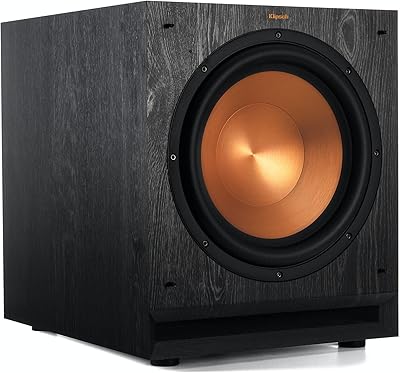
Klipsch SPL-120 Powered Subwoofer 12-inch
87%
92%
Bass Performance
89%
Sound Clarity
87%
Ease of Setup
91%
Value for Money
88%
Build Quality
More
BOSS Audio B12ES 12-Inch Powered Car Subwoofer
72%
88%
Ease of Installation
79%
Bass Output & Impact
83%
Value for Money
63%
Build Quality & Materials
81%
Remote Bass Control Usability
More
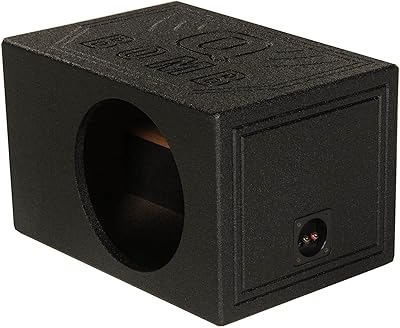
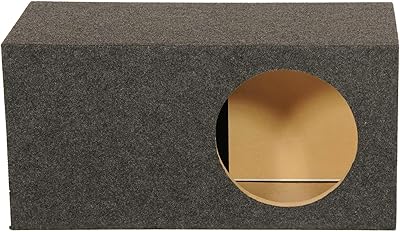
QPower QBOMB12VL 12-inch Vented Subwoofer Enclosure
78%
88%
Value for Money
82%
Build Quality
76%
Bass Performance
91%
Ease of Installation
84%
Exterior Finish
More
BIC America V-80 8″ 100 Watt Powered Subwoofer
83%
86%
Sound Quality
80%
Bass Performance
88%
Ease of Setup
92%
Value for Money
85%
Build Quality
More
Q Power HD112VL 12-Inch Ported Subwoofer Enclosure
75%
88%
Value for Money
79%
Bass Performance
67%
Build Quality
86%
Fitment & Compatibility
71%
Port Design & Tuning
More
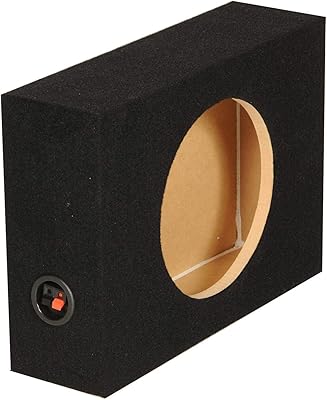
Q Power Shallow Single 12-Inch Sealed MDF Truck Subwoofer Enclosure Box
86%
85%
Bass Performance
90%
Build Quality
88%
Durability
93%
Ease of Installation
91%
Space Efficiency
More

FAQ

You need a receiver or amplifier with a dedicated subwoofer preamp output — typically labeled SUB OUT or LFE — to get the best results. Most modern TVs do not have this output, so connecting it directly to a television is generally not practical. An AV receiver is the standard and recommended pairing.

The physical connection is straightforward — one RCA cable from your receiver to the sub. The trickier part is calibrating the crossover and volume dials on the back of the unit to blend naturally with your main speakers. If your receiver has an auto-calibration feature like Audyssey or MCACC, run that first and let it handle the heavy lifting; otherwise, plan for some trial-and-error listening time.

The front-firing, dual-port design is specifically friendlier to corner and near-wall placement than rear-ported alternatives. That said, corner placement does tend to amplify bass, so you may need to dial back the volume control slightly to avoid an overpowering low end. Most owners find a spot along a front wall, away from the corner, gives the cleanest result.

It handles music genuinely well for its class. The frequency extension and driver control are sufficient for bass guitar, kick drums, and electronic music without sounding one-dimensional. It is not tuned exclusively for cinematic boom — owners who use it primarily for music tend to be satisfied, particularly those listening to hip-hop, jazz, or rock.

It performs most convincingly in rooms up to roughly 2,000 to 2,200 square feet. In smaller dedicated theater rooms or medium-sized living rooms, it pressurizes the space with authority. In very large, open-plan spaces, you may find it struggles to fill the room with the same depth and impact it delivers in a contained environment.

BASH is a hybrid design that runs more efficiently than traditional linear amplifiers, meaning it generates less heat and wastes less power during normal operation. In practice, this translates to a cooler-running amp over long sessions and a longer expected service life. The tradeoff is that some listeners feel it sounds slightly less immediate on very fast bass transients compared to high-quality class-D designs, though the difference is subtle for most people.

The PL-200 II has an auto-sensing standby function that activates the sub when it detects an audio signal and powers it down after a period of inactivity. In practice, some users find the auto-on feature slightly slow to wake up at the start of a listening session, so a small number of owners simply leave it in always-on mode via the power switch.

Yes, if your AV receiver has dual subwoofer outputs or you use a Y-splitter on a single subwoofer output, you can run two units simultaneously. Dual sub configurations tend to smooth out bass response across the room and are a popular upgrade path for home theater enthusiasts who want more even coverage in larger spaces.

At moderate-to-high volume levels it handles itself well — no obvious distortion or strain. Pushing the volume dial to its upper range does introduce some port noise and minor cabinet vibration, so most owners find a sweet spot at around 75 to 80 percent of maximum output where it performs cleanly and still gets impressively loud for a room-filling experience.

The PL-200 II has been on the market since 2017 and has a generally solid reliability record among buyers. The BASH amplifier running cool is a real longevity advantage. A subset of long-term owners have reported amplifier issues after several years of heavy daily use, which is worth knowing, but this is not the dominant experience. Keeping it in a ventilated space and not consistently running it at maximum volume are sensible precautions.

Where to Buy