Andonstar AD266S 7-Inch 5-Lens Digital Microscope
Andonstar AD266S 7-Inch 5-Lens Digital Microscope — image 1
Andonstar AD266S 7-Inch 5-Lens Digital Microscope — image 2
Andonstar AD266S 7-Inch 5-Lens Digital Microscope — image 3
Andonstar AD266S 7-Inch 5-Lens Digital Microscope — image 4
Andonstar AD266S 7-Inch 5-Lens Digital Microscope — image 5
Andonstar AD266S 7-Inch 5-Lens Digital Microscope — image 6
Andonstar AD266S 7-Inch 5-Lens Digital Microscope — image 7
Andonstar AD266S 7-Inch 5-Lens Digital Microscope — image 8
74%
26%

Overview

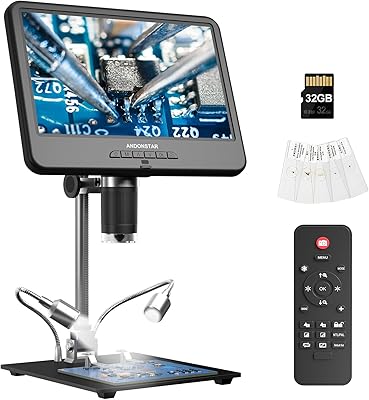
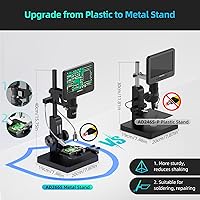
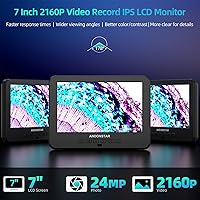
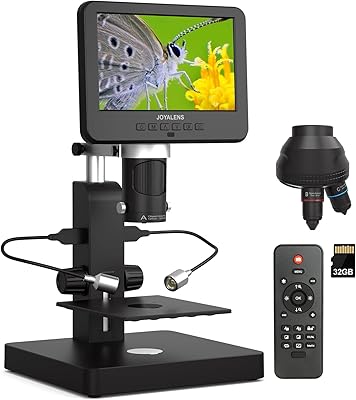
The Andonstar AD266S 7-Inch 5-Lens Digital Microscope is one of those rare tools that genuinely tries to replace a whole shelf of specialized equipment with a single device. It combines stereo, compound, and handheld microscope functionality into one relatively compact unit, which sounds ambitious — and it is. The built-in 7-inch LCD means you can start observing immediately without plugging anything into a computer, while the HDMI output lets you push the image to a larger display when detail really matters. Built around a metal stand, the unit feels more solid than most plastic-framed competitors at this price tier, making it a credible choice for serious hobbyists rather than casual toy buyers.

Features & Benefits

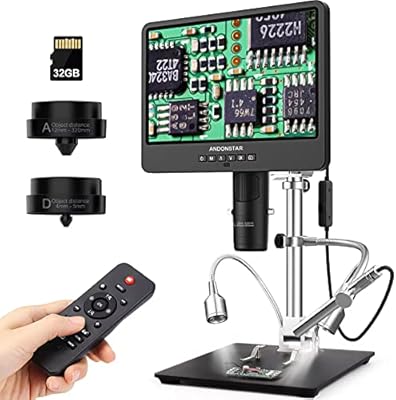
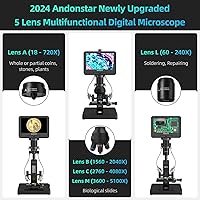
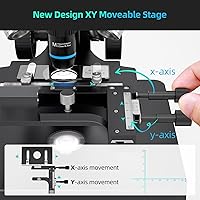
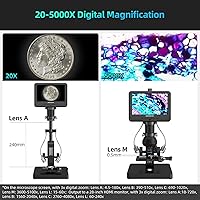
What sets the AD266S apart from simpler digital microscopes is the five-lens system, and understanding which lens does what matters before you buy. Lens A handles broad views — coins, plants, stones — while Lenses B, C, and M step through increasing magnification for biological slides, topping out around 5000x on-screen with digital zoom engaged. Lens L is dedicated to soldering and repair, with external LED lighting optimized for that purpose. The X-Y moveable stage is a genuine quality-of-life addition at this level, making slide navigation at high magnification far easier than fumbling with the specimen by hand. Video capture hits 2160P UHD, and PC connectivity adds measurement tools for Windows users.

Best For

This five-lens microscope hits a sweet spot for people who need real versatility without buying three separate tools. Biology students and teachers will appreciate the included slide kit and the range of magnification options for classroom or home study. Coin collectors get dedicated full-view coverage with Lens A, no awkward repositioning required. Repair technicians and electronics hobbyists benefit from the soldering-focused lens and the stable stand that does not wobble under hands-on work. It also makes a strong case as a long-term educational tool for kids — one that can grow from basic nature observation all the way to serious slide work as their curiosity develops.

User Feedback

Buyers generally respond well to the AD266S, with image clarity and lens variety drawing consistent praise. Most find the on-screen display sharp and genuinely useful, and the metal stand earns positive comments for reducing shake during detailed work. That said, the PC software setup has a noticeable learning curve — it is not always plug-and-play, and some users report minor frustrations getting the measurement tools to cooperate. A handful of reviewers noted that the included slide kit feels basic if you intend to do serious biological work long-term. Overall, the consensus leans positive: most feel this digital microscope punches above its weight compared to single-purpose alternatives at a comparable price.

Pros

  • Five distinct lenses cover biological slides, coin viewing, and electronics repair without swapping devices.
  • The built-in 7-inch LCD lets you start observing immediately, no laptop or monitor required.
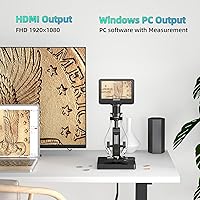
  • HDMI output makes it easy to share live views on a larger screen for group study or demonstrations.
  • The metal stand is noticeably more rigid than plastic-framed competitors, reducing shake at high magnification.
  • UHD 2160P video recording produces footage sharp enough to review details after the session.
  • The X-Y moveable stage makes navigating specimens at high magnification far less frustrating than repositioning by hand.
  • Dedicated bottom and external LED lighting systems are matched to the right lenses, improving usability straight out of the box.
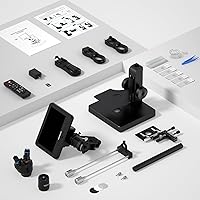
  • Includes five prepared biological slides, so first-time users can start exploring without sourcing specimens separately.
  • At its price point, the breadth of functionality genuinely competes with buying two or three separate tools.

Cons

  • The PC measurement software has a real learning curve and is not reliably plug-and-play for all Windows setups.
  • Mac users get no software support at all, which cuts off a significant portion of the measurement features.
  • Maximum 5000x magnification depends on digital zoom, so image quality at the extreme end is noticeably softer.
  • The included biological slide kit is thin — serious students will need to purchase additional prepared slides quickly.
  • At 7.48 pounds, this digital microscope is not something you move around casually between workspaces.
  • Five lenses means five sets of context to learn; the initial setup can feel overwhelming without careful reading of the manual.
  • No wireless or Bluetooth connectivity limits flexibility for users who prefer a cable-free workspace.
  • Some users report minor inconsistencies in LED brightness uniformity, particularly noticeable during high-magnification slide work.

Ratings

Our AI scoring engine analyzed verified global buyer reviews for the Andonstar AD266S 7-Inch 5-Lens Digital Microscope, actively filtering out incentivized, duplicate, and bot-generated submissions to surface what real users genuinely experience. The scores below reflect a balanced synthesis of consistent praise and recurring frustrations across thousands of purchase-verified interactions. Both the standout strengths and the honest pain points are weighted into every category without favoritism.

Image Clarity
83%
Most users are genuinely impressed by the sharpness they get on the built-in screen, particularly when using the mid-range biological lenses for slide work or Lens A for coin inspection. At moderate magnification levels, the 2160P output delivers crisp, detailed images that hold up well when pushed to an external monitor.
At extreme digital zoom levels, especially with Lens M pushed to its upper limit, softness and digital noise become noticeable enough to frustrate users expecting consistent sharpness throughout the entire magnification range. The gap between optical and digital zoom quality is real and catches some buyers off guard.
Lens Versatility
88%
Having five purpose-built lenses in one unit is the single most praised aspect across user reviews, particularly among buyers who previously juggled multiple tools for coin collecting, biology study, and electronics repair. The dedicated soldering lens with matched LED lighting stands out as a genuinely thoughtful design choice rather than a checkbox feature.
Switching between lenses takes time to get comfortable with, and a few users report that the lens labeling system is not immediately intuitive without reading the manual carefully first. For buyers expecting a quick plug-and-play experience, the five-lens learning curve can be an early source of frustration.
Build Quality
81%
19%
The metal stand is consistently called out as a step above what buyers expect at this price tier, with most users noting that vibration and wobble during high-magnification observation is significantly reduced compared to plastic-framed alternatives they had used previously. The overall construction feels purposeful and durable rather than flimsy.
While the stand itself earns praise, some users note that the lens housing connections feel slightly less precise than the stand quality implies, with minor play detectable when lenses are swapped repeatedly over time. A handful of buyers also flagged that the unit arrives heavier than anticipated, making repositioning between workspaces less convenient.
Value for Money
79%
21%
Buyers who do the math on what it would cost to buy a dedicated coin microscope, a biological slide setup, and a soldering inspection tool separately consistently land on this five-lens microscope as a financially sensible consolidation. The inclusion of five prepared slides and the functional HDMI output add tangible value beyond just the hardware itself.
Users who only need one specific function — pure biology work or pure electronics repair — sometimes feel the multi-tool pricing does not fully benefit them, since they are effectively paying for lenses they may rarely touch. The included slide kit also feels thin relative to the overall price, pushing serious biology users toward additional accessory purchases early on.
LCD Display
76%
24%
The 7-inch built-in screen is bright enough for comfortable viewing in a typical home lab or classroom environment and removes the need for any external device to get started, which most users find genuinely practical for quick observation sessions without setup overhead.
In brightly lit rooms or under direct overhead lighting, some users report that the screen washes out slightly, requiring adjustments to ambient lighting for comfortable extended viewing. The display size, while adequate, starts to feel limiting when reviewing fine specimen details that benefit from the larger HDMI monitor output.
HDMI Output
84%
The ability to push a live view to a 28-inch or larger monitor is a standout feature for group use, particularly in classroom settings or shared workshop environments where multiple people need to see the same specimen simultaneously. Users consistently describe the HDMI-connected image as noticeably sharper and more detailed than the built-in screen alone.
The HDMI cable is not included in the box, which catches a meaningful number of buyers off guard and requires an additional purchase before they can access this core feature. Setup on some older TVs and monitors also requires manual resolution matching that is not clearly explained in the included documentation.
PC Software
57%
43%
When the Windows software does connect correctly, users who need on-screen measurement tools for electronics inspection or specimen sizing find it genuinely useful, adding a layer of analytical capability that most consumer microscopes at this level do not offer at all.
Getting the software to cooperate is the single most complained-about aspect across user reviews, with reports of driver conflicts, inconsistent USB recognition, and a near-total absence of in-box setup guidance that makes the installation process feel unnecessarily opaque. Mac users are completely excluded, which is a significant omission for a device released in 2024.
Lighting System
77%
23%
The dual LED system — external lights for surface observation and bottom-facing lights for slide work — is purpose-matched to the lens set in a way that removes a lot of guesswork. Coin collectors and electronics users in particular find the external LED coverage clean and shadow-free during close inspection work.
A portion of users note uneven brightness distribution at the edges of the illumination field, particularly with the bottom lights during high-magnification slide observation, which can create slightly washed-out centers or darker peripheries. Independent brightness adjustment works, but finding the optimal setting for each lens combination takes trial and error.
X-Y Stage
74%
26%
Anyone who has tried to nudge a slide by hand under high magnification will immediately appreciate the X-Y stage, which brings a level of controlled specimen navigation that is rare at this price point and makes systematic scanning of biological samples noticeably less tedious.
The stage movement is functional but not silky — users who have worked with higher-end optical stages describe the action as slightly coarse, with minor jump or skip at very fine adjustment increments. For professional-level biological work, the stage precision falls short, though for home lab and educational use it holds up well enough.
Magnification Range
72%
28%
The breadth of the magnification range — from 4.5x on Lens A all the way up through the biological lens set — genuinely covers a wide variety of observation needs within one device, which is the core appeal of the multi-lens design and is well-executed across the practical mid-range of the spectrum.
The top-end 5000x figure is achievable only through combined digital zoom, and image quality at that level is not suitable for any kind of detailed analytical work, which leads to buyer disappointment when expectations are set by the headline specification rather than the realistic optical performance curve.
Setup & Ease of Use
68%
32%
The standalone operation mode — powering on, selecting a lens, and observing directly on the built-in LCD — is genuinely approachable for beginners and younger users, requiring minimal technical knowledge to get a clear image within the first few minutes of unpacking.
Once users move beyond basic standalone use into PC connectivity, HDMI output, or lens-specific lighting configuration, the experience becomes considerably more demanding, and the documentation does not scale proportionally to guide users through those more advanced setups with any real clarity.
Portability
61%
39%
The unit is self-contained enough that it can be moved between rooms or packed up for occasional transport, and the all-in-one design at least means there are fewer separate components to track compared to a traditional multi-device microscopy setup.
At 7.48 pounds with the metal stand, this is not a device that moves effortlessly between spaces, and the dimensional footprint — just over 16 inches tall — means it occupies meaningful desk real estate permanently. Buyers expecting a compact, easily relocated tool will find the physical presence more substantial than anticipated.
Accessory Completeness
63%
37%
The inclusion of five prepared biological slides is a thoughtful starting point that allows new users to validate the microscope's biological lens performance immediately without sourcing specimens separately, which lowers the barrier for first-time microscopy users considerably.
Beyond the slides, the accessory package feels noticeably sparse — no HDMI cable, no extended slide selection, and minimal supplementary tools for the soldering use case leave buyers piecing together additional purchases fairly quickly. For a device positioned as an all-in-one solution, the in-box completeness does not fully match that ambition.

Suitable for:

The Andonstar AD266S 7-Inch 5-Lens Digital Microscope is genuinely well-matched for curious, multi-interest buyers who do not want to purchase several specialized tools separately. Biology students and home educators will find real value in the slide-focused lens set and the included starter kit, which lowers the barrier to getting hands-on with specimens right away. Coin collectors benefit from the dedicated wide-view lens that captures an entire coin face without repositioning, something single-lens microscopes often struggle with. Electronics hobbyists and repair technicians will appreciate that the soldering lens comes with its own optimized external LED lighting, making PCB inspection and rework genuinely practical. Parents looking for a science tool that can scale with a child from basic nature exploration all the way to structured biological study will also find this a smart long-term investment rather than a throwaway beginner toy.

Not suitable for:

The Andonstar AD266S 7-Inch 5-Lens Digital Microscope is not the right call for buyers who need professional-grade optical clarity or research-level magnification accuracy. The advertised 5000x figure relies on digital zoom at maximum screen output, which means image quality degrades noticeably at the extreme end — this is not the same as true optical magnification, and anyone expecting lab-standard resolution at high zoom will be disappointed. Mac users should also know upfront that the PC measurement software is Windows-only, so the connectivity features are simply unavailable without a workaround. If you already own dedicated tools for soldering inspection or biological study and only need one function, a purpose-built single-lens microscope will likely outperform this five-lens setup in that specific area. Buyers who want a fully wireless or tablet-integrated workflow will also find the wired-only connectivity limiting.

Specifications

  • Brand: Manufactured by ShenZhen Andonstar Technology Co., Ltd under the Andonstar brand.
  • Model: The unit designation is AD266S, released to market in September 2024.
  • Screen: Features a built-in 7-inch LCD display for direct on-unit viewing without requiring an external monitor.
  • Resolution: Captures photos and video at up to 24MP and 2160P UHD quality.
  • Lenses: Includes five interchangeable lenses labeled A, B, C, M, and L, each optimized for a different observation task.
  • Magnification: On-screen magnification ranges from 4.5x with Lens A up to approximately 5100x with Lens M using 3x digital zoom.
  • HDMI Output: Supports HDMI output for connecting to external monitors up to 28 inches, expanding effective magnification range significantly.
  • PC Connectivity: Compatible with Windows PCs via USB, enabling photo capture, video recording, and on-screen measurement through bundled software.
  • Stand: Ships with a 15.5-inch metal biological stand designed to minimize vibration during high-magnification work.
  • Dimensions: The unit measures 7.9 inches long by 7.5 inches wide by 16 inches tall in its assembled configuration.
  • Weight: Complete unit weighs 7.48 pounds, reflecting the metal construction of the stand and body.
  • Lighting: Uses LED illumination with two systems: external LEDs for Lenses A and L, and bottom-facing LEDs for Lenses B, C, and M.
  • Stage: Equipped with an X-Y moveable stage that allows precise horizontal and lateral specimen positioning.
  • Included Slides: Comes with five prepared biological slides ready for immediate use out of the box.
  • Power: Operates at 5 volts, powered via a standard USB connection.
  • Storage Output: Supports direct photo and video saving to a memory card when used in standalone mode without a PC.
  • Video Format: Records UHD 2160P video files suitable for post-session review and sharing on external displays.
  • Material: Stand and primary body components are constructed from metal, with optical lens housings made from precision-grade materials.

Related Reviews
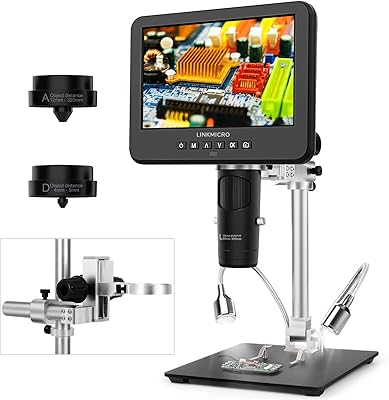
LINKMICRO LM246MS 3-Lens 7-Inch HDMI Digital Microscope
85%
88%
Image Quality
91%
Ease of Setup
85%
Build Quality
90%
Lens Versatility
74%
Display Size
More
Koolertron 5.5-inch LCD Digital Microscope
75%
78%
Image Clarity
83%
Screen Quality
71%
Build Quality
86%
Stand & Adjustability
67%
Magnification Range
More
UF-TOOLS 7 Inch LCD Digital Microscope
86%
88%
Image Quality
90%
Magnification Accuracy
87%
Portability
85%
Ease of Use
84%
Battery Life
More
Andonstar AD210 10.1 Inch Digital Microscope
83%
91%
Image Quality & Magnification
82%
Usability & Ergonomics
95%
Display Clarity & Viewing Angle
88%
Value for Money
85%
Build Quality
More
Andonstar AD249S-M 3 Lens HDMI Digital Microscope
85%
92%
Image Clarity
89%
Magnification Range
88%
Build Quality
85%
LED Lighting
78%
Stand Stability
More
Andonstar AD246S-M 7″ 3-Lens Digital Microscope
80%
83%
Image Clarity
88%
Lens Versatility
91%
Stand & Build Quality
89%
Ease of Setup
58%
Lens Swap Workflow
More
Andonstar AD203 Handheld Digital Microscope
83%
89%
Value for Money
93%
Portability & Ease of Use
82%
Magnification Quality
85%
Image & Video Quality
80%
Battery Life
More
eco4life 7-Inch Digital Picture Frame
76%
93%
Ease of Setup
88%
Value for Money
71%
Display Quality
62%
Build Quality
66%
Remote Control
More
aspure 5-inch Portable Digital TV
84%
91%
Portability
85%
Battery Life
87%
Picture Quality
65%
Sound Quality
92%
Ease of Use
More
Yoidesu 7-Inch Portable Digital TV
85%
91%
Portability
88%
Display Quality
84%
Battery Life
95%
Ease of Setup
85%
Connectivity (USB/SD Card)
More

FAQ

It works completely on its own. The built-in 7-inch LCD screen lets you observe, capture photos, and record video without connecting to a computer at all. The PC connection is an optional add-on for users who want measurement tools or prefer working on a larger monitor.

It is a lot to take in at first, but each lens has a clear purpose. Lens A gives you a wide field of view, great for coins, plants, or stones. Lenses B, C, and M are for biological slides at increasing magnification levels. Lens L is specifically designed for electronics work like soldering and PCB inspection, with external LEDs to match.

It is technically achievable but requires context. That figure represents on-screen magnification using Lens M combined with 3x digital zoom. At that level, you are pushing digital zoom hard, so image sharpness will be noticeably reduced compared to lower optical magnification settings. For practical, clear imaging, most users will spend the majority of their time well below that maximum.

The bundled measurement and capture software is Windows-only, so Mac users will not have access to those features through the official software. You can still use the microscope in standalone mode with the built-in screen or connect it via HDMI to any monitor regardless of your computer setup.

The metal stand performs noticeably better than the plastic alternatives you will find at similar price points. At very high magnification, any vibration in the stand gets amplified, but most users report the metal construction keeps shake to a manageable level for home lab and hobbyist use. It is not surgical-grade stability, but it is solid enough for the tasks this microscope is designed for.

They are perfectly fine for a first session and give you a feel for how the biological lenses work. That said, five slides is a slim starting set if you intend to do regular biology study. Most users working beyond casual exploration will want to pick up an expanded prepared slide kit fairly quickly.

Yes, it is specifically designed for that use case. Lens L handles soldering distances, and the external LED lighting is positioned to illuminate circuit boards effectively. The metal stand is sturdy enough to hold the unit steady while your hands are free to work underneath it.

Older kids — roughly ten and up — can navigate the basic functions on their own with a short orientation session. Younger children will likely need an adult alongside them, especially when swapping lenses or adjusting the stage. The built-in screen is intuitive enough that it does not feel like a lab instrument out of the gate.

You plug a standard HDMI cable from the microscope into any compatible monitor or TV, and the live microscope view appears on the larger screen. This is particularly useful for group settings, like a classroom or workshop, where multiple people want to see the same specimen simultaneously. Magnification values effectively increase when output to a larger display.

It is actually a strong fit for coin collecting. Lens A is purpose-built for full-view coin inspection, meaning you can see the entire face of a coin in one shot without repositioning. The HDMI output to a larger monitor makes grading details much easier than squinting through a traditional loupe. If coins are your primary use case, the other four lenses are a bonus rather than a necessity.