RME Fireface 800 FireWire Audio Interface
Overview
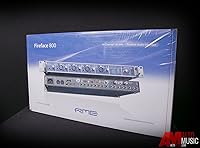
The RME Fireface 800 FireWire Audio Interface has earned a quiet, stubborn loyalty since it first appeared in 2004 — and that staying power says something real. With 56 channels and 24-bit/192kHz resolution, it sits firmly in professional territory, well above the crowded mid-range interfaces aimed at bedroom producers. Before you commit, though, one thing deserves an upfront mention: this unit runs on FireWire. No USB, no Thunderbolt native. If your machine lacks a FireWire port, you will need an adapter. That is a genuine consideration, not a footnote. What keeps people coming back is RME's driver reliability — long-term OS support that outlasts most competitors by years.
Features & Benefits
The Fireface 800's analog section centers on eight balanced line I/O with software-switchable reference levels — -10 dBV, +4 dBu, and HiGain — which means you can match it to virtually any piece of outboard gear without touching a physical pad or trim. Beyond analog, it handles ADAT, SPDIF, and AES/EBU simultaneously, making it a legitimate hub for larger studio setups. Sample rates reach 192kHz across all channels, which matters for mastering work or high-resolution archiving. The bundled TotalMix software mixer lets you build complex monitoring mixes and signal routings with near-zero latency, all without taxing your CPU. RME DIGICheck adds real-time metering and signal diagnostics — a genuinely useful tool for troubleshooting gain staging issues.
Best For
This FireWire interface is built for fixed studio environments where channel count and low latency actually matter — think recording engineers tracking live bands, producers running large analog outboard rigs, or mastering engineers who need pristine converters. If you are already on a FireWire-equipped machine or willing to use a reliable Thunderbolt-to-FireWire adapter, the workflow holds up well. It is not the right fit for someone wanting a portable, plug-and-play USB option; a modern Thunderbolt interface will suit that scenario better. Where RME's flagship 56-channel unit genuinely excels is with buyers who value long-term OS support and consistent driver behavior over chasing the latest hardware standard.
User Feedback
With only nine ratings on Amazon, the feedback pool is small — but it skews heavily toward experienced buyers who knew exactly what they were purchasing. The 4.3-star average reflects consistent praise for audio transparency and build quality, with several owners specifically calling out TotalMix's routing depth as something rivals simply do not match. The recurring concern, predictably, is FireWire connectivity: some buyers have moved the unit to a dedicated DAW machine rather than retrofitting their main rig. TotalMix also earns a notable learning curve warning from newcomers — it is powerful, but it rewards patience. Critically, no serious complaints surface around audio quality or driver crashes, which for a unit this age speaks volumes.
Pros
- Exceptional audio transparency and conversion quality that holds up against far newer interfaces.
- TotalMix provides near-zero-latency monitoring and routing depth that most competitors simply do not match.
- Software-controlled reference level switching makes integrating consumer and pro-level gear genuinely practical.
- RME's driver support for Windows and macOS continues well beyond what most manufacturers offer for older hardware.
- Handles ADAT, SPDIF, and AES/EBU simultaneously, making it a true hub for complex studio configurations.
- 56-channel capacity gives engineers room to grow without immediately outgrowing the interface.
- RME DIGICheck provides real hardware-level metering and diagnostics — a useful tool for signal path troubleshooting.
- Build quality is sturdy and rack-friendly; owners report years of reliable daily use without hardware failures.
- 192kHz support across all channels is practical for mastering and archival work, not just a spec sheet number.
Cons
- FireWire connectivity is a genuine obstacle on most modern machines — adapter solutions add setup complexity.
- TotalMix has a steep learning curve; newcomers often spend significant time before routing feels intuitive.
- The unit weighs 12 pounds and measures 22 inches wide, making it impractical for mobile or location recording.
- Only 9 Amazon ratings means buyer consensus is thin — harder to gauge real-world reliability across diverse setups.
- No native USB or Thunderbolt port limits future-proofing as FireWire infrastructure continues to disappear.
- 30-watt power draw requires a dedicated power connection — not bus-powered, so desktop or rack use only.
- Finding compatible FireWire cards or reliable adapters for newer machines can be a research project in itself.
- The rackmount form factor and fixed installation design make spontaneous studio reconfigurations less convenient.
Ratings
The RME Fireface 800 FireWire Audio Interface has been scored by our AI system after analyzing verified owner feedback from global sources, with spam, bot-generated, and incentivized reviews actively filtered out. Scores reflect the honest consensus of deliberate, experienced buyers — both the aspects that consistently impress and the friction points that genuinely frustrate. This FireWire interface earns strong marks where it counts most for studio professionals, but the ratings do not shy away from the real-world trade-offs that matter before you commit.
Audio Conversion Quality
Driver Stability
TotalMix Routing Depth
Connectivity & I/O Flexibility
Build Quality & Durability
Low-Latency Performance
Reference Level Flexibility
High-Resolution Recording Support
Bundled Software Utility
Setup & Initial Configuration
Value for Money
Portability & Form Factor
Modern Compatibility
Headphone Monitoring
Suitable for:
The RME Fireface 800 FireWire Audio Interface is purpose-built for recording engineers, producers, and serious home-studio owners who need professional-grade performance in a fixed studio setup. If you are tracking multiple musicians simultaneously, running a large analog outboard rig, or doing high-resolution mastering work, the 56-channel capacity and 24-bit/192kHz conversion give you real headroom to work with. Studios that already have FireWire infrastructure in place — or are comfortable running a dedicated DAW machine or a reliable Thunderbolt-to-FireWire adapter — will find the workflow entirely solid. The software-controlled reference level switching is a genuine convenience for anyone juggling consumer and professional-level gear in the same signal chain. Buyers who have been burned by driver instability on other interfaces will also find RME's long-term OS support commitments to be a meaningful differentiator.
Not suitable for:
If you are shopping for a portable, plug-and-play interface to use with a modern laptop, the RME Fireface 800 FireWire Audio Interface is almost certainly the wrong choice. FireWire is a legacy standard — most current MacBooks and Windows laptops ship without it, which means you are immediately dependent on adapter solutions that add complexity and potential failure points. Casual podcasters, streamers, or musicians who only need two or four channels of I/O will find the feature set excessive and the learning curve for TotalMix genuinely steep without a clear payoff. Anyone on a tight budget should also weigh the acquisition cost carefully against a modern USB or Thunderbolt interface that offers comparable quality for simpler use cases. This is not a unit to buy casually; it rewards buyers who have a clear, specific need for what it offers.
Specifications
- Brand: Manufactured by RME, a German audio company well regarded for professional-grade converters and driver stability.
- Model Number: The unit's official model designation is FF800, commonly referred to as the Fireface 800.
- Connectivity: Connects to a host computer via FireWire 400 (6-pin) and FireWire 800 (9-pin) ports.
- Total Channels: Supports up to 56 channels of combined analog and digital I/O at standard sample rates.
- Bit Depth: Operates at a maximum bit depth of 24-bit for all analog and digital signal paths.
- Sample Rate: Supports sample rates from 32kHz up to 192kHz across all channels simultaneously.
- Analog I/O: Provides 8 balanced analog line inputs and 8 balanced analog line outputs via 6.35mm TRS connectors.
- Reference Levels: Analog reference levels are software-switchable between -10 dBV, +4 dBu, and HiGain on a per-channel basis via TotalMix.
- Digital I/O: Includes ADAT Lightpipe, SPDIF coaxial, and AES/EBU digital I/O for integration with external converters and digital gear.
- Bundled Software: Ships with RME TotalMix (a DSP-based software mixer) and RME DIGICheck (a real-time signal analysis and metering utility).
- OS Support: Officially supported on both Windows and macOS, with RME continuing to issue driver updates well beyond typical manufacturer support windows.
- Power Draw: Consumes 30 watts and requires a dedicated mains power connection; the unit is not bus-powered.
- Unit Weight: Weighs 12 pounds, reflecting a robust metal chassis designed for long-term rackmount or desktop studio use.
- Dimensions: Measures 22 x 12 x 5 inches, conforming to a standard 19-inch rackmount form factor at 2U height.
- Form Factor: Designed as a rackmount desktop unit suitable for fixed studio installation rather than portable or mobile use.
- Headphone Outputs: Includes two dedicated headphone outputs on the front panel, each with its own independent volume control.
- Instrument Input: Features a front-panel instrument-level input (high-impedance) via a 6.35mm jack for direct guitar or bass connection.
- MIDI I/O: Provides one MIDI input and one MIDI output for connecting hardware synthesizers, controllers, or MIDI-capable studio equipment.
- First Available: The Fireface 800 was first made available in April 2004, making it one of the longer-running professional interfaces still in production.
- Manufacturer Status: As of the time of this review, the unit is listed as not discontinued by the manufacturer.
Related Reviews
RME Fireface 802 Audio Interface
RME Fireface UC USB Audio Interface
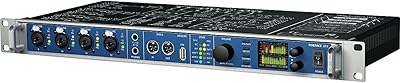
RME Fireface UFX Audio Interface

RME Fireface UFX II USB Audio Interface

RME UFX+ Audio Interface
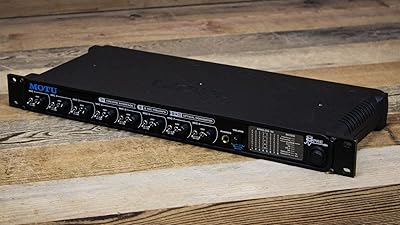
MOTU 8pre Firewire Audio Interface
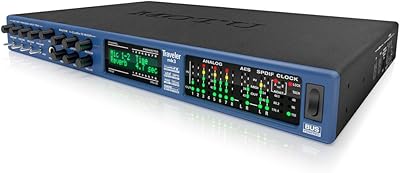
MOTU Traveler-mk3 FireWire Audio Interface
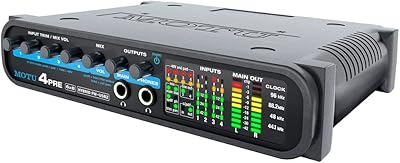
MOTU 4pre USB Audio Interface
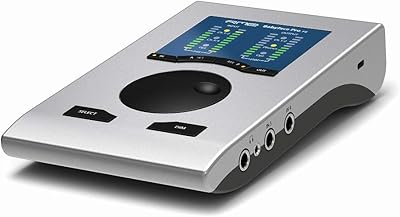
RME Babyface Pro FS USB Audio Interface