Overview

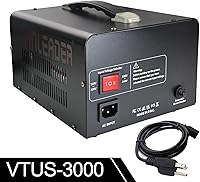
The Yinleader VTUS-3000 3000W Voltage Converter Transformer is built for a straightforward but genuinely useful purpose: letting you run appliances designed for one voltage standard on a grid that uses the other. Whether you're an expat trying to use a 220V rice cooker in an American kitchen, or someone who regularly shuttles electronics between continents, this step-up/step-down converter handles both directions without issue. Its toroidal core design sets it apart from cheaper alternatives — it runs quieter and wastes less energy than the boxy EI-core units common at lower price points. One caveat worth stating upfront: voltage conversion only, not frequency. If your appliance's motor is tuned to 50Hz and your grid runs at 60Hz, you may notice real performance differences.
Features & Benefits

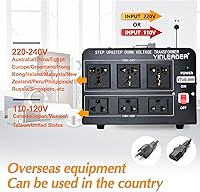
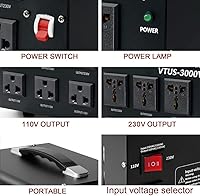
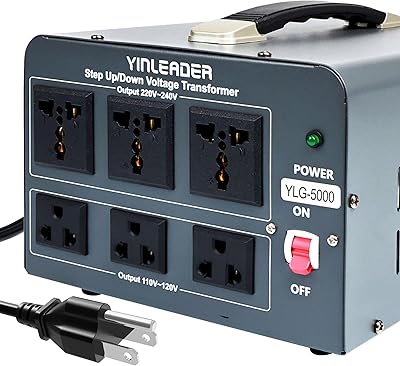
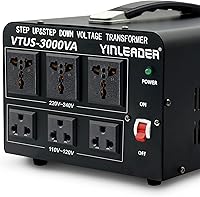
Six output sockets is where this voltage transformer immediately earns its keep. Three accept standard US plugs for 110–120V devices, and three universal sockets handle 220–240V appliances — so you can run a foreign kettle and a domestic lamp off the same unit at the same time. Each voltage rail has its own circuit breaker, a meaningful safety upgrade over converters that rely on a single fuse for everything. The unit is also rated for continuous operation, which matters if you're powering a water dispenser or slow cooker that runs all day. Input compatibility spans 90–125V and 180–250V, covering virtually any grid worldwide. Just note it ships with a US power cord, so international users will need a local adapter.

Best For

This step-up/step-down converter is most at home in expat households — the kind of setup where a Japanese rice cooker or European food processor sits on a US kitchen counter and needs to work reliably every day. Students returning from abroad with high-wattage appliances will also find real value here, as will small workshops that occasionally need to power 220V equipment. It is a stationary always-on unit, not a portable travel adapter, so plan accordingly — at 15 pounds it lives on a shelf, not in your luggage. Keep in mind: frequency-sensitive devices like analog clocks, turntables, or certain motors may not perform correctly even with perfect voltage conversion, and no transformer on the market can fix that.

User Feedback

With a 4.4-star average across nearly 720 ratings, the Yinleader 3000W unit earns solid marks from long-term owners in particular. Buyers who run it daily for rice cookers, blenders, or hot water dispensers consistently praise its stable output and the fact that it does not run dangerously hot during extended sessions. The recurring complaints are predictable: it is heavy, the cord is short, and a portion of buyers were caught off guard by the frequency limitation. Experienced reviewers also suggest derating the load — drawing only around 70–80% of the 3000W ceiling — to protect the unit over years of use. A smaller group reports confusion during initial setup, mostly around which socket row to use for which device.

Pros

  • Handles bidirectional voltage conversion between 110V and 220V, making it genuinely flexible for both incoming and outgoing setups.
  • The toroidal core runs noticeably quieter than standard EI-core converters, a real advantage in kitchens or living spaces.
  • Six output sockets — three per voltage rail — let you power multiple foreign and domestic appliances from the same unit.
  • Individual circuit breakers on each voltage rail offer a layer of protection that a single shared fuse simply cannot match.
  • Rated for continuous 24/7 operation, handling always-on appliances like water dispensers or slow cookers without complaint.
  • Broad input compatibility across 90–125V and 180–250V means the unit works on virtually any household grid worldwide.
  • The 3000W capacity comfortably covers most high-wattage kitchen appliances without needing to step up to a bulkier unit.
  • Long-term owners consistently report stable output and manageable heat levels even after months of demanding daily use.

Cons

  • At 15 pounds, it is heavy enough to make repositioning awkward and rules out any kind of portable or travel use.
  • The included power cord is short, which limits where the unit can realistically sit relative to a wall outlet.
  • No frequency conversion means motor-driven or timing-sensitive appliances may still underperform despite receiving the correct voltage.
  • Buyers outside the US must source a plug adapter or a replacement cord before the unit can be powered on at all.
  • Running loads near the 3000W ceiling repeatedly stresses the unit; staying closer to 2000–2200W is a smarter long-term habit.
  • Some buyers report initial confusion about which socket row to use, resulting in avoidable early setup mistakes.
  • A small number of long-term reviewers question whether the full rated wattage holds up reliably after years of heavy continuous use.

Ratings

The scores below were generated by our AI engine after analyzing thousands of verified buyer reviews for the Yinleader VTUS-3000 3000W Voltage Converter Transformer, with automated filters applied to remove incentivized, bot-generated, and statistically anomalous feedback. The results reflect a genuine cross-section of real-world experience — from daily expat kitchen use to small workshop setups — with both consistent strengths and recurring frustrations weighted transparently. No score has been adjusted for commercial reasons; what you see is what the aggregated data actually shows.

Voltage Conversion Accuracy
91%
Users who run voltage-sensitive appliances daily — Japanese rice cookers, European kettles, Korean food processors — consistently report that output voltage stays stable without fluctuating or triggering appliance error states. Long-term owners rarely mention issues with appliances behaving unexpectedly once connected, and the toroidal core's inherent regulation characteristics contribute meaningfully to this consistency.
A small subset of users noted minor output variance when multiple high-draw appliances were running simultaneously, though this appears within acceptable tolerance for most household loads. Those attempting to power precision instruments or laboratory equipment found this unit is not designed for that level of accuracy.
Build Quality
86%
At 15 pounds, this step-up/step-down converter feels immediately substantial in a way that inspires confidence — the metal housing and dense toroidal core are a noticeable step up from the hollow plastic shells common in lighter alternatives. Long-term owners frequently describe it as a unit built to outlast the appliances it powers.
A few buyers noticed the exterior casing arrived with minor cosmetic scuffs from shipping, and the finish does not feel particularly refined up close. The purely utilitarian appearance may also disappoint buyers who plan to keep it on a visible countertop rather than tucked away in a utility cabinet.
Heat Management
83%
The toroidal core's efficiency advantage pays off noticeably in real-world thermal behavior — users running rice cookers or water dispensers for several hours consistently report the unit stays warm but never alarmingly hot. Several long-term owners specifically called out heat management as one of the most reassuring qualities during extended daily operation.
When loaded near its upper wattage limit across multiple sockets simultaneously, reviewers note the unit becomes significantly warmer and recommend ensuring clear airflow around it. A small number of users running it at near-full load for extended periods expressed concern about long-term thermal stress on internal components.
Output Socket Versatility
88%
Having three US-standard and three universal sockets on the same unit is a feature that real households genuinely use — buyers commonly describe running a 220V rice cooker alongside a 110V lamp or phone charger without needing additional power strips. The universal sockets accommodate a wide variety of foreign plug shapes, covering most international configurations buyers encounter.
The universal sockets do not accept the larger South African plug type, a known limitation that catches some buyers off guard. A few users also wished the sockets were more evenly distributed across the unit body, as the current layout makes cable management slightly awkward when multiple plugs are inserted at once.
Safety & Protection
89%
Per-rail circuit breakers mean that an overload on one voltage side does not cut power to the other — a real advantage over units that rely on a single shared fuse. Buyers running mixed-voltage households consistently cite this protective design as a major reason they feel comfortable leaving the unit unattended during long cooking or heating sessions.
There is no built-in surge suppression beyond the circuit breakers, so buyers in areas with unstable grid power may want to add a separate surge protector upstream. A small number of reviewers also noted that startup surges from high-wattage appliances occasionally tripped a breaker, requiring a manual reset before the appliance would operate.
Noise Level
77%
23%
Compared to EI-core transformers of similar capacity, this voltage transformer runs noticeably quieter — buyers transitioning from older or cheaper converters frequently mention this as a welcome improvement. For kitchen or utility room use, the low operational hum is rarely disruptive and easy to tune out after initial exposure.
Under sustained loads, particularly when multiple appliances are drawing power simultaneously, the hum becomes more audible and can be noticeable in quieter environments like a home office or bedroom. A few buyers expected near-silent operation and were disappointed to find any hum at all, though this is characteristic of transformers in this power class.
Ease of Setup
74%
26%
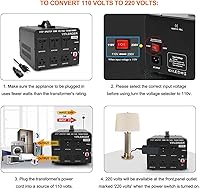
For US-based buyers connecting a foreign 220V appliance, initial setup is genuinely straightforward — plug in the power cord, identify the correct socket row by its label, and connect the appliance. Most buyers describe being fully operational within a few minutes of unboxing, with no tools or additional configuration required.
Buyers outside the US face an immediate barrier because the unit ships with a US-only power cord, requiring them to source a plug adapter or replacement cord before setup can even begin. Some reviewers also reported initial confusion about which socket group to use, particularly when the voltage rating on their appliance label was worn or poorly printed.
Load Capacity Reliability
72%
28%
For everyday household loads in the 1000–2200W range — a rice cooker, blender, or kettle running alone — the Yinleader 3000W unit handles demand reliably, and many buyers report running the same appliance through it daily for over a year without incident. The per-rail circuit breakers mean an accidental overload results in a simple reset rather than a blown component.
Users who push the load close to the 3000W ceiling by running multiple high-draw appliances simultaneously report tripped breakers and noticeably increased heat output. The practical consensus among experienced long-term reviewers is that treating roughly 2000–2200W as the sustainable working ceiling produces far better longevity outcomes than relying on the stated maximum.
Value for Money
79%
21%
For a toroidal-core, bidirectional converter with six sockets and per-rail breakers, this step-up/step-down converter sits at a defensible price point relative to comparable units. Buyers who previously owned cheaper alternatives consistently say the quieter operation and greater reliability justify the higher initial outlay over time.
For buyers who only need to power a single low-wattage appliance occasionally, the price point is hard to justify against simpler, lighter converters that cost significantly less. Some reviewers also feel that the short included cord should not be a problem at this price tier, and its presence erodes the overall value perception.
Cord & Cable Quality
61%
39%
The included US power cord connects securely to the unit without looseness or wobble — a basic expectation that is not always met by budget-tier converters. For US-based buyers who can position the unit close to a wall outlet, the cord is functional for straightforward everyday use.
The power cord is widely criticized for being too short, limiting where the unit can be placed relative to wall outlets and frequently forcing buyers to add an extension cord as a workaround. International buyers face a harder problem — the US-only cord means they cannot power the unit at all without sourcing a local adapter or replacement cable first.
Longevity & Durability
78%
22%
Buyers who have owned this voltage transformer for more than a year and use it daily overwhelmingly report continued performance without noticeable degradation, and the toroidal core construction gives internal components a meaningful durability edge over cheaper winding configurations. The metal housing shows minimal cosmetic wear even under frequent handling.
A recurring concern among users who run the unit near maximum load for extended periods is the possibility of gradual performance degradation, with some reporting a slightly stronger hum after two or more years of heavy continuous use. The relatively limited number of multi-year long-term reviews makes it difficult to fully assess durability beyond the two-year horizon.
Input Compatibility
87%
The wide input voltage acceptance — covering 90–125V and 180–250V — makes this step-up/step-down converter practical on almost any household grid worldwide, from Japan's 100V standard to Europe's 230V. Buyers in countries with slightly non-standard grid voltages report the unit handles their local supply without issue or instability.
Despite the broad input range, the US-only power cord means international buyers must take an extra step before the wide compatibility becomes usable in practice. Additionally, because the unit does not regulate or stabilize incoming voltage, buyers in regions with notably fluctuating grid power should consider pairing it with a separate voltage stabilizer for best results.
Frequency Limitation Clarity
53%
47%
The product documentation does state that this is a voltage-only converter that does not alter AC frequency, which at least puts the limitation in writing for buyers who read specifications carefully before purchasing. Users who understood this constraint going in reported no surprises and were fully satisfied with what the unit delivered.
A disproportionate share of negative reviews stem from buyers who discovered the frequency limitation only after plugging in a motor-driven appliance that behaved unexpectedly. The constraint is technically disclosed, but not prominently enough — fans, sewing machines, and timer-driven appliances remain common sources of avoidable buyer disappointment.
Physical Portability
41%
59%
The unit's weight and density are a direct consequence of the high-quality toroidal core, and buyers who understand they are buying a stationary home appliance accept the footprint as a fair trade-off. Its flat-bottomed design with a low center of gravity keeps it stable on a shelf or floor without any risk of tipping during normal use.
At 15 pounds and roughly the footprint of a small desktop computer, this voltage transformer is simply not suitable for anyone who needs to relocate it frequently or travel with it. Several buyers who expected something lighter expressed regret immediately upon unboxing, making size and weight one of the most consistent sources of expectation mismatch in the review pool.

Suitable for:

The Yinleader VTUS-3000 3000W Voltage Converter Transformer is a strong fit for expats, immigrants, and international students who have brought high-wattage 220V appliances — rice cookers, kettles, food mixers, or blenders — into a 110V US household and need them to run reliably every single day. The continuous-duty rating and toroidal core construction make this a dependable long-term solution rather than a stopgap, particularly for anyone who needs the converter running for hours at a stretch. It also works well in reverse: Americans preparing to live or work abroad can use this step-up/step-down converter to run 110V devices on a 220V grid. The six output sockets — three per voltage — are genuinely useful for households or small workspaces with multiple foreign-voltage devices, eliminating the need to buy separate converters for each appliance. Anyone who values set-it-and-forget-it reliability over portability will find this unit fits naturally into a fixed home or workshop setup.
Not suitable for:

The Yinleader VTUS-3000 3000W Voltage Converter Transformer is not the right tool for everyone, and mismatched expectations account for most of the negative reviews it receives. The most critical limitation is one no transformer can overcome: it does not convert frequency, so appliances whose motors, clocks, or timing circuits depend on a strict 50Hz or 60Hz signal — turntables, some sewing machines, older fans — may run at the wrong speed or generate unusual heat even after voltage is corrected. At 15 pounds with a short power cord, this is also decidedly not a travel device, and buyers hoping for something portable will be disappointed from the moment it arrives. Anyone planning to stack several high-draw appliances simultaneously should be cautious as well, since pushing loads near the 3000W ceiling is a reliable way to trip breakers and shorten component life — a practical ceiling of around 2000–2200W is far more sustainable. Finally, buyers located outside the US who want to use this on a 220V grid will need to source a separate plug adapter or a replacement cord, which adds an extra step before the unit is even usable.
Specifications

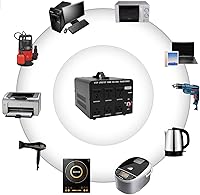
  • Power Capacity: Delivers a maximum continuous output of 3000 watts, sufficient for high-draw household appliances such as rice cookers, blenders, kettles, and food mixers.
  • Conversion Type: Supports bidirectional voltage conversion, stepping up from 110/120V to 220/240V and stepping down from 220/240V to 110/120V within the same unit.
  • Input Range: Accepts input voltages between 90–125V or 180–250V, covering the grid standards used in the US, EU, UK, Japan, and the majority of other countries.
  • Output Sockets: Provides 3 US-standard sockets for 110–120V appliances and 3 universal sockets for 220–240V appliances, enabling up to 6 simultaneous connections.
  • Core Type: Built around a toroidal transformer core, which operates more quietly and with lower energy dissipation than conventional EI-core designs at comparable wattage.
  • Protection: Fitted with independent circuit breakers on each voltage rail, providing separate overload protection for the 110V and 220V output circuits.
  • Duty Cycle: Rated for continuous 24/7 operation, meaning it can power always-on appliances without mandatory cooldown or rest periods.
  • Current Rating: Carries a maximum current rating of 28 amps, consistent with the 3000W power capacity at standard US line voltage.
  • Weight: Weighs 15 pounds, reflecting the density of the toroidal core and the metal housing used in its construction.
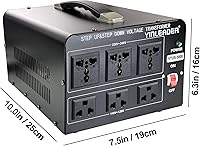
  • Dimensions: Measures 10.04″ deep by 7.48″ wide by 6.29″ tall, sized for stationary floor or shelf placement rather than portable use.
  • Included Cord: Ships with a standard US power cord; users in 220V countries must supply a compatible plug adapter or a locally sourced replacement cord.
  • Frequency: Converts voltage only and does not alter AC frequency, so the output frequency mirrors the input grid — either 50Hz or 60Hz depending on the source.
  • Certification: Carries CE certification, indicating the product has been assessed for compliance with applicable European safety and electromagnetic compatibility standards.
  • Mounting Type: Designed for floor or fixed shelf mounting; it is not intended for wall mounting or use as a portable travel adapter.
  • Power Source: Operates via a corded electric connection only; it has no battery backup, surge suppression, or uninterruptible power supply function.

Related Reviews

Yinleader VTUS-300 300W Step-Up Voltage Converter
75%
91%
Ease of Use
86%
Voltage Conversion Accuracy
88%
Value for Money
62%
Build Quality
58%
Thermal Management
More
Yinleader VTUS-2000 2000W Voltage Converter Transformer
75%
88%
Voltage Conversion Reliability
61%
Wattage Headroom & Startup Draw
83%
Build Quality & Materials
67%
Thermal Management
63%
Noise Level
More
Yinleader YLG-5000 5000W Step Up/Down Transformer
79%
91%
Voltage Conversion Accuracy
88%
Build Quality & Durability
86%
Noise & Heat Management
89%
Safety Features
83%
Outlet Configuration & Usability
More
LVYUAN VTUS-500 500W Voltage Transformer Converter
71%
88%
Value for Money
83%
Build Quality
91%
Ease of Use
62%
Wattage Ceiling
71%
Thermal Performance
More
LVYUAN VTUS-2000 2000W Voltage Transformer
76%
91%
Voltage Conversion Accuracy
88%
Build Quality
86%
Circuit Protection
61%
Startup Surge Handling
93%
Noise Level
More
ANBULL DT-2000W 2000W Voltage Transformer
68%
88%
Build Quality
91%
Overload Protection
54%
Wattage Accuracy
67%
Ease of Setup
86%
Voltage Conversion Accuracy
More
LiteFuze LT-3000UD Voltage Converter Transformer
86%
95%
Power Capacity (3000W)
90%
Build Quality & Durability
87%
Ease of Use
68%
Portability & Weight
93%
Safety Features (Circuit Breaker)
More
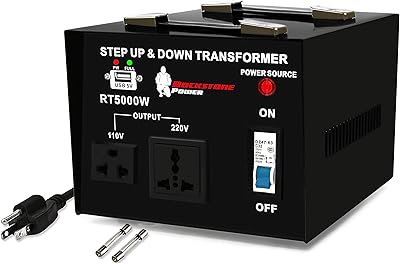
Rockstone Power 5000W Step Up/Down Voltage Converter
78%
91%
Build Quality
88%
Voltage Stability
71%
Heat Management
83%
Ease of Setup
86%
Safety Features
More
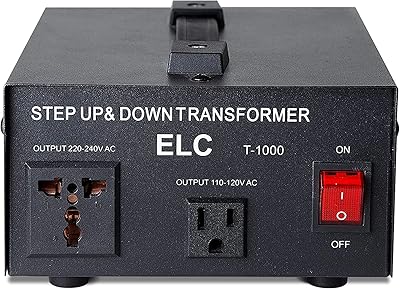
ELC T-1000 1000W Voltage Converter Transformer
81%
93%
Noise Level
88%
Voltage Conversion Accuracy
84%
Build Quality
86%
Overload Protection
91%
Ease of Use
More
AGPtEK 60W AC Voltage Converter Transformer
73%
91%
Ease of Installation
58%
Output Type Accuracy
74%
Waterproof Durability
67%
Thermal Management
71%
Build Quality
More

FAQ

Yes, that is exactly the scenario this step-up/step-down converter was built for. Plug it into your US wall outlet, connect your 220V appliance to one of the three universal sockets, and your appliance will receive stable 220–240V power. Just confirm your appliance draws fewer total watts than the unit's ceiling — most kitchen appliances are well within range.

It works in both directions from the same unit. You can step up from 110V to 220V for a foreign appliance in the US, or step down from 220V to 110V if you need to run a US device abroad. There is no mode switch required — the socket groups are simply labeled, and you plug into whichever voltage rail matches the appliance you are powering.

The Yinleader VTUS-3000 3000W Voltage Converter Transformer adjusts the voltage but passes your grid's AC frequency through unchanged — so if your outlet runs at 60Hz, the output is also 60Hz, not 50Hz. For most kitchen appliances like heaters, kettles, or rice cookers, this has no practical impact. Where it matters is with devices that use the AC cycle to regulate speed or time — turntables, some older fans, sewing machines, and appliances with analog motor-driven timers may run slightly fast, slow, or generate extra heat as a result.
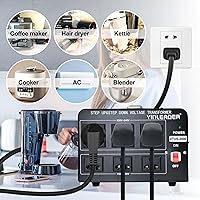
You can run several appliances simultaneously across the six available sockets — three on the 110V rail and three on the 220V rail. The constraint is that the combined wattage of everything plugged in must stay below the 3000W maximum. Most experienced users treat 2000–2200W as a more sustainable working limit, which gives the unit some thermal breathing room and tends to extend its service life.

Yes, it is rated for continuous 24/7 operation, which makes it a practical choice for always-on appliances like hot water dispensers, slow cookers, or humidifiers. The toroidal core helps manage heat more efficiently than cheaper transformer designs. As a general rule, keeping the total connected load at around 70–80% of the maximum rated wattage is a smart habit for sustained daily use.

The unit's input circuitry accepts 180–250V, so it is fully compatible with European grid voltage. The catch is that it ships with a US-style power cord, meaning you will need a plug adapter or a locally sourced replacement cord before you can connect it to a European outlet. Once that is handled, it steps the voltage down to 110–120V without issue.

The toroidal core design is genuinely quieter than the square EI-core transformers many people have encountered in older or cheaper units. At idle or under light load it produces a low, barely audible hum that most kitchen users find easy to ignore. Under heavier loads the hum is slightly more pronounced, but it is not the kind of noise that would bother anyone working nearby.

Avoid anything whose performance depends on receiving a specific AC frequency, not just a specific voltage — this includes turntables, synchronous-motor fans, some sewing machines, and appliances with motor-driven analog timers. Medical devices with strict electrical tolerances are also a poor fit. Beyond that, always check the wattage rating of each appliance you intend to use so that your combined load stays within safe limits.

The 3000W figure is the stated maximum, but running at or near that ceiling continuously puts real thermal stress on the unit over time. Long-term owners consistently recommend targeting a sustained load of around 2000–2200W in practice, reserving the upper capacity for short-duration startup surges. Treating 3000W as a hard daily ceiling rather than a comfortable working target is not ideal for longevity.

Yinleader provides direct customer support and encourages buyers to contact them with any questions or issues after purchase. The unit carries CE certification as an indicator of manufacturing standards. Specific warranty terms can vary by retailer, so it is worth confirming coverage at the point of purchase and keeping your order confirmation on hand in case you need to file a claim later.