Overview

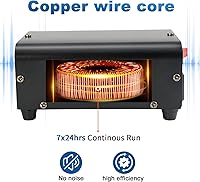
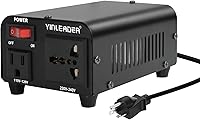
The Yinleader VTUS-300 300W Step-Up Voltage Converter is a straightforward, no-frills solution for anyone in the US trying to run 220-240V appliances on standard 110V outlets. It's particularly aimed at expats, international students, and travelers who've brought devices from Europe or Asia. The unit tops out at 300W, though Yinleader recommends keeping your load at 200W or below for safe, reliable operation. At under four pounds, it's portable enough to pack without much hassle. One thing worth knowing upfront: this step-up converter changes voltage only — it doesn't touch the frequency. If your appliance needs a strict 50Hz supply and you're on a 60Hz US grid, that mismatch could affect performance.
Features & Benefits

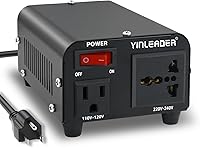
The core job of this voltage transformer is converting your home's 110-120V AC supply into a stable 220-240V AC output — which covers virtually every European and Asian voltage standard you're likely to encounter. A standout feature is the resettable circuit breaker: if you accidentally overload the unit, it trips automatically and resets with a simple button press rather than requiring a fuse swap. Setup is genuinely plug-and-play — no switches to configure, no manual to consult. That said, Yinleader is explicit about prohibited high-wattage appliances — hair dryers, kettles, rice cookers, and similar devices are off-limits. Pushing beyond the 200W safe limit risks damaging both the converter and whatever's plugged into it.

Best For

This step-up converter hits its stride in some pretty specific situations. If you're an expat or international student living in the US with a bag full of appliances bought back home in Europe or Asia, this is exactly the kind of low-cost fix you need for everyday low-wattage devices. Electric shavers, phone chargers, small Bluetooth speakers, digital cameras — it handles all of these without breaking a sweat. It's also a solid pick for travelers who want occasional use rather than running something heavy all day. What it's not built for is continuous, high-load operation. If you're hoping to power a kitchen or bathroom appliance, look elsewhere — this one just isn't rated for that kind of demand.

User Feedback

Since the VTUS-300 is a relatively new listing, there isn't a deep well of reviews to draw from yet. Early buyers generally seem satisfied with its core performance — most note that it works reliably with small personal electronics and that the plug-and-play setup lives up to its promise. The resettable breaker gets occasional praise from users who accidentally pushed the load too high and found recovery easy. On the downside, a few buyers feel the 200W recommended ceiling is limiting in practice, especially if they were hoping to use it with something slightly more demanding. Some also report the unit runs noticeably warm after extended use, which is worth keeping in mind for longer sessions.

Pros

  • Converts 110-120V US power to stable 220-240V output, covering virtually all European and Asian appliance standards.
  • The resettable circuit breaker is a practical safeguard — trip it, press a button, and you're back up in seconds.
  • Genuinely compact and light enough to pack in luggage without much sacrifice in space or weight.
  • No setup required — plug your appliance in and the converter does its job immediately.
  • Affordable entry point for expats and students who need a basic voltage fix without overspending.
  • Works reliably with low-draw personal electronics like shavers, chargers, cameras, and audio gear.
  • Clear product labeling about incompatible devices helps buyers avoid misuse before they even unbox it.
  • Resettable breaker means no hunting for replacement fuses if you accidentally push the load too high.

Cons

  • The 200W recommended load ceiling rules out a wide range of common household appliances buyers might reasonably want to use.
  • Does not convert frequency, which can cause problems with motor-driven or frequency-sensitive devices on US 60Hz power.
  • Users report the unit runs noticeably warm during extended sessions, which may be a concern for longer continuous use.
  • At 300W maximum, the VTUS-300 has limited headroom — there's almost no buffer between the safe load and the rated maximum.
  • Build quality feels modest at this price tier, and long-term durability under regular use remains an open question given limited review history.
  • Only steps voltage up — it cannot step down from 220V to 110V, limiting its versatility for two-way use cases.
  • The product is relatively new to market, so there is not yet enough real-world user data to fully validate reliability over time.

Ratings

The scores below reflect an AI-assisted analysis of verified global user reviews for the Yinleader VTUS-300 300W Step-Up Voltage Converter, with spam, bot activity, and incentivized feedback actively filtered out to ensure the ratings reflect real-world buyer experiences. Both the genuine strengths and the recurring frustrations are weighted transparently — no category has been inflated to flatter the product. If a pain point came up consistently across independent buyers, it shows up in the score.

Ease of Use
91%
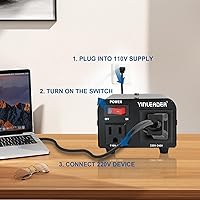
Buyers consistently praise how little effort this step-up converter demands — plug your appliance in, plug the unit into the wall, and it works. Expats and students with zero technical background reported getting it running in under a minute, with no instructions needed.
A small number of users were initially confused about which end to plug their appliance into versus the wall, suggesting clearer labeling on the sockets would help first-time buyers avoid any momentary uncertainty.
Voltage Conversion Accuracy
86%
For its intended purpose, this voltage transformer delivers a stable 220–240V output that most low-wattage personal electronics respond to without issue. Users running shavers, phone chargers, and small audio devices reported their appliances behaving exactly as they would back home.
A handful of buyers noted slight voltage fluctuations detected by sensitive equipment, and the lack of a built-in voltmeter means most users have no way to verify output stability without external tools.
Value for Money
88%
At its price point, this step-up converter punches above its weight for buyers who only need to power small personal electronics occasionally. Expats and international students regularly cite it as a cost-effective alternative to replacing appliances bought abroad.
Users with slightly higher power demands quickly run into the 200W ceiling and feel they need to upgrade sooner than expected, making the initial purchase feel like a short-term fix rather than a long-term solution.
Build Quality
62%
38%
The casing feels solid enough for occasional home use, and the overall fit and finish is acceptable given the accessible price. Most buyers who use it a few times a week rather than continuously report no structural issues after several months.
Reviewers who handle it frequently note the plastic housing feels thin, and the output socket can feel slightly loose depending on the plug type inserted. Long-term durability under daily heavy use remains an open question given the product's limited review history.
Thermal Management
58%
42%
For short sessions with genuinely low-wattage devices — think a shaver running for a few minutes — the unit stays at a reasonable temperature and raises no concerns about heat-related safety.
Extended sessions push the casing noticeably warm, which several buyers flagged as uncomfortable when the unit is placed on a desk or bedside table. Running it close to the 200W safe load ceiling accelerates heat buildup and has led some users to shorten their sessions as a precaution.
Circuit Breaker Reliability
83%
The resettable breaker earns genuine appreciation from users who accidentally exceeded the load limit. Rather than a blown fuse that requires a replacement part, a simple button press restores operation — something buyers cite as a practical, stress-free safety net.
A few reviewers noted the breaker tripped at loads they believed were within the rated limit, suggesting the threshold may be slightly conservative or inconsistent across units. This can be frustrating if you are trying to operate a device that should theoretically be within spec.
Portability
79%
21%
At under 2 kg and with a reasonably compact footprint, the VTUS-300 fits into a checked bag without consuming much space. Travelers moving between temporary accommodations appreciate not having to buy a new unit at each destination.
It is still a transformer — meaning it has real weight and bulk that some buyers underestimate from product photos. Compared to lightweight plug adapters, this voltage transformer is a noticeably heavier item to carry, particularly on shorter trips.
Compatibility Range
67%
33%
The 220–240V output covers the vast majority of European, Asian, and Australian appliance standards, making it broadly useful for buyers whose devices span multiple regions. Most modern personal electronics fall well within the compatible wattage range.
The hard 200W recommended ceiling and the inability to handle common household appliances like kettles or hair dryers significantly narrows the real-world compatibility range. Buyers who discover their specific appliance is on the prohibited list after purchase account for a notable share of negative reviews.
Frequency Compatibility
53%
47%
For the large category of purely electronic devices — phone chargers, USB adapters, camera battery chargers — the lack of frequency conversion is effectively a non-issue, since these devices tolerate 50–60Hz input without any performance impact.
Motor-driven appliances, analog clocks, and audio equipment sensitive to frequency are directly affected by the 60Hz US supply passing through unchanged. Buyers who did not research this caveat before purchasing report their appliances running faster, hotter, or with audible differences in performance.
Safety Features
77%
23%
The automatic overload protection is a meaningful inclusion at this price level, and the clear warnings about prohibited appliances in the product listing reflect a reasonable attempt to prevent misuse before it happens.
Beyond the resettable breaker, there are no additional safety indicators — no power-on light, no temperature warning, and no audible alert before the breaker trips. Users running the unit unattended have no passive signal that something is going wrong until the breaker cuts power.
Setup & Configuration
93%
Plug-and-play really does describe the experience accurately here — there are no dials, switches, or configuration steps between unboxing and first use. This simplicity is consistently highlighted as a strong positive by non-technical buyers.
The absence of any controls is also a limitation for users who want more control over output or need to verify the unit is actively converting rather than simply passing power through — there is no confirmation that conversion is occurring.
Product Documentation
61%
39%
The listing itself does a reasonable job of communicating what the converter can and cannot do, including the prohibited device list and the frequency caveat, which helps buyers self-screen before purchasing.
The physical documentation included with the unit is minimal, and several buyers reported the included instructions were brief to the point of being unhelpful for anyone with questions about edge-case compatibility or safe operating practices.

Suitable for:

The Yinleader VTUS-300 300W Step-Up Voltage Converter is a practical pick for a fairly specific group of buyers — and for those people, it genuinely delivers. Expats and international students living in the US who arrived with personal electronics from Europe, Asia, or other 220-240V regions will find this voltage transformer solves a real, everyday problem without a big investment. It's equally useful for travelers who are setting up a temporary living situation and need to run a foreign-bought electric shaver, phone charger, or small audio device on US power. The plug-and-play design means there's no learning curve — you plug your appliance in and it works. For anyone powering low-wattage electronics occasionally rather than running something continuously for hours, this step-up converter hits a sensible balance of portability, simplicity, and affordability.
Not suitable for:

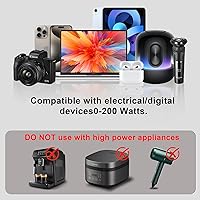
If your goal is to run kitchen or bathroom appliances you brought from abroad, the Yinleader VTUS-300 300W Step-Up Voltage Converter is not the right tool for the job — full stop. Hair dryers, electric kettles, rice cookers, coffee makers, and induction stoves all draw well above the 200W recommended safe load, and connecting them risks damaging both the converter and the appliance itself. The 300W ceiling is also not a soft suggestion; it's a hard boundary for safe operation. Beyond wattage, there's a frequency issue to consider: this voltage transformer does not convert Hz, so motor-driven appliances that are sensitive to 50Hz versus 60Hz supplies may run hotter, slower, or less accurately on US grid power. Anyone expecting to run high-draw devices continuously, or who needs a true frequency-converting transformer, should look at heavier-duty options rated for 500W or more.
Specifications

  • Input Voltage: Accepts standard US household power at 110–120V AC.
  • Output Voltage: Delivers a stable 220–240V AC output, compatible with most European and Asian appliance standards.
  • Max Power: Rated at a maximum output of 300W under load.
  • Safe Load: Yinleader recommends keeping connected devices at 200W or below for safe, reliable operation.
  • Frequency: Passes through the input frequency unchanged — it does not convert between 50Hz and 60Hz.
  • Circuit Breaker: Includes a resettable circuit breaker that trips automatically on overload and resets with a simple button press.
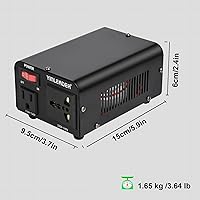
  • Weight: Weighs approximately 1.8 kg (3.86 lbs), making it portable enough for luggage.
  • Dimensions: Measures 9.92 x 5.98 x 3.39 inches in its packaged form.
  • Power Source: Corded electric — requires a standard US wall outlet to operate.
  • Model Number: Officially designated as the VTUS-300 by Yinleader.
  • Brand: Manufactured and sold under the Yinleader brand by ShenZhen Yinhang Zhe Technology Co., Ltd.
  • Compatible Devices: Designed for low-wattage electronics including smartphones, tablets, cameras, electric shavers, and portable audio equipment.
  • Incompatible Devices: Not suitable for high-draw appliances such as hair dryers, kettles, rice cookers, induction stoves, or air conditioners.
  • Operation: Plug-and-play design requires no technical configuration or installation before use.
  • Conversion Type: Step-up only — converts 110–120V to 220–240V and does not function as a step-down converter.

Related Reviews

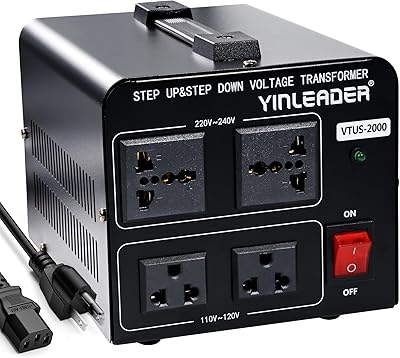
Yinleader VTUS-2000 2000W Voltage Converter Transformer
75%
88%
Voltage Conversion Reliability
61%
Wattage Headroom & Startup Draw
83%
Build Quality & Materials
67%
Thermal Management
63%
Noise Level
More
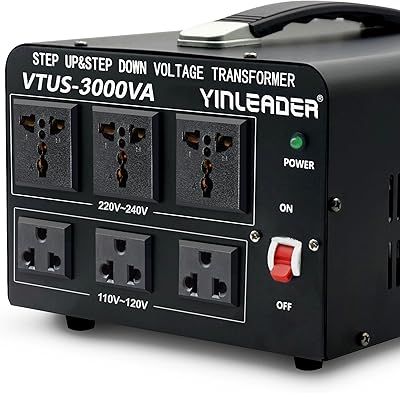
Yinleader VTUS-3000 Voltage Converter Transformer
85%
87%
Overall Performance
92%
Safety Features
90%
Ease of Use
85%
Portability
88%
Build Quality
More
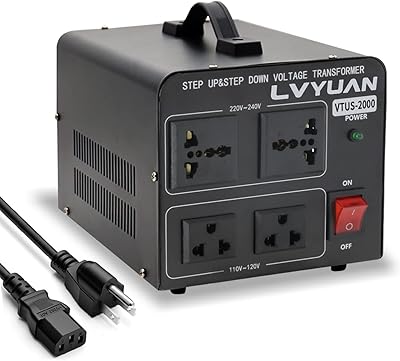
LVYUAN VTUS-2000 2000W Voltage Transformer
76%
91%
Voltage Conversion Accuracy
88%
Build Quality
86%
Circuit Protection
61%
Startup Surge Handling
93%
Noise Level
More
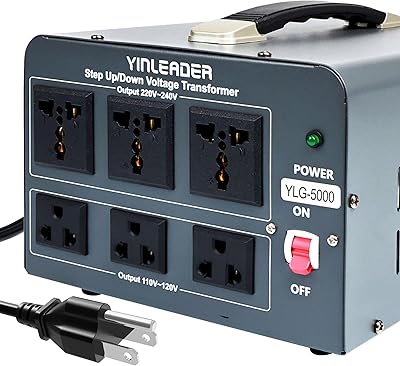
Yinleader YLG-5000 5000W Step Up/Down Transformer
79%
91%
Voltage Conversion Accuracy
88%
Build Quality & Durability
86%
Noise & Heat Management
89%
Safety Features
83%
Outlet Configuration & Usability
More
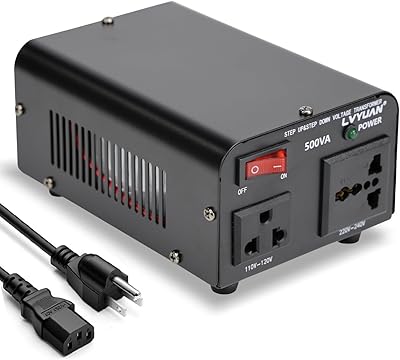
LVYUAN VTUS-500 Voltage Transformer Converter 500W
83%
92%
Value for Money
88%
Ease of Use
85%
Build Quality
90%
Compactness/Portability
86%
Performance (Voltage Conversion)
More
AceChef Voltage Converter 2300W
87%
89%
Performance
91%
Portability & Size
93%
Multi-Device Support
87%
Safety Features
84%
Build Quality & Durability
More
Pyle PVTC320U 500W Voltage Converter Transformer
70%
88%
Voltage Conversion Accuracy
84%
Safety Features
74%
Build Quality
61%
Heat Management
91%
Ease of Setup
More
DOACE X30 350W Voltage Converter
80%
92%
Ease of Setup
89%
Voltage Conversion Accuracy
71%
Power Capacity & Wattage Limit
84%
Multi-Device Charging
74%
Build Quality & Durability
More
ANBULL DT-2000W 2000W Voltage Transformer
68%
88%
Build Quality
91%
Overload Protection
54%
Wattage Accuracy
67%
Ease of Setup
86%
Voltage Conversion Accuracy
More
LiteFuze LT-3000UD Voltage Converter Transformer
86%
95%
Power Capacity (3000W)
90%
Build Quality & Durability
87%
Ease of Use
68%
Portability & Weight
93%
Safety Features (Circuit Breaker)
More

FAQ

No, and this is genuinely important to understand before buying. Hair dryers typically draw 1200W or more, which is well beyond the 200W safe load this step-up converter is rated for. Connecting a hair dryer would almost certainly trip the breaker at best, and damage the unit or the appliance at worst. For hair dryers and similar high-wattage devices, you would need a much heavier-duty transformer rated for 1500W or higher.

No. The VTUS-300 is a step-up-only unit, designed specifically to convert 110–120V US power up to 220–240V. It cannot step voltage down in the other direction. If you need two-way conversion, you would need a different transformer that explicitly supports both step-up and step-down operation.

Yes, this is exactly the kind of device the Yinleader VTUS-300 300W Step-Up Voltage Converter is built for. Electric shavers draw very little power — usually well under 20W — so you are nowhere near the 200W safe load limit. Just make sure your shaver accepts 220–240V input, and you should be good to go.
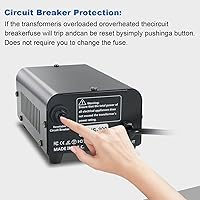
The resettable circuit breaker will trip automatically to protect both the converter and your appliance. You will hear a click and the unit will stop supplying power. To reset it, just press the breaker button back in — it takes a few seconds. It is worth checking what you had plugged in before resetting, though, since the breaker tripped for a reason.

Potentially, yes. This voltage transformer only converts voltage — it does not touch the frequency. US grid power runs at 60Hz, and if your appliance was designed strictly for 50Hz (common in Europe), things like motors, clocks, or turntables may run slightly faster, run hotter, or behave inconsistently. Purely electronic devices like phone chargers and most modern gadgets are usually frequency-tolerant, so they tend to be fine. Check your appliance's label for a 50/60Hz rating before assuming it will work perfectly.

It can handle extended use, but it is not really designed for continuous heavy operation. Users have noted the unit gets warm during longer sessions, which is normal for a transformer of this size, but worth keeping an eye on. If you are running something for hours on end, try to stay well below the 200W recommended ceiling to reduce heat buildup and stress on the unit.

No adapter is needed on the input side — this voltage transformer plugs directly into a standard US two- or three-prong wall outlet. You may still need an adapter on the output side depending on the plug type of your foreign appliance, since outlet shapes vary by country.

Technically you could if your combined load stays under 200W, but the converter only has one output socket. You would need a multi-outlet adapter or power strip rated for 220–240V to run more than one device simultaneously, and you would still need to keep the total wattage within the safe operating limit.

Check the label or power brick of your appliance for the input voltage rating. If it says something like 220–240V or 50/60Hz, it needs this kind of converter to run in the US. Also check the wattage — if it draws more than 200W, this step-up converter is not the right fit. Most low-power personal electronics list this information clearly on the device itself or in the manual.

For occasional, light use with small personal electronics, it makes a lot of sense. The price is low, setup is instant, and it does the one job it promises reliably. Where it becomes a harder sell is if you have bigger power needs or expect to run devices continuously — in those cases, spending more on a higher-capacity unit is probably the smarter long-term call.