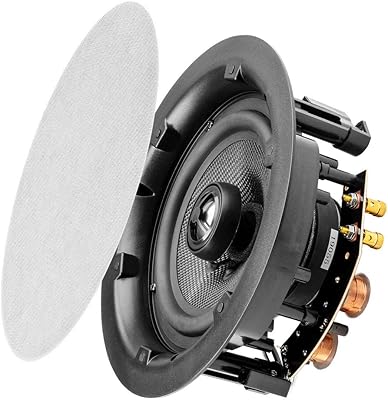
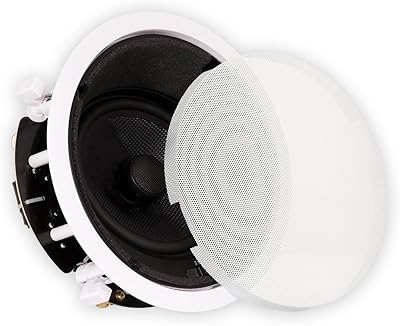
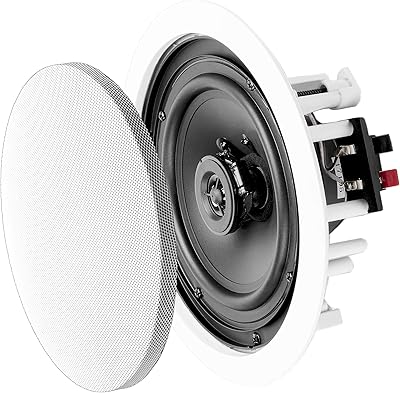
Overview

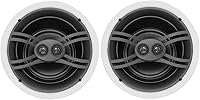
The Yamaha NS-IW280CWH 6.5″ In-Ceiling Speakers represent Yamaha's mid-range answer to clean, unobtrusive home audio — a category they've been refining since this model launched back in 2007. What sets them apart from the typical in-ceiling option is the 3-way driver configuration, which most competing speakers at this price point simply don't offer. The flush-mount design with a paintable aluminum grille means they can disappear into virtually any ceiling finish. One thing to be clear about upfront: these are passive speakers. You'll need a separate amplifier or AV receiver to drive them — something buyers occasionally overlook before purchasing.
Features & Benefits

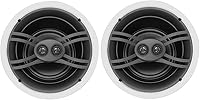
The 6.5-inch PP mica cone woofer handles low-end duties with more control than you'd expect from a ceiling-mounted driver, making it genuinely usable in rooms up to about 200 square feet without reaching for a subwoofer. The dual swivel tweeters are a standout — each can be angled independently, so you can direct high frequencies exactly where your listening position is rather than letting them scatter. The tilted woofer adds a similar directional advantage. With 100W maximum input capacity and a standard 8-ohm impedance, these Yamaha in-ceiling speakers will pair cleanly with most mid-range AV receivers without any matching headaches.

Best For

This Yamaha ceiling speaker pair is a natural fit for whole-home audio builds — think living rooms, hallways, and dining areas where you want background music without visual clutter. Home theater enthusiasts will also find them useful for adding surround or overhead channels without sacrificing floor space to freestanding speakers. Contractors doing new construction work tend to appreciate the included cutout template and straightforward mounting system. That said, if your room is large or you're after heavy bass from movies or music, plan to run a dedicated subwoofer alongside them. For smaller, aesthetics-conscious spaces, they hit a practical sweet spot.

User Feedback

Long-term owners consistently praise the sound clarity at moderate volumes and the flexibility the swivel tweeters give them for dialing in coverage across an asymmetric room. The installation process draws positive comments too — the included cutout template removes most of the guesswork, and the paint-protective grille cover is a small detail that actually earns its keep during ceiling finishing work. On the critical side, buyers in larger rooms regularly note that bass feels thin without a subwoofer in support. A few users have flagged that grille paint adhesion isn't always perfect, though this seems more finish-dependent than a consistent flaw. Overall, the NS-IW280CWH set has held up well across many years of real-world use.

Pros

  • The 3-way driver configuration delivers noticeably cleaner sound than the 2-way ceiling speakers most competitors offer at this price.
  • Dual swivel tweeters let you aim high frequencies directly at your seating area — a practical feature that makes a real audible difference.
  • The tilted woofer design compensates for ceiling placement by directing sound toward the listener rather than straight at the floor.
  • Paintable aluminum grille blends invisibly into any ceiling finish, making these Yamaha in-ceiling speakers genuinely unobtrusive once installed.
  • Standard 8-ohm impedance pairs cleanly with virtually any mainstream AV receiver or multi-zone amplifier without compatibility issues.
  • The included cutout template takes the guesswork out of ceiling prep, making DIY installation realistic even for first-timers.
  • With a 100W maximum input rating, this Yamaha ceiling speaker pair handles dynamic audio peaks without distortion at normal home listening levels.
  • A market track record stretching back to 2007 means real long-term durability data exists — and most owners report sustained performance over many years.
  • The paint-protective grille cover is a thoughtful inclusion that protects the driver during ceiling finishing work.

Cons

  • Bass output falls noticeably short in rooms larger than roughly 200 square feet, making a subwoofer a near-requirement in open-plan spaces.
  • These are passive speakers — buyers must budget separately for an AV receiver or amplifier, which adds significant cost to the total setup.
  • Grille paint adhesion can be inconsistent without a primer coat first, which adds an extra finishing step many buyers don't anticipate.
  • Ceiling-mounted placement is an inherent imaging compromise; don't expect the soundstage depth of a properly positioned bookshelf speaker.
  • At nearly 12 inches deep, tight ceiling cavities or awkward joist placement can complicate installation in older homes.
  • Speaker wire is not included, which is easy to forget when budgeting for a multi-room installation.
  • The swivel mechanism has no detented positions, making it fiddly to lock tweeters at a precise angle during setup.
  • The instruction sheet is thin on detail — buyers new to in-ceiling audio may need to rely on third-party installation guides.
  • High-volume performance in larger rooms degrades noticeably, as these are optimized for consistent moderate-level coverage rather than high-output listening.

Ratings

The Yamaha NS-IW280CWH 6.5″ In-Ceiling Speakers have accumulated a substantial body of verified buyer feedback over their long market life, and our AI has analyzed that global data — actively filtering out incentivized reviews, duplicate submissions, and bot activity — to produce the scores below. These Yamaha in-ceiling speakers earn strong marks in several areas, but the ratings also surface genuine limitations that real buyers run into. Both sides of that picture are reflected here, without softening the weak spots.
Sound Clarity
83%
Buyers consistently describe midrange reproduction as clean and well-defined, particularly for speech, acoustic music, and TV dialogue. The 3-way configuration gives these Yamaha in-ceiling speakers a noticeable clarity advantage over typical 2-way ceiling options at the same price tier.
At higher volumes, some listeners report a slight harshness creeping into the upper midrange, especially in rooms with hard surfaces like tile or drywall. Ceiling placement also limits the stereo imaging you'd get from conventional speakers, which is an inherent constraint rather than a manufacturing flaw.
Bass Performance
61%
39%
In smaller rooms — think a home office, a compact bedroom, or a hallway — the 6.5-inch woofer delivers enough low-end body to make background music feel full and satisfying. For casual listening, many buyers say they don't miss a subwoofer at all.
In living rooms and open-plan spaces, the bass falls noticeably short. Users regularly mention that movie soundtracks and bass-heavy music feel thin without a dedicated subwoofer running alongside the NS-IW280CWH set, which is an added cost buyers should factor in upfront.
Tweeter Performance
88%
The dual swivel tweeters draw consistent praise for the control they give listeners — being able to angle each one independently toward a sofa or kitchen island is a practical feature that most competing ceiling speakers skip entirely. High frequencies come through crisp without becoming fatiguing.
A small number of buyers note that the tweeter output can feel slightly bright in acoustically reflective rooms. The dual-tweeter setup also means the dispersion pattern is wider than some installations need, which occasionally creates off-axis hotspots.
Installation Ease
86%
The included cutout template takes most of the stress out of the ceiling prep work, and buyers — including first-timers — frequently mention completing the install in under an hour per speaker. The dog-leg spring clamp system is simple enough that you don't need a professional to get clean results.
The speaker depth of nearly 12 inches means shallow ceiling cavities or joists running in awkward directions can complicate the install. A handful of buyers report difficulty with wire management when attic access isn't available, which is less about the speaker design and more about older construction realities.
Build Quality
79%
21%
The aluminum grille feels solid and doesn't rattle at moderate listening levels — something buyers of cheaper in-ceiling speakers often complain about. For a passive speaker system that lives behind a painted grille, the physical construction inspires reasonable confidence in long-term durability.
The plastic speaker basket and mounting hardware feel adequate rather than premium. A few long-term owners note that the mounting clips show some wear after years of ceiling vibration, though outright failure reports are rare given how long this product has been available.
Grille & Finish
72%
28%
The paintable aluminum grille is a genuine convenience for anyone doing a renovation or new build — being able to match the ceiling color exactly means these Yamaha in-ceiling speakers essentially vanish once installed and painted. The included protective cover does a reasonable job shielding the driver during painting.
Paint adhesion on the grille is inconsistent. Several buyers report that ceiling paint doesn't bond well to the aluminum surface without a primer coat first, and a few note that the protective cover lets paint mist through onto the woofer if the painter isn't careful. Not a dealbreaker, but worth knowing.
Value for Money
77%
23%
Relative to similarly priced in-ceiling options from lesser-known brands, these Yamaha ceiling speakers deliver a noticeable step up in audio performance and build confidence. Buyers doing multi-room installs particularly appreciate that the price per pair stays manageable when purchasing several sets.
The need for a separate AV receiver or amplifier pushes the real total cost significantly higher than the speaker price alone suggests. For buyers who haven't factored that in, the value proposition can feel weaker once they add up the full system cost.
Swivel Tweeter Flexibility
91%
This is one of the most frequently praised features across buyer reviews. Being able to direct the tweeters toward an off-center seating area — like a couch positioned against one wall — solves a real acoustic problem that fixed-tweeter ceiling speakers simply can't address. Buyers describe noticeably better stereo presence after adjusting the angles.
The swivel mechanism, while useful, doesn't have detented positions — it's free-moving, which means finding and holding the exact angle requires some patience during setup. Over time, a small number of buyers report the swivel loosening slightly, though most say it remains functional.
AV Receiver Compatibility
89%
The standard 8-ohm impedance means the NS-IW280CWH set works cleanly with virtually any mainstream AV receiver or multi-zone amplifier without any impedance-matching headaches. Buyers running multi-room audio systems with brands like Denon, Yamaha, or Onkyo report no pairing issues.
These are purely passive speakers with no built-in amplification, which rules them out for anyone hoping to connect directly to a TV or streaming device without an intermediary amplifier. This limitation catches some buyers off guard, particularly those newer to wired audio systems.
Long-Term Durability
81%
19%
Having been on the market since 2007, there's a real-world track record here that most in-ceiling speakers can't match. Buyers who installed these years ago frequently return to leave updates noting the speakers still perform without noticeable degradation, which is reassuring for a ceiling-mounted application where replacement is inconvenient.
A small cohort of long-term owners report slight discoloration around the grille edge after several years, particularly in rooms with high humidity. The mica cone woofer appears to hold up well, but the mounting hardware is the component most likely to show age in high-vibration environments.
Stereo Imaging
58%
42%
For background music, the stereo spread from a properly angled pair of these Yamaha in-ceiling speakers is genuinely pleasant — wide enough to fill a room without sounding like audio is coming from a single point. The swivel tweeters help recover some directionality that ceiling placement typically sacrifices.
Ceiling mounting is inherently a compromise for stereo imaging, and the NS-IW280CWH set is no exception. Buyers using these as primary listening speakers for critical music enjoyment often find the soundstage feels diffuse and lacks the depth of floor-standing or bookshelf alternatives.
High-Volume Performance
69%
31%
With a 100W maximum input rating, these speakers handle dynamic peaks in movies and live recordings without distorting at the volume levels most home installations realistically use. Buyers running them off mid-range receivers in the 50-80W range report clean, distortion-free output.
Push the volume hard in a larger room and the limitations of ceiling-mounted drivers become apparent — the sound can feel strained and directional coherence degrades. These aren't speakers designed for loud party audio; they're optimized for consistent, moderate-volume coverage across a room.
Package Completeness
84%
Yamaha includes the cutout template, paint-protective cover, and grille clips in the box, which removes a surprising number of frustrations from the first install. Buyers who've purchased other brands note that competitors often ship the speakers with nothing but the grilles, leaving installers to source templates themselves.
Speaker wire is not included, which is expected at this category level but still catches some buyers off guard. The instruction sheet is minimal — functional, but not detailed enough for a first-time installer who's never cut a ceiling before.
Room Size Suitability
66%
34%
In small-to-medium spaces, this Yamaha ceiling speaker pair genuinely punches above what you'd expect from a ceiling-mounted driver. Rooms in the 100–200 square foot range are where these speakers sound most balanced and complete without any supplemental bass support.
Beyond 200 square feet, the audio feels noticeably spread thin. Buyers with open-plan living and dining areas consistently flag that the sound loses impact at practical ceiling heights, and that a second pair or subwoofer integration becomes less optional and more necessary.

Suitable for:

The Yamaha NS-IW280CWH 6.5″ In-Ceiling Speakers are an excellent fit for homeowners who want clean, invisible audio without sacrificing sound quality or cluttering their living spaces with freestanding equipment. If you're building a whole-home audio system and want consistent, room-filling sound in bedrooms, hallways, kitchens, or a dedicated listening room, this Yamaha ceiling speaker pair belongs on your shortlist. Home theater enthusiasts adding surround or ambient height channels will appreciate the 3-way configuration, which outperforms the typical 2-way ceiling speakers often bundled into budget surround kits. Contractors and custom AV installers working on new construction will find the included cutout template and standard 8-ohm impedance make multi-room deployments straightforward. These speakers are also a natural choice for design-conscious buyers — once painted to match the ceiling, they genuinely disappear, which matters a great deal in showroom-style interiors or rental properties where aesthetics are non-negotiable.

Not suitable for:

If your primary listening space is large, open-plan, or acoustically demanding, the NS-IW280CWH set will likely leave you wanting more — particularly in the low end, where a dedicated subwoofer becomes less of an optional add-on and more of a necessity. Buyers expecting a plug-and-play experience should look elsewhere; these are passive speakers requiring a separate AV receiver or amplifier, which adds both cost and complexity that not everyone anticipates. Critical listeners who prioritize precise stereo imaging for serious music listening will find ceiling placement an inherent compromise regardless of brand, and these Yamaha in-ceiling speakers are no exception to that acoustic reality. Anyone shopping for outdoor or high-humidity environments should also pass — these are rated strictly for indoor, dry installations. Finally, budget-conscious buyers need to think about the total system cost: the speakers alone are just one piece, and a quality amplifier to drive them properly represents a meaningful additional investment.

Specifications

  • Driver Config: Each speaker uses a 3-way driver layout, combining a 6.5″ PP mica cone woofer, a midrange driver, and dual 3/4″ dome tweeters for broader frequency coverage than typical 2-way ceiling speakers.
  • Woofer Size: The primary woofer measures 6.5 inches in diameter and uses a polypropylene mica cone material chosen for its balance of stiffness and low resonance coloration.
  • Tweeter Type: Each speaker features dual 3/4″ dome tweeters built under Yamaha's SoundMax design, with individual swivel adjustment to allow directional aiming toward a listening position.
  • Power Handling: Maximum input power is rated at 100W per speaker, with a nominal output of 60W, providing ample headroom for dynamic music and cinematic content without clipping.
  • Impedance: Both speakers in the pair are rated at 8 ohms, making them broadly compatible with standard home AV receivers and multi-zone amplifiers without any special impedance-matching equipment.
  • Mounting Type: Designed primarily for in-ceiling installation, the speakers can also be mounted in-wall, using a spring-clamp dog-leg bracket system that clamps to drywall or plaster surfaces.
  • Grille Material: The included grille is constructed from aluminum and is fully paintable, allowing it to be finished to match any ceiling color for a flush, invisible appearance.
  • Dimensions: Each speaker unit measures 13.4″ deep by 12.1″ wide by 11.6″ high, so ceiling cavities should be verified for adequate depth before installation begins.
  • Weight: The complete pair weighs 8 pounds total, making ceiling handling manageable for a single installer during the mounting process.
  • Connectivity: These are entirely wired, passive speakers with no wireless or Bluetooth capability; connection is made via standard speaker wire terminals on the rear of each unit.
  • Waterproofing: These speakers carry no waterproof or moisture-resistance rating and are intended strictly for indoor, dry-environment installations.
  • Included Items: Each package includes two speakers, two paintable aluminum grilles, a ceiling cutout template, a paint-protective cover for the drivers, two adhesive glue strips for grille attachment, and Yamaha warranty documentation.
  • Surround Config: The pair is configured for 3.0 surround channel use, making it suitable for stereo music distribution or as part of a broader multi-channel home theater layout.
  • Woofer Angle: The woofer baffle is set at a deliberate tilt angle rather than firing directly downward, allowing the driver to project sound toward a seating area rather than straight at the floor.
  • Warranty: Yamaha provides a limited warranty with this product; buyers should register the product with Yamaha directly to confirm current coverage terms and duration in their region.
  • Availability: This model has been in continuous production since April 2007, giving it an unusually long commercial track record for a consumer electronics product.
  • Impedance Type: Speaker impedance is fixed at 8 ohms with no switchable impedance modes, which suits the vast majority of home AV receiver configurations sold in North America and Europe.
  • Finish Color: The speakers and grilles are finished in white as standard, suited for installation in rooms with white or light-colored ceilings without requiring repainting.

Related Reviews
Yamaha NS-IC800 8-Inch In-Ceiling Speakers
85%
88%
Sound Quality
91%
Installation Ease
85%
Build Quality
75%
Bass Response
89%
Frequency Range
More
Pyle PDIC68FG 6.5” Ceiling Speaker Set
86%
86%
Sound Quality
92%
Ease of Installation
68%
Bass Response
88%
Build Quality
90%
Compatibility with Ceiling/Wall
More
Polk Audio MC60 6.5-inch In-Ceiling Speaker
80%
88%
Sound Clarity
91%
Installation Ease
83%
Moisture Resistance
72%
Value for Money
79%
Tweeter Performance
More
Yamaha NS-IW480CWH 3-way In-ceiling Speaker System
88%
93%
Sound Quality
88%
Ease of Installation
91%
Value for Money
90%
Compatibility with Home Theater Systems
85%
Build Quality
More
OSD Audio ACE640 6.5″ In-Ceiling Speaker Pair
85%
91%
Sound Clarity
78%
Bass Response
88%
Tweeter Directionality
85%
Installation Ease
82%
Build Quality
More
Herdio HCS-818 6.5-Inch Passive Ceiling Speakers
75%
73%
Sound Quality
91%
Installation Ease
84%
Value for Money
67%
Build Quality
88%
Amplifier Compatibility
More
Theater Solutions TSS6A 6.5″ Angled In-Ceiling Speaker
87%
91%
Sound Quality
87%
Ease of Installation
89%
Build Quality
92%
Value for Money
85%
Frequency Response
More
OSD Audio ICE610 6.5″ In-Ceiling Speaker Pair
79%
83%
Sound Clarity
61%
Bass Performance
91%
Installation Ease
78%
Build Quality
86%
Grille & Aesthetics
More
OSD Audio ACE670 6.5″ Trimless In-Ceiling LCR Speaker
88%
95%
Sound Clarity
92%
Bass Response
90%
Surround Sound Imaging
88%
Dolby Atmos Performance
85%
Ease of Installation
More
Cerwin Vega XLS-6 6.5″ Bookshelf Speaker
84%
92%
Sound Quality
88%
Bass Performance
87%
Build Quality
83%
Ease of Setup
89%
Durability
More

FAQ

You do need a separate amplifier or AV receiver — these are passive speakers with no built-in power source. Connecting them directly to a TV's speaker output terminals is possible only if your TV has a dedicated speaker output, which most modern flat-panel TVs do not. Plan for a standalone AV receiver or a dedicated in-ceiling speaker amplifier as part of your budget.

Each speaker is roughly 11.6 inches deep, so your ceiling cavity needs to accommodate at least that depth — plus a little extra for wire routing. In newer construction with standard drywall ceilings and open joist bays, this is rarely a problem. In older homes with shallower cavities or dense insulation packed tightly between joists, it is worth measuring before you cut.

Yes, that's exactly what they're designed for. The aluminum grilles accept standard ceiling paint well, though buyers consistently recommend applying a light primer coat first to help adhesion — bare aluminum can cause some paints to bead or peel over time. Use the included paint-protective cover over the driver before spraying or rolling paint to avoid coating the cone.

No — these speakers carry no moisture or weather resistance rating and should be installed only in dry indoor environments. For covered outdoor areas, you would need speakers specifically rated for outdoor or high-humidity exposure. Using these outside, even in a covered space, risks water ingress and long-term driver damage.

Realistically, one pair works best in rooms up to about 200 square feet. In a larger open-plan space, you'll likely find the coverage feels thin and the bass underwhelming. Running a second pair in a distributed zone, and adding a subwoofer for low-end support, is a practical solution for bigger rooms.

Each of the dual tweeters on every speaker can be physically rotated to aim toward a specific direction in the room. So if your sofa sits off to one side rather than directly below the speaker, you can angle the tweeters toward it instead of leaving them pointing straight down. In practice, buyers who take the time to adjust them properly report a noticeably more focused and natural-sounding high frequency response compared to fixed-tweeter alternatives.

Because these Yamaha in-ceiling speakers are rated at a standard 8 ohms, they pair cleanly with virtually any mainstream AV receiver — Denon, Yamaha, Onkyo, Marantz, and similar brands are all regularly mentioned by buyers without any compatibility complaints. The 100W maximum input means most receivers in the 50–80W per channel range drive them comfortably without pushing the speakers into distress.

Most buyers with basic DIY confidence — comfortable using a drywall saw and running speaker wire through walls — manage the install without professional help. The included cutout template removes the main source of error, and the spring-clamp mounting system is straightforward once the hole is cut. Where things get more complex is in homes with difficult attic access or dense insulation, where routing wire cleanly can take considerably more time and patience.

Speaker wire is not included in the box. You'll need to source and run your own wire from the amplifier or receiver location to each speaker position. For in-ceiling runs, most installers use 14-gauge or 16-gauge CL2-rated in-wall speaker cable, which is designed to meet fire code requirements for wires run inside wall and ceiling cavities.

Given that this model has been on the market since 2007, there's genuine long-term feedback to draw from — and the picture is mostly positive. Most long-term owners report that the drivers perform consistently years after installation without perceptible degradation. Some note minor cosmetic issues like slight grille discoloration in humid rooms, and a small number mention the mounting hardware showing wear over time, but outright failures are rarely reported.

Where to Buy