Overview

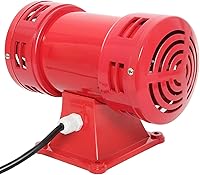
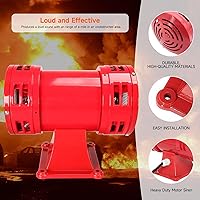
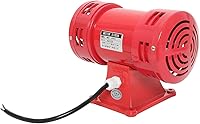
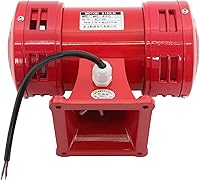
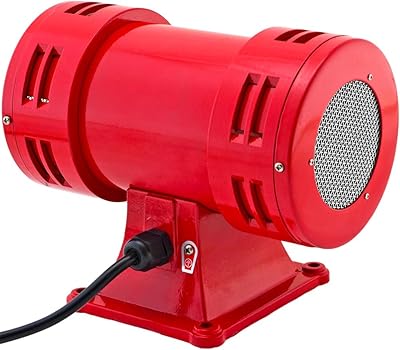
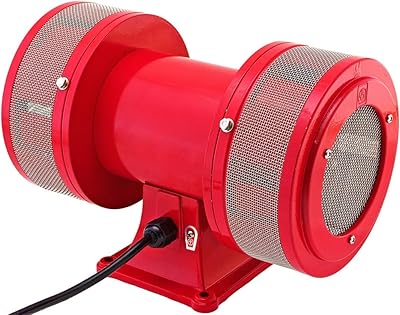
The YaeCCC RA-0121 Air Raid Siren is a corded, motor-driven alarm built for environments where a plastic horn simply won't cut it. Unlike battery-operated options that fail at the worst possible moment, this electric siren pulls power directly from a standard 110V AC outlet, making it a permanent fixture rather than a stopgap. The heavy-gauge steel housing gives it an immediately industrial feel — solid, weighty at just over five and a half pounds, and clearly built to handle vibration and rough conditions. It sits in a mid-range price bracket that makes sense given the build quality on offer, not a cheap novelty but not an enterprise-grade system either.

Features & Benefits

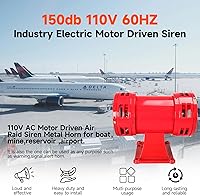
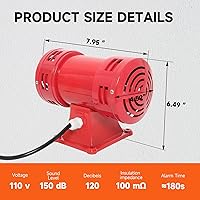
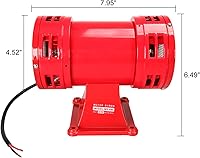
The motor inside this air-raid horn spins fast enough to produce a continuous wailing tone rated at 150 decibels — though real-world performance will vary by distance and environment, so treat that number as a ceiling rather than a constant. That said, the sound carries impressively across open ground, with an effective range approaching a full mile in unobstructed conditions. Mounting takes just four screws, and the compact body — roughly eight inches long and six and a half inches tall — rarely creates space issues. Standard 110V wiring means no special electrical work for most North American installations, which keeps the barrier to entry low for anyone comfortable with basic wiring.

Best For

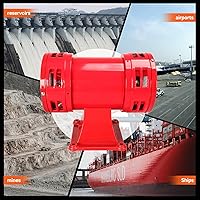
This motor-driven alarm makes the most sense for people with a real, practical alerting need. Factories and warehouses are natural fits — a shift-change signal that reaches every corner of a large floor without relying on PA systems is hard to replicate cheaply. Farms and rural homesteads benefit from the outdoor range, especially where distances between buildings are significant. Docks and marine environments appreciate the all-steel build that holds up in damp, harsh conditions. Schools and community centers running fire-drill protocols will find the volume hard to miss. Collectors and prop builders — haunted attractions, film sets — also form a genuine segment of buyers drawn to the classic mechanical sound.

User Feedback

Buyers consistently report that the loudness genuinely surprises them in a good way — the sound output lives up to expectations for most outdoor and large-space applications. The most common frustration is wiring setup: this electric siren has no built-in switch. You'll need an external contactor or relay to control it, which first-time buyers sometimes don't anticipate until the unit arrives. The steel housing earns consistent praise for feeling solid and well-made straight out of the box. A smaller number of users note the 150dB rating feels optimistic at longer distances, and a few report inconsistency in motor noise over extended duty cycles. Overall, sentiment trends positive, with most criticism pointing at installation prep rather than the siren itself.

Pros

  • Steel housing feels genuinely solid and industrial — not flimsy or hollow like cheaper plastic alternatives.
  • Sound output at close to mid range genuinely surprises most buyers with its real-world carrying power.
  • Four-screw wall-mount installation is straightforward for anyone comfortable with basic hardware tasks.
  • Corded 110V operation means no batteries to replace and no risk of the unit going dead when you need it most.
  • Compact body fits tight mounting locations without sacrificing output volume.
  • Works well in harsh outdoor environments where moisture, vibration, and temperature swings are routine.
  • The classic motor-driven wail is distinctly attention-grabbing in a way that electronic beepers simply are not.
  • A practical mid-range price point makes it accessible for small businesses, farms, and serious hobbyists alike.

Cons

  • No built-in switch means you cannot operate this electric siren without purchasing and wiring a separate external relay or contactor.
  • The 150dB rating is a peak spec — perceived loudness at longer distances falls off noticeably and may not match expectations.
  • No included wiring diagram or setup instructions, which creates a frustrating first experience for buyers without electrical background.
  • The power cord length may be insufficient for some mounting locations, requiring an extension or repositioning of the power source.
  • Motor noise consistency has been questioned by a small number of users over extended or repeated duty cycles.
  • No weather-sealing or IP rating is specified, leaving outdoor durability in rain or high-humidity environments somewhat uncertain.
  • The unit ships with no integrated timing or control features, making automation require additional third-party components.
  • Color and size options are fixed — no variants available if the standard red finish or current dimensions do not suit your installation.

Ratings

The scores below reflect AI-driven analysis of verified buyer reviews for the YaeCCC RA-0121 Air Raid Siren, collected from global sources with spam, bot-submitted, and incentivized feedback actively filtered out. Each category is scored to reflect the honest distribution of real user experiences — strengths are credited where they're earned, and genuine pain points are not glossed over. The result is a transparent, balanced picture of where this motor-driven alarm excels and where it asks more of the buyer.

Sound Output
83%
The raw volume this unit delivers consistently catches buyers off guard in the best way — warehouse managers, farm owners, and dock operators all report that the wail cuts through ambient industrial noise without strain. At close to mid range, the mechanical tone is genuinely hard to ignore, which is exactly the point for emergency alerting.
The advertised 150dB peak figure is a lab-condition ceiling, and some buyers feel the real-world output at longer distances falls short of that expectation. In built-up or acoustically complex environments like multi-building facilities, the effective range drops more sharply than the spec sheet implies.
Build Quality
88%
The all-steel housing is consistently praised for feeling substantial and serious the moment it comes out of the box — nothing rattles, nothing flexes, and the paint finish holds up well to workshop and outdoor conditions. Buyers replacing cheap plastic horns often comment that this feels like an entirely different category of product.
A small number of buyers have noted minor surface rust appearing at weld points after extended outdoor exposure, suggesting the steel lacks a heavy-duty protective coating. The mounting hardware included is basic, and a few users report that screws stripped slightly during installation into harder wall materials.
Installation Ease
61%
39%
The physical wall-mount process is genuinely simple — four screws, a solid surface, and ten minutes of work for anyone with basic DIY confidence. The compact body makes positioning flexible, and the unit sits flush and stable once mounted correctly.
The installation experience falls apart when buyers discover there is no built-in switch and no wiring diagram in the box. Sourcing and wiring an external relay or contactor is a non-trivial step that surprises a meaningful share of first-time buyers, and the lack of any guidance from the manufacturer makes this frustrating.
Value for Money
76%
24%
Relative to comparable industrial-grade steel sirens, the mid-range price point is fair for what you receive in terms of materials and raw output. Buyers who install it correctly and use it in the right environment — farms, warehouses, docks — tend to feel the purchase was justified and durable long-term.
Buyers who underestimate the wiring requirements end up spending additional money on a relay, contactor, and potentially electrician fees, which pushes the real total cost noticeably above the sticker price. For casual or one-off use cases, that hidden setup cost makes the value equation less compelling.
Volume Consistency
71%
29%
Under normal, controlled operating conditions — short duty cycles with adequate cool-down — the motor maintains a consistent, steady wail that does what it's supposed to do without dipping or wavering. Buyers using it for scheduled shift signals report dependable, repeatable performance over months of use.
A subset of long-term users report that the motor tone changes subtly after extended or continuous run cycles, sometimes producing a rougher or slightly uneven sound. Whether this represents motor wear or a thermal effect is unclear, but it suggests the unit is better suited to intermittent use than truly continuous operation.
Outdoor Durability
69%
31%
The steel construction handles rain splash, humidity, and temperature swings better than any plastic-bodied alternative at this price, and buyers in coastal and agricultural settings report years of functional use from covered outdoor installations. The weight and rigidity also mean wind and vibration don't loosen the mount over time.
Without a published IP rating or any weatherproofing specification, fully exposed outdoor mounting is a gamble — especially in high-humidity or salt-air environments where rust can develop around seams and motor vents over time. The lack of any sealant on the motor housing is a gap buyers in wet climates should account for.
Effective Range
74%
26%
In genuinely open terrain — flat farmland, open industrial yards, unobstructed dockside areas — buyers confirm the sound carries impressively, easily covering distances that defeat any consumer buzzer or electronic horn. Rural property owners particularly value the ability to reach distant outbuildings with a single fixed unit.
Any meaningful obstruction — tree lines, multiple buildings, or terrain variation — cuts the effective range considerably and makes the near-mile claim feel optimistic. Urban or semi-industrial settings with background noise and physical barriers should expect significantly reduced usable range in practice.
Motor Performance
78%
22%
The high-speed motor spins up quickly and produces that distinctive, authentic mechanical wail that electronic sirens cannot replicate — a quality that matters both to industrial users and to hobbyists or prop builders who need the real sound, not a digital approximation. Startup time is fast and the tone establishes immediately.
Motor longevity under sustained heavy use is an open question, as most reviewers have not operated the unit long enough to stress-test it thoroughly. A few buyers report a slight grinding or rattling quality in the motor sound after many months of repeated use, which hints at bearing wear over time.
Mounting Stability
82%
18%
Once properly anchored to a stud or solid masonry surface, the unit sits rock-solid and handles its own vibration without working loose — even buyers who run it frequently for shift-change schedules report no drift or loosening after extended installation periods. The four-point mount distributes load well.
Mounting into drywall only, without hitting a stud or using appropriate anchors, results in visible vibration and a unit that gradually pulls away from the wall surface. The included hardware is minimal and not suited for all wall types, so buyers should source appropriate fasteners for their specific surface.
Aesthetic & Form Factor
79%
21%
The classic red steel body with its motor-horn profile has genuine visual appeal for buyers who want the look and feel of a real industrial or civil defense alarm — it reads as authentic rather than toylike, which matters for film productions, themed installations, and professional facility environments alike.
The single red color finish offers no options for buyers who need a specific color for safety compliance or aesthetic matching. The retro industrial look is also completely out of place in any residential or office setting, which limits its decorative versatility for non-industrial buyers.
Noise Character
81%
19%
The mechanical wail produced by the motor-driven mechanism has a tonal quality and rise-fall character that genuinely commands attention in a way digital recordings struggle to match — event operators and prop builders specifically praise this as the key differentiator over cheaper electronic alternatives.
The sound is a single, fixed wail with no adjustable tone, pattern, or volume control — what you hear is what you get, every time. For applications that require varied alert patterns or selectable signal types, this air-raid horn offers no flexibility whatsoever.
Setup Documentation
38%
62%
The unit itself is mechanically uncomplicated and straightforward enough that experienced electricians or technically confident buyers can figure out the wiring requirements without help, especially with widely available online resources covering motor relay setups.
The complete absence of a wiring diagram, setup guide, or even a basic warning about the external switch requirement in the box is a genuine failure point — it is the single most complained-about aspect in buyer reviews. Many buyers only discover the relay requirement after the unit arrives, creating unnecessary frustration and additional cost.
Corded Reliability
86%
The fact that this electric siren draws directly from mains power means there is no battery degradation, no charging routine, and no risk of the alarm failing due to a dead cell during an actual emergency — industrial buyers particularly value this as a core reliability advantage over battery-dependent systems.
Being fully dependent on mains power is also a single point of failure — a power outage disables the unit entirely with no backup option. Facilities in areas prone to power interruptions should factor in whether a UPS or generator backup is part of their overall alerting strategy.

Suitable for:

The YaeCCC RA-0121 Air Raid Siren is a strong fit for anyone who needs a permanent, high-volume alerting solution in a large or noisy environment. Factory floor managers and warehouse supervisors will find it practical for shift changes, emergency evacuations, or zone alerts where a standard buzzer simply doesn't carry far enough. Farmers and rural property owners benefit from the near-mile outdoor range, making it useful for calling workers in from distant fields or triggering perimeter alerts across wide open land. Docks, boatyards, and marine facilities appreciate the all-steel construction that holds up in damp, corrosive conditions far better than plastic alternatives. Schools, community centers, and public buildings needing a reliable fire-drill or lockdown signal will also get solid value here. Even hobbyists — prop builders, haunted attraction operators, or collectors who want that authentic mechanical wail — will find this unit delivers the real thing rather than a digital imitation.

Not suitable for:

The YaeCCC RA-0121 Air Raid Siren is not the right choice for buyers expecting a plug-and-play device they can simply wire into a wall outlet and switch on directly. This unit has no built-in on/off switch; you must install an external contactor, relay, or control switch to operate it safely, which requires at least basic electrical knowledge and additional components not included in the box. Anyone looking for a portable or battery-powered option will need to look elsewhere entirely, as this is a fixed wall-mount installation designed to stay in one place. It is also a poor fit for residential or suburban settings where a siren at this volume would immediately disturb neighbors, violate noise ordinances, or create legal liability. Buyers hoping for a smart or remotely programmable alarm system will find the feature set too basic, as there is no built-in timer, wireless control, or integration with modern alarm panels.

Specifications

  • Voltage: The unit operates on 110V AC power, making it compatible with standard North American wall circuits without any voltage conversion.
  • Noise Level: The motor is rated to produce up to 150 decibels at peak output, though perceived loudness will decrease with distance and environmental obstructions.
  • Maximum Range: Sound can carry up to approximately one mile in open, unobstructed outdoor conditions under ideal circumstances.
  • Dimensions: The housing measures 7.95″ in length, 4.52″ in width, and 6.49″ in height, making it relatively compact for its output class.
  • Weight: The assembled unit weighs 5.65 pounds, reflecting the density of its all-steel construction.
  • Housing Material: The outer body is constructed from heavy-duty steel, offering resistance to physical impact, vibration, and general industrial wear.
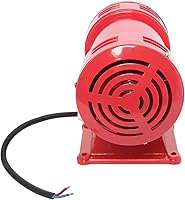
  • Motor Type: An internal high-speed electric motor drives the siren mechanism to generate a continuous, mechanical wailing tone.
  • Power Source: The unit is fully corded and requires a live 110V AC connection; it contains no internal battery and cannot operate without mains power.
  • Mounting Type: Designed for permanent wall mounting using four screws, with no alternative mounting configurations specified by the manufacturer.
  • Control Method: The siren has no integrated on/off switch and requires an externally wired contactor, relay, or control switch to start and stop operation.
  • Color: The unit ships in a single standard red finish with no alternative color variants available.
  • Part Number: The manufacturer part number is RA-0121, which can be used to verify compatibility and identify the correct replacement unit if needed.
  • Manufacturer: This product is made by Yae First Trading Co., Ltd, a Chinese manufacturer supplying industrial and commercial alerting hardware.
  • Package Contents: Each order includes one siren unit only; no external switch, relay, wiring hardware, or mounting fasteners are included in the box.
  • Batteries: No batteries are included or required at any point during operation, as the unit runs entirely on hardwired AC power.

Related Reviews
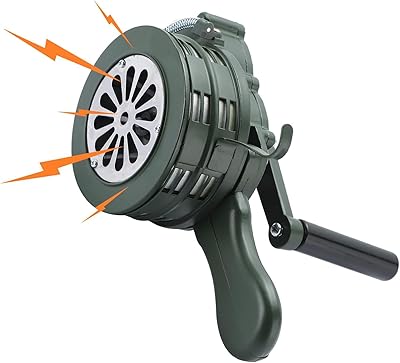
MAOPINER Handheld Air Raid Siren
85%
92%
Sound Loudness
89%
Portability
82%
Ease of Use
88%
Build Quality
78%
Manual Crank Operation
More
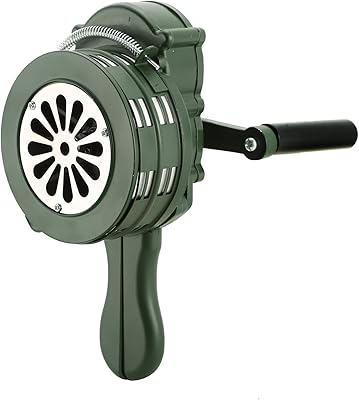
MYFULLY MY-0289 Manual Hand Crank Siren
78%
88%
Build Quality
83%
Sound Output
74%
Ease of Use
81%
Portability & Storage
93%
Battery-Free Reliability
More
Vixen Horns VXS-1450AR Industrial Air Raid Siren
79%
93%
Sound Output & Loudness
88%
Build Quality & Materials
84%
Installation Ease
61%
Duty Cycle & Continuous Operation
67%
Value for Money
More
Vixen Horns VXS-1050AR 116dB Air Raid Siren
78%
94%
Sound Output
88%
Range & Coverage
91%
Build Quality
83%
Ease of Installation
58%
Continuous Run Performance
More
YUHUO 360000RPM Cordless Electric Air Duster

75%
88%
Airflow Power
79%
Battery Life
54%
Noise Level
84%
Charging Speed
63%
Build Quality
More
Bumble and bumble Don't Blow It Fine (H)air Styler Air Dry Cream, 5 Fl Oz
84%
88%
Effectiveness for Fine Hair
90%
Lightweight Feel
85%
Volume and Body
92%
Ease of Use
80%
Scent/Fragrance
More
Garmin D2 Air X10
Garmin D2 Air X10
87%
89%
Aviation Features
92%
GPS Accuracy
85%
Battery Life
88%
Ease of Use
90%
Health Tracking
More
realme Buds Air 5
realme Buds Air 5
85%
89%
Sound Quality
91%
Active Noise Cancellation (ANC)
90%
Battery Life
84%
Comfort & Fit
87%
Gaming Performance
More
Truwelby MS-C001 Electric Air Duster
81%
83%
Airflow Performance
78%
Noise Level
74%
Battery Life
88%
Charging Speed
81%
Nozzle Versatility
More
YaeCCC 2000W Voltage Transformer
83%
88%
Build Quality
85%
Performance
82%
Usability
90%
Safety Features
87%
Value for Money
More

FAQ

No, it does not. This is one of the most important things to know before buying — the motor-driven alarm has no built-in switch whatsoever. To control it, you'll need to wire in an external relay, contactor, or a suitably rated toggle switch rated for the current draw. If you're not comfortable doing basic electrical wiring, budget for an electrician to handle that part.

Technically it will draw power from a standard 110V outlet, but without an external switch in the circuit, plugging it in will cause it to run continuously with no way to stop it short of unplugging. Most buyers route the power through a relay or external switch so they have proper control over when the alarm sounds.

The 150dB figure is the motor's peak rated output at very close range under ideal conditions — treat it as a ceiling, not a guarantee at distance. In practice, most buyers report that the volume is genuinely impressive and much louder than consumer-grade buzzers, but perceived loudness drops off with distance like any sound source. At a few hundred feet in open air it still carries strongly; across a full mile it will be much quieter.

The steel housing holds up well to general outdoor conditions and handles vibration and moisture exposure better than plastic units. That said, the manufacturer does not publish a formal IP weather-resistance rating, so mounting it in a fully exposed location with heavy rain or salt-air exposure involves some uncertainty. Many buyers mount it in a covered outdoor area or under an eave as a precaution.

The motor runs on 110V AC, so you'll want a relay or contactor rated for at least the motor's startup current, which is typically higher than its running current — a contactor rated for one horsepower or above on 120V AC is a common safe choice. For wiring, standard 14-gauge or 12-gauge household wire is appropriate for the circuit. If you're unsure, consulting a licensed electrician before installation is worthwhile.

The all-steel body resists rust and handles damp environments better than plastic alternatives, and many buyers do mount it outdoors. However, because no IP rating or weatherproof certification is specified, direct and sustained exposure to rain — especially on the motor vents — may shorten the unit's lifespan. A covered or semi-sheltered mounting location is the safer long-term choice.

No. This electric siren is designed specifically for 110V AC power and is not compatible with 220V or European-standard 230V circuits without a step-down transformer. Running it at higher voltages without conversion would likely damage or destroy the motor. If you're outside North America, you'll need a properly rated step-down transformer in the circuit.

It's straightforward if you have basic DIY experience. The housing has four mounting points and attaches to a wall surface with four screws. The main effort is ensuring you mount it to a solid surface — a stud, concrete wall, or backing plate — since the unit weighs nearly six pounds and will vibrate during operation. Drilling and basic tools are all that's required for the physical mount.

For most farm applications, yes. The range of close to a mile in open conditions means it can reach outbuildings, far fields, or equipment yards that smaller horns would never cover. Buyers using it to call workers in from the field or trigger alerts across large acreage report it performs well for that purpose. Just factor in that tree lines, hills, and buildings will reduce effective range in practice.

Absolutely, and this is actually a real and well-documented use case for the air-raid horn. The mechanical wail it produces is the authentic sound that digital recordings try to imitate, which makes it popular with haunted house operators, event designers, and film or TV prop teams. Just remember you'll need a properly wired control switch to trigger it on cue, and at this volume, coordination with your venue or set safety team is essential.

Where to Buy