Overview

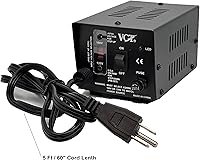
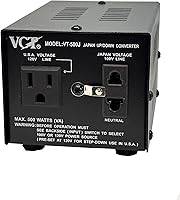
The VCT VT-500J 500W Japan/USA Voltage Transformer exists to solve a very specific problem: Japan runs on 100 volts while the US grid operates at 110 to 120 volts, and that gap is just enough to damage sensitive electronics or cause appliances to underperform. This Japan-USA converter is built for continuous daily use, not just the occasional test plug-in, which puts it in a different category from cheap travel adapters. It sits in the mid-range price tier — practical rather than premium — and its relatively compact size belies a solid, transformer-grade weight of nearly five pounds, typical for units that use real copper windings instead of electronic switching.
Features & Benefits

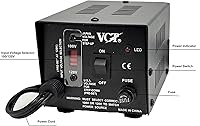
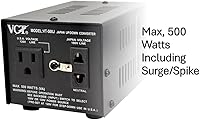
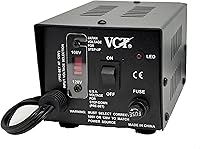
The VT-500J handles bidirectional voltage conversion — 100V to 120V and back — which means you don't need two separate units depending on which direction you're traveling. The 500-watt continuous rating is its practical ceiling, and VCT builds in an allowance for power surges, but you should still treat 500W as the hard limit. A rice cooker drawing 300W fits comfortably; a hair dryer pulling 1,200W does not. The built-in on/off switch lets you cut power without unplugging, which matters if the unit stays on a shelf long-term. Integrated fuse protection adds a basic safety layer, and the unit meets UL specifications — useful context, though not a guarantee against every misuse scenario.

Best For

This voltage transformer is a strong fit for expats and long-stay visitors who need a reliable, always-on solution rather than something they pack in a suitcase. If you have bought a Japanese rice cooker, audio amplifier, or small kitchen appliance and want to run it daily in the US, this converter handles that job well — as long as your device stays under the wattage limit. Americans heading to Japan with low-draw electronics or small tools will find it equally useful in the other direction. Where it falls short is with high-wattage appliances: anything with a heating element or motor that approaches or exceeds 500W is going to be a problem.

User Feedback

Buyers who use this Japan-USA converter for rice cookers and similar low-draw appliances tend to report solid long-term reliability — that continuous-use rating appears to hold up in practice. The more common frustrations come from people who underestimate the 500W ceiling; hitting it unexpectedly with an appliance that surges on startup is a recurring complaint, and the manual's guidance on power spikes isn't always absorbed before purchase. A few reviewers note the unit runs noticeably warm during extended use, which is normal for transformer-based designs but can be alarming if you're not expecting it. Build quality feedback is generally positive, with the weight actually reassuring buyers rather than turning them off.

Pros

  • Handles continuous daily use reliably — this isn't a flimsy travel adapter that overheats after an hour.
  • Bidirectional conversion means one unit works in both Japan and the US, no swapping required.
  • The built-in on/off switch lets you cut power without unplugging, a small but genuinely useful feature.
  • Integrated fuse protection provides a basic safety buffer against electrical faults.
  • Compact footprint for a transformer of this capacity — fits neatly behind a countertop appliance.
  • Meets UL specifications, which gives safety-conscious buyers a factual basis for confidence.
  • Works well for Japanese rice cookers and audio equipment, the two most common import use-cases.
  • Relatively accessible price for a continuous-duty transformer with bidirectional capability.
  • Build quality feels solid and appropriately substantial — the weight signals real copper windings, not cheap components.

Cons

  • The 500W ceiling is easy to underestimate, especially with appliances that surge on startup.
  • Manual guidance on power spikes and surge margins is not always clear enough to prevent misuse.
  • The unit runs noticeably warm during extended operation, which can be unsettling if you're not expecting it.
  • At nearly five pounds, the VT-500J is not practical for travel — it's a stationary solution only.
  • No indicator light to show the unit is live, which makes it easy to forget it's on.
  • The Type K plug format may require an additional adapter depending on your specific outlet configuration.
  • Not suitable for heating appliances or power tools, which cuts out a large category of potential use-cases.
  • Fuse replacement, while straightforward, adds a maintenance consideration most buyers don't anticipate upfront.

Ratings

The scores below were generated by AI after analyzing verified global buyer reviews for the VCT VT-500J 500W Japan/USA Voltage Transformer, with spam, bot submissions, and incentivized feedback actively filtered out. The ratings reflect real-world usage patterns from expats, importers, and everyday consumers across both Japan and the United States. Strengths and recurring pain points are represented transparently — no category has been softened to flatter the product.

Voltage Conversion Accuracy
91%
Buyers running Japanese rice cookers and audio equipment in the US consistently report stable, accurate output voltage with no noticeable impact on appliance performance. The bidirectional design means the same unit works reliably in both conversion directions without any reconfiguration.
A small number of users report minor voltage fluctuation under sustained high-load conditions approaching the 500W ceiling, though this appears to be an edge case rather than a systematic issue.
Continuous Use Reliability
84%
Long-term users — particularly expats who run appliances daily — report that this converter holds up well over months and years of regular use, which is the core promise of a continuous-duty rating. It earns genuine trust from people who depend on it every single day.
There are occasional reports of fuse failure after extended operation near the wattage limit, suggesting that buyers who consistently push the unit close to 500W may see shorter service life than those running lighter loads.
Wattage Capacity
67%
33%
For low-to-moderate draw appliances — rice cookers, small audio amplifiers, CPAP machines, fans — 500W is more than adequate and gives reasonable headroom for normal startup behavior. Most household appliances in the target use-case fall comfortably within this range.
The 500W ceiling is a hard constraint that frustrates buyers who discover after purchase that their intended appliance exceeds it, especially heating devices and power tools that spike aggressively on startup. This single limitation is the source of most negative reviews.
Build Quality
82%
18%
The unit feels substantial and purposefully constructed — the near five-pound weight communicates that real copper transformer windings are inside, not cheap electronic substitutes. Users frequently describe it as sturdy and industrial in a reassuring way.
The exterior finish is purely utilitarian, and a few buyers note that the casing can show scuff marks or minor wear over time in workshop or kitchen counter environments. There are no rubber feet on some units, which causes minor sliding on smooth surfaces.
Safety Features
78%
22%
Integrated fuse protection and UL specification compliance give safety-conscious buyers a factual foundation for confidence, especially those running the converter in a home with children or in an always-on kitchen setup. The fuse does its job when the unit is overloaded.
Beyond the fuse and UL spec, the safety feature set is basic — there is no thermal cutoff, no overload indicator light, and no audible alert if the unit is being stressed. Buyers expecting active protection monitoring will find the passive design underwhelming.
Ease of Use
88%
Setup requires no configuration — plug it in, connect your appliance, flip the switch. The built-in on/off switch is a small but genuinely appreciated feature that allows users to power down without crawling behind furniture to unplug the unit.
The absence of an indicator light means there is no visual confirmation that the unit is live, which has led to a few users leaving it on unintentionally for extended periods. A simple LED would eliminate this entirely.
Thermal Management
63%
37%
The warmth generated during extended operation is within normal parameters for transformer-based designs, and buyers who understand this report no concern after the initial surprise. The heat dissipates through the casing passively without any fan noise.
A meaningful number of buyers are caught off guard by how warm the casing gets after an hour or more of use, and a few have incorrectly interpreted this as a malfunction. The manual does not adequately prepare users for this expected behavior.
Portability
47%
53%
The compact 6″ by 3″ by 4″ footprint means it does not dominate a countertop or shelf, and it can be repositioned around a home without much effort. For a stationary installation, the size is genuinely reasonable.
At nearly five pounds, this is not a unit anyone should consider packing for travel. Multiple buyers purchased it expecting something more portable and were disappointed by the weight, which is simply a function of how transformer-based conversion works at this wattage.
Value for Money
76%
24%
For buyers who need exactly what this converter does — reliable, continuous bidirectional Japan-US voltage conversion for modest appliances — the price represents fair value for a continuous-duty unit with fuse protection and a recognizable brand behind it.
Buyers who hit the 500W limit quickly and need to upgrade feel the purchase was wasted money, and a handful of reviewers feel the price is slightly high for a unit without more advanced safety features or a broader wattage range.
Documentation & Guidance
54%
46%
The manual does address the surge and spike margin concept, which is genuinely important information that many buyers would otherwise overlook when selecting an appropriate wattage ceiling for their appliance.
The surge and spike guidance is not presented clearly enough to prevent repeated user errors — it is one of the most common complaint themes across reviews. A clearer, more prominent warning with specific appliance examples would have prevented a significant portion of negative experiences.
Noise Level
83%
Under normal operating conditions with a load well within the wattage range, the unit runs quietly with only a faint transformer hum that most users in kitchen or living room environments do not find intrusive. It is far quieter than any fan-cooled electronic converter.
At higher loads, the transformer hum becomes more noticeable, and a small number of buyers in quiet environments like bedrooms or home studios describe it as mildly distracting during nighttime or focused work sessions.
Plug & Outlet Compatibility
69%
31%
The Type K plug configuration works in most standard US and Japanese outlet setups that the target buyer base will encounter, and the corded design gives enough reach to avoid awkward positioning directly at the wall plate.
Some users find they need an additional adapter depending on their specific outlet configuration, which adds a minor extra cost and setup step that was not anticipated at the time of purchase. The product listing could be clearer about this.
Longevity
79%
21%
Buyers who use the converter within its rated parameters and leave adequate wattage headroom report multi-year service life with no degradation in conversion quality, which is a strong indicator of durable internal construction.
Units pushed consistently near the 500W threshold tend to show earlier fuse fatigue and, in some cases, reduced output stability over time. Longevity is closely tied to how responsibly the buyer manages the load — which not all users do.

Suitable for:

The VCT VT-500J 500W Japan/USA Voltage Transformer is built for people who need a dependable, everyday solution to the Japan-US voltage gap — not a one-time travel fix. Expats relocating between the two countries are the clearest fit, especially those shipping household appliances or audio equipment that wasn't designed for the destination country's grid. If you've brought back a Japanese rice cooker, a quality amplifier, or a compact kitchen appliance and want to use it daily without worrying about voltage damage, this converter handles that job at a reasonable price point. It's equally useful in reverse: Americans working or living in Japan who want to run US-spec electronics without hunting for local replacements will find the bidirectional capability genuinely practical. Anyone looking for a plug-and-leave setup — something that sits behind an appliance permanently rather than being packed and repacked — will appreciate the continuous-duty rating and the built-in on/off switch.
Not suitable for:

The VCT VT-500J 500W Japan/USA Voltage Transformer has a hard ceiling of 500 watts, and buyers who don't respect that limit will run into trouble fast. High-draw appliances like hair dryers, space heaters, toaster ovens, laser printers, and most power tools are simply incompatible — many of these spike well above 500W at startup, which can blow the fuse or damage connected devices. Even appliances that seem borderline should be evaluated carefully: a 400W device looks fine on paper, but startup surges can push actual draw significantly higher. This converter is also not the right choice for short-term travelers who just need a quick plug adapter; its nearly five-pound weight and corded design make it impractical to throw in a carry-on. Buyers expecting a sleek, lightweight unit will be surprised by the heft, and those unfamiliar with transformer behavior may be caught off guard by the warmth the unit generates during extended operation.
Specifications

  • Model Number: This unit is manufactured by VCT Electronics under the model designation VT-500J.
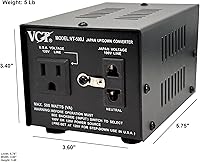
  • Wattage: Maximum continuous capacity is 500W, which also represents the ceiling for startup power surges.
  • Input Voltage: Accepts either 100V or 120V input, making it compatible with both Japanese and US wall outlets.
  • Output Voltage: Delivers either 100V or 120V output depending on conversion direction needed.
  • Conversion Type: Bidirectional design supports both step-up (100V to 120V) and step-down (120V to 100V) conversion in a single unit.
  • Dimensions: The unit measures approximately 6″ long by 3″ wide by 4″ tall, a compact footprint for its capacity.
  • Weight: Weighs approximately 4.9 pounds, consistent with transformer-based designs that use copper windings.
  • Power Switch: A built-in On/Off switch allows the user to cut power without physically unplugging the unit.
  • Safety Feature: Integrated fuse protection provides a basic electrical safeguard against overload or fault conditions.
  • Certification: Meets UL specifications, providing a baseline level of verified electrical safety compliance.
  • Power Source: Corded electric — requires a standard wall outlet and is not battery-operated or rechargeable.
  • Plug Format: Ships with a Type K plug configuration; users should verify outlet compatibility before use.
  • Use Classification: Rated for continuous duty, meaning it is engineered to run for extended periods rather than short intermittent sessions.
  • Color: Available in black with a utilitarian, no-frills exterior finish.
  • Package Quantity: Sold as a single unit with no additional converters, adapters, or accessories included in the box.

Related Reviews
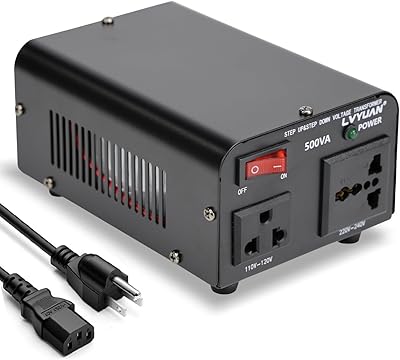
LVYUAN VTUS-500 Voltage Transformer Converter 500W
83%
92%
Value for Money
88%
Ease of Use
85%
Build Quality
90%
Compactness/Portability
86%
Performance (Voltage Conversion)
More
LVYUAN VTUS-2500 2500W Voltage Transformer
76%
88%
Voltage Conversion Accuracy
83%
Build Quality
91%
Noise & Vibration
86%
Overload Protection
41%
Portability & Weight
More
YaeCCC 2000W Voltage Transformer
83%
88%
Build Quality
85%
Performance
82%
Usability
90%
Safety Features
87%
Value for Money
More
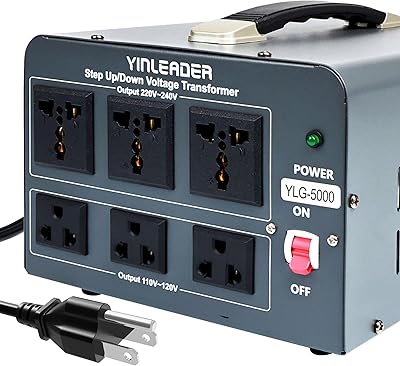
Yinleader YLG-5000 5000W Step Up/Down Transformer
79%
91%
Voltage Conversion Accuracy
88%
Build Quality & Durability
86%
Noise & Heat Management
89%
Safety Features
83%
Outlet Configuration & Usability
More
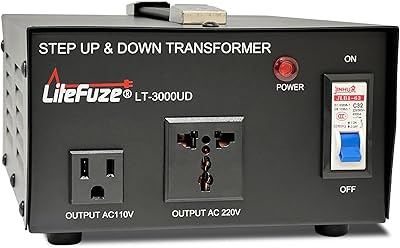
LiteFuze LT-3000UD Voltage Converter Transformer
86%
95%
Power Capacity (3000W)
90%
Build Quality & Durability
87%
Ease of Use
68%
Portability & Weight
93%
Safety Features (Circuit Breaker)
More
Yinleader VTUS-3000 Voltage Converter Transformer
85%
87%
Overall Performance
92%
Safety Features
90%
Ease of Use
85%
Portability
88%
Build Quality
More
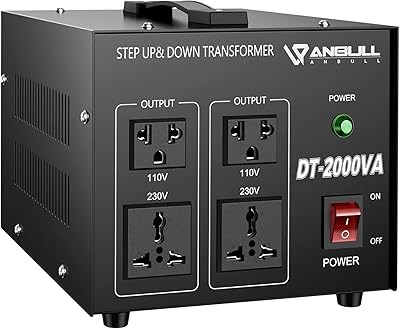
ANBULL DT-2000W 2000W Voltage Transformer
68%
88%
Build Quality
91%
Overload Protection
54%
Wattage Accuracy
67%
Ease of Setup
86%
Voltage Conversion Accuracy
More
Rockstone Power 5000W Step Up/Down Voltage Converter
78%
91%
Build Quality
88%
Voltage Stability
71%
Heat Management
83%
Ease of Setup
86%
Safety Features
More
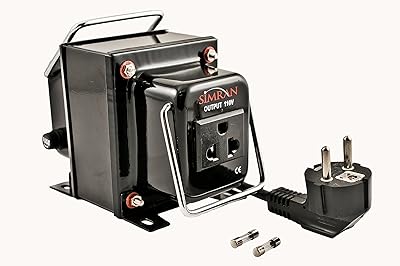
Simran THG-5000 Step Down Voltage Transformer 5000W
85%
91%
Build Quality & Durability
88%
Performance & Power Handling
85%
Ease of Use
68%
Portability
87%
Compatibility with Different Plug Types
More
ELC T-1000 1000W Voltage Converter Transformer
81%
93%
Noise Level
88%
Voltage Conversion Accuracy
84%
Build Quality
86%
Overload Protection
91%
Ease of Use
More

FAQ

It is rated for continuous duty, which means daily, all-day use is within its designed operating parameters. That said, make sure whatever you plug into it stays comfortably under the 500W limit to avoid stressing the unit long-term.

Yes, 300W is well within the 500W ceiling and a very common use-case for this converter. You have enough headroom to account for minor startup surges, so you should be fine for daily cooking use.

It works in both directions — you can convert from 100V Japanese power to 120V US power, or from 120V US power down to 100V Japanese power. One unit covers both scenarios, which is one of its main practical advantages.

Almost certainly not. Most hair dryers and space heaters draw between 1,000W and 1,875W, which is well above the 500W maximum. Plugging a high-draw heating appliance into this converter would blow the fuse at best and create a hazard at worst.

Yes, warmth is completely normal for transformer-based converters. Unlike electronic switching converters, these units use copper windings that generate some heat as a byproduct of operation. As long as it is not too hot to touch and you are within the wattage rating, that warmth is not a sign of a problem.

Check the wattage label on your appliance, usually found on a sticker on the bottom or back. If it shows 250W or less, you are well within range. If it is between 250W and 450W, it likely still works but leaves less buffer for startup surges. Heating appliances, laser printers, and motors tend to spike significantly above their rated wattage when first switched on, so treat those categories with extra caution.

No, and this distinction matters. A travel adapter only changes the physical plug shape — it does not change the voltage at all. This converter actually transforms the electrical voltage, which is what protects your appliance from receiving the wrong power level. If your device is not dual-voltage, a plug adapter alone will not protect it.

No, there is no indicator light on this model. The only way to confirm it is active is through the on/off switch position. It is worth developing a habit of checking the switch if the unit stays in a fixed location, since there is no visual reminder that power is flowing.

Technically the unit has one output, but even if you use a strip, the combined wattage of all connected devices must stay under 500W total. Running multiple devices simultaneously increases the risk of hitting that ceiling unexpectedly, so it is generally smarter to use it for one appliance at a time.

Setup is straightforward — plug it into the wall, connect your appliance, and use the on/off switch to power it up. The main thing to do before you start is confirm your appliance's wattage rating and make sure it falls comfortably below 500W. Reading the included manual is worthwhile, especially the section on power surge margins, which catches some buyers off guard.