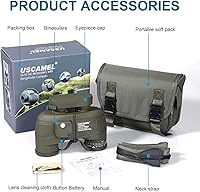
Overview

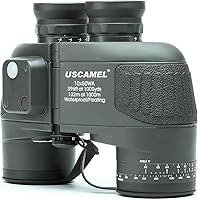
The USCAMEL UW004 10x50 Marine Binoculars occupy a practical middle ground in the marine optics market — purpose-built for use on the water rather than casual land-based sightseeing. What sets them apart at this price tier is the pairing of an illuminated compass and internal rangefinder in a single unit, a combination that typically costs considerably more elsewhere. The IPX7 waterproof rating is worth taking seriously: this means submersible protection, not just resistance to rain or spray. With over 2,400 ratings accumulated since their 2015 debut, these marine binoculars have earned a long track record. Just keep expectations grounded — this is a functional tool for sailors and anglers, not a premium optic for wildlife photography or astronomy.

Features & Benefits

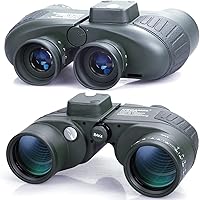
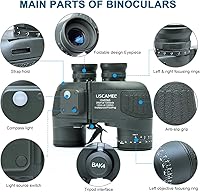
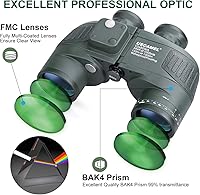
The 10x magnification and large 50mm objective lenses work well together on open water, pulling in distant vessels or coastline detail while still gathering enough light to stay usable at dusk. The built-in rangefinder and compass, both visible through the left eyepiece, let you estimate distances and check your heading without reaching for a separate device — useful, though they supplement rather than replace dedicated navigation tools. Optically, the BAK4 prism glass with fully multi-coated lenses delivers noticeably bright, sharp images with good contrast. The nitrogen-purged, O-ring sealed housing keeps fog out in cold or humid conditions. Foldable eyecups and a wide diopter range make the USCAMEL 10x50s comfortable for eyeglass wearers, and everything arrives ready to use, batteries and harness strap included.

Best For

These marine binoculars make the most sense for recreational sailors and boaters who want a capable, all-in-one optic without investing in professional-grade gear. Offshore anglers will appreciate the rangefinder for gauging distances to structure or other boats. Kayakers and paddlers get real peace of mind knowing this compass binocular can survive a drop overboard, not just a wave splash. It is also a strong choice for buyers upgrading from basic consumer binoculars who want genuine marine specifications at a reasonable outlay. And while the name says marine, hunters and hikers who need a rugged, fog-proof optic for all-weather use will find it equally capable away from the water.

User Feedback

Across more than 2,400 reviews and a 4.4-star average, the USCAMEL 10x50s have built a reputation for solid optical quality at their price point — buyers regularly note that images appear brighter and sharper than expected. The compass and rangefinder get praised for practicality, though a few users point out the compass illumination can be hard to read in bright midday glare. The focus wheel is reported as stiff out of the box by some owners, though most say it smooths out after a few outings. Weight comes up too — nearly two pounds feels manageable for short deck sessions but can cause fatigue on longer watches. The waterproofing draws almost no complaints; real-world dunks and heavy rain have not exposed any seal issues in the feedback patterns.

Pros

  • Fully waterproof to IPX7 — survives submersion, not just rain or spray.
  • Built-in illuminated compass and rangefinder add real navigational value in one package.
  • BAK4 prism glass with multi-coated lenses produces bright, clear images for the price tier.
  • The USCAMEL 10x50s have accumulated over 2,400 ratings with a 4.4-star average, a reliable signal of consistent quality.
  • Nitrogen-purged housing prevents internal fogging in cold or humid marine conditions.
  • Foldable eyecups and a wide diopter range make these comfortable for both eyeglass wearers and bare-eye users.
  • Arrives ready to use out of the box — batteries and harness strap are included.
  • A wide field of view makes tracking moving targets like vessels or wildlife straightforward.
  • Long market history since 2015 suggests dependable parts availability and a stable product design.

Cons

  • The focus wheel can feel noticeably stiff on first use, requiring a break-in period.
  • Nearly two pounds becomes fatiguing during extended handheld sessions on the water.
  • Compass illumination can wash out and become difficult to read in direct bright sunlight.
  • The rangefinder and compass are orientation aids only — not a substitute for proper marine navigation instruments.
  • Edge sharpness and color rendering fall short of what dedicated birding or astronomy optics provide at higher price points.
  • No image stabilization, which makes holding a steady view challenging in rough sea conditions.
  • The harness strap, while included, is basic and may need replacing for heavy or daily use.
  • This compass binocular offers limited close-focus capability, making it unsuitable for subjects at short range.

Ratings

Our AI-generated scores for the USCAMEL UW004 10x50 Marine Binoculars were produced by analyzing thousands of verified purchase reviews from global markets, with automated filters applied to remove bot activity, duplicate submissions, and incentivized feedback. The scoring reflects both what these marine binoculars genuinely do well and where real buyers have experienced consistent friction. Nothing has been smoothed over — the numbers tell the full story.

Optical Clarity
84%
Buyers consistently praise the image brightness and center sharpness, especially when scanning coastlines or tracking distant vessels. The BAK4 prism glass and multi-coated lenses genuinely punch above their weight for mid-range marine optics, with many users noting they outperform pricier binoculars they previously owned.
Edge softness becomes noticeable when scanning at wide angles, and color fringing appears in high-contrast scenes such as a bright horizon line. Users expecting birding-grade sharpness across the full field of view will find the performance less convincing in those conditions.
Waterproofing
91%
The IPX7 rating is not just a spec claim — users have repeatedly validated it through accidental drops overboard, heavy rain squalls, and extended spray exposure during offshore fishing. No recurring pattern of seal failures or moisture ingress has surfaced across the large review base, which is a meaningful confidence signal.
IPX7 covers incidental submersion up to one meter but does not address extended deep-water pressure, so users in extreme conditions should not treat it as equivalent to higher-rated submersible gear. A small number of users in tropical climates have noted humidity finding its way in over long-term storage.
Build Quality
78%
22%
The rubber-armored housing feels solid and purposeful in hand, and the overall construction holds up well to the knocks and scrapes typical of boat deck use. Most users report no structural issues even after years of regular marine exposure.
Some reviewers note that the plastic components around the eyecups and focus wheel feel less premium than the rest of the body. The hinge tension can feel slightly loose on certain units, which affects how securely the barrels hold their interpupillary distance setting.
Compass Usability
73%
27%
The illuminated compass visible through the left eyepiece is a practical feature that sailors and coastal boaters appreciate for quick heading checks without breaking their visual focus. It works as intended for basic directional orientation and adds genuine utility for recreational navigation on open water.
The illumination struggles in direct bright sunlight, making the compass readout difficult to see during midday boating — exactly when many users are most active on deck. A few reviewers also note that the compass response can feel sluggish when panning quickly, reducing its usefulness for fast course corrections.
Rangefinder Usability
69%
31%
Anglers and sailors who use the rangefinder for estimating distances to buoys, structure, or other vessels find it a helpful tool that requires no extra gear. Once you understand the reticle scale, reading distance estimates becomes reasonably intuitive during routine on-water scanning.
The rangefinder is an estimation tool, not a precision instrument, and some buyers come in expecting GPS-level accuracy. Without a thorough user manual for the reticle calibration, new buyers sometimes find the learning curve frustrating, and a handful of reviews mention that the reticle markings are small and hard to read in low contrast.
Value for Money
88%
The combination of IPX7 waterproofing, a built-in compass, rangefinder, and quality optics in a single mid-range package represents strong value by any realistic comparison. Buyers who have owned similar or more expensive models regularly cite these marine binoculars as the smarter financial decision for recreational use.
Buyers who push into demanding use cases — extended wildlife observation, serious offshore racing, or professional survey work — will hit the ceiling of what this price tier can deliver. The value proposition is strongest for casual to moderate marine use; power users may find themselves upgrading within a season or two.
Ergonomics & Comfort
64%
36%
For short to medium sessions on a boat deck — scanning for landmarks or checking on nearby vessels — the grip feels stable and the barrel width suits most adult hands well. The harness-style strap is a welcome addition that spreads weight more evenly than a simple neck cord.
At nearly two pounds, fatigue sets in faster than users expect during extended watch-keeping or long fishing trips. The body shape lacks a dedicated thumb rest or ergonomic grip molding, which reduces comfort during sustained one-handed use when simultaneously operating a boat's helm or rod.
Focus Mechanism
61%
39%
The central focus wheel covers a wide focal range and, once broken in, allows reasonably smooth transitions between close-range and distant subjects. Users who give it time report it becomes reliably functional for general marine scanning without needing frequent readjustment.
Out of the box, the focus wheel stiffness is a recurring complaint that catches many buyers off guard — particularly those used to the smoother action of premium optics. A small number of units appear to remain stiff even after extended use, suggesting some quality variance in this component across production batches.
Low-Light Performance
76%
24%
The 50mm objective lenses pull in meaningful light for dawn and dusk use — a common scenario for early-morning fishing trips or watching a sunset anchorage. The multi-coating contributes to a noticeably bright image in transitional light conditions compared to smaller-aperture marine binoculars at similar price points.
In genuine low-light conditions — overcast night crossings or below-deck environments — the optical performance drops noticeably, and the compass illumination is the only active light-assistance feature. Users should not expect near-darkness capability; this is a daylight and twilight optic by design.
Eye Relief & Eyecups
77%
23%
The foldable eyecups work well for eyeglass wearers, letting them position their eyes at the correct relief distance without vignetting or field cutoff at the edges. Buyers who wear prescription glasses consistently note that the full field of view remains accessible, which is not always the case with competing models at this tier.
The rubber on the eyecups can degrade with prolonged UV exposure on deck, and a few long-term users report the cups becoming sticky or developing surface cracks after a couple of seasons. Bare-eye users who prefer a multi-click twist-up system will find the fold-down design less precise for fine-tuning eye relief.
Fog Resistance
86%
The nitrogen-purged, O-ring sealed construction consistently performs well in the real-world conditions marine binoculars face — moving from an air-conditioned cabin onto a warm humid deck, or from a cool dawn into midday heat. Users in coastal and tropical environments confirm internal fogging is effectively eliminated.
While internal fogging is well-controlled, external lens fogging from breath condensation on cold days still occurs naturally and requires a gentle wipe-down before use. A very small minority of reviews from cold-climate users have noted that extreme temperature swings occasionally reveal minor sealing inconsistencies over extended ownership.
Ease of Setup
82%
18%
The USCAMEL 10x50s arrive ready to use straight out of the box — batteries pre-installed, strap included, and no complex pre-calibration required before heading out on the water. The diopter adjustment is intuitive, and most users report getting comfortable with the compass and rangefinder within one or two outings.
The rangefinder reticle system has a learning curve that the included documentation does not fully address, leaving some buyers to work out the scale independently through trial and error. First-time binocular users or those unfamiliar with marine navigation tools may take several sessions before using the full feature set with confidence.
Portability & Storage
72%
28%
For a full-size 10x50 marine binocular, the overall footprint is manageable enough to fit in a standard dry bag or gear locker without dominating the available space. The harness strap option means they can be worn across the body during active use, keeping both hands free when needed.
At nearly two pounds, these are not the kind of optic you casually slip into a jacket pocket or a compact day bag. Travelers and kayakers who prioritize a minimal kit will find the bulk and weight a real constraint compared to compact or mid-size alternatives purpose-built for portability.

Suitable for:

The USCAMEL UW004 10x50 Marine Binoculars are a smart pick for recreational boaters, sailors, and offshore anglers who want functional navigation tools built directly into their optics. The combination of an illuminated compass and internal rangefinder means you can check your heading and estimate distances to a buoy, vessel, or shoreline without juggling separate gear — a genuine convenience on a moving deck. Kayakers and paddlers who spend time in open or coastal water will appreciate the IPX7 rating, which means a full submersion won't kill the optic, not just a splash on the bow. Buyers upgrading from a basic pair of consumer binoculars will notice a real step up in image brightness and build quality. Even outside marine use, hunters and hikers who need a rugged, fog-proof optic for unpredictable weather conditions will find these marine binoculars hold up well in the field.

Not suitable for:

The USCAMEL UW004 10x50 Marine Binoculars are not the right tool for birders, wildlife photographers, or astronomers who need precision edge-to-edge sharpness and color accuracy across the full field of view. At close to two pounds, extended handheld use — think long bird counts or hours on a watch — can become tiring, and the absence of image stabilization makes that fatigue more pronounced on choppy water. Buyers expecting the built-in compass and rangefinder to replace a dedicated chart plotter or marine GPS will be disappointed; these features are helpful orientation aids, not navigation instruments. If you wear glasses and are particularly sensitive to eye relief comfort, it is worth testing the foldable eyecups before committing. And if you need the absolute lightest or most compact optic for a minimalist kit, these marine binoculars carry more bulk than ultralight alternatives designed for backpacking or travel.

Specifications

  • Magnification: These binoculars provide 10x magnification, bringing distant objects ten times closer than the naked eye, which is well-suited for scanning open water.
  • Objective Lens: The 50mm objective lenses gather a generous amount of light, supporting usable image brightness during overcast conditions and around dusk on the water.
  • Prism Type: BAK4 borosilicate prism glass is used internally, a higher-density optical material that reduces light scatter and produces rounder, brighter exit pupils than lower-grade BK7 prisms.
  • Lens Coating: Fully multi-coated (FMC) optics apply anti-reflective layers to all air-to-glass surfaces, improving light transmission, contrast, and color accuracy across the image.
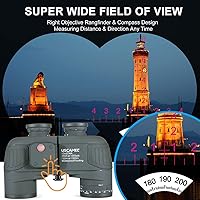
  • Field of View: The field of view spans approximately 396 feet at a distance of 1,000 yards, offering a wide enough sweep to track moving vessels or locate landmarks without constant repositioning.
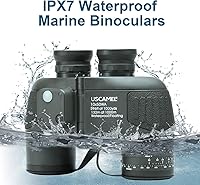
  • Waterproof Rating: Rated IPX7, these marine binoculars can withstand submersion in up to one meter of water for up to 30 minutes without internal water ingress.
  • Sealing Method: O-ring seals and dry nitrogen purging work together to block moisture and prevent internal fogging when moving between temperature extremes.
  • Compass: An illuminated compass is built into the left eyepiece, providing directional heading information viewable without removing the binoculars from your eyes.
  • Rangefinder: An internal rangefinder reticle is integrated into the left eyepiece, allowing users to estimate the distance and approximate size of objects in the field of view.
  • Diopter Adjustment: A diopter ring offers plus or minus 5 degrees of adjustment to compensate for differences in vision between the user's left and right eyes.
  • Eyecups: Foldable rubber eyecups can be rolled down for eyeglass wearers to maintain a correct eye relief distance, or left extended for bare-eye use.
  • Weight: The unit weighs 1.94 pounds, which is manageable for short to medium-length sessions but worth considering if extended handheld use is expected.
  • Batteries: Two LR936 (AG9) button-cell batteries power the compass illumination and are included in the box, so the unit is ready to use on arrival.
  • Included Accessories: A harness-style carrying strap is included, distributing weight across the shoulders rather than concentrating it at the neck on a traditional lanyard.
  • Model Number: The official model designation is UW004, which can be used when searching for compatible accessories, replacement parts, or manufacturer support.
  • Brand Origin: Manufactured by USCAMEL, a brand focused on outdoor and marine optics, with this model having been commercially available since December 2015.

Related Reviews
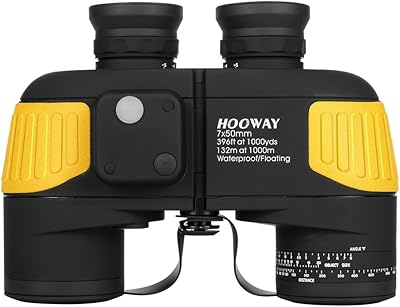
Hooway 7x50 Marine Binoculars
79%
83%
Optical Clarity
91%
Waterproof Performance
67%
Compass Usability
61%
Rangefinder Accuracy
86%
Build Quality & Durability
More
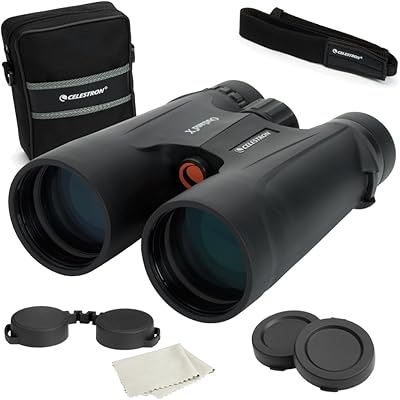
Celestron Outland X 10x50 Binoculars
81%
88%
Optical Clarity
83%
Low-Light Performance
86%
Build Quality
84%
Weather Resistance
91%
Value for Money
More
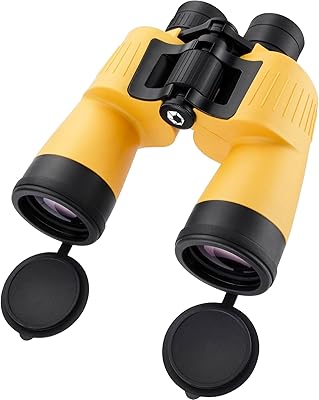
Barska Floatmaster 7x50
81%
94%
Buoyancy & Water Safety
76%
Optical Clarity
91%
Waterproofing
83%
Build Quality & Durability
81%
Ergonomics & Grip
More
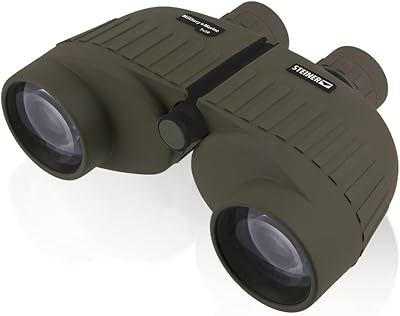
Steiner Military-Marine 7x50 Binoculars
81%
91%
Optical Clarity
93%
Low-Light Performance
94%
Build Quality & Durability
74%
Focus System (Sports Auto Focus)
92%
Waterproofing & Weather Resistance
More
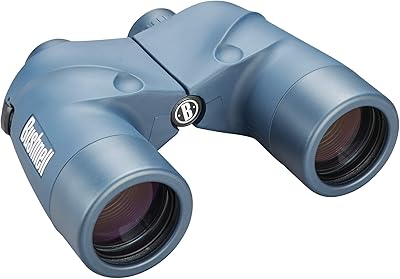
Bushnell Marine 7x50 Waterproof Binocular
88%
93%
Optical Clarity
96%
Waterproof Performance
89%
Build Quality
85%
Ease of Use
78%
Magnification
More
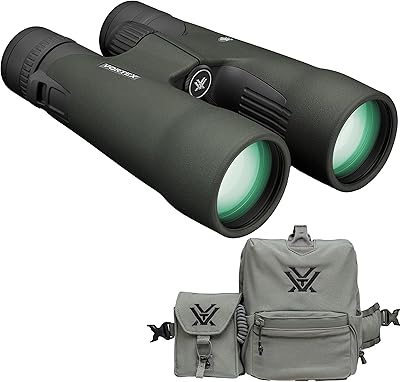
Vortex Optics Razor UHD 10x50 Binoculars
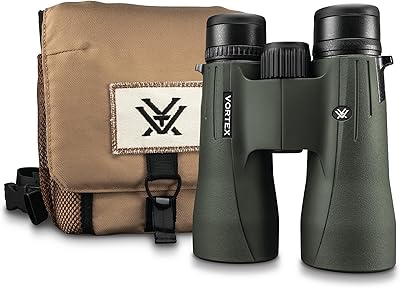
82%
94%
Optical Clarity
91%
Low-Light Performance
88%
Build Quality
72%
Value for Money
74%
Ergonomics & Handling
More
Vortex Crossfire HD 10x50 Binoculars
85%
91%
Optical Clarity
88%
Low-Light Performance
93%
Build Quality
89%
Waterproof & Fogproof Reliability
84%
Ergonomics & Grip
More
Vortex Optics Viper HD 10x50 Binoculars
88%
94%
Image Clarity & Sharpness
88%
Comfort & Ergonomics
92%
Durability & Build Quality
90%
Low-Light Performance
91%
Waterproof & Fogproof Functionality
More
Aurosports 15x56 Binoculars
77%
83%
Optical Clarity
71%
Low-Light Performance
67%
Magnification Usability
76%
Build Quality
88%
Value for Money
More
Retulgie 12x25 Compact Binoculars
75%
74%
Optical Clarity
58%
Low-Light Performance
63%
Build Quality
91%
Portability & Size
78%
Comfort & Ergonomics
More

FAQ

They carry a genuine IPX7 waterproof rating, which means they are tested for full submersion — not just resistance to rain or spray. If they go overboard in calm water, they should survive the dunk intact. That said, IPX7 covers up to one meter for 30 minutes, so they are not designed for deep-water pressure.

Yes, the USCAMEL UW004 10x50 Marine Binoculars are designed to float, which is a useful safety feature on any vessel. The buoyancy is intentional and part of the marine design spec, giving you a fighting chance to retrieve them if they go over the side.

It is a helpful estimation tool, not a precision instrument. You use a reticle scale visible through the left eyepiece to estimate the distance to objects of a known height, like a standard navigation buoy or vessel. It works well for rough situational awareness on the water but should not replace a dedicated range finder or chart plotter for serious navigation.

The illumination helps most in low-light or overcast conditions. In direct, bright sunlight, some users find the compass backlight washes out and becomes harder to read clearly. It is worth being aware of this limitation if most of your boating happens in midday sun on open water.

Yes, the foldable rubber eyecups are designed with eyeglass wearers in mind. Rolling them down brings your eyes to the correct distance from the lens to see the full field of view without black vignetting at the edges. The diopter adjustment also helps fine-tune the focus for any vision difference between your eyes.

Almost certainly not. This is a commonly reported quirk with these marine binoculars, and the large majority of users say the wheel loosens and smooths out naturally after a few sessions of regular use. If it remains extremely stiff after extended use, that would be worth contacting the seller about, but initial stiffness appears to be a normal break-in characteristic.

They can handle casual wildlife viewing, but dedicated birders will likely find the optical performance limiting compared to purpose-built birding binoculars in a similar or higher price range. The 10x magnification can make handheld steadiness difficult for small, fast-moving birds, and edge-to-edge sharpness is optimized for marine use rather than fine wildlife detail.

Use a soft, lint-free microfiber cloth and work in gentle circular motions from the center outward. For stubborn smudges or salt residue, a small amount of lens-cleaning solution designed for optics is safe to use. Avoid paper towels, clothing fabric, or any abrasive material, as the multi-coating on the glass can be scratched if treated roughly.

The LR936 button cells that power the compass illumination are widely available at pharmacies and electronics retailers, and replacement is straightforward. Battery life will depend on how often the illumination is used, but since it is only needed in low-light conditions rather than continuously, most users find the batteries last a reasonable amount of time before needing a swap.

The included harness strap is a meaningful upgrade over a basic neck lanyard for marine use — it distributes the weight across your chest and shoulders rather than concentrating it at your neck, which matters when wearing these marine binoculars for longer periods. That said, it is a fairly basic accessory, and users who spend a lot of time on the water may prefer a more padded or adjustable aftermarket option for added comfort.

Where to Buy