Overview

The trueCABLE Cat6A Shielded Riser 1000ft Ethernet Cable is built for people who take structured cabling seriously — not for those looking to run a single drop between rooms. Buying a 1000ft reel signals intent: you're wiring a floor, a building, or a multi-story home network from scratch. What sets this shielded riser cable apart from standard unshielded Cat6A is the F/UTP foil shielding, which matters in real environments crowded with wireless access points, electrical conduit, or HVAC interference. It carries ETL listing and has been Fluke DSX-8000 tested, which means its performance claims aren't marketing guesses — they're verified against ANSI/TIA standards.
Features & Benefits

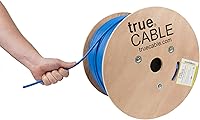
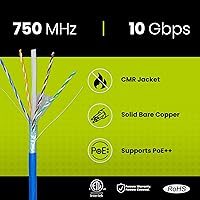
The 23AWG solid bare copper conductors are a meaningful detail, not just a spec sheet checkbox. Thicker conductors maintain signal integrity over long cable runs and handle the heat generated by high-wattage PoE devices — useful when you're powering a bank of IP cameras or ceiling-mounted access points pulling close to 100W each. The F/UTP foil wrap keeps interference out in electrically noisy spaces, and the CMR riser jacket means you can legally run this between floors in most building codes without worrying about fire spread. On the practical side, the 2ft sequential markings on the jacket let you cut exactly what you need without guessing.

Best For

This bulk Cat6A cable makes the most sense in scenarios where unshielded cable would create headaches down the road. IT professionals wiring multi-floor office buildings, schools, or commercial spaces will appreciate having riser-rated shielded cable that meets code and handles the interference that comes with dense infrastructure. Home lab builders running 10GbE to a NAS or a high-end switch will find it equally capable. It's also a natural fit for PoE camera systems and access point deployments where a single cable needs to carry both data and significant power. If you're still on Cat5e or unshielded Cat6, this is a logical upgrade path.

User Feedback

The consensus among buyers — a mix of professional installers and advanced DIYers — is that the trueCABLE riser reel holds up across the full 1000ft. Consistent jacket quality from end to end is the most repeated observation, which matters when you're pulling cable through walls and ceilings for hours. The reel design and footage markings earn widespread praise for saving time on large installs. A fair caveat: shielded cable is less forgiving to terminate than unshielded. A few less-experienced buyers noted the drain wire and foil require more care during punchdown or keystone termination. Professionals rarely flag it as an issue, and the overall satisfaction-to-value ratio sits high across both audiences.

Pros

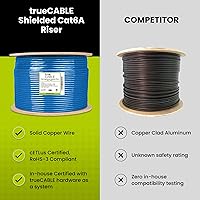
  • Solid bare copper conductors maintain signal integrity across long runs without the performance drop of copper-clad aluminum alternatives.
  • F/UTP foil shielding delivers measurable interference reduction in environments crowded with wireless gear or electrical conduit.
  • CMR riser jacket satisfies building code requirements for vertical in-wall runs between floors in most jurisdictions.
  • PoE++ support up to 100W means a single run can reliably power PTZ cameras, enterprise access points, and VoIP gear.
  • Sequential 2ft jacket markings save real time on large multi-drop installs where accurate cutting reduces waste.
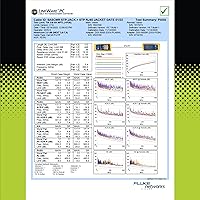
  • ETL listing and Fluke DSX-8000 testing verify performance against ANSI/TIA standards rather than relying on self-reported specs.
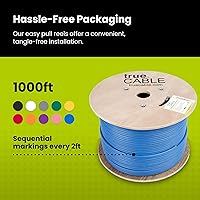
  • Easy-pull reel design minimizes tangling and keeps the cable feeding smoothly during long pulls through walls and ceilings.
  • Backwards compatibility with Cat6 and Cat5e infrastructure means this shielded riser cable fits into mixed-generation environments without issue.
  • Buyers consistently report uniform jacket quality across the full reel length, with no mid-spool inconsistencies.
  • Supports 10 Gigabit Ethernet up to 328ft, giving this cable headroom well beyond what most current deployments demand.

Cons

  • Terminating shielded cable correctly takes more skill than unshielded Cat6A — first-timers often need a few practice runs before getting clean results.
  • Properly grounding the foil shield requires planning and additional hardware that many buyers do not budget for upfront.
  • At 1000ft, the reel volume and total cost make little sense for anyone running fewer than eight to ten cable drops.
  • CMR rating does not cover plenum spaces, so this cable cannot legally substitute for CMP-rated cable in air-handling ceiling environments.
  • Shielded bulk cable is noticeably heavier and stiffer than unshielded, which can make pulling through tight bends or conduit more physically demanding.
  • To preserve the shield's effectiveness end-to-end, shielded keystone jacks and patch panels are necessary — adding cost that some buyers overlook initially.
  • Strictly rated for indoor dry use, with no outdoor, direct-burial, or wet-location suitability whatsoever.
  • In a typical low-interference home environment, the shielded construction adds termination complexity without delivering any performance advantage over standard unshielded Cat6A.

Ratings

The scores below reflect an AI-driven analysis of verified global buyer reviews for the trueCABLE Cat6A Shielded Riser 1000ft Ethernet Cable, with spam, incentivized submissions, and bot-generated feedback actively filtered out before scoring. Each category captures the honest consensus from real installers, IT professionals, and advanced home-network builders who put this cable to work in demanding environments. Both the standout strengths and the genuine frustrations buyers encountered are transparently baked into every number.

Conductor Quality
93%
Buyers running structured cabling in offices and multi-floor buildings consistently report that the 23AWG solid bare copper conductors perform exactly as expected under sustained PoE loads and long pull distances. Professionals testing with Fluke analyzers noted tight pair geometry and low resistance readings throughout the reel, not just at the start.
A small number of DIY buyers found the solid conductors less forgiving when making tight routing bends near termination points, occasionally causing micro-kinks if the cable was forced rather than guided. This is a handling issue rather than a material defect, but it trips up first-time installers.
Shielding Effectiveness
88%
Installers deploying this shielded riser cable near HVAC ductwork, electrical conduit bundles, and dense wireless access point environments report noticeably cleaner link performance compared to unshielded Cat6A runs in the same spaces. The F/UTP foil wrap earns particular praise in warehouse and school environments where interference sources are numerous and unpredictable.
The shielding's real-world value depends entirely on proper grounding at both ends, and buyers who skipped shielded termination hardware reported no improvement over standard unshielded cable. A few reviewers felt the benefits were hard to perceive in typical home environments without a way to measure baseline interference levels.
Jacket & Build Quality
91%
One of the most consistently praised aspects across professional reviews is how uniform the jacket quality remains across the full 1000ft run — no soft spots, thin sections, or inconsistent printing. Installers pulling cable through metal conduit commented that the PVC jacket held up to abrasion without cracking or peeling at the pull points.
A handful of buyers noted the jacket has a slightly stiffer feel than competing bulk cables, which can make routing through tight conduit bends or wall cavities more physically demanding during solo installs. In cold environments, the stiffness increases further, making the cable harder to manage before it warms to room temperature.
Termination Experience
67%
33%
Experienced installers who regularly work with shielded cable found termination straightforward, appreciating the consistent pair twist rates that made seating conductors into Cat6A keystone jacks predictable and repeatable across dozens of drops in a single job.
Less experienced buyers reported a real learning curve around handling the drain wire and bonding the foil shield correctly at each termination point — a step that does not exist with unshielded cable. Several DIY reviewers noted their first few terminations failed a link test until they watched a shielded-specific tutorial and reworked the connections.
PoE Reliability
92%
Buyers powering enterprise-grade access points and PoE++ cameras through this bulk Cat6A cable report stable device operation with no thermal issues at the cable or injector end, even on runs exceeding 200ft. The solid copper conductors handle the sustained current draw of high-wattage endpoints without the voltage drop that thinner or aluminum-core cables can introduce.
A small number of buyers running multiple high-draw PoE devices in parallel through a dense cable bundle noted that proper spacing and airflow around the bundled runs matters more with shielded cable, as the foil can trap heat slightly more than unshielded jackets in tightly packed conduit.
Signal Consistency
89%
IT professionals who tested this shielded riser cable end-to-end using Fluke and NetAlly analyzers consistently reported passing results across all ANSI/TIA channel parameters, with crosstalk figures that stayed well within Cat6A margins at full 328ft runs. Home lab users running 10GbE NAS transfers noted stable throughput without the occasional packet loss they experienced on older unshielded runs.
A few reviewers who self-terminated without shielded jacks reported intermittent link drops that disappeared after reterminating with proper shielded hardware, suggesting that inconsistent results are more often a termination issue than a cable consistency problem.
Reel & Packaging Design
86%
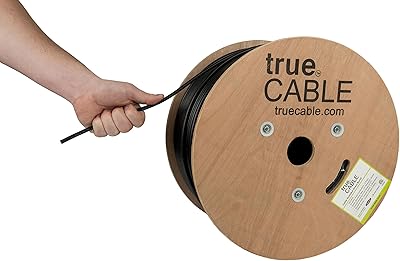
The center-pull reel design receives consistent praise from working installers, who note that the cable feeds smoothly without spinning or tangling during pulls across large floor plates or up multi-story riser shafts. The packaging is sturdy enough to survive a job site without the reel deforming under typical storage and transport conditions.
A few buyers on very long pulls found that the center-pull hole can create mild friction drag as the reel empties, requiring slightly more tension than expected near the end of the spool. The reel itself is not resealable once opened, so storing a partial reel requires improvised wrapping to prevent tangling.
Measurement Markings
84%
The 2ft sequential footage markings printed along the jacket were called out repeatedly by installers as a genuine time-saver on multi-drop jobs, eliminating the need to unspool and re-measure when pre-cutting runs. The print contrast was noted as legible under typical job-site lighting conditions without needing to squint or use a flashlight.
Some buyers noted that the markings can become partially obscured after pulling through tight metal conduit, particularly on longer runs where the jacket contacts abrasive surfaces over an extended distance. The ink does not appear to be recessed or particularly scratch-resistant, though this is a minor complaint given the markings' primary purpose.
Certification & Compliance
94%
The ETL listing and Fluke DSX-8000 verification give procurement teams and building inspectors a documented compliance baseline that self-certified or unverified bulk cables simply cannot offer. Buyers who needed to submit cabling documentation for commercial building sign-offs reported that the trueCABLE credentials satisfied inspectors without additional testing.
The IEC 61300-3-35 end face certification, while legitimate, is not a standard that most buyers are familiar with or specifically required to meet, making it a minor trust signal for most purchasers rather than a purchasing differentiator in typical deployment contexts.
Value for Money
78%
22%
Professional installers who compared per-foot costs across certified shielded Cat6A bulk options consistently placed this cable at a competitive position for verified, Fluke-tested riser cable. For buyers running dozens of drops where performance and code compliance are non-negotiable, the total project cost math tends to work in its favor.
DIY buyers wiring small home networks with only a handful of runs found the total outlay harder to justify when factoring in the additional cost of shielded keystone hardware and the learning curve of proper termination. For those scenarios, an unshielded Cat6A reel delivers comparable real-world speeds at meaningfully lower total cost.
Installation Ease
71%
29%
For experienced structured cabling installers, the combination of the smooth-feeding reel, consistent jacket stiffness, and clear footage markings makes this a relatively efficient cable to work with across a full day of pulling and terminating. Professionals noted the cable behaves predictably in conduit and wall cavities without unexpected resistance or kinking.
For buyers newer to bulk cabling, the shielded construction adds meaningful complexity compared to unshielded alternatives — from grounding requirements to shielded-specific termination tools. Those coming directly from patch-cord experience should plan for a learning period before attempting a full structured wiring deployment with this cable.
EMI Rejection
87%
Buyers in industrial environments running cable near variable-frequency drives, fluorescent lighting ballasts, and dense conduit bundles carrying line voltage specifically called out this shielded riser cable as a reliable solution after unshielded alternatives caused persistent link instability. The foil shield's ability to reject radiated interference in those environments was described as clearly measurable rather than theoretical.
In standard office or residential environments with no unusual interference sources, the EMI rejection advantage is largely invisible to the end user, and some buyers felt they paid a premium for shielding that their specific environment did not actually require.
Compatibility
91%
Backwards compatibility with existing Cat6 and Cat5e patch panels and switch ports was confirmed by numerous buyers upgrading legacy infrastructure in stages, allowing new cable runs to co-exist with older hardware without link negotiation issues. The standard RJ45 termination geometry means no proprietary tooling or adapters are needed.
Full performance extraction requires pairing this cable with shielded Cat6A jacks and patch panels throughout, which adds sourcing complexity for buyers who assumed their existing unshielded hardware would work without compromise. Mixing shielded cable with unshielded termination points is a common oversight that generates frustration and re-work.
Long-Run Performance
90%
Buyers running drops at or near the 300ft range in multi-story buildings reported consistent 10GbE link establishment and stable throughput, with no mid-run attenuation issues flagged in field tests. The 750MHz bandwidth ceiling provides enough overhead that real-world performance stays well within comfortable margins even at extended distances.
A very small number of reviewers reported marginal test results on runs that approached the full 328ft limit when the cable path included a high number of sharp bends or short patch cord extensions at both ends, suggesting that real-world channel budgeting needs to account for the total path rather than raw cable length alone.

Suitable for:

The trueCABLE Cat6A Shielded Riser 1000ft Ethernet Cable is built for buyers who are committing to a structured wiring project rather than patching a single connection. IT professionals running cable through multi-story office buildings, schools, or commercial spaces will find both the riser rating and shielded construction worth the investment, since these aren't optional extras when electrical infrastructure is dense. Home lab builders pushing 10GbE to a NAS, a high-end switch, or a dedicated workstation cluster will get consistent performance across long in-wall runs without the signal degradation that cheaper bulk cable can introduce. The PoE++ support up to 100W also makes this shielded riser cable a strong match for IP camera deployments and ceiling-mounted wireless access points, where a single run needs to carry both data and significant power reliably. Anyone replacing aging Cat5e or unshielded Cat6 in a building with HVAC equipment, industrial machinery, or conduit-heavy electrical layouts will benefit most from the F/UTP foil shielding here.
Not suitable for:

If you need to connect two devices in the same room, the trueCABLE Cat6A Shielded Riser 1000ft Ethernet Cable is the wrong tool entirely — a pre-terminated patch cord is simpler, far cheaper, and ready to plug in without any tools. Buyers who have never worked with shielded bulk cable should understand upfront that the foil wrap and drain wire require more careful handling at termination than unshielded cable; a sloppy punchdown or poorly seated keystone can compromise the shield and defeat the purpose of buying shielded in the first place. This cable carries a CMR riser rating, not a plenum (CMP) rating, so it cannot legally be installed in air-handling spaces like drop-ceiling plenums in commercial buildings — that requires a different cable entirely. The 1000ft format makes the economics work only at a certain project scale, and anyone running fewer than eight to ten drops will likely end up with a lot of leftover cable they paid for. Finally, in a standard residential environment with no unusual interference sources, the added complexity of shielded termination and grounding may not deliver any real-world advantage over a quality unshielded Cat6A alternative.
Specifications

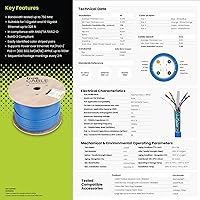
  • Cable Standard: Rated to Cat6A specifications per ANSI/TIA 568.3-D, supporting structured cabling installations that require high-bandwidth, low-crosstalk performance.
  • Shielding Type: F/UTP construction places an overall aluminum foil shield around four unshielded twisted pairs, blocking external electromagnetic interference without individually shielding each pair.
  • Conductor: 23AWG solid bare copper conductors deliver lower resistance and more stable signal transmission over long runs compared to stranded or copper-clad aluminum alternatives.
  • Bandwidth: Tested and rated to 750MHz, which exceeds the 500MHz minimum threshold required for Cat6A certification and provides meaningful headroom for demanding applications.
  • Max Data Rate: Supports 10 Gigabit Ethernet (10GBASE-T) at distances up to 328ft (100m) per IEEE 802.3an, and standard Gigabit Ethernet well beyond that range.
  • PoE Support: Compatible with PoE, PoE+, and PoE++ standards (IEEE 802.3af/at/bt), supporting 4PPoE power delivery up to 100W across a single cable run.
  • Jacket Rating: CMR (Communications Multipurpose Cable, Riser) rated PVC jacket is approved for vertical in-wall runs between building floors in non-plenum, dry indoor spaces.
  • Cable Length: Ships as a single continuous 1000ft (approximately 305m) run on a center-pull easy-feed reel designed for large structured cabling deployments.
  • Jacket Markings: Sequential footage markings are printed directly on the jacket at every 2ft interval, allowing accurate measurement and precise cutting without a separate tape measure.
  • ETL Listing: ETL Listed by Intertek, confirming the cable meets applicable North American safety and communications performance standards for in-wall building installations.
  • Performance Test: Verified using a Fluke DSX-8000 Versiv CableAnalyzer against ANSI/TIA 568.3-D channel and permanent link parameters, providing third-party performance validation.
  • End Face Cert: End face certified to IEC 61300-3-35 ED.2 MM, a standard addressing the physical geometry and cleanliness quality of connector termination end faces.
  • Intended Use: Designed exclusively for dry indoor environments including vertical in-wall runs, conduit routing, and non-plenum structured cabling in residential, commercial, or data center settings.
  • Compatibility: Designed for field termination with standard Cat6A-rated shielded RJ45 keystone jacks, shielded patch panels, and compatible structured wiring hardware.

Related Reviews

trueCABLE Cat5e Outdoor Shielded 1000ft Ethernet Cable
87%
93%
Cable Build Quality
88%
Shielding Effectiveness
91%
Direct Burial Performance
89%
PoE Reliability
86%
Installation Experience
More
trueCABLE Cat6A Direct Burial Ethernet Cable 1000ft
85%
94%
Conductor Quality
92%
Outdoor Weatherproofing
91%
Signal & Data Performance
89%
PoE Reliability
86%
Reel & Usability
More
TrueCable RG6 Dual Shield 1000ft Coaxial Cable
84%
93%
Signal Performance
91%
Build Quality
88%
Direct Burial Durability
86%
Ease of Installation
61%
Termination Experience
More
VIVO CABLE-V003 Waterproof Cat5e Ethernet Cable 1000ft
84%
88%
Performance in Outdoor Conditions
91%
Ease of Installation
85%
Waterproofing Effectiveness
87%
Build Quality & Durability
92%
Value for Money
More
Vertical Cable Cat5e 1000ft Outdoor Ethernet Cable
77%
91%
Jacket Durability
88%
Signal Performance
93%
UV & Weather Resistance
79%
Value for Money
74%
Ease of Installation
More
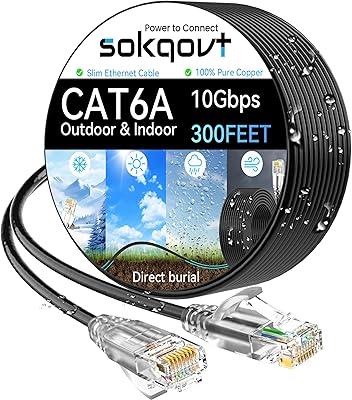
Sokqovt Cat6a Ethernet Cable 300ft
87%
91%
Performance
87%
Installation Ease
89%
Durability (Indoor/Outdoor Use)
94%
Speed (10Gbps Performance)
82%
Flexibility for Tight Spaces
More
JARNHNG Cat6 1000ft Ethernet Cable
85%
92%
Outdoor Durability
88%
Signal Quality and Performance
85%
Ease of Installation
81%
Flexibility for DIY Installations
89%
UV and Weather Resistance
More
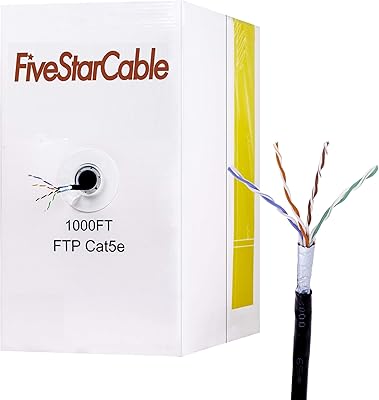
FiveStarCable 1000Ft Cat5e FTP Ethernet Cable
85%
92%
Performance at Gigabit Speeds
88%
Ease of Installation
90%
Durability for Outdoor Use
87%
Value for Money
89%
Compatibility with High-Speed Networks
More
SolidLink CAT5e 1000ft Ethernet Cable
78%
89%
Value for Money
82%
Signal Performance
84%
Installation Experience
86%
Packaging & Dispensing
77%
Build Quality
More
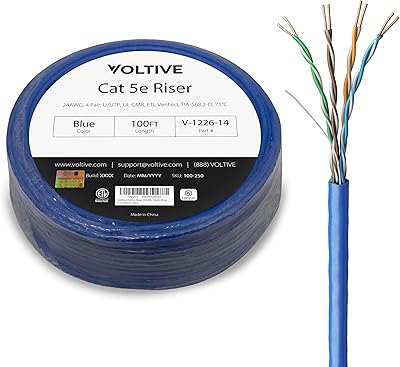
Voltive Cat5e Riser Ethernet Cable 100ft
87%
88%
Performance
91%
Ease of Installation
89%
Build Quality
85%
Signal Quality & Reliability
92%
PoE Compatibility
More

FAQ

Yes, and this is one of the most commonly overlooked costs. To preserve the shield's effectiveness from end to end, you need shielded Cat6A keystone jacks and shielded patch panel ports that include a proper bonding point for the drain wire and foil. Plugging this cable into standard unshielded keystones will still work electrically, but the shielding will be broken at the termination point and provide little real-world benefit. Budget for shielded hardware on both ends before purchasing this bulk riser cable.

Grounding is essential for shielded cable to function as intended. Without a proper ground path, the foil can act as an unintended antenna and actually worsen interference rather than block it. In practice, shielded patch panels are typically bonded to a grounding bar, which in turn connects to the building's electrical ground. For most commercial installations this is straightforward, but in residential settings or older buildings it may require input from an electrician to confirm a proper ground is available at your termination points.

No. The PVC jacket on this cable is rated for dry indoor use only and provides no UV resistance or moisture protection. For outdoor runs, exterior conduit, or direct-burial applications you need a cable with a specifically rated outdoor or gel-filled jacket. Running this indoors-only cable outside will eventually lead to jacket degradation and potential water ingress into the conductors.

No, and this distinction matters for building code compliance. This cable carries a CMR riser rating, which is approved for vertical runs between floors but not for the air-handling plenum spaces found above drop ceilings in many commercial buildings. Plenum spaces require a CMP-rated cable with a low-smoke, low-flame jacket. Installing CMR cable in a plenum space typically fails inspection and can create a fire safety hazard. If your installation involves plenum ceilings, you need a separately sourced plenum-rated Cat6A cable.

Yes, within the specified distance limit. The trueCABLE Cat6A Shielded Riser 1000ft Ethernet Cable is rated for 10GBASE-T up to 328ft per run, which is the full 100-meter channel length defined by IEEE 802.3an. For most building installations, individual runs stay well under that ceiling. The 750MHz bandwidth rating also gives the cable meaningful headroom above the 500MHz Cat6A minimum, which supports stable high-speed performance under real-world conditions rather than just lab settings.
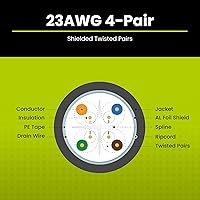
It is noticeably more involved but not unmanageable with some preparation. The main difference is handling the drain wire and bonding the foil to the shielded jack housing during termination, which adds steps that unshielded cable simply does not have. Expect a slower pace on your first few terminations until the process becomes familiar. Watching a walkthrough video specific to shielded Cat6A keystones before starting your first run is genuinely worth the time — it prevents the most common mistakes that compromise shielding integrity.

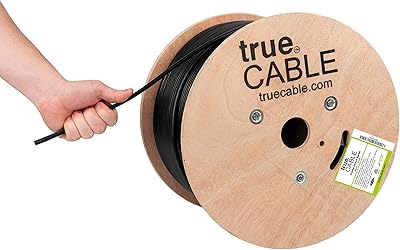
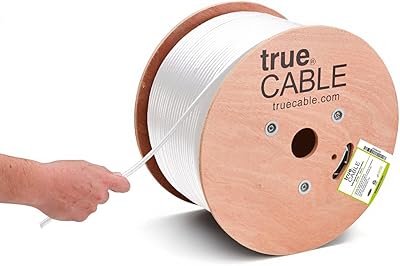
The cable feeds from the center of the reel through a pull-out hole, which means the reel stays stationary rather than spinning as you pull. This dramatically reduces tangling compared to older reel designs. Combined with the 2ft sequential jacket markings, most installers find it easy to track usage and feed the cable cleanly through walls or conduit. For very long runs or tight conduit paths, having a second person guide the cable near the reel entry keeps tension consistent and prevents kinks.

For a small home network with three to five drops, a 1000ft reel is more than most people will use in a single project, and a significant portion of the reel may go unused. If interference from nearby electrical wiring or HVAC equipment is a genuine concern, shielded cable is worth it regardless of run count. If your home environment is relatively interference-free, however, a quality unshielded Cat6A cable would likely deliver identical real-world performance at lower cost and with simpler termination.

Yes. This shielded riser cable is rated for PoE++ under IEEE 802.3bt, which covers 4PPoE delivery up to 100W per run. That comfortably handles enterprise-class wireless access points, IP PTZ cameras, PoE displays, and other high-draw devices. The 23AWG solid copper conductors are a meaningful factor here — thicker conductors carry higher currents with less resistive heat buildup over long runs, which is exactly what high-wattage PoE applications demand for safe, stable operation.

Fully. Cat6A interoperates with Cat6 and Cat5e switches, routers, and patch panels without any issues. The link will simply operate at the performance level of its lowest-rated component, so connecting this shielded riser cable to a Cat5e switch gives you Cat5e speeds on that port rather than 10GbE. Nothing is damaged or degraded by mixing generations — it just means you can upgrade switches later without needing to replace the cable runs already in the walls.