Overview

The SolidLink CAT5e 1000ft Ethernet Cable is a bulk-run spool built for people who need to wire an entire house, office floor, or multi-room setup in a single purchase — not someone shopping for a short patch cable. SolidLink sits in the budget-to-mid-range tier of structured cabling brands, and this 1000ft ethernet cable reflects that positioning honestly. The conductors are Copper Clad Aluminum, not pure copper — something worth knowing upfront, since CCA is standard at this price point but carries slightly higher resistance over very long runs. CAT5e tops out at 1Gbps at 100 meters, which covers the vast majority of home and small business scenarios without issue.
Features & Benefits

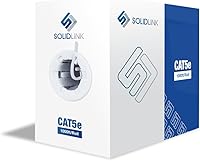
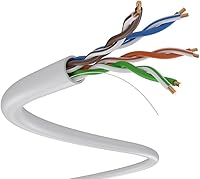
The solid-core 24AWG conductors are the right choice for permanent in-wall or ceiling runs — solid core holds its shape, terminates cleanly into keystone jacks, and maintains consistent signal over distance in ways stranded cable simply cannot. The jacket combines HDPE insulation with a PVC outer layer, which handles the abrasion and minor moisture you inevitably encounter during a real installation. One practical detail that stands out is the easy-pull dispensing box with footage markings printed directly on the jacket — you know exactly how much cable you have left without guessing. The unshielded UTP construction keeps the cable light and manageable through conduit, and the standard RJ45 compatibility means no surprises with your existing tools or hardware.

Best For

This bulk CAT5e spool makes the most sense for people running cable through walls for the first time — a 1000ft spool can cover a typical three-bedroom house end-to-end with room to spare. It is also a natural fit for small business structured cabling where staying under budget matters more than squeezing out marginal performance gains from pricier pure-copper alternatives. IP camera and surveillance installs are another strong use case, since the runs tend to be long and one-directional, playing to the cable's strengths. If you are considering CAT6 for a high-density or industrial environment, this SolidLink cable is probably not your best pick — but for standard gigabit networking, it covers virtually every common scenario.

User Feedback

The pattern across buyer reviews is fairly consistent. People who understand they are buying a CCA conductor cable and use it for typical-length runs tend to walk away satisfied, with clean terminations and stable throughput being the most commonly reported positives. Installation experience gets a lot of praise — the pull box and footage markings in particular — because they translate directly to time saved on the job. The complaint worth flagging is jacket stiffness in cold environments, which makes routing through tight bends noticeably harder. A smaller share of negative feedback comes from buyers pushing the cable past its practical limits, expecting pure-copper performance from a CCA product. Realistic expectations go a long way with this 1000ft ethernet cable.

Pros

  • A single spool covers an entire house or small office without needing to reorder mid-project.
  • Solid-core 24AWG conductors terminate cleanly and hold their shape reliably in keystone jacks and patch panels.
  • The easy-pull dispensing box with printed footage markings saves real time and reduces waste during installs.
  • Gigabit-ready performance handles VoIP, IP cameras, NAS, and standard broadband routing without issues.
  • Unshielded UTP construction keeps the cable lightweight and manageable to pull through conduit.
  • Universal RJ45 compatibility works with all standard crimping tools, keystone jacks, and patch panels out of the box.
  • HDPE and PVC jacket construction holds up to the abrasion typical of real-world installation work.
  • Strong value for structured cabling projects where pure-copper pricing is not justified by the use case.
  • Most buyers report consistent crimp results and stable network performance over typical run lengths.

Cons

  • CCA conductors have higher resistance than pure copper, which becomes a real issue on very long runs or demanding PoE circuits.
  • The jacket stiffens noticeably in cold environments, making installation in unheated or outdoor-adjacent spaces harder.
  • Not suitable for 10-Gigabit or multi-gig networking — CAT5e is capped at 1Gbps regardless of cable quality.
  • Buyers expecting pure-copper signal integrity from a CCA product will likely be disappointed.
  • The 15.5-pound spool is bulky and awkward to handle solo during overhead or confined-space installs.
  • No shielding makes this SolidLink cable unsuitable for environments with significant electromagnetic interference.
  • Overkill for anyone who only needs a single short connection — a pre-terminated patch cable is the smarter buy.
  • CCA conductors are rejected by some local building codes and commercial cabling specs that require solid pure copper.

Ratings

The SolidLink CAT5e 1000ft Ethernet Cable scores in this section are generated by an AI system that analyzed thousands of verified buyer reviews from across the globe, actively filtering out spam, bot activity, and incentivized feedback before any rating is calculated. Every score reflects the real balance of experience — both where this bulk cabling spool consistently delivers and where genuine trade-offs surface in buyer-reported use cases. The result is a transparent, honest snapshot of how this product performs in the hands of actual installers, home networkers, and IT professionals.
Value for Money
89%
At the price per foot, this 1000ft ethernet cable is hard to beat for structured cabling jobs where buying in bulk makes obvious financial sense. Installers and DIY home networkers consistently point to the cost-per-drop as one of the strongest reasons to choose this spool over pre-made alternatives or smaller quantity purchases.
The value proposition only holds if you actually need close to 1,000 feet — buyers who overestimate their project scope end up with leftover cable and a sunk cost. A portion of reviewers also note that CCA's slightly higher resistance shifts the value calculation if the installation eventually needs to be rewired with pure copper for compliance or performance reasons.
Signal Performance
82%
18%
For runs under 80 meters — the practical sweet spot for this bulk CAT5e spool — the vast majority of users report stable gigabit throughput with no dropped packets or connection instability. Real-world installations covering home offices, NAS boxes, IP cameras, and VoIP handsets consistently return positive reports on link reliability.
On runs approaching the 90- to 100-meter range, a portion of reviewers note slightly degraded performance compared to pure-copper alternatives, which is a predictable consequence of CCA's higher resistance. Users running high-density switches with many simultaneous long connections tend to see this more than those doing simple residential point-to-point drops.
Installation Experience
84%
The footage markings printed on the jacket are repeatedly called out as a practical time-saver — no separate tape measure needed when cutting drops during a multi-room install. The easy-pull box dispenses cable cleanly and without tangling in the overwhelming majority of use cases, which meaningfully speeds up solo jobs.
A minority of installers report that the pull box becomes awkward when dispensing from elevated positions, such as working off a ladder or pulling cable through a tight ceiling cavity. The box design is not well-suited for steep-angle pulls, and some buyers would prefer a hard plastic reel for more demanding routing configurations.
Packaging & Dispensing
86%
The easy-pull dispensing box earns consistent praise from both first-time DIYers and experienced low-voltage technicians for keeping the cable orderly and accessible throughout a job. Printed footage markers on the jacket are a standout practical detail that eliminates material waste on longer runs — something field installers genuinely value.
The cardboard pull box can weaken or tear if it gets wet during a damp installation environment, and several buyers note it does not hold up as well as a hard plastic reel for jobs spanning multiple days or requiring outdoor staging. Once the box is damaged, smooth tangle-free dispensing becomes harder to maintain.
Build Quality
77%
23%
The PVC jacket handles the everyday demands of installation work — dragging through rough wall openings, pulling through conduit, and being stepped on at a job site — without splitting or exposing conductors under normal conditions. The HDPE insulation on the individual pairs is consistent, which is reflected in the reliable crimp and termination results buyers report.
The jacket stiffens considerably in cold environments, and buyers installing cable in unheated garages or crawl spaces in winter report that tight bends become physically difficult to execute cleanly. The overall jacket thickness is average for the price tier — adequate for standard indoor work, but a noticeable limitation in demanding physical routing scenarios.
Conductor Quality
67%
33%
For standard gigabit networking at reasonable run lengths, the CCA conductors deliver perfectly acceptable performance, and the solid-core format terminates consistently into jacks and patch panels without the fraying that can affect stranded alternatives. Buyers who use this 1000ft ethernet cable within its intended parameters are generally satisfied with what they get.
CCA's higher electrical resistance compared to solid pure copper is a real, measurable limitation — not a marketing myth — and it matters most on runs over 80 meters or in high-wattage PoE applications. Buyers coming from pure-copper installation backgrounds often find the trade-off difficult to accept regardless of the price difference.
Flexibility & Routing
71%
29%
For a solid-core UTP cable, this SolidLink cable routes through standard residential conduit and wall cavities without unusual difficulty in temperate conditions. The unshielded UTP design keeps cable diameter and weight low compared to shielded alternatives, which reduces fatigue during long solo installs where handling bulk matters.
Solid-core cable is inherently less flexible than stranded patch cable, and tight 90-degree bends in crowded junction boxes or behind entertainment centers can stress the conductors if forced. Flexibility drops significantly in cold weather, making curved routing through confined spaces during winter installations noticeably more frustrating than in warmer conditions.
Termination Reliability
83%
Buyers report consistently clean punch-down and crimp results across a wide range of tool and jack brands, which is a reliable indicator of good pair geometry and consistent insulation thickness. Home networkers and professional technicians alike note high first-pass termination success rates, reducing costly rework time during installs.
A small number of buyers flag occasional inconsistencies in pair twist rate near the ends of the spool, which can affect crosstalk performance in high-density patch panel environments where precision matters. This is uncommon but worth verifying with a dedicated cable tester on critical runs before closing up walls.
Cold Weather Performance
54%
46%
In standard indoor environments at room temperature, cold weather performance is a non-issue — the cable installs and routes without any meaningful stiffness complaints during temperate conditions, which describes the majority of installation scenarios buyers encounter with this type of product.
Below about 10 degrees Celsius, the PVC jacket stiffens enough to make routing through tight bends and conduit corners noticeably harder. Buyers working in unheated garages, basements, or crawl spaces in winter consistently flag this as a genuine installation frustration, and letting the spool warm up indoors before pulling helps but is not always practical on larger jobs.
PoE Compatibility
68%
32%
For standard PoE (802.3af) and PoE+ (802.3at) applications at typical residential and small-office run lengths, this bulk CAT5e spool handles power delivery without reported link drops or heat-related issues. IP cameras, VoIP phones, and wireless access points on short-to-medium runs work reliably in the vast majority of buyer use cases.
CCA's higher resistance amplifies voltage drop over long PoE runs, which can cause underpowered devices — particularly high-wattage PoE++ equipment — to malfunction or fail to boot reliably. Buyers powering demanding devices like PTZ cameras or multi-radio access points over longer runs should budget for pure-copper cable to avoid troubleshooting complications.
Length Accuracy
88%
The footage markings on the jacket are widely reported as accurate and dependable, giving buyers confidence that a 1,000-foot spool actually delivers close to 1,000 feet without the short-spool surprises sometimes found with lesser brands. Installers who measure runs before cutting appreciate having real footage data printed at every point along the cable.
A small percentage of buyers report receiving spools that fall slightly short of 1,000 feet, though this appears to be an isolated fulfillment inconsistency rather than a systematic manufacturing problem. For critical installations where every foot is planned in advance, verifying actual spool length before committing to a cutting plan is a sensible precaution.
Compatibility
91%
The cable works with every standard RJ45 crimping tool, keystone jack, patch panel, and network switch on the market — there are virtually no compatibility complaints in user feedback, reflecting consistent adherence to universal CAT5e specifications. Home users and IT professionals both report straightforward results with their existing infrastructure and tooling.
The one firm compatibility ceiling is network speed: this cable is not suited for 2.5G, 5G, or 10G multi-gigabit equipment in any supported configuration. If your switches or network cards operate above 1 Gbps, this CAT5e spool will be the throughput bottleneck regardless of how well the runs are installed and terminated.
Brand Reliability
74%
26%
SolidLink has a genuine following among budget-conscious installers and IT technicians who have run multiple spools without significant quality consistency complaints. Repeat buyers appearing in the feedback data are a meaningful reliability signal, suggesting the product delivers on its stated specifications on a reasonably consistent basis.
SolidLink is not a Tier 1 structured cabling brand with a formal warranty program or enterprise support infrastructure, which matters more in commercial deployments than residential ones. Buyers sourcing cable for data centers or compliance-sensitive projects typically prefer brands with independently certified test data and documented warranty terms.
Gigabit Stability
81%
19%
On standard home and small business networks running at 1 Gbps, link stability is a consistent strength in buyer feedback — connections stay up, throughput is solid, and there are no widespread reports of intermittent drops when the cable is properly installed and terminated within spec. Gaming, streaming, and NAS users report reliable results.
Stability issues, when they do surface, are almost always traceable to poor terminations or runs exceeding safe length limits rather than the cable itself — but CCA's inherent resistance leaves less headroom for marginal installations than pure copper would. Buyers who skip post-installation testing occasionally attribute setup-related problems to the cable incorrectly.

Suitable for:

The SolidLink CAT5e 1000ft Ethernet Cable is the kind of purchase that makes immediate sense for anyone tackling a whole-house wiring job or a small office structured cabling project — one spool handles the entire deployment without mid-project reorders. DIY home networkers running cable through walls for the first time will find the footage markings and easy-pull box genuinely practical, removing much of the guesswork from measuring and cutting. IT technicians and low-voltage installers who keep bulk cable on hand will appreciate the consistent termination results and reliable gigabit-ready performance for standard network runs. This 1000ft ethernet cable is equally well-suited for IP camera and surveillance setups, where long point-to-point runs to an NVR or PoE switch are typical. If your project lives in the world of everyday home or SMB networking — VoIP, NAS, streaming, wireless access points — this bulk CAT5e spool covers it comfortably without paying a premium for capabilities you will never use.
Not suitable for:

If you are planning to wire an environment where signal integrity is non-negotiable — dense industrial facilities, spaces with heavy electromagnetic interference, or runs that regularly push past 90 meters — the SolidLink CAT5e 1000ft Ethernet Cable is not the right tool for the job. The Copper Clad Aluminum conductors carry measurably higher resistance than pure copper, which becomes a real concern on very long single runs or in demanding PoE applications where voltage drop is a factor. Buyers who need CAT6 or CAT6A performance for 10-Gigabit networks, multi-gig switches, or genuinely future-proofed infrastructure should step up accordingly, as this 1000ft ethernet cable makes no claim to those capabilities. The jacket also stiffens noticeably in cold environments, which complicates installs in unheated spaces or outdoor-adjacent runs. Finally, CCA conductors are not accepted under some local building codes or commercial cabling specifications that mandate pure copper, so it is worth checking your project requirements before buying.
Specifications

  • Cable Category: This cable meets the CAT5e standard, supporting network frequencies up to 100 MHz and data rates up to 1 Gbps.
  • Conductor Gauge: Conductors are 24AWG, a standard gauge for solid-core structured cabling used in permanent building installations.
  • Conductor Material: Conductors are Copper Clad Aluminum (CCA), consisting of an aluminum core with a thin outer copper layer bonded around it.
  • Conductor Type: Solid-core construction makes this cable appropriate for fixed, permanent runs inside walls, ceilings, and conduit.
  • Shielding: The cable uses an Unshielded Twisted Pair (UTP) configuration with no foil or braided shielding around the individual pairs.
  • Insulation: Each conductor is insulated with HDPE (High-Density Polyethylene), and the overall outer jacket is PVC for day-to-day abrasion resistance.
  • Connector Type: The cable is compatible with standard RJ45 connectors, keystone jacks, and patch panels using common crimping and punch-down tools.
  • Spool Length: Each spool contains 1,000 feet (approximately 305 meters) of cable in a single continuous run.
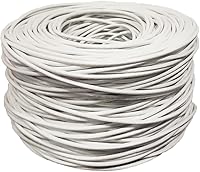
  • Cable Color: The PVC outer jacket is white, a common choice for residential and light commercial structured cabling environments.
  • Max Data Rate: Rated for Gigabit Ethernet (1 Gbps), supporting all standard 10BASE-T, 100BASE-TX, and 1000BASE-T network applications.
  • Max Frequency: Tested and certified to 100 MHz, which represents the full performance ceiling defined by the CAT5e specification.
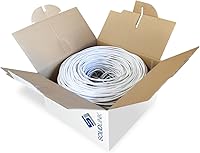
  • Packaging: The spool is housed in an easy-pull dispensing box engineered to allow smooth, tangle-free cable deployment during active installation.
  • Footage Markings: Sequential footage markers are printed directly on the cable jacket at regular intervals to allow accurate measurement without a separate tape measure.
  • Spool Weight: The full 1,000-foot spool weighs approximately 15.5 pounds, which is typical for a bulk solid-core CAT5e spool of this length.
  • Manufacturer: Manufactured by SDS Creative Technologies LLC and sold under the SolidLink product brand.
  • Model Number: The manufacturer model designation for this spool is SL600.

Related Reviews
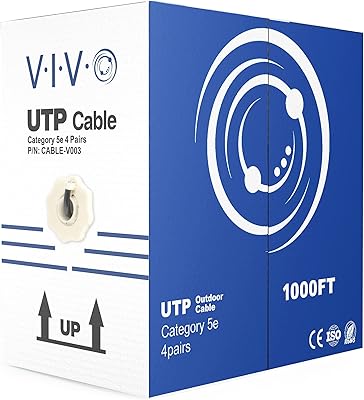
VIVO CABLE-V003 Waterproof Cat5e Ethernet Cable 1000ft
84%
88%
Performance in Outdoor Conditions
91%
Ease of Installation
85%
Waterproofing Effectiveness
87%
Build Quality & Durability
92%
Value for Money
More
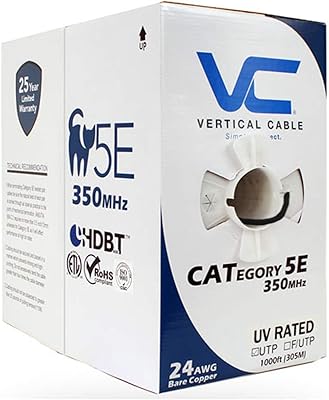
Vertical Cable Cat5e 1000ft Outdoor Ethernet Cable
77%
91%
Jacket Durability
88%
Signal Performance
93%
UV & Weather Resistance
79%
Value for Money
74%
Ease of Installation
More
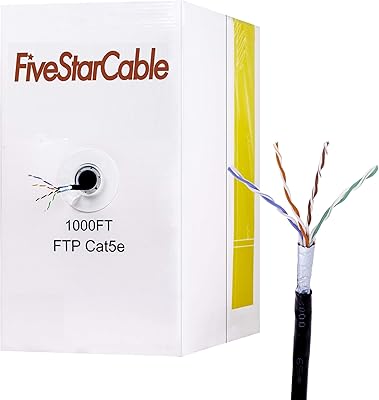
FiveStarCable 1000Ft Cat5e FTP Ethernet Cable
85%
92%
Performance at Gigabit Speeds
88%
Ease of Installation
90%
Durability for Outdoor Use
87%
Value for Money
89%
Compatibility with High-Speed Networks
More
trueCABLE Cat5e Outdoor Shielded 1000ft Ethernet Cable
87%
93%
Cable Build Quality
88%
Shielding Effectiveness
91%
Direct Burial Performance
89%
PoE Reliability
86%
Installation Experience
More
UltraPoE Cat5e 1000ft Direct Burial Ethernet Cable
83%
91%
Conductor Quality
88%
Waterproofing & Direct Burial Rating
84%
UV & Weather Resistance
86%
PoE Performance
79%
Signal Performance & Speed
More
fast Cat. Cat5e Ethernet Cable 1000ft
83%
93%
Conductor Quality
91%
Dispenser & Packaging
88%
Signal Performance
86%
Build & Jacket Durability
84%
Crosstalk & Interference Rejection
More
trueCABLE Cat6A Shielded Riser 1000ft Ethernet Cable
86%
93%
Conductor Quality
88%
Shielding Effectiveness
91%
Jacket & Build Quality
67%
Termination Experience
92%
PoE Reliability
More
trueCABLE Cat6A Direct Burial Ethernet Cable 1000ft
85%
94%
Conductor Quality
92%
Outdoor Weatherproofing
91%
Signal & Data Performance
89%
PoE Reliability
86%
Reel & Usability
More
JARNHNG Cat6 1000ft Ethernet Cable
85%
92%
Outdoor Durability
88%
Signal Quality and Performance
85%
Ease of Installation
81%
Flexibility for DIY Installations
89%
UV and Weather Resistance
More
trueCABLE Cat5e Outdoor Ethernet Cable 500ft
89%
93%
Outdoor Durability
88%
Ease of Installation
91%
Signal Integrity
92%
Value for Money
95%
UV Resistance
More

FAQ

For the vast majority of home networking tasks — streaming, gaming, VoIP, NAS access, and wireless access points — CCA cable performs fine. The higher electrical resistance compared to pure copper only becomes a meaningful concern on very long single runs close to or beyond 90 meters, or in high-wattage PoE applications. For typical home drops of 20 to 60 meters, you will not notice any practical difference in throughput or reliability.

In a typical two- or three-bedroom house, a 1,000-foot spool can comfortably cover 10 to 15 individual outlet drops, depending on your routing paths. Each run might consume anywhere from 50 to 100 feet once you factor in wall routing, attic or crawl space travel, and slack at the patch panel. Most residential installers find that one spool handles a full house job with some cable left over.

Yes — solid-core construction is specifically designed for fixed, permanent installations inside walls, ceilings, and conduit. Solid-core cable holds its shape, terminates cleanly into keystone jacks, and maintains consistent signal over longer distances better than stranded cable. One thing worth checking: some local building codes or commercial specifications require pure copper conductors, so confirm CCA is permitted in your jurisdiction before you start the job.

If your network runs at 1 Gbps or below — which covers nearly every home and small business scenario in use today — CAT5e is fully sufficient. CAT6 becomes worthwhile if you are running 2.5G, 5G, or 10G multi-gigabit switches, or if you want to future-proof infrastructure you would rather not rewire in a few years. For a standard gigabit setup, this 1000ft ethernet cable handles everything without compromise.

It works reliably with standard PoE (802.3af, up to 15.4W) and PoE+ (802.3at, up to 30W) devices across typical run lengths. Because CCA has higher resistance than pure copper, longer runs under heavier PoE loads can see more voltage drop than a pure-copper equivalent. For high-power PoE++ (802.3bt, 60W or 90W) applications, or runs pushing close to 100 meters, pure copper is the safer and more reliable choice.

For making patch leads, you will need a standard RJ45 crimping tool, RJ45 connectors, and a cable stripper — all widely available at any hardware or electronics store. For in-wall terminations into keystone jacks or a patch panel, a punch-down tool is all you need beyond that. There is nothing proprietary about this cable, so your existing tools will work without any special adapters.

No — it is an indoor-rated UTP cable with a standard PVC jacket that is not designed for direct burial, prolonged UV exposure, or unprotected outdoor conditions. For true outdoor runs, you need a UV-stabilized or gel-filled direct-burial cable rated for exterior use. Short runs through a weatherproof conduit between two structures can sometimes be acceptable, but always check your local electrical and cabling codes before proceeding.

In typical indoor temperatures, this bulk CAT5e spool pulls through conduit without much trouble and handles moderate bends reasonably well. Like most solid-core cables, it stiffens noticeably when the temperature drops — below about 50 degrees Fahrenheit, the jacket becomes harder and tight bends require more effort. If you are working in a cold unheated space, letting the spool warm up indoors before pulling can make the job significantly easier.

Not reliably. CAT5e is officially rated for 1 Gbps at the full 100-meter distance, and while 2.5GBASE-T can sometimes operate over CAT5e on very short runs in ideal conditions, it is not a supported or guaranteed configuration. For 2.5G, 5G, or 10G multi-gigabit networking, CAT6 or CAT6A cable is the correct and supported choice.

The pull box works well in practice when positioned upright on a flat, stable surface — most installers report smooth, tangle-free dispensing throughout the spool. The footage markings on the jacket are a legitimately useful feature during a real install, letting you cut accurately without stopping to measure. The box is less ideal for steep-angle overhead dispensing from a ladder, but for standard floor-level or workbench use, it does its job cleanly.