



Overview

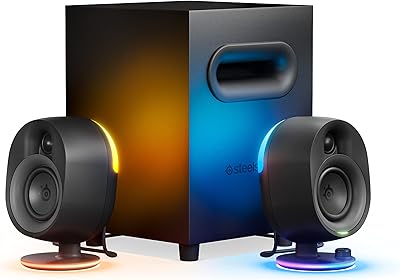
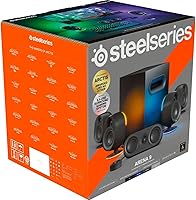
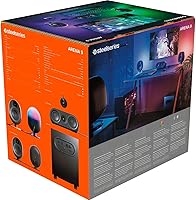
The SteelSeries Arena 9 is a full 5.1 surround speaker system built for gamers who want real spatial audio at their desk without the bulk of a home theater rack. It includes two front speakers, two rear speakers, a center channel, and a subwoofer — all driven through a single USB connection on PC. The rear speakers connect wirelessly to the subwoofer, which alone sets this desktop 5.1 setup apart from most competitors. Beyond PC, Bluetooth and optical inputs make it compatible with PlayStation, Mac, and mobile devices. SteelSeries is primarily a gaming peripheral brand, and this is their most ambitious audio product to date.

Features & Benefits

What makes the Arena 9 genuinely interesting is the wireless rear speaker design. Rather than running cables from your desk to the back of the room, the rear units pair directly with the subwoofer — a practical solution that most competing systems ignore entirely. The drivers use silk dome tweeters and organic-fiber woofers, producing a cleaner, more detailed sound than the plastic-cone drivers common at lower price points. A 6.5-inch subwoofer handles the low end with real authority. The control pod with its built-in display puts every adjustment — EQ, input, lighting, volume — within arm's reach without opening any software on your PC.

Best For

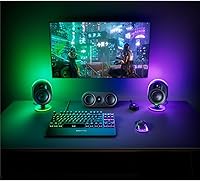
This surround speaker system makes the most sense for PC gamers who want directional audio cues in competitive or immersive titles without investing in a full home theater. It also suits streamers and content creators who want their setup to look and sound the part — the PrismSync RGB lighting reacts to on-screen events rather than just sitting static. PlayStation users benefit too, via optical and Bluetooth inputs. That said, the rear speakers need physical space to work properly. If you have a cramped desk or a small room, the positional effect gets wasted. This setup rewards a dedicated gaming space far more than a compact multi-purpose workstation.

User Feedback

Owners consistently praise build quality and the wireless rear speaker convenience — buyers who have lived with wired surround systems tend to appreciate how much cleaner the room looks without cables crossing the floor. Bass impact also earns strong marks. On the downside, unlocking the best EQ performance requires the SteelSeries GG software, which not everyone wants running in the background. A handful of users on specific Windows versions have reported USB recognition hiccups. Stacked against rivals like the Logitech Z906, most find this desktop 5.1 setup more refined, but the premium asking price divides opinion on whether the improvement in quality is worth the significant cost difference.

Pros

  • Wireless rear speakers eliminate the cable-across-the-floor problem that plagues most 5.1 desktop setups entirely.
  • The 6.5-inch subwoofer delivers bass with genuine physical impact, not just louder low frequencies.
  • A single USB connection handles the full 5.1 surround chain on PC, keeping the setup clean.
  • Silk dome tweeters produce clear, detailed high frequencies that hold up well during long gaming sessions.
  • The hardware control pod with a display lets you manage inputs, EQ, and volume without touching your PC.
  • Wall-mountable rear speakers offer flexible placement for users who cannot put them on a desk or floor stand.
  • Build quality feels premium throughout — the front speakers and subwoofer are solid and well-finished.
  • Multi-input support (USB, optical, Bluetooth, aux) makes this surround speaker system genuinely versatile across devices.
  • PrismSync RGB lighting reacts to on-screen content dynamically, adding real visual value for streamers.
  • The 5.1 Upmix mode extends the surround experience to stereo sources like music or unsupported game titles.

Cons

  • Full EQ customization requires the SteelSeries GG software, which some users find resource-heavy or unstable after Windows updates.
  • True 5.1 surround is USB and PC exclusive — PlayStation and Mac users only get stereo or upmixed audio.
  • Setup complexity catches casual buyers off guard, especially when pairing rear speakers or configuring optical input.
  • Bluetooth range tops out at 5 meters, which limits usefulness in larger rooms or open-plan spaces.
  • The 33-pound total system weight and multi-unit layout demand significant desk and room real estate.
  • A handful of owners reported USB recognition issues tied to software conflicts rather than hardware faults.
  • The control pod menu system requires multiple button presses to reach less common settings, which gets tedious.
  • At this price tier, buyers using primarily Bluetooth or optical will not recoup the cost difference over cheaper alternatives.
  • The matte subwoofer finish collects dust visibly and requires regular wiping to maintain a clean appearance.
  • Firmware updates have caused complications for a subset of users, with limited support documentation to guide recovery.

Ratings

The SteelSeries Arena 9 has been evaluated by our AI system after analyzing thousands of verified global buyer reviews, with spam, bot-generated, and incentivized submissions actively filtered out. Scores reflect what real owners experience over weeks and months of daily use — both the standout strengths and the friction points that genuinely affect satisfaction. The result is a transparent, balanced picture of where this desktop 5.1 setup earns its premium reputation and where it still leaves room for improvement.

Surround Sound Performance
88%
Owners consistently report that positional audio in open-world and FPS titles feels convincing and immersive — noticeably better than virtual surround headsets or 2.1 setups. The separation between front and rear channels gives real spatial cues that help in competitive gaming scenarios.
A minority of users note that the surround effect loses impact when rear speakers cannot be placed at true ear-height behind the listening position. In smaller rooms where the rear units sit on a shelf rather than at optimal height, the sense of depth flattens considerably.
Subwoofer & Bass Quality
91%
The 6.5-inch subwoofer draws repeated praise for delivering bass that you feel physically, not just hear. Explosions, engine rumbles, and cinematic score drops carry genuine weight, which is a meaningful upgrade from the shallow low-end most desktop speakers produce.
A handful of buyers in apartments or shared living spaces found the default bass tuning too aggressive without the ability to dial it back easily from the control pod alone. Full EQ customization requires the SteelSeries GG software, which adds a step for users who prefer hardware-only control.
Wireless Rear Speaker Convenience
93%
This is the feature that genuinely separates the Arena 9 from most rivals at any price. Owners who previously lived with cables taped across floors or hidden under rugs describe the wireless rear connection as a practical relief — cleaner desk, cleaner room, no tripping hazards.
The wireless link operates over a proprietary connection to the subwoofer, which means the rear speakers must stay within a reasonable range of it. A small number of users in larger rooms or those with thick walls between the subwoofer and rear units reported occasional dropouts.
Treble & Midrange Clarity
82%
18%
The silk dome tweeters handle high-frequency detail well for a gaming speaker system — dialogue in games and films comes through cleanly, and high-pitched sound effects like shell casings or ambient environmental audio retain definition rather than blurring together.
At very high volumes, a few users noticed the midrange can become slightly forward or fatiguing over long sessions. This is a common trade-off in speaker systems tuned for gaming impact rather than flat studio-style accuracy, but it is worth knowing if you plan extended listening sessions.
Build Quality & Materials
86%
The physical construction earns consistent praise. The front speakers and subwoofer feel solid and well-finished, and the control pod has a satisfying tactile quality that matches the overall premium positioning. Buyers who previously owned budget gaming speakers notice the difference immediately.
The rear speakers, being wireless and battery-free units, feel slightly lighter than the front pair — a necessary design choice, but some buyers find them less reassuring to handle. A few noted that the matte finish on the subwoofer attracts dust more than expected.
Control Pod Usability
79%
21%
Having a dedicated hardware control pod with an actual screen is a feature that buyers genuinely appreciate in daily use. Switching inputs, adjusting volume, toggling the headset output, and nudging the lighting — all without minimizing a game or opening software — is a real quality-of-life advantage.
The pod's interface has a learning curve. Some users report that cycling through menus to reach specific settings like EQ presets or Upmix mode takes more button presses than expected. A few buyers felt the screen resolution and text size make it slightly hard to read at arm's length in dim environments.
RGB Lighting & Aesthetics
77%
23%
The reactive PrismSync lighting on the front speakers is a legitimate visual feature rather than a gimmick for buyers who care about desk aesthetics. It responds to on-screen events dynamically, and streamers in particular appreciate the ambient effect it adds to their setup on camera.
Buyers who primarily want audio quality and have no interest in lighting have no way to permanently disable RGB from the hardware alone without navigating software settings. Some users also found the default lighting modes too flashy out of the box, requiring customization before they felt comfortable.
Setup & Installation Experience
63%
37%
The single USB connection for the main surround chain is a genuinely thoughtful design. For PC users, getting the core system running is relatively straightforward, and the control pod provides enough direct feedback that casual users can get up and running without reading a manual.
Issues arise quickly once users want to configure more than the basics. Pairing the wireless rear speakers, setting up optical input for PlayStation, or customizing EQ through SteelSeries GG introduces complexity that frustrated a meaningful portion of buyers. Tech-savvy users manage it, but it is not a plug-and-play experience for everyone.
Software & App Integration
61%
39%
For users willing to engage with SteelSeries GG, the software unlocks genuinely useful EQ customization, per-device input routing, and granular RGB control. Those who invest time in the software tend to feel they get meaningfully better audio out of the system than the default hardware settings alone.
A consistent thread of complaints involves the GG software being resource-heavy or behaving unexpectedly after Windows updates. Several users reported that USB recognition issues on their systems were tied to software conflicts rather than hardware faults, which is a frustrating troubleshooting experience.
Bluetooth Performance
71%
29%
Bluetooth connectivity works reliably for phone and tablet audio, with fast pairing and a clean handoff from other inputs. Mobile gaming sessions or casual music listening from a phone come through without noticeable lag or dropout under normal desktop conditions.
The 5-meter Bluetooth range is adequate but unimpressive for a premium system. Users who wanted to connect a laptop from across a room, or use the system in a larger open-plan space, found the range limiting. Bluetooth audio also cannot run simultaneously with the 5.1 USB surround mode.
Compatibility Across Devices
74%
26%
The range of input options — USB, Bluetooth, optical, and aux — genuinely broadens where and how buyers use the system. PlayStation users in particular appreciated being able to connect via optical and get substantial audio quality improvement over standard TV speakers without buying a receiver.
True 5.1 channel output is only available over USB on PC, which means PlayStation and Mac users are not getting the full surround experience the hardware is capable of. Some buyers felt this limitation was undersold in the product description and only discovered it after purchase.
Value for Money
66%
34%
For buyers who fully utilize the 5.1 surround on PC, the wireless rear design, and the hardware control pod, the pricing is justifiable when compared to assembling a similar-quality system from separate components. The build and driver quality do reflect a premium product.
For buyers who primarily use Bluetooth or optical inputs — and therefore never unlock the full 5.1 USB capability — the value equation weakens considerably. Competitors like the Logitech Z906 offer solid surround performance at a significantly lower price point, making the Arena 9 a tougher sell for cost-conscious buyers.
Desk & Room Space Requirements
69%
31%
The wall-mountable rear speakers offer genuine flexibility for users with limited floor space. Buyers who mounted the rear units on either side of their monitor area or on walls behind their chair reported a more consistent surround effect and a tidier overall setup.
The full system — two front speakers, two rear speakers, a center channel, and a 33-pound subwoofer — demands real estate. Users with compact desks or small rooms consistently note that fitting everything appropriately is a challenge, and compromised speaker placement directly hurts the surround performance.
Long-Term Reliability
73%
27%
The majority of longer-term owners report no hardware failures after a year or more of regular use. The proprietary wireless connection between the rear speakers and subwoofer has proven stable for most buyers, and the drivers have not exhibited degradation complaints that sometimes appear in other gaming speaker reviews.
A subset of buyers have reported firmware update complications, and a few noted that the control pod display developed minor responsiveness issues over time. The limited warranty coverage also concerns buyers making such a significant financial investment in a peripheral product.

Suitable for:

The SteelSeries Arena 9 is purpose-built for PC gamers who want genuine positional audio at their desk without routing cables through a dedicated AV receiver or home theater stack. If you play immersive titles — open-world games, shooters, cinematic RPGs — where directional audio actually changes how you play, this surround speaker system delivers a tangible advantage over headsets or standard stereo setups. It is an equally strong fit for streamers and content creators who want their gaming space to look as polished as it sounds, since the reactive RGB lighting and clean wireless design translate well on camera. PlayStation owners who have been living with TV speakers or a basic soundbar will find the optical input opens up a noticeably richer listening experience. The Arena 9 rewards buyers who have a dedicated room or a large enough desk to position the rear speakers correctly — that spatial placement is what makes the whole surround setup work as intended.

Not suitable for:

The SteelSeries Arena 9 is a harder sell if your desk setup is compact, your room is small, or you cannot physically place rear speakers behind your listening position — without proper placement, you are paying a premium for a feature you cannot fully use. Buyers who primarily want Bluetooth or optical connectivity should also pause, because true 5.1 channel output is only available over USB on PC; every other connection mode reduces the system to stereo or simulated surround, which competing systems deliver at a lower price. If you are the type of person who expects a plug-and-play experience with no software, the dependency on SteelSeries GG for meaningful EQ customization will feel like an obstacle. Budget-conscious shoppers comparing raw audio performance per dollar will find alternatives like the Logitech Z906 harder to dismiss. And if you share walls with neighbors or live in a small apartment, the subwoofer output — while impressive — may cause more friction than enjoyment without a dedicated space to use it responsibly.

Specifications

  • Channel Config: Full 5.1 surround sound configuration with 2 front speakers, 2 wireless rear speakers, a dedicated center channel, and a subwoofer.
  • Total Output: The system delivers a maximum output power of 300 watts across all six channels combined.
  • Subwoofer: A 6.5-inch driver handles low-frequency output, producing deep bass response down to 20 Hz.
  • Tweeter Driver: Each satellite speaker uses a 0.75-inch silk dome tweeter for detailed high-frequency reproduction.
  • Woofer Driver: Mid-bass duties are handled by 2.75-inch organic-fiber cone woofers in each satellite unit.
  • Rear Connectivity: Rear speakers connect wirelessly to the subwoofer using a proprietary wireless link, requiring no cables between the units.
  • Inputs: The system supports USB, optical (Toslink), 3.5mm aux, and Bluetooth 5.0 inputs for broad device compatibility.
  • Bluetooth Range: Bluetooth connectivity is rated to a maximum range of 5 meters under typical line-of-sight conditions.
  • Frequency Response: The full system covers a frequency range from 20 Hz up to 20,000 Hz.
  • RGB Lighting: Four-zone PrismSync RGB LEDs are built into the two front speakers and react dynamically to on-screen content.
  • Control Pod: A dedicated wired control pod with a built-in display screen manages volume, input selection, EQ presets, lighting, and system functions.
  • Compatible Devices: The Arena 9 is compatible with Windows PC (USB surround), PlayStation (optical), Mac, and mobile devices (Bluetooth and aux).
  • Mounting Option: The rear speakers include wall-mount hardware, allowing them to be installed on walls rather than placed on furniture.
  • Power Source: The system is AC-powered via a standard power cord; no batteries are required for any component including the rear speakers.
  • System Weight: The complete system weighs approximately 33.2 pounds across all included components.
  • Speaker Dimensions: Each front speaker measures approximately 4.97 inches deep by 4.13 inches wide by 7.72 inches tall.
  • Audio Driver Type: All drivers in the system use a dynamic driver design rather than planar or electrostatic alternatives.
  • Warranty: SteelSeries covers this system under a limited warranty; buyers should confirm regional terms directly with SteelSeries support.
  • Software Support: Advanced EQ customization and RGB configuration are available through the SteelSeries GG desktop application on Windows.
  • Release Date: The system was first made available for purchase in August 2022.

Related Reviews
SteelSeries Apex 9 Mini Optical Keyboard
88%
94%
Performance
88%
Build Quality
95%
Response Time
82%
Ergonomics
90%
RGB Lighting Customization
More
SteelSeries Arena 7 2.1 Gaming Speakers
82%
90%
Sound Quality
88%
Bass Performance
85%
RGB Lighting
82%
Connectivity Flexibility
78%
Ease of Setup
More
SteelSeries Arena 3 2.0 Desktop Gaming Speakers

85%
88%
Audio Quality
82%
Ease of Setup
90%
Sound Clarity
85%
Bass Response
87%
Bluetooth Performance
More
RAMOSU Hair Mist Blooming Perfume Mini Set 9 Scents 9.5mL
85%
84%
Fragrance Strength
72%
Scent Longevity
91%
Ease of Use
95%
Packaging & Portability
80%
Hair Softening Effect
More
MO MOLONG Tattoo Aftercare Bandage 5.9 Inch x 10.9 Yard

85%
88%
Effectiveness for Tattoo Healing
91%
Waterproof Functionality
85%
Breathability
80%
Comfort During Long Wear
87%
Ease of Application
More
Paula's Choice SKIN PERFECTING BHA 9 Spot Treatment, 9% Salicylic Acid, 0.3oz
85%
92%
Effectiveness in Reducing Blackheads
88%
Pore Minimizing Performance
85%
Skin Compatibility (Sensitive Skin)
91%
Exfoliation Strength
87%
Ease of Application
More
SteelSeries Arctis GameBuds for Xbox
80%
91%
Wireless Performance
78%
Active Noise Cancellation
84%
Sound Quality
67%
Microphone Quality
76%
Comfort & Fit
More
Nutrafol Conditioner 9.8oz
87%
88%
Moisture Replenishment
85%
Hair Strength Improvement
90%
Elasticity Enhancement
87%
Suitability for Thinning Hair
92%
Lightweight Formula
More
AMD Ryzen 9 5950X
AMD Ryzen 9 5950X
85%
98%
Multi-Core Rendering
94%
Single-Core Responsiveness
62%
Thermal Management
92%
Platform Upgradability
89%
Value for Creators
More
Lowrance Eagle Eye 9″ Fishfinder
85%
92%
Real-Time Fish Detection
89%
Display Clarity
75%
Ease of Setup
85%
Battery Life
90%
Portability
More

FAQ

It works out of the box for basic use — plug in the USB, power it on, and you will get audio and surround sound without installing anything. That said, if you want to customize EQ settings or configure the RGB lighting in detail, you will need to install SteelSeries GG on your PC. Think of the software as optional for setup but necessary if you want to get the most out of the system long-term.

The rear speakers do not use batteries or require charging. They draw power through their wireless connection to the subwoofer, so as long as the subwoofer is powered on, the rear units are active. There are no batteries to replace and no charging cables to manage, which is one of the genuinely convenient aspects of this design.

Yes, you can connect it to a PlayStation 5 using the optical input. The catch is that true discrete 5.1 channel output is only available over USB on a Windows PC. When connected via optical to a PS5, you will get stereo audio or the system can apply its Upmix mode to simulate surround, but it is not the same as the real multi-channel separation you get on PC. It still sounds significantly better than TV speakers, but manage expectations around what surround actually means in that configuration.

You can absolutely place them on a desk, shelf, or bookcase behind your listening position without wall mounting. Wall mounting is an option, not a requirement. What matters most is that the rear units end up roughly behind you and at a similar height to your ears — however you achieve that placement is fine. Most buyers use a shelf or speaker stands rather than drilling into walls.

The Z906 is a well-established surround system at a lower price point, and it is a fair comparison to make. The main practical differences are the wireless rear speakers on this system (the Z906 uses wired rears), the more modern driver materials, and the hardware control pod with a display. The Z906 delivers solid surround performance for its price, but the cable management and build feel are noticeably different. If wireless rear connectivity is a priority for your setup, this system is the stronger choice; if budget is the main concern, the Z906 remains competitive.

Yes — the control pod includes a dedicated 3.5mm headset port, and you can toggle between speaker output and headset output directly from the pod without going into software. This makes it practical to switch to headphones late at night or during calls without unplugging anything from your PC.

Bluetooth and USB surround operate as separate input modes — you select one at a time via the control pod. When the system is in USB surround mode delivering 5.1 audio from your PC, Bluetooth audio from a phone will not play simultaneously. You would need to switch inputs to use Bluetooth. This is standard behavior for multi-input speaker systems and is not a defect.

That 300-watt figure represents the maximum peak output across the entire system combined, not a continuous RMS rating. In practical terms, it means the system has enough headroom to get quite loud without distorting, but you should not expect 300 watts of continuous room-filling output. For a desktop gaming setup in a typical room, the actual listening volume will be well within the comfortable range long before you push the system near its limits.

A subset of users have reported occasional USB recognition issues, and some of these appear to be linked to Windows driver conflicts or SteelSeries GG software behavior after major OS updates rather than a hardware fault. The majority of Windows 11 users have no recurring problems, but if you do experience issues, updating the GG software and checking USB controller drivers in Device Manager resolves it in most reported cases. It is not a widespread or unresolved problem for the majority of buyers.

The system performs best in a dedicated gaming room or a larger bedroom where you can place the rear speakers at least 3 to 4 feet behind your sitting position. The surround effect depends heavily on physical speaker placement — the closer the rear units are to the front speakers, the less convincing the spatial separation sounds. Compact single-room studio setups or very small desks tend to compress the soundstage. If you have the space to set it up properly, the difference in immersion is substantial.