Overview

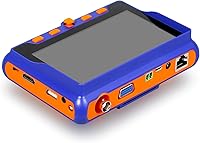
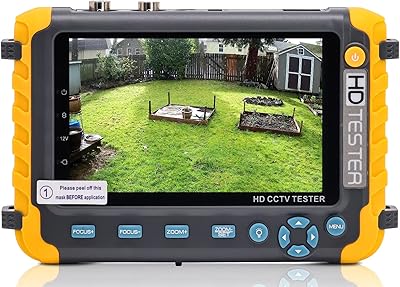
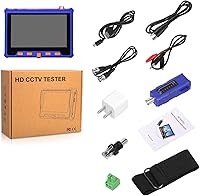
The SGEF 5900ACT 5″ Portable CCTV Tester is a wrist-mounted diagnostic tool built for security camera installers who spend their days navigating ceiling spaces and climbing ladders to commission coaxial camera systems. It handles AHD, CVI, TVI, and traditional CVBS analog cameras, covering the vast majority of what you'll encounter on a typical commercial or residential install. Worth stating upfront: IP and SDI cameras are not supported, so if your work is primarily network-based, this isn't the right fit. The 5-inch TFT LCD screen and built-in rechargeable battery make this field camera tester a genuinely practical device rather than a bench-only unit.

Features & Benefits

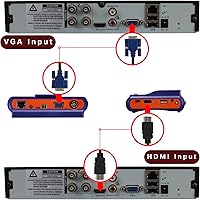
What sets the SGEF 5900ACT apart from basic testers is the range of inputs packed into a one-pound device. The 5-in-1 coaxial support covers AHD, CVI, TVI, and CVBS with automatic PAL/NTSC detection — handy when you're testing cameras from different manufacturers on the same job. The HDMI input handles resolutions up to 1920×1080, so you can connect a laptop or DVR directly on-site without hunting for a separate monitor. VGA works similarly for legacy equipment. The RS485 PTZ control supports PELCO-D and PELCO-P protocols, letting you verify pan, tilt, and zoom behavior right where you're standing. The cable tester also identifies UTP wire sequence, which cuts diagnostic time noticeably.

Best For

This wrist-mounted tester makes the most sense for installers who are still predominantly working with HD coaxial infrastructure — AHD, CVI, or TVI systems common in commercial retrofits and residential builds. If you're a sole-operator installer juggling cable checks, camera image verification, and PTZ commissioning all in one visit, consolidating those tasks into a single device has real value. The wrist-strap design isn't just a novelty — it keeps both hands free when you're up a ladder. It's also a solid pick if your work regularly involves connecting a laptop or DVR on-site, since the dual monitor inputs remove the need to carry additional display hardware.

User Feedback

Across 54 reviews, the SGEF 5900ACT holds a 4.2 out of 5 rating — solid for a specialist tool. Installers consistently praise the LCD screen clarity, since seeing a sharp image on-site saves the back-and-forth trip to the DVR to confirm camera alignment. PTZ control earns positive marks too, particularly from technicians managing systems with multiple pan/tilt cameras. On the downside, a handful of buyers note that battery life falls short during longer working days, which is consistent with the manufacturer-stated five-hour figure — treat that as a best-case number. The interface also looks a bit dated next to newer units. Functional, but not cutting-edge in terms of user experience.

Pros

  • Supports AHD, CVI, TVI, and CVBS cameras in a single device with automatic PAL/NTSC switching.
  • The 5-inch LCD screen lets installers verify live camera image quality without returning to the DVR.
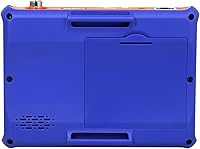
  • Wrist-strap design keeps both hands free on ladders — a practical advantage, not just a novelty.
  • RS485 PTZ control covers both PELCO-D and PELCO-P, handling the majority of real-world pan/tilt cameras.
  • Built-in UTP and BNC cable tester identifies wire sequence on the spot, cutting diagnostic back-and-forth.
  • HDMI and VGA inputs eliminate the need to carry a separate portable monitor to job sites.
  • The 12V DC output lets you power a camera directly from the tester without a separate power supply.
  • At 1.1 pounds, this field camera tester adds minimal weight to a working tool kit.
  • A 4.2 out of 5 rating across verified buyers reflects consistent satisfaction among its target audience.

Cons

  • No support for IP or SDI cameras limits relevance as installs increasingly shift to network-based systems.
  • Battery life falls short of a full working day under real-world conditions, despite the five-hour manufacturer claim.
  • The on-screen interface feels outdated and takes meaningful time to learn without prior experience on similar testers.
  • No ruggedized or IP-rated housing leaves the device vulnerable on active construction sites.
  • Charging takes approximately four hours with no fast-charge option, making mid-day top-ups inconvenient.
  • The LCD resolution of 800×480 can appear soft or washed out when working in direct sunlight.
  • PTZ protocol support is limited to PELCO-D and PELCO-P, leaving some less common camera systems uncovered.
  • No USB-C charging port is a noticeable omission compared to more recently designed competing tools.

Ratings

The SGEF 5900ACT 5″ Portable CCTV Tester has been scored by our AI system after analyzing verified buyer reviews from multiple global markets, with spam, bot activity, and incentivized feedback actively filtered out. The scores below reflect what real installers and technicians consistently praised — and where they ran into friction. Both sides of the picture are represented honestly.
Display Clarity
83%
Installers repeatedly call out the 5-inch LCD as one of the most practical aspects of this field camera tester. Being able to pull up a live camera image on-site — without running back to a DVR — saves real time on commercial and residential jobs alike.
The 800×480 resolution is functional but not sharp by modern standards, and a few users mention it can wash out in direct sunlight. It is adequate for most diagnostic purposes, but not what you'd call impressive next to newer competing units.
Camera Compatibility
79%
21%
The 5-in-1 coaxial support — covering AHD, CVI, TVI, and CVBS with automatic PAL/NTSC switching — is genuinely useful for technicians working across mixed-brand installations. Not needing to reconfigure the tester between camera types speeds up the commissioning process noticeably.
The complete absence of IP and SDI camera support is a real constraint as more installs shift toward network-based systems. For shops that work exclusively on modern IP infrastructure, this wrist-mounted tester simply will not cover the job.
PTZ Control
81%
19%
Support for both PELCO-D and PELCO-P protocols covers the lion's share of PTZ cameras in the field. Being able to verify pan, tilt, and zoom behavior directly from the tester — without a separate controller — is a meaningful time saver on larger multi-camera installs.
The baud rate options cover common configurations well, but advanced protocol variations beyond PELCO-D and PELCO-P are not supported. Installers working with less common PTZ systems may still need supplementary equipment for full commissioning.
Portability & Form Factor
86%
The wrist-strap design is more than a gimmick — it keeps both hands free when you are up a ladder adjusting a camera mount, which is exactly the scenario this tool is built for. At just 1.1 pounds it adds minimal load to a toolkit.
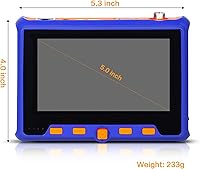
The 5×1×4-inch body is compact but not pocketable for every technician. Some users find the wrist-worn format awkward during extended use at ground level, where a belt-clip or pocket-sized alternative might feel more natural.
Battery Life
67%
33%
The 3000mAh lithium polymer battery is sufficient for a half-day of active testing without needing a recharge, which works well for installers doing focused commissioning sessions across a handful of cameras on a single site.
The manufacturer-stated five-hour figure appears to be a best-case number — several buyers report falling short of that in real-world use, particularly when running HDMI input or PTZ functions simultaneously. A full day of heavy field use will likely require either a mid-day charge or a backup power source.
HDMI Input Functionality
77%
23%
Having HDMI input that handles up to 1920×1080 turns this field camera tester into a temporary monitor for laptops or DVRs during on-site configuration, eliminating the need to carry a separate portable display. That is a practical benefit on cramped job sites.
The HDMI mode works as described, but the automatic switching can occasionally feel sluggish when toggling between sources. It is a useful bonus feature, though not one that matches the responsiveness of a dedicated portable monitor.
VGA Input Functionality
71%
29%
VGA support at resolutions up to 1920×1080 keeps this tester relevant on sites with older DVR hardware or legacy laptops that lack HDMI outputs. It rounds out the input options nicely without requiring adapters in most cases.
VGA is increasingly rare on modern equipment, so this feature has limited day-to-day utility for technicians working on newer installs. It feels more like a safety net than a headline capability at this point.
Cable Testing
78%
22%
The built-in UTP and BNC cable tester displays wire sequence and connection status directly on screen, which is a practical time-saver when tracing runs or verifying a newly terminated cable before connecting a camera. It removes a separate tool from the bag.
The cable testing function covers the basics well but lacks the depth of a dedicated cable tester — it will not replace a proper network cable tester for complex structured wiring diagnostics. Think of it as a quick-check tool rather than a thorough analysis instrument.
Build Quality
72%
28%
The housing feels solid enough for daily field use and the unit does not feel flimsy when handled on a job site. The compact form holds together well across repeated handling and transport in a tool bag.
It does not have an IP-rated or ruggedized shell, which is a notable omission for a tool designed for construction environments. Drops onto concrete or exposure to rain are legitimate risks that the casing is not explicitly built to withstand.
Interface & Usability
63%
37%
The on-screen menu is functional and covers all the key settings — brightness, contrast, color saturation, PTZ config, and cable test — without being hard to navigate once you have spent a session getting familiar with it.
Multiple reviewers describe the interface as feeling dated, and that is a fair assessment. Menu navigation is not intuitive out of the box, and the multilingual OSD, while helpful, does not fully compensate for a layout that has not kept pace with more modern diagnostic tool UX design.
Value for Money
74%
26%
At its mid-range price point, this wrist-mounted tester bundles a display, multiple camera format support, PTZ control, cable testing, and dual monitor inputs into one device. For a coaxial-focused installer, that consolidation has genuine cost efficiency compared to buying separate tools.
The value equation weakens for technicians whose work is shifting toward IP camera systems. Paying a mid-range price for a tool that cannot handle network cameras feels harder to justify as analog installs become a smaller share of the workload.
Charging & Power Options
76%
24%
The included DC 5V 1A adapter covers standard charging needs, and the 12V DC output for powering cameras directly is a genuinely useful field feature — it lets you test a camera without needing a separate power supply on site.
Charging takes around four hours to reach a full battery, which is on the slower side if you need a quick top-up between jobs. There is no fast-charging support and no USB-C option, which feels like a missed update given how common those are on comparable tools now.
Multi-format Signal Detection
82%
18%
The automatic PAL/NTSC detection removes a manual step that would otherwise slow down testing when switching between camera brands or regions. In practice, this auto-detection works reliably and is one of the quieter but genuinely appreciated features among experienced users.
The auto-detection covers analog and HD coaxial formats well but offers no flexibility for hybrid or non-standard signal configurations outside its supported range. Edge-case camera types will simply return no signal rather than an informative error.
Setup & Learning Curve
69%
31%
Experienced CCTV technicians typically get up to speed with the SGEF 5900ACT within a single job. The core testing functions are accessible without deep menu exploration, and the device ships ready to use with battery partially charged.
First-time users without prior experience on similar testers may find the menu structure confusing, particularly around PTZ protocol setup. The manual covers the basics but lacks the depth needed to troubleshoot edge-case configuration issues quickly.

Suitable for:

The SGEF 5900ACT 5″ Portable CCTV Tester is built for security camera installers and technicians whose daily work revolves around coaxial camera systems — AHD, CVI, TVI, and legacy analog CVBS installs in particular. If you are a sole-operator or small integrator who regularly climbs ladders to commission cameras, the wrist-strap design is a genuine field advantage, keeping both hands free while you verify image quality and adjust camera angles in real time. Technicians who currently carry separate tools for cable testing, PTZ control, and camera signal verification will find real value in consolidating those tasks into a single handheld device. The HDMI and VGA inputs also make it practical for anyone who needs to connect a DVR or laptop on-site without hunting for a spare monitor. At its mid-range price point, this field camera tester makes the most sense for working professionals who need a dependable, multi-function diagnostic unit they can rely on across a full install day.
Not suitable for:

If your work has shifted primarily to IP-based or network camera systems, this wrist-mounted tester will not cover your needs — the complete absence of IP and SDI camera support is a hard limitation, not a minor footnote. Modern security integrators handling PoE cameras, NVR-based installs, or hybrid IP-analog systems will quickly hit the ceiling of what this device can do. The roughly five-hour battery life, which appears to be a manufacturer best-case figure rather than a guaranteed real-world result, may also frustrate technicians working long consecutive days without access to a power source. The interface, while functional, feels dated compared to newer diagnostic tools on the market, and users who value an intuitive, modern UX may find the learning curve more friction than it is worth. Anyone expecting ruggedized construction suitable for rain exposure or repeated drops on a construction site should also look elsewhere, as the housing offers no formal protection rating.

Specifications

  • Display: 5-inch TFT LCD screen with 800×480 resolution for on-site camera image verification.
  • Dimensions: The unit measures 5×1×4 inches, making it compact enough to wear on the wrist during installation work.
  • Weight: The device weighs 1.1 pounds, adding minimal burden to a technician's standard tool kit.
  • Camera Types: Supports AHD, CVI, TVI, and CVBS analog coaxial cameras; IP and SDI cameras are not supported.
  • Max Resolution: Capable of testing coaxial cameras up to 8MP, covering 720P through to 4K-equivalent AHD, CVI, and TVI formats.
  • Signal Standard: Automatically detects and adapts to both PAL and NTSC signal standards without manual configuration.
  • HDMI Input: HDMI input supports resolutions of 1024×768, 1280×720, 1280×1024, 1440×900, and 1920×1080.
  • VGA Input: VGA input is compatible with 1024×768, 1280×1024, 1440×900, and 1920×1080 resolutions.
  • PTZ Protocols: RS485 PTZ control supports PELCO-D and PELCO-P protocols with selectable baud rates of 2400, 4800, 9600, and 19200.
  • Cable Testing: Integrated UTP and BNC cable tester displays wire connection status and sequence numbering for on-site diagnostics.
  • DC Output: Provides a 12V DC output port to power cameras directly from the tester during installation or troubleshooting.
  • Battery: Built-in 3.7V 3000mAh rechargeable lithium polymer battery powers the unit for approximately 5 hours per charge under manufacturer-stated conditions.
  • Charging: Charges via an included DC 5V 1A power adapter; full charge takes approximately 4 hours.
  • Audio Test: Includes a built-in audio test function for verifying audio signal output from compatible cameras.
  • OSD Language: On-screen display supports multiple languages, selectable through the device menu.
  • Model Number: Manufacturer model number is SGEF-5900ACT, produced by SGEF.
  • Availability: First listed for sale in April 2018 and confirmed as not discontinued by the manufacturer.
  • Battery Included: One lithium-ion battery is included in the box and pre-installed in the unit at time of purchase.

Related Reviews

Anpviz IV8-GM 5-Inch CCTV Camera Tester
74%
88%
Battery Life
91%
Analog Format Compatibility
84%
Resolution Support
63%
Display Quality
71%
PTZ Controller
More
Triplett CamView IP Pro 5 Camera Tester
79%
93%
Multi-Format Compatibility
88%
Display Quality
91%
Built-in PoE Output
84%
Cable Testing Capability
61%
Interface & Navigation
More
Acogedor 5-Inch Portable ATSC Digital TV
71%
93%
Portability
78%
Picture Quality
61%
Battery Life
66%
Signal Reception
81%
Ease of Setup
More
EVERSECU CCTV IP Camera Tester
83%
88%
Ease of Use
91%
Display Quality
85%
Battery Life
80%
Versatility
75%
Compatibility
More
KEEPTIME 21.5″ Portable Monitor
85%
89%
Display Quality
91%
Portability & Design
88%
Gaming Performance
78%
Connectivity & Compatibility
84%
Setup & Installation
More
Zyyini 5-Inch Portable TV
66%
88%
Portability
57%
Signal Reception
61%
Battery Life
59%
Picture Quality
83%
Ease of Setup
More
Desobry 10.5″ Portable TV with ATSC Tuner
73%
83%
Picture Quality
88%
Portability
54%
Audio Performance
71%
ATSC Tuner & Reception
79%
Connectivity & Inputs
More
VOKENSU RF10 10.5″ Portable Monitor
73%
93%
Portability
81%
Display Quality
47%
Glare & Reflections
89%
Aspect Ratio Utility
74%
Connectivity
More
JBL Flip 5 Portable Bluetooth Speaker
80%
83%
Sound Quality
91%
Waterproof Performance
88%
Battery Life
86%
Portability & Design
82%
Connectivity & Pairing
More
Cocopar 18.5-inch Portable Monitor
84%
90%
Display Quality
95%
Portability & Weight
88%
Gaming Performance
85%
Connectivity
80%
Build Quality
More

FAQ

No, it does not. The SGEF 5900ACT 5″ Portable CCTV Tester is designed exclusively for coaxial camera formats — AHD, CVI, TVI, and analog CVBS. If your install uses IP or PoE cameras on an NVR system, you will need a different tool for that work.
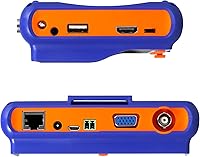
Yes, that is exactly what the HDMI input is designed for. It supports up to 1920×1080, so you can connect a laptop or DVR directly and use the 5-inch screen as a compact on-site display. It switches to HDMI mode automatically when a cable is connected.

The manufacturer states approximately 5 hours per charge, but real-world battery life tends to vary based on which features you are running. Users who actively use HDMI input or PTZ control alongside camera testing tend to see shorter runtimes. Treat 5 hours as a best-case figure and plan for a mid-day charge on long jobs.

It supports PELCO-D and PELCO-P, which cover the vast majority of PTZ cameras you will encounter on standard commercial and residential installs. The RS485 baud rate is selectable between 2400, 4800, 9600, and 19200. Less common or proprietary PTZ protocols are not supported.

Yes, the wrist-mounted tester has a 12V DC output port that lets you power a camera directly from the device. This is genuinely useful when you need to test a newly installed camera that is not yet connected to its permanent power source.

No, it does not carry any official IP rating or ruggedized classification. The housing is reasonably solid for everyday handling but is not designed to withstand rain exposure or significant drops onto hard surfaces. Take reasonable care with it on active construction sites.

The built-in UTP and BNC cable tester checks the connection status of your cable run and displays the wire sequence numerically on screen. It is a quick-check tool that helps you confirm a cable is properly terminated before connecting a camera, rather than a full-featured network cable analyzer.

Most experienced installers who use it on ladders genuinely appreciate the wrist-strap design. Having the tester secured to your wrist keeps both hands free when you are adjusting a camera mount or running cable overhead. At ground level some users find it a bit awkward, but for overhead work it earns its keep.

Yes, and the automatic PAL/NTSC detection is part of what makes that practical. You do not need to manually reconfigure the tester when switching between camera brands or between cameras using different HD coaxial formats — AHD, CVI, and TVI are all handled in the same session.

It takes a bit of time upfront, particularly for setting up PTZ protocols. Experienced technicians generally get comfortable with this field camera tester within one full job. The menu is functional but feels dated, and the included manual covers the basics without going deep on troubleshooting edge cases. Budget some time for familiarization before relying on it on a high-pressure install.

Where to Buy