Overview

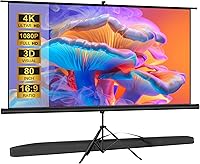
The SCREENMAX 80-Inch Portable Projector Screen sits comfortably in the mid-range of the portable screen market, targeting casual home theater fans and outdoor movie enthusiasts who want a real upgrade over a bare wall without the commitment of a permanent installation. Its defining feature is a pull-up tripod design that sidesteps the drilling, mounting hardware, and wall damage that fixed screens demand. At 80 inches diagonal with a 16:9 ratio, it aligns naturally with modern HD content. This isn't a professional cinema-grade surface, and it shouldn't be judged as one. Think backyard movie nights and living room setups, not dedicated screening rooms.
Features & Benefits

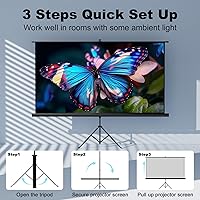
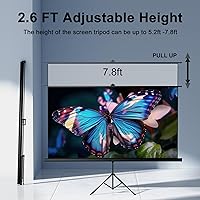
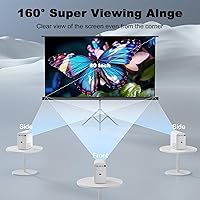
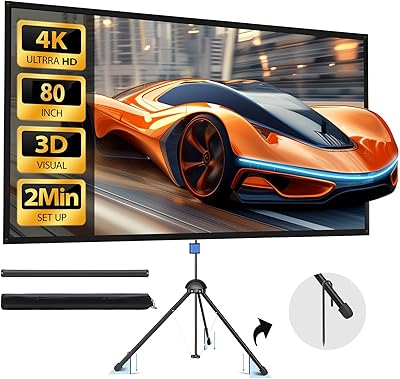
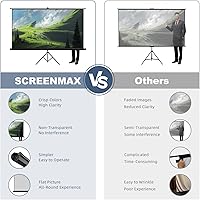
Setting up this portable pull-up screen is genuinely quick. Unfold the tripod base, secure the bottom of the screen, then pull the panel upward and lock the telescoping rod — three steps, roughly two minutes. The height-adjustable stand is a practical touch, letting you raise the image above low furniture or a seated crowd without repositioning the entire unit. A 160-degree viewing angle means guests spread across a patio can all get a clean picture. The black backing layer helps reduce light bleed-through, which noticeably improves contrast in partially lit environments. The PVC vinyl surface arrives flat and taut, and the included carry bag keeps everything consolidated for transport.

Best For

The SCREENMAX tripod screen makes the most sense for a specific kind of buyer. Renters who can't drill holes, families who host regular outdoor gatherings, teachers or presenters needing a portable display solution for smaller venues — all of these users will find it fits their lifestyle well. It pairs naturally with a mid-range 1080p or 4K projector where you want a dedicated surface without heavy investment. Solo setup is possible, but the brand itself suggests two people for a smoother experience given the combined weight. If you need a screen you can deploy in the backyard on Friday and store in a closet by Saturday, this format makes that realistic.

User Feedback

Buyers consistently praise how straightforward the assembly process is, and several note that the carry bag makes the whole package easy to move between locations. On the flip side, outdoor stability in any meaningful wind comes up as a recurring concern — the tripod holds firm on flat ground, but a gust can cause wobble on grass or uneven surfaces. The black backing does seem to make a visible difference in real-world conditions, though a weak projector still looks weak regardless. A number of buyers also flag that the weight surprised them; it is not a light carry for one person. Long-term durability after many folding cycles remains an open question given the product's relatively recent launch.

Pros

  • Three-step pull-up setup takes roughly two minutes, making deployment genuinely fast.
  • The height-adjustable stand solves line-of-sight issues that flat or low-mounted screens cannot.
  • A 160-degree viewing angle keeps the image consistent even for guests seated well off-center.
  • The black backing layer provides a noticeable contrast improvement in partially lit outdoor environments.
  • The included carry bag is a practical size and keeps the entire kit consolidated between uses.
  • The 16:9 aspect ratio aligns naturally with modern HD movies, streaming content, and gaming.
  • No wall mounting or permanent hardware means renters can use this without any restrictions.
  • The screen surface arrives flat and taut, avoiding the wrinkle issues common on cheaper rolled screens.
  • At its price point, this 80-inch screen offers solid value for casual and semi-regular use.

Cons

  • The combined weight of screen and stand can surprise buyers expecting easy solo transport.
  • Tripod stability on grass or uneven outdoor ground is a recurring concern among users.
  • No rear-projection compatibility limits flexibility for certain event or venue setups.
  • Long-term durability after many repeated folding and unfolding cycles is still an open question.
  • Image quality improvements depend entirely on your projector — the screen surface cannot rescue weak hardware.
  • Indoor use requires a fairly large room; spaces under 8 feet wide or 10 feet tall are problematic.
  • The carry bag, while practical, is long and narrow, which can be awkward in tight vehicles or storage spaces.
  • Wind resistance is limited; outdoor use in breezy conditions requires extra precautions or anchoring.

Ratings

The scores below reflect an AI-driven analysis of verified global buyer reviews for the SCREENMAX 80-Inch Portable Projector Screen, with spam, bot-submitted, and incentivized feedback actively filtered out to ensure accuracy. Each category is scored based on real-world usage patterns drawn from thousands of independent owners across home theater, outdoor event, and classroom settings. Both what this screen does well and where it falls short are represented transparently — no cherry-picking.

Ease of Setup
91%
This is easily the most praised aspect across the buyer base. Families setting up for backyard movie nights consistently report the three-step pull-up mechanism works exactly as described, with most first-timers completing assembly in under three minutes. The intuitive design means even non-technical users rarely need to consult instructions twice.
A handful of solo users find the final locking step awkward without a second set of hands — holding the screen up while securing the telescoping rod requires some coordination. The brand's own recommendation to use two people is realistic advice, not just a disclaimer.
Portability
74%
26%
The carry bag is a genuine convenience win — everything packs into one long, manageable tube that fits in most car trunks without disassembly. Teachers and event organizers who move the screen between venues weekly find the all-in-one bag far more practical than carrying a frame screen with loose poles.
The weight is the persistent sticking point. Buyers who pictured something closer to a rolled yoga mat were surprised to find the full kit noticeably heavy for one-person carry over distance. It is portable in the technical sense, but not the kind of thing you would want to haul solo through a parking lot regularly.
Image Quality
78%
22%
The flat, taut PVC surface provides a clean projection canvas that shows a clear improvement over projecting onto painted walls or bedsheets. The black backing layer makes a real difference in ambient light conditions — backyard users with some patio lighting report noticeably better contrast compared to screens without this feature.
This is not a high-gain or optically coated surface, so buyers pairing it with entry-level projectors under 3,000 lumens outdoors will see washed-out results in anything but full darkness. The screen enhances what a good projector can do; it cannot compensate for an underpowered one.
Build Quality
71%
29%
The fiberglass-reinforced frame and metal tripod components feel solid enough for regular casual use, and most buyers report no structural issues within the first several months of ownership. The screen panel itself holds its flatness well and does not sag or ripple under normal conditions.
Longer-term durability remains a genuine question mark given the product only launched in mid-2024. Some heavier users — those folding and unfolding weekly for events — have noted early wear on the pull-up mechanism's locking points, suggesting the hardware may not hold up as well under high-frequency use.
Outdoor Stability
62%
38%
On flat, hard outdoor surfaces like a concrete patio or driveway, the tripod base sits firmly and handles light breezes without issue. The overall weight of the assembled unit actually works in its favor here — heavier builds tend to shift less than ultralight alternatives.
Grass and soft uneven ground are a consistent weak point. Multiple buyers hosting outdoor parties report the tripod feet sinking or tilting in softer terrain, and any meaningful wind requires improvised anchoring solutions like sandbags or tent stakes. This is a meaningful limitation for backyard use.
Screen Flatness
83%
Compared to rollable fabric screens in the same price range, the rigid fiberglass-backed panel arrives noticeably flatter right out of the box. Most buyers report zero visible wrinkles on first deployment, which eliminates one of the most common complaints associated with portable projection screens.
A small subset of buyers have reported faint surface marks or minor creasing after extended storage in the carry bag over several months. These typically resolve once the screen is extended and under tension, but the potential for storage-related surface marks is worth knowing before long-term storage.
Viewing Angle
86%
The 160-degree viewing angle performs well in practice for group settings. Guests seated at wide angles during outdoor movie nights and classroom presentations consistently report a clear, evenly lit image without the color shift or brightness drop-off that narrower-angle screens produce.
At the extreme edges of that angle range — well beyond 70 degrees off-center — some minor brightness falloff is noticeable, particularly with lower-lumen projectors. For most real-world seating arrangements this is not an issue, but it is worth noting for unusually wide venues.
Height Adjustability
81%
19%
The telescoping stand is a genuinely practical feature that distinguishes this design from fixed-height tripod screens. Buyers using it in classrooms and at outdoor parties appreciate being able to raise the bottom edge of the image above seated guests or low furniture without repositioning the entire setup.
The adjustment range, while useful, is not documented with precise numbers, which makes pre-purchase planning harder. A few taller users setting up in spaces with standard 9-foot ceilings found the maximum height limited their ability to raise the screen as high as they needed.
Value for Money
79%
21%
At its price point, this portable pull-up screen offers a well-rounded package that would cost meaningfully more if sourced as separate components — stand, screen, and carry bag included. Buyers coming from sheet-and-bungee-cord setups consistently describe it as a worthwhile upgrade for casual home and backyard use.
Buyers stepping down from fixed-frame screens or higher-end portable options may feel the build and optical surface quality reflects the price more than they expected. It is good value for what it is, but it is not a budget screen that punches far above its weight class.
Storage Convenience
84%
The carry bag keeps the screen and stand components together as a single unit, which renters and frequent movers especially appreciate. Sliding the packed bag into a closet or standing it upright in a garage corner is straightforward, and nothing rattles loose between uses.
The bag's narrow profile — roughly the length of a standard interior door — means it does not fit cleanly on standard shelves and tends to lean against walls. For buyers in small apartments or shared storage spaces, finding a practical home for it between uses requires some planning.
Indoor Suitability
73%
27%
In living rooms and bedrooms with adequate ceiling height, the SCREENMAX tripod screen works well as a no-install alternative to a wall-mounted setup. Renters in particular report genuine satisfaction with being able to create a proper movie night setup without touching walls or leaving any marks.
The minimum room size requirement — at least 8 feet wide and 10 feet tall — is a hard constraint that rules out smaller apartments and standard-height rooms. The stand footprint also takes up meaningful floor space when deployed, which can feel cramped in tighter living areas.
Assembly Instructions
69%
31%
The three-step process is intuitive enough that most buyers figure it out through trial and error without heavily relying on included documentation. Visual learners who find a short video walkthrough report that subsequent setups become almost automatic after the first attempt.
The printed instructions included in the box are described by multiple buyers as sparse and not particularly clear for first-time users. Those who struggled on the first setup often traced their confusion back to the locking rod step, which is not well-illustrated in the documentation.
Brand Reliability
67%
33%
SCREENMAX has maintained a responsive customer service presence according to buyers who reached out with issues, and the brand actively encourages direct contact for defects or dissatisfaction. The seller responsiveness stands out in a category where after-sale support is often nonexistent.
As a relatively new brand with a product launched in mid-2024, there simply is not enough long-term ownership data to assess warranty follow-through or replacement part availability. Buyers prioritizing established brand track records may prefer to wait for a longer review history before committing.

Suitable for:

The SCREENMAX 80-Inch Portable Projector Screen is a strong fit for anyone who wants a dedicated projection surface without the permanence or effort of a wall-mounted setup. Renters get a real win here — no drilling, no wall damage, no landlord headaches. Families who run regular backyard movie nights or outdoor sports watch parties will appreciate how quickly the whole unit deploys and folds away again. Teachers, event coordinators, and small-venue presenters who move between spaces also land in the sweet spot, since the carry bag keeps everything organized and the adjustable stand handles varied room layouts. If you already own a decent 1080p or 4K projector and simply want a flat, properly sized surface to pair it with, this portable pull-up screen delivers exactly that without requiring a major financial commitment.
Not suitable for:

Buyers expecting a featherlight, truly one-person carry will likely be caught off guard — the combined weight of the screen and stand is meaningful, and the brand itself recommends two people for comfortable assembly. The SCREENMAX 80-Inch Portable Projector Screen is also not the right choice for anyone who needs rock-solid outdoor stability in windy conditions, since the tripod base can wobble on grass or uneven terrain without additional anchoring. Home theater enthusiasts chasing reference-grade image accuracy should look toward fixed-frame screens with higher-gain surfaces, as this unit is built for convenience rather than precision optics. If your space is smaller than roughly 8 feet wide or 10 feet tall indoors, the setup geometry simply will not work well. And buyers hoping to use this for rear projection will need to look elsewhere — the black backing that improves front-projection contrast makes it incompatible with rear-projection setups.
Specifications

  • Diagonal Size: The screen measures 80 inches diagonally, providing a large viewing area suited to groups in backyard or living room settings.
  • Aspect Ratio: The native 16:9 aspect ratio matches the standard format of HD and 4K movies, streaming content, and most modern games.
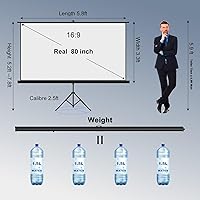
  • Display Dimensions: The active projection surface measures 67″ wide by 39″ tall, delivering a usable image area consistent with an 80-inch 16:9 panel.
  • Overall Dimensions: With the stand fully extended, the assembled unit reaches approximately 72″ in width and 59″ in height.
  • Viewing Angle: The screen supports a 160-degree horizontal viewing angle, allowing audiences seated well off-center to see a clear, undistorted image.
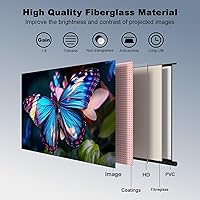
  • Screen Material: The projection surface is made from PVC vinyl with a fiberglass-reinforced body designed to hold a flat, taut, wrinkle-resistant panel.
  • Frame Material: The tripod stand and structural frame are constructed from iron and metal components for stability during both indoor and outdoor use.
  • Screen Backing: A black light-blocking backing layer is bonded to the rear of the screen to reduce light transmission and improve front-projection contrast.
  • Mounting Type: The screen uses a manual pull-up retractable mechanism mounted on a foldable, height-adjustable tripod stand requiring no tools or hardware.
  • Setup Time: The manufacturer states the full assembly process — from unboxing to a ready screen — takes approximately two minutes following three main steps.
  • Weight: The complete screen and stand system weighs between approximately 11 and 18.52 lbs depending on measurement scope, which is noticeable but contributes to stability.
  • Carry Bag: An included carrying bag measuring roughly 79″ x 7.5″ x 4″ houses the folded screen and stand components for storage and transport.
  • Rear Projection: This screen does not support rear projection; the opaque black backing is specifically designed for front-facing projection only.
  • Indoor Clearance: The manufacturer recommends a minimum indoor space of 8 feet wide and 10 feet tall for proper setup and safe viewing distances.
  • Use Environment: The screen is rated for both indoor and outdoor use, covering home theaters, classrooms, patios, backyards, and small event venues.
  • Brand: This screen is manufactured and sold under the SCREENMAX brand, which specializes in affordable portable projection accessories.
  • Market Rank: The product holds a Best Sellers Rank of #101 in the Projection Screens category on Amazon as of its listed ranking date.
  • Availability Date: The product was first made available for purchase on July 31, 2024, making it a relatively recent entry in the portable screen market.

Related Reviews

HOIN 80-inch Portable Projector Screen Stand
78%
91%
Ease of Assembly
88%
Portability & Transport
84%
Screen Fabric Flatness
82%
Frame Stability — Calm Conditions
56%
Wind Resistance
More
Elite Screens Yard Master Sport 110-inch Screen
78%
88%
Ease of Setup
83%
Portability & Storage
79%
Image Clarity & Screen Performance
71%
Outdoor Stability
58%
Aspect Ratio Suitability
More
YF2009 200-inch Portable Projector Screen
75%
88%
Value for Money
91%
Screen Size & Impact
86%
Portability & Weight
82%
Setup & Installation
71%
Image Quality & Clarity
More
AODIOU 60-Inch Portable Projector Screen with Stand
76%
88%
Portability & Transport
91%
Ease of Assembly
73%
Image Clarity & Surface Quality
74%
Build Quality & Frame Durability
62%
Outdoor Wind Stability
More
Tecdigbo 50-Inch Retractable Tripod Projector Screen
74%
93%
Ease of Setup
91%
Portability
78%
Image Quality
61%
Stand Stability
67%
Screen Flatness
More
SKERELL Portable Projector Screen 150-inch
87%
91%
Ease of Setup
87%
Portability
94%
Display Quality
80%
Durability
85%
Outdoor Performance
More
VISULAPEX 80-Inch Projector Screen with Stand
78%
88%
Ease of Setup
79%
Image Quality
91%
Portability & Storage
71%
Build Quality & Stability
82%
Screen Material & Surface
More
HYZ 80-inch Projector Screen with Stand
86%
91%
Portability & Ease of Setup
88%
Image Quality & Viewing Experience
87%
Durability & Build Quality
89%
Adjustable Height Flexibility
68%
Outdoor Visibility in Bright Conditions
More
Towond 100-inch Portable Projector Screen with Stand
74%
91%
Portability & Pack-Down Size
88%
Assembly & Setup Speed
74%
Screen Surface & Image Quality
67%
Wrinkle Resistance
63%
Outdoor Wind Stability
More
SCREENMAX 120-inch Outdoor Projector Screen with Stand
87%
90%
Ease of Setup
87%
Portability
85%
Image Clarity
80%
Durability
92%
Viewing Angle
More

FAQ

Technically one person can do it, but the brand recommends two people for a smoother experience. The screen panel is large and somewhat unwieldy when you are trying to lock the telescoping rod with one hand while keeping the screen pulled up with the other. For a first-time setup, having a second pair of hands makes the process noticeably easier.

On flat, hard surfaces like a patio or driveway the stand is reasonably solid. On grass or soft ground it can shift, especially if there is any wind. A number of buyers suggest placing sandbags or heavy objects near the base feet when using it outdoors in anything beyond calm conditions.

Yes, in practice it does help. The backing prevents ambient light from passing through the screen and washing out the image from behind. In a partially lit backyard or a room that is not fully blacked out, the contrast looks noticeably better compared to screens without this layer. That said, it is not a substitute for a quality projector — a weak lamp will still look weak.

The screen surface itself is compatible with 4K projection. It does not have a specialized high-gain coating, so the resolution and color accuracy you see will depend largely on your projector's output quality. For a mid-range 4K projector used in casual home or outdoor settings, the results are generally well-regarded by buyers.

Most buyers report that it arrives flat and taut without the creasing problems common on cheaper rolled screens. The fiberglass-reinforced body helps the panel hold its shape. A small number of users have noted minor surface marks after extended storage, but these typically smooth out once the screen is fully extended and under slight tension.

The telescoping stand allows you to raise the bottom edge of the screen off the ground, which is genuinely useful when projecting over seated guests at outdoor events. The exact adjustment range is not specified numerically, but users in backyard party scenarios generally find it sufficient for keeping the image visible above head height when the audience is seated.

The fold-down process is the reverse of setup and takes roughly the same amount of time once you are familiar with it. The carry bag is a snug fit, so it helps to have someone guide the folded screen in while you manage the stand. After a couple of uses most people get the hang of it fairly quickly.

No. The black backing layer that improves front-projection contrast makes rear projection impossible — light simply cannot pass through it. If you need rear projection capability, you would need a screen designed specifically with a translucent surface material.

Because the product launched in mid-2024 there is not yet a large pool of long-term owner feedback to draw from. Early reports suggest the mechanism and surface hold up well with occasional use. Buyers who deploy it weekly for outdoor events have flagged some wear on the pull-up mechanism over time, so heavy-rotation users may want to handle the retract function carefully to extend its lifespan.

The manufacturer specifies a minimum indoor space of at least 8 feet wide and 10 feet tall. Beyond that, the viewing distance from your projector to the screen will depend on your projector's throw ratio — you will need enough depth in the room to achieve the correct image size at your projector's zoom setting. Most living rooms with standard 9-foot ceilings will be borderline, so measure before you commit.

Where to Buy