Overview

The Schiit Loki Mini+ 4-Band Equalizer occupies a genuinely rare space in modern audio: a proper hardware EQ at a time when most listeners reach for a software plugin or skip tone shaping entirely. Schiit has built a reputation around straightforward, no-nonsense gear made in the USA, and this analog equalizer fits that mold well. It won't dazzle you with a touchscreen or a companion app — it gives you four knobs, a passive bypass switch, and gets out of the way. For the price, you'd be hard-pressed to find a comparable analog option that isn't a DIY kit or a vintage unit with an unknown service history.
Features & Benefits

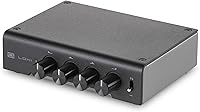
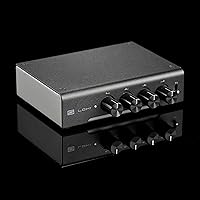
The four frequency bands — 20Hz, 400Hz, 2kHz, and 8kHz — aren't arbitrary. Bass at 20Hz lets you add or pull back low-end weight without muddying the midbass, while the 400Hz knob targets a congested zone that affects vocal and instrument body. At 2kHz and 8kHz you're shaping presence and air, the frequencies that most affect perceived brightness. The ±12dB range at the extremes makes sense since those bands usually need more correction, while the tighter ±6dB limit on midrange bands prevents overcooking the mids. Passive LC filtering keeps noise low, and the discrete gain stage stays remarkably transparent. The compact size means it fits neatly beside a DAC without dominating your desk.

Best For

This analog equalizer makes most sense for listeners who've already built a solid system and hit a specific wall — a slightly bright headphone that fatigues after an hour, a phono stage that sounds a touch lean, or bookshelf speakers that go hollow in a small room. Vinyl enthusiasts especially benefit, since they can trim or boost at the analog stage without ever touching a computer. It also suits headphone listeners chasing a more natural tonal balance without relying on software profiles that vary by app. That said, it's not the right pick for anyone wanting precision room correction or parametric control — this hardware EQ trades flexibility for simplicity, deliberately.

User Feedback

Buyers consistently highlight the solid build quality, smooth knob action, and the fact that the passive bypass genuinely delivers — switching it in and out reveals just how transparent this hardware EQ sounds when set flat. The recurring complaint, and it's worth taking seriously, is hum from inductors when the unit sits too close to a power supply, DAC, or amplifier. It's a physics reality more than a defect; moving it away from other electronics usually clears it up. Some users also wish for more than four bands. With 155 reviews averaging 4.3 stars, the overall picture is a product that consistently satisfies the right buyer, with a couple of manageable quirks to plan around.

Pros

  • The passive bypass switch enables honest A/B comparisons, confirming exactly what the EQ is and isn't adding to your signal.
  • Four frequency bands cover the most practically useful correction points for real-world listening scenarios.
  • Passive LC filtering keeps the noise floor impressively low compared to many active EQ designs.
  • Build quality is solid and consistent with Schiit's reputation for durable, no-frills construction.
  • Compact size fits easily on a desktop or in a modest rack setup without demanding extra shelf space.
  • Designed and assembled in the USA, which matters to buyers who prioritize domestic manufacturing.
  • The analog signal path means no analog-to-digital conversion, keeping purist listening chains intact.
  • Knob action is smooth and deliberate, making subtle adjustments easy to dial in without overshooting.
  • A 4.3-star average across over 150 reviews indicates consistent real-world satisfaction beyond marketing claims.
  • The Loki Mini+ performs competently as a headphone EQ, making it genuinely dual-purpose in a desktop setup.

Cons

  • Fixed frequency bands mean you cannot target a specific problem frequency outside the four preset points.
  • Inductors can pick up audible hum if placed near transformers, power bricks, or other electronics — placement is not optional.
  • The included power adapter is limited to 115VAC regions only, creating an added hurdle for international buyers.
  • Four bands feel limiting for users who need the kind of surgical correction a parametric EQ provides.
  • There is no visual indication of how much each band has been adjusted, which can make repeating a setting tricky.
  • At its price point, it competes with capable software EQ options that offer far more control for zero extra hardware cost.
  • Hum troubleshooting can be time-consuming and may require rearranging your entire desktop setup to resolve.
  • No balanced connections, which limits integration into more advanced or professional-grade signal chains.

Ratings

The scores below reflect our AI-driven analysis of verified global buyer reviews for the Schiit Loki Mini+ 4-Band Equalizer, with spam, bot-generated, and incentivized submissions actively filtered out before scoring. We evaluated this analog equalizer across categories that real buyers consistently raised — from signal transparency to placement flexibility — and made sure both the genuine strengths and the honest frustrations are reflected in every number.

Signal Transparency
91%
Listeners consistently report that the Loki Mini+ adds virtually nothing to the signal when set flat, and the passive bypass confirms this with a genuinely neutral reference point. For headphone users doing careful A/B comparisons, that transparency is not just a spec claim — it holds up in practice.
A small number of critical listeners with resolving systems detected a very subtle coloration even when the unit was supposedly flat. It is not a widespread complaint, but it exists among buyers with high-sensitivity setups and revealing source chains.
Passive Bypass Quality
93%
The 100% passive bypass is one of the most praised features across verified reviews, and for good reason — it gives users a true hardware reference point rather than a software approximation. Switching between EQ and bypass mid-listening is instant and reveals exactly how much the tone shaping is contributing.
There is no visual or tactile indicator distinguishing the bypass position from the active position at a glance, which has led to a handful of users accidentally leaving it in bypass and wondering why their adjustments were doing nothing.
Build Quality
88%
The chassis feels solid and unpretentious — heavier than its small footprint suggests and finished without excess. Knobs track smoothly and do not feel cheap under hand, which matters when you are making fine adjustments during a listening session.
Some buyers noted that the knobs lack a center detent, meaning there is no tactile confirmation when you have returned to the flat position. For users who frequently switch between EQ settings and flat, this requires visual checking each time.
Noise Floor
82%
18%
The passive LC filter design keeps hiss remarkably low, which is noticeable compared to older graphic EQ designs that tend to add audible noise at high gain settings. Users with sensitive headphones and in-ear monitors in particular appreciated the clean background.
The inductors used in the filter circuit are susceptible to picking up electromagnetic hum from nearby electronics, and this issue appears consistently enough in reviews to be considered a genuine design trade-off rather than an isolated defect. Placement next to a DAC or power amp can introduce an audible low-frequency hum that takes trial and error to resolve.
Tonal Control Range
76%
24%
The ±12dB range at 20Hz and 8kHz is wide enough to make meaningful corrections to bright headphones or bass-light speakers without needing to push knobs near their limits. For casual tonal shaping — warming up a lean cartridge or pulling back some upper treble harshness — the range feels appropriately sized.
The narrower ±6dB range on the 400Hz and 2kHz bands can feel limiting when dealing with more pronounced midrange coloration. Users who need deeper midrange correction, particularly for room resonances or notably colored speakers, found themselves wanting more headroom in those bands.
Frequency Band Selection
71%
29%
The four chosen frequencies address the most common real-world correction needs well — sub-bass weight, body, presence, and air are the four zones where most casual to intermediate listeners want to make adjustments. For the target audience, the band placement is thoughtful rather than arbitrary.
Users with more advanced correction needs quickly bump into the limitations of fixed bands. There is no way to target a resonance at, say, 600Hz or 3kHz, and compared to even a basic parametric EQ plugin, the inflexibility is a genuine constraint that a portion of buyers only discover after purchase.
Ease of Setup
84%
Getting this hardware EQ into a signal chain is straightforward for anyone already familiar with RCA connections — plug in, power on, and you are ready to adjust. There is no software installation, no firmware, and no pairing process involved.
Users who are new to analog signal chains occasionally struggled with understanding correct placement in the chain, and Schiit's documentation is minimal. The hum troubleshooting process also adds setup friction that some buyers did not anticipate.
Desktop Integration
86%
At 5 x 3.5 x 1.25 inches, this analog equalizer fits neatly beside a DAC or headphone amp without dominating a desk. Its weight gives it enough stability to stay put when adjusting knobs, and the low profile means it does not block anything behind it.
The power adapter adds a cable to an already potentially crowded desktop setup, and with no rear cable management or mounting options, it can contribute to clutter. The RCA connectors also point straight back, requiring a bit of clearance behind the unit.
Value for Money
79%
21%
In the analog hardware EQ space, comparable alternatives are either budget units with questionable noise performance or vintage gear requiring servicing. For what it does in its price bracket, buyers consistently feel the build and sound quality justify the spend.
The comparison against software EQ is unavoidable — free or inexpensive plugins offer far more precision and flexibility. Buyers who are not specifically committed to an analog signal path may struggle to justify the cost over a software solution that does more.
Headphone System Compatibility
83%
Positioned between a DAC and a headphone amp, this hardware EQ works particularly well for compensating for headphone frequency response anomalies. Users with bright planar or dynamic headphones frequently cited meaningful listening fatigue reduction after modest 8kHz adjustments.
It is a line-level device only, so it cannot be inserted after a headphone amp unless that amp has a preamp output — a configuration that is not universal. Buyers with all-in-one DAC/amp units may find integration impossible without restructuring their setup.
Vinyl and Phono Compatibility
87%
Vinyl listeners using this analog equalizer after a phono preamp reported practical improvements in cartridge tonal balance, particularly for correcting slightly bright or mid-forward phono stages without touching their digital chain at all. It slots naturally into a traditional analog stack.
A handful of users initially attempted to connect it directly from a turntable output, which does not work and produces almost no signal. The documentation does not clearly spell out that a phono preamp is required upstream, which caused confusion for less experienced vinyl newcomers.
Geographic Usability
54%
46%
For buyers in North America — the USA, Canada, and Mexico — the included power adapter works perfectly out of the box with no additional accessories required. It is a non-issue for the majority of the domestic market the product primarily targets.
International buyers face a real barrier: the included adapter is strictly 115VAC and will not function on 230VAC mains common in Europe, Asia, Australia, and most of the world. This limits the product's usability globally and has generated visible frustration among international buyers who did not notice the warning before purchasing.
Long-Term Reliability
85%
Given Schiit's track record and the relatively simple analog circuit involved, buyers report consistent performance over extended ownership periods. The product does not depend on firmware, software support, or wireless connectivity that could become obsolete.
There is limited long-term data given the February 2021 release date, and Schiit's warranty and repair process, while generally regarded positively, is not universally accessible for international customers who may have sourced the unit from a third-party seller.

Suitable for:

The Schiit Loki Mini+ 4-Band Equalizer is a strong fit for anyone who has already invested in a decent analog audio chain and needs a practical, no-digital-compromise way to tame a specific frequency problem. Vinyl listeners are perhaps the most natural audience — if your cartridge or phono stage skews slightly bright or lean, four well-chosen bands let you correct that without routing your signal through a computer. Headphone enthusiasts dealing with a fatiguing treble peak or a lack of bass weight will find the high and low controls genuinely useful, especially since the passive bypass lets you confirm exactly how much you're actually changing. Audiophiles who are philosophically opposed to DSP processing, or who simply want a tactile, always-on hardware solution they can reach for mid-listening, will appreciate its signal path philosophy. It also slots in naturally for owners of bookshelf speakers in small, acoustically awkward rooms who need a light touch of correction rather than a full room-calibration overhaul.
Not suitable for:

If you need precision frequency correction — say, a specific 3dB cut at 1.4kHz to tame a resonance in your speakers — the Schiit Loki Mini+ 4-Band Equalizer is not the right tool, and pretending otherwise will lead to frustration. Its four fixed bands simply cannot target arbitrary problem frequencies the way a parametric EQ or room correction software can. Beginners who are not yet familiar with how frequency bands interact with real sound may find it easy to over-boost and worsen their system rather than improve it. Anyone living outside North America should note that the included power adapter only works on 115VAC systems, meaning buyers in Europe, Asia, or Australia need a compatible third-party adapter or power solution before it even turns on. Listeners who prefer a clean digital workflow — using software EQ inside their DAW or streaming app — won't gain anything here that their existing tools don't already offer with more flexibility. Finally, anyone hoping to place this unit in a tight, electronics-dense rack should be aware that the inductor-based filtering can pick up hum from nearby power supplies or transformers, which may require careful cable management and spacing.
Specifications

  • Brand: Manufactured by Schiit Audio, a company known for designing and building its products in the USA.
  • Model: Loki Mini+, the updated compact version of Schiit's analog equalizer lineup.
  • Product Type: 4-band analog hardware equalizer designed for insertion into a home hi-fi or headphone signal chain.
  • EQ Bands: Four fixed frequency bands are provided at 20Hz, 400Hz, 2kHz, and 8kHz.
  • Adjustment Range: The 20Hz and 8kHz bands offer ±12dB of adjustment, while the 400Hz and 2kHz bands allow ±6dB of adjustment.
  • Filter Topology: Uses passive LC filtering for three bands and a gyrator circuit for the bass band to minimize noise.
  • Gain Stage: Employs a single discrete current-feedback gain stage designed for low coloration and high transparency.
  • Bypass Switch: Includes a 100% passive bypass switch that removes the unit entirely from the signal path when engaged.
  • Dimensions: The unit measures 5 x 3.5 x 1.25 inches, making it compact enough for most desktop setups.
  • Weight: The Loki Mini+ weighs 2.14 pounds, reflecting its solid internal construction.
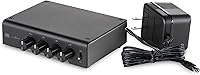
  • Power Supply: Powered by an included 115VAC wall adapter intended exclusively for use in the USA, Canada, and Mexico.
  • Voltage Compatibility: The included adapter is not compatible with 230VAC mains voltage used in Europe, Asia, Australia, and most other regions.
  • Origin: Designed and built in the United States of America.
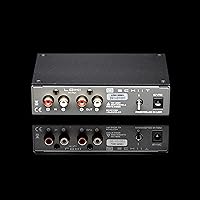
  • Connectivity: Features standard RCA analog input and output connections for integration into a traditional hi-fi signal chain.
  • Noise Characteristic: The passive LC filter topology contributes to a low hiss floor, though inductors may be susceptible to hum from nearby electronics.
  • Release Date: First made available in February 2021.
  • User Rating: Holds an average rating of 4.3 out of 5 stars based on 155 customer ratings on Amazon.
  • Market Rank: Ranked number 2 in the Audio Component Equalizers category on Amazon at the time of evaluation.

Related Reviews

Autotek ATEQ709 4-Band Audio Equalizer with 2-Way Crossover
86%
85%
Sound Quality
92%
Ease of Installation
80%
Build Quality
87%
User Interface
88%
Audio Clarity
More
Sound Storm Laboratories S4EQ 4 Band Pre-Amp Car Audio Stereo Equalizer
84%
88%
Sound Quality
93%
Ease of Installation
85%
Bass Response
80%
Build Quality
87%
Subwoofer Control
More
NVX XEQ7 7-Band Graphic Equalizer
86%
87%
Sound Performance
92%
Ease of Installation
90%
Bass Control
83%
Build Quality
88%
Connectivity Options
More
Apple iPad Mini 4 32GB Refurbished Tablet
71%
88%
Display Quality
83%
Build Quality
71%
Performance
54%
Storage Capacity
74%
Battery Life
More
Amazfit GTS 4 Mini Smart Watch
84%
88%
Battery Life
82%
Fitness Tracking Accuracy
75%
App Performance
86%
Build Quality
90%
Display Quality
More
Blaupunkt CEBP870 7-Band Digital Equalizer
83%
91%
Ease of Installation
85%
Sound Customization
88%
Build Quality
70%
Bass Control
87%
Versatility of Outputs
More
Taramps TEQ 7.4 Stereo Equalizer
90%
95%
Sound Clarity
92%
Frequency Control Precision
88%
Ease of Installation
90%
Build Quality
93%
Connectivity Flexibility
More
DS18 EQX7 7-Band Graphic Equalizer
85%
88%
Sound Quality
90%
Bass Performance
82%
Ease of Installation
85%
Build Quality
87%
Frequency Range
More
Audiotek At-eq500 5-Band Graphic Equalizer
84%
88%
Audio Performance
91%
Ease of Use
89%
Bass Control
60%
Build Quality
87%
Sound Clarity
More
DJI RS 4 Mini Combo
DJI RS 4 Mini Combo
82%
93%
Setup Speed
91%
Stabilization Performance
84%
Intelligent Tracking
89%
Build Quality & Materials
88%
Vertical Shooting Switch
More

FAQ

It sits between your source or preamp and your amplifier, or between a DAC and an integrated amp. The analog signal passes through it on the way to your speakers or headphone amp. You connect source output to the Loki Mini+ input via RCA, then run RCA from its output to your amp input.

The Loki Mini+ is a line-level device, not a headphone amplifier, so it cannot drive headphones on its own. It needs to be placed between your DAC or source and a dedicated headphone amp. It works very well in that position for tonal shaping before amplification.

Probably not — this is a known and well-documented behavior of the inductor-based filter design. The inductors used in the Schiit Loki Mini+ 4-Band Equalizer can pick up electromagnetic interference from nearby power supplies, DACs, or amplifiers. Try moving it away from other electronics, especially anything with a transformer inside, and the hum usually clears up. Running it through a different outlet or repositioning cables can also help.
It is genuinely useful and not a gimmick. When the bypass is engaged, the signal skips the active circuitry entirely and passes through passively, meaning the unit adds essentially nothing to your signal. This makes A/B comparisons between your EQ settings and a flat signal honest and immediate, which is exactly what you want when dialing in adjustments.

Yes, but you need to connect it after your phono preamp, not directly from the turntable cartridge. Turntables output a very low phono-level signal that needs RIAA equalization and amplification first. Once that is handled by a phono stage, the line-level output is exactly what this analog equalizer is designed to accept.

Unfortunately, no. The included adapter is designed for 115VAC outlets only, which covers the USA, Canada, and Mexico. UK and European mains run at 230VAC, which will damage the adapter. You would need to source a compatible third-party 115VAC power supply with the correct connector specifications before using it outside North America.

Software EQ is more flexible — most parametric options let you target any frequency you want with adjustable bandwidth. This hardware EQ offers only four fixed bands, so it cannot match that precision. Where it has an edge is in keeping your signal fully analog with no additional conversion steps, and in giving you a physical knob you can reach for during playback without switching windows or apps. It depends on what matters more to you.

The Loki Mini+ uses rotary potentiometers with a relatively smooth feel, which some listeners interpret as loose compared to stepped attenuators. There is no detent or click at the center position, so finding the exact flat setting by feel alone takes a bit of practice. If your knobs feel unusually wobbly or inconsistent, contacting Schiit directly is worthwhile since their customer support has a solid reputation.

It can help at the margins. The 20Hz band lets you reduce sub-bass energy, and nudging the 400Hz band down slightly can tighten up a congested, boxy-sounding midrange. That said, serious room resonance problems are better addressed with acoustic treatment or software room correction — this hardware EQ is better suited for broad tonal adjustments than for fixing deep acoustic issues.

In practice, the difference is very small when the unit is set flat, but if you want absolute certainty, flip the passive bypass switch. That physically removes the unit from the signal path so you are not passing through any active circuitry at all. It is one of the main reasons many buyers specifically chose this over competing units that lack a true hardware bypass.

Where to Buy