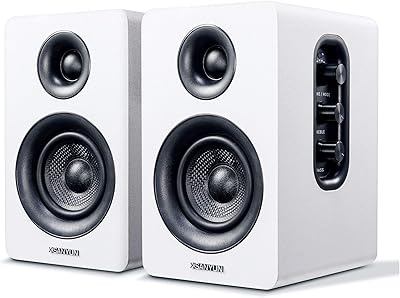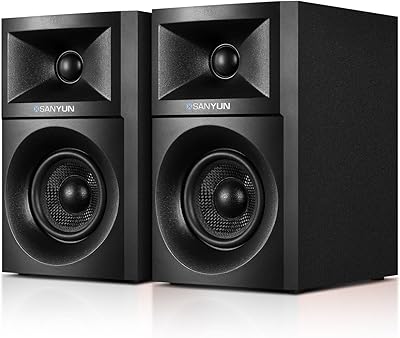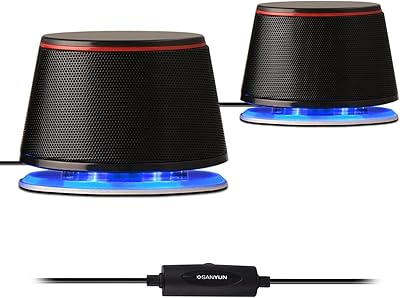





Overview

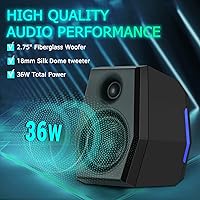
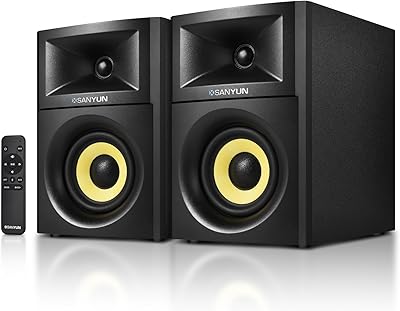
The Sanyun SW209 is a mid-range desktop speaker set that punches above its size by cramming USB DAC, Bluetooth 5.2, and AUX connectivity into one compact unit. The column-shaped cabinet has a 10-degree upward tilt — not just a cosmetic choice, but a practical one that angles sound toward ear level rather than straight at your desk surface. At 36W total output, these desktop gaming speakers deliver noticeably more presence and volume than the typical USB-powered budget options most people start with. One thing worth flagging upfront: they are AC-powered, not bus-powered, so a free wall outlet nearby is a must.

Features & Benefits

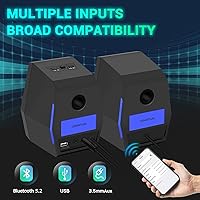
The built-in 24-bit DAC is arguably the most practical feature here. When connected via USB, the SW209 bypasses your motherboard's onboard audio entirely, pulling a cleaner digital signal and converting it on-board — a meaningful improvement over a standard headphone jack, though not studio-grade reproduction by any stretch. Bluetooth 5.2 pairs quickly and holds steady up to roughly 10 meters in typical room conditions. The three EQ presets actually do something audible: Game mode sharpens high-frequency detail, Movie mode widens the perceived soundstage, and Music mode smooths things out for balanced listening. The 2.75-inch woofer and silk dome tweeter handle midrange clarity well, though deep bass extension hits a natural ceiling without a dedicated subwoofer.

Best For

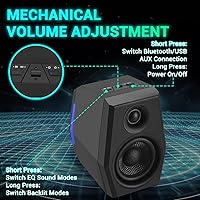
This speaker set suits a fairly specific type of desk user well. PC gamers who want directional audio cues without wearing a headset all day will appreciate the Game EQ and stereo imaging. Students or remote workers who constantly juggle a laptop, a phone, and a desktop will find the multi-input flexibility genuinely useful — switching between Bluetooth and USB without unplugging anything is a small but real daily convenience. The RGB lighting, fully controllable from the speaker buttons with zero software required, also makes these desktop gaming speakers a solid fit for anyone assembling an aesthetic setup on a reasonable budget.

User Feedback

Verified buyers tend to praise mid-range sound clarity and how straightforward the initial setup is — most report being up and running within minutes. The USB DAC connection draws particular appreciation for reducing the hiss and noise common with direct motherboard audio. On the critical side, several users find the push-button controls fiddly, especially when cycling through RGB modes or EQ settings in a dim room. Bass-hungry listeners consistently note the low end, while decent, falls short without an external subwoofer. A handful of buyers also mention the RGB runs quite bright and can only be cycled off rather than dimmed. Overall value sentiment leans positive for the price tier.

Pros

  • The Sanyun SW209 bypasses weak motherboard audio via USB, delivering a noticeably cleaner signal.
  • Triple connectivity — USB, Bluetooth 5.2, and AUX — handles multi-device workflows without constant cable swapping.
  • Bluetooth 5.2 pairs in seconds and holds a steady connection across a typical room distance.
  • The 10-degree cabinet tilt angles sound toward ear level rather than straight at your desk.
  • Three EQ presets produce genuinely audible differences, not just subtle placebo-level changes.
  • RGB lighting runs through 16 modes with zero software installation required.
  • Setup is fast and driver-free on Windows, macOS, and most mobile devices.
  • At 36W, the SW209 comfortably fills a small-to-medium room without audible straining.
  • The column cabinet design saves horizontal desk space compared to traditional bookshelf speakers.
  • Build quality feels solid and well-assembled with no rattles even at higher volume levels.

Cons

  • Push-button-only controls become genuinely tedious when adjusting settings in a dim or busy environment.
  • RGB brightness cannot be dimmed — only cycled off entirely after passing through all active modes.
  • Bass output hits a hard ceiling that no EQ mode can fully overcome without a separate subwoofer.
  • Input switching between Bluetooth and USB lacks a clear audio or visual confirmation of the active source.
  • Music EQ mode sounds nearly identical to a neutral baseline, making it the least useful of the three presets.
  • The AC power cord limits placement flexibility for desks with few nearby outlets.
  • Volume knob feel is underwhelming tactilely for a speaker set at this price point.
  • A small number of Linux users report manual configuration is needed before the USB DAC is recognized.
  • No remote control or companion app means all adjustments require reaching directly for the speaker panel.

Ratings

The Sanyun SW209 has been evaluated by our AI system after analyzing verified buyer reviews from global markets, with spam, bot-submitted, and incentivized feedback actively filtered out. The scores below reflect a balanced picture of where these desktop gaming speakers genuinely impress and where real users have run into friction. Both the strengths and the recurring pain points are represented transparently across every category.

Sound Clarity
83%
Most buyers coming from basic USB-powered speakers immediately notice the improvement in midrange detail and vocal presence. Dialogue in games and movies comes through cleanly, and instruments in music playback are reasonably well separated for a 2.0 stereo setup at this price tier.
Listeners accustomed to higher-end desktop audio will find the overall soundstage relatively narrow. The clarity advantage is most apparent in the midrange; treble can feel slightly brittle at higher volumes.
Bass Performance
61%
39%
For a compact 2.0 system with a 2.75-inch woofer, the low end holds up surprisingly well in Game and Movie EQ modes, providing enough thump to make action sequences feel grounded without being entirely flat.
There is a hard physical ceiling on how deep the bass can reach without a dedicated subwoofer. Bass-heavy music genres like EDM or hip-hop expose this limitation quickly, and several buyers specifically noted disappointment after expecting more from the 36W rating.
USB DAC Quality
86%
Connecting via USB rather than a standard headphone jack makes a noticeable real-world difference, particularly on motherboards with mediocre onboard audio. Users consistently report reduced background hiss and a cleaner overall signal, which is exactly what the 24-bit DAC is meant to address.
The improvement is real but should not be overstated. Users with dedicated external audio interfaces or high-end motherboard audio may find the difference marginal. It is a meaningful upgrade for average PC builds, not a professional-grade solution.
Bluetooth Stability
78%
22%
Bluetooth 5.2 pairs quickly with phones and tablets, typically within a few seconds, and the connection stays solid across a normal desk-to-couch distance. Multiple buyers noted using it to stream music from a phone while the PC stays connected via USB without issues.
A handful of users report occasional dropout or lag during extended Bluetooth-only sessions, particularly when walls or other wireless devices are nearby. Input switching between Bluetooth and USB can also feel inconsistent without a clear audio cue confirming the active source.
EQ Modes Usefulness
72%
28%
The three presets do produce audibly different results rather than functioning as placebo switches. Game mode tightens the high-frequency response noticeably, which helps with directional audio cues, and Movie mode adds a bit of width that benefits surround-mixed content.
Music mode is the least dramatic of the three and some users feel it sounds nearly identical to a flat default. The absence of any custom EQ adjustment means buyers are locked into three fixed profiles, which feels limiting once the novelty wears off.
Build Quality
81%
19%
The cabinets feel solid and well-assembled for the price point, with no obvious rattles or creaking even at higher volume levels. The column form factor looks more premium than typical wedge-shaped budget speakers and sits stably on most desk surfaces.
The plastic finish shows fingerprints easily and the button panel on the front feels slightly cheap to the touch. A few users noted the volume knob lacks the satisfying tactile resistance they expected given the overall aesthetics.
RGB Lighting
77%
23%
Having 16 lighting modes cycling through a single button with zero software installation is genuinely appreciated by users who have dealt with bloated RGB ecosystems before. The colors are vivid and the breathing and cycling effects look polished in a dim gaming room.
The RGB runs quite bright by default and cannot be dimmed — only cycled through modes or turned off entirely. Several buyers who wanted subtle ambient lighting found the brightness excessive, and turning it fully off requires cycling through all active modes first.
Connectivity Versatility
89%
Having USB, Bluetooth, and AUX available simultaneously on a single speaker set is a genuine daily-use advantage for people who juggle multiple devices. Switching a phone to Bluetooth while keeping the PC on USB is a workflow that multiple verified buyers specifically called out as a key reason for their purchase.
Input priority and switching behavior is not always intuitive, and there is no on-screen or audio indicator to confirm which source is active. New users often spend a few minutes troubleshooting what should be an instant transition.
Volume & Loudness
82%
18%
At 36W across a 2.0 configuration, these speakers can fill a small-to-medium bedroom or home office with ease and still have headroom to spare. Users in shared apartments noted the volume ceiling is more than sufficient without the speakers straining audibly.
There is a slight compression quality at near-maximum volumes where the sound loses some of its midrange definition. For most desk use cases this is a non-issue, but those who regularly push speakers to their limits will notice it.
Setup & Ease of Use
88%
Virtually every verified buyer mentions how fast the initial setup is — cables are included, the USB DAC requires no driver installation on modern operating systems, and the speakers are ready within minutes of unboxing. Plug-and-play reliability is consistently highlighted.
The push-button control scheme becomes frustrating when trying to make quick adjustments in a dark room. There is no remote, no companion app, and no physical labeling next to the buttons, which means memorizing the button sequence for each function.
Control Interface
57%
43%
A single control panel keeps the design clean and minimalist, which suits users who set their preferred EQ and volume once and leave it alone. For straightforward use, the buttons work reliably without any connectivity dependency.
Multiple users flagged the push-button-only interface as a recurring annoyance. Cycling through RGB modes, adjusting volume precisely, and switching EQ presets all require repeated button presses with no visual feedback, which feels underdeveloped compared to similarly priced competitors that offer rotary knobs or remote controls.
Value for Money
84%
Buyers comparing these desktop gaming speakers to similarly priced options consistently note that the combination of USB DAC, Bluetooth 5.2, three EQ modes, and RGB lighting in one package would typically cost more elsewhere. The feature density relative to the price tier is a recurring positive theme.
Users who purchased primarily for audio quality and have no interest in RGB or multi-device connectivity may feel the price reflects features they will never use. A stripped-down audio-only version at a lower price point is something several buyers wished existed.
Desk Footprint & Placement
80%
20%
The column cabinet design occupies less horizontal desk space than traditional bookshelf-style speakers, which desk space-conscious users appreciate. The 10-degree tilt means positioning them close to the monitor edge still delivers sound aimed at ear level.
The AC power requirement limits placement flexibility compared to USB-bus-powered alternatives. Users with limited outlet access near their desk, or those using monitor-mounted USB hubs for everything, found the corded power supply mildly inconvenient.
Compatibility
87%
Works across Windows, macOS, and mobile devices without driver installation via USB or Bluetooth, which matters to users running mixed-OS environments. Multiple buyers confirmed using the speaker set with a gaming PC, a MacBook, and an Android phone interchangeably without issues.
A small number of users reported that certain Linux distributions required manual audio configuration for the USB DAC to be recognized correctly. Compatibility is strong overall but not completely universal across every operating environment.

Suitable for:

The Sanyun SW209 is a strong fit for PC gamers and everyday desk users who want a meaningful audio upgrade without committing to a complex, expensive setup. If your current speakers are cheap USB-powered units with thin sound and no flexibility, this speaker set will feel like a genuine step forward — the USB DAC alone cleans up the signal noticeably on average motherboards. Students and remote workers who constantly switch between a work laptop, personal phone, and desktop will find the triple-input setup genuinely practical rather than a spec-sheet checkbox. The plug-and-play nature of the USB connection, requiring no driver installation, makes it approachable even for users who do not want to dig into audio settings. Anyone building or upgrading a gaming desk where RGB lighting ties the aesthetic together will also appreciate that the lighting works independently, without any software to install or maintain.

Not suitable for:

Buyers who prioritize deep, room-filling bass above everything else should think carefully before choosing these desktop gaming speakers — there is no subwoofer in this 2.0 configuration, and no amount of EQ adjustment fully compensates for that physical reality. Audiophiles or anyone already running a dedicated external audio interface will likely find the 24-bit DAC improvement underwhelming, since the benefit is most meaningful for users with weak onboard audio rather than those with an established audio chain. People who frequently adjust volume, switch inputs, or toggle lighting on the fly may find the push-button-only control panel genuinely frustrating in daily use — there is no rotary knob, no remote, and no app to simplify navigation. If your desk has limited wall outlet access, the AC power requirement could also be a real inconvenience, since this speaker set cannot draw power from a USB port like simpler alternatives. Lastly, buyers whose primary use case is bass-heavy music production or immersive low-frequency gaming audio would be better served by a 2.1 system with a dedicated subwoofer.

Specifications

  • Total Power: The speaker set delivers a maximum output of 36W across its 2.0 stereo configuration.
  • Driver Config: Each cabinet houses a 2.75″ fiberglass woofer paired with an 18mm silk dome tweeter for two-way audio reproduction.
  • USB Audio: The built-in 24-bit DAC processes digital audio directly from a connected device via USB-A, bypassing the host device's onboard audio chip.
  • Bluetooth: Bluetooth 5.2 provides wireless connectivity with a rated range of up to 10 meters in open conditions.
  • Analog Input: A 3.5mm AUX input accepts analog audio from any standard headphone output or line-level source.
  • EQ Modes: Three selectable presets — Game, Movie, and Music — adjust frequency response via push button with no software required.
  • RGB Lighting: Sixteen lighting modes, including static colors, breathing, and cycling effects, are controlled entirely from the speaker's onboard button panel.
  • Impedance: Speaker impedance is rated at 6 ohms, making the drivers compatible with the unit's built-in amplifier without external matching hardware.
  • Cabinet Tilt: Each column cabinet is angled at 10 degrees upward to direct sound toward seated ear level on a standard desk.
  • Dimensions: Each speaker unit measures 4.57″ deep, 3.74″ wide, and 5.51″ tall.
  • Weight: The combined weight of the full speaker set is 4.4 pounds including cables and power adapter.
  • Power Source: The system is powered via a corded AC adapter rated at 110 volts, and cannot draw power from a USB bus.
  • Included Cables: The package includes one USB-A cable, one 3.5mm AUX cable, one AC power adapter, and a printed user manual.
  • Channel Config: The system operates as a 2.0 stereo setup with no dedicated subwoofer channel or satellite configuration.
  • Control Method: All functions — volume, input selection, EQ mode, and RGB mode — are managed through physical push buttons on the speaker body.
  • Compatibility: The speaker set is compatible with desktop PCs, laptops, smartphones, and tablets running Windows, macOS, or Android via USB or Bluetooth.
  • Bluetooth Version: Bluetooth 5.2 supports faster pairing and more stable connections compared to older Bluetooth 4.x implementations.
  • Warranty: The product is covered by a full manufacturer warranty as documented in the included user manual.

Related Reviews
Sanyun SW206
Sanyun SW206
81%
83%
Sound Quality
78%
Dual Sound Modes
93%
Connectivity & Inputs
71%
Bluetooth Performance
86%
Build Quality & Cabinet
More
Sanyun SW102 Computer Speakers
79%
74%
Sound Quality
71%
Bass Performance
78%
Build Quality
66%
Cable & Controls
93%
Setup & Ease of Use
More
Sanyun SW203
Sanyun SW203
80%
86%
Sound Clarity
63%
Bass Response
82%
Soundstage & Imaging
91%
Connectivity & Input Options
78%
Bluetooth Stability
More
Sanyun SW208 3″ Bookshelf Speakers
86%
88%
Build Quality
84%
High-Frequency Clarity
91%
Mid-Range Warmth
78%
Bass Performance
93%
Control Ergonomics
More
Sanyun SW205
Sanyun SW205
78%
83%
Sound Quality
61%
Bass Performance
87%
Soundstage & Imaging
89%
Connectivity & Inputs
84%
Bluetooth Performance
More

FAQ

No, you do not. The built-in DAC is recognized as a standard USB audio device on Windows 10 and 11 as well as modern macOS versions without any driver installation. You may need to manually select it as your default audio output in your system settings, but that takes about ten seconds.

Yes, both inputs can be physically connected simultaneously. Switching between them is done via the button on the speaker panel. The main thing to know is that there is no audio chime or display indicator confirming which source is active, so new users sometimes need a moment to figure out which input is currently live.

The RGB is genuinely bright — bright enough to be noticeable even in a well-lit room. It can be turned off, but you have to cycle through all the active lighting modes to reach the off state rather than pressing a dedicated off button. If you plan to use these speakers in a bedroom at night, that is worth knowing upfront.

There is a noticeable gap. The 2.75-inch woofer produces enough low end for casual gaming and everyday media, but it physically cannot reproduce the deep bass that a dedicated subwoofer delivers. If you primarily listen to bass-heavy music or want that floor-shaking impact in games, a 2.1 system will serve you better.

For music streaming and general media playback, the lag is minimal and most users do not notice it. For competitive gaming where audio sync matters, using the USB connection is strongly recommended since Bluetooth inherently introduces a small delay that can be distracting in fast-paced situations.

They do produce audible differences, which puts them ahead of many budget-tier speaker EQ implementations. Game mode adds crispness to high frequencies, Movie mode opens up the soundstage a bit, and Music mode smooths the overall tone. That said, the differences are moderate rather than dramatic, and Music mode in particular sounds fairly similar to a neutral setting.

Yes, via the 3.5mm AUX input if your console or TV has a headphone output, or via Bluetooth if your console supports it. USB audio from consoles may or may not work depending on the platform and its USB audio support, so AUX is the most reliable connection in a console setup.

This is one of the more common frustrations users mention. The push buttons are not backlit and there are no tactile differences between them, so adjusting volume or switching modes during a game without looking at the speakers can be tricky. It is a real usability limitation if quick adjustments are important to you.

The box includes a USB-A cable, a 3.5mm AUX cable, an AC power adapter, and a user manual, so you have everything you need to get started on day one regardless of which input you prefer to use.

At 36W, this speaker set comfortably handles a small bedroom or a home office and still has volume headroom to spare. It is not designed to fill a large living room or open-plan space, but for standard desk use up to around 15 feet away, the output is more than sufficient.