

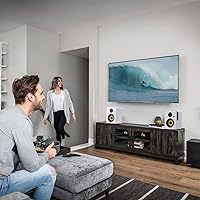
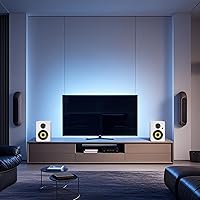
Overview

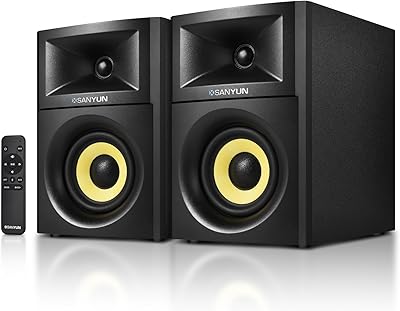
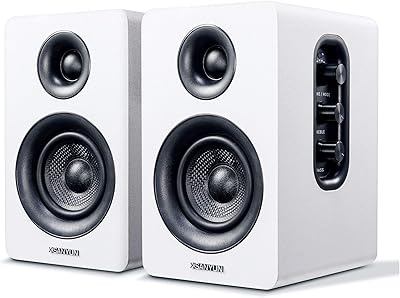
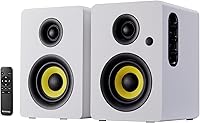
The Sanyun SW206 sits in an interesting middle ground — more capable than a typical desktop speaker pair, yet priced well below a proper studio monitor setup. Built around an MDF cabinet with a matte PVC finish, it feels noticeably more solid than the plasticky competition you often encounter at this tier. The accessory bundle is genuinely generous: optical cable, USB audio cable, a 3.5mm-to-RCA adapter, and an IR remote are all in the box. The central concept is a dual sound mode switch that toggles between warmer HiFi playback and flatter studio monitoring — and whether that feature holds up in practice is the most interesting question surrounding these bookshelf speakers.

Features & Benefits

The dual sound mode is what sets these apart on paper, and it does deliver a perceptible difference. HiFi mode adds a subtle low-mid warmth and a slight bass bump that makes casual music listening more enjoyable. Flip to Studio mode and the sound noticeably flattens — useful when you need an honest read of a mix or podcast edit. The carbon fiber woofer and 25mm silk dome tweeter combination handles extended listening sessions without the harshness you get from cheaper drivers. Six inputs — including a 6.35mm balanced TRS and a USB port with an onboard 24-bit DAC — cover virtually every source you could connect. The 80W rating is peak power; at a typical desk distance, you will rarely push past 40% volume.

Best For

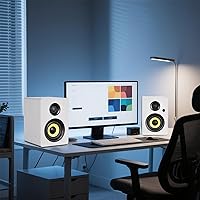
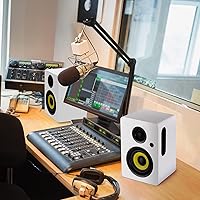
This desktop speaker set makes the most sense for people who wear multiple hats — a producer who also watches TV, a podcaster who also streams music, or a remote worker who wants decent monitoring without a dedicated studio budget. The balanced TRS input is a legitimate selling point for anyone running an audio interface; you rarely find that at this price point. If you are upgrading from basic 2.0 PC speakers or a thin soundbar, the clarity jump will be obvious. Be realistic about one thing, though: a 4-inch driver has physical limits, and low bass extension is not this speaker set's strength. If deep sub-bass matters to you, pair it with a subwoofer or look at a larger cabinet.

User Feedback

With over 7,000 ratings and a strong overall score, these bookshelf speakers have enough of a track record to draw real conclusions. Connectivity flexibility is consistently the top praise — buyers love having optical, USB, and Bluetooth all in one box, and the clean white aesthetic earns repeated mentions too. On the critical side, bass-light output at higher volumes and occasional Bluetooth latency come up with some regularity. A handful of reviewers note that the volume knob feels less premium than the rest of the build. Opinions on mode-switching are mixed: some find the HiFi-to-Studio difference genuinely useful, while others consider it subtle. Quality consistency is mostly solid, though a small number of pairing issues have been reported.

Pros

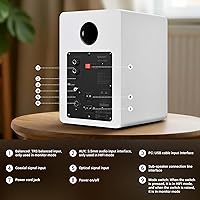
  • Six inputs — optical, coaxial, Bluetooth, TRS, AUX, and USB DAC — make this one of the most versatile speakers at this price tier.
  • The MDF cabinet construction noticeably reduces resonance and buzz compared to cheaper plastic-shell competitors.
  • Switching between HiFi and Studio modes delivers a perceptible difference useful for both casual listening and light editing work.
  • The included accessory bundle covers most connection scenarios out of the box with no extra purchases needed.
  • A 25mm silk dome tweeter keeps high frequencies smooth and non-fatiguing during long desktop sessions.
  • The balanced 6.35mm TRS input allows direct connection to audio interfaces — rare and genuinely useful for home creators.
  • The IR remote lets you change inputs and adjust volume from across the room, which matters when used as a TV speaker.
  • Vocal clarity and mid-range reproduction are consistently praised for podcasts, video content, and acoustic music.
  • The matte white PVC finish resists fingerprints and holds up well in day-to-day use on a busy desk.
  • Buyers upgrading from entry-level PC speakers or thin soundbars report an immediately noticeable improvement in sound quality.

Cons

  • Bluetooth latency is noticeable enough during video playback to cause audio-to-video sync issues for some users.
  • The volume knob feels cheaper and lighter than the rest of the build, which undercuts the overall premium impression.
  • Unit-to-unit consistency is not perfect — a notable minority of buyers report channel imbalance or connectivity quirks out of the box.
  • The IR remote requires direct line-of-sight and does not function reliably from off-angle positions.
  • Auto input-switching between multiple active sources can misfire, occasionally requiring a power cycle to restore clean audio.
  • The SNR of 80 dB is adequate but leaves a faint noise floor that sensitive listeners may detect at low volumes.
  • Only available in white, which limits compatibility with darker desk setups or predominantly black audio gear.
  • Studio mode improves flatness but still falls short of the neutrality that dedicated near-field monitors provide.

Ratings

The Sanyun SW206 has accumulated thousands of verified ratings across global markets, and the scores below reflect what real buyers consistently reported — filtered for spam, bot activity, and incentivized submissions. Our AI analysis weighted patterns across both enthusiastic praise and recurring frustrations to give you an honest picture of where this desktop speaker set genuinely delivers and where it falls short. Strengths and pain points are reflected in equal measure, so you can make an informed call before buying.

Sound Quality
83%
Most users coming from basic PC speakers or budget soundbars describe a clear, meaningful step up in clarity and detail. The silk dome tweeter keeps the high end smooth and easy to listen to for hours, and the carbon fiber woofer handles mids with more precision than drivers in this class typically manage.
The low end runs thin for a 4-inch driver — not surprising physically, but worth knowing upfront. Listeners who favor bass-heavy genres like EDM or hip-hop often feel the sound lacks body without a subwoofer to fill in the bottom.
Dual Sound Modes
78%
22%
The HiFi-to-Studio mode switch is one of the more practically useful features at this price tier. Podcasters and light home-studio users report that flipping to Studio mode gives them a noticeably flatter, more honest playback reference when checking edits or mixes.
The perceptible difference between modes divides users fairly evenly — some find it genuinely useful, others describe it as subtle enough to question its value. Critical listeners note that Studio mode still does not approach the neutrality of a dedicated near-field monitor.
Connectivity & Inputs
93%
Six input options — optical, coaxial, Bluetooth 5.4, balanced 6.35mm TRS, 3.5mm AUX, and USB with a 24-bit DAC — is a genuinely rare combination at this price point. Buyers consistently praise being able to keep a TV, a PC, and a phone all connected simultaneously without constant cable-swapping.
A small number of users report that the automatic input detection can misfire when multiple sources are active at once. The coaxial input, while present, sees limited real-world use and gets almost no mention in user feedback either way.
Bluetooth Performance
71%
29%
Bluetooth 5.4 maintains a stable connection across a typical room, and pairing with phones or laptops is generally described as quick and reliable on first connection. The 10-meter range holds up well in open living spaces according to multiple longer-distance users.
Latency is a recurring complaint, particularly when watching video content directly over Bluetooth. Several users note a noticeable audio-to-video sync offset that becomes distracting for anything beyond background music playback.
Build Quality & Cabinet
86%
The MDF enclosure with its matte PVC coating genuinely feels more premium than the thin plastic shells common among competing speakers in this bracket. Users frequently comment that the cabinet does not rattle or buzz even at higher volumes, which keeps the listening experience clean.
The volume knob draws criticism for feeling lighter and cheaper than the rest of the unit — a small but tactile inconsistency that a few buyers find undermines the overall build impression. At nearly 13 pounds for the pair, portability is not a strength.
Value for Money
88%
Relative to what you get — MDF cabinet, carbon fiber driver, six inputs, a 24-bit DAC, and a remote — the pricing lands in a spot that most buyers consider genuinely fair. Upgraders from entry-level setups overwhelmingly feel the improvement justifies the spend.
Buyers comparing this directly to dedicated studio monitors in a similar price range may feel the trade-offs in audio neutrality are too significant. You are paying partly for convenience and connectivity breadth, which not every buyer needs.
USB DAC Quality
81%
19%
The built-in 24-bit DAC on the USB input is a legitimate addition that improves sound from a connected PC compared to using the headphone jack out. Multiple users specifically note cleaner, lower-noise audio from their laptops once they switched to the USB input.
It is a 24-bit DAC without high-resolution sample rate specifications disclosed, which limits its appeal to more technically demanding users. Audiophiles looking for a high-fidelity DAC stage will likely find it adequate rather than impressive.
Remote Control
77%
23%
The included IR remote covers the basics — volume, input selection, and standby — and is particularly appreciated by users who have these speakers hooked up to a TV across the room. Not having to walk to the desk just to change inputs is a small but genuinely convenient perk.
It is an infrared remote, meaning it requires line-of-sight and does not work through walls or from odd angles. A few users also mention that the remote feels lightweight and cheap compared to the speaker unit itself.
Treble Clarity
84%
The 25mm silk dome tweeter handles highs with a smoothness that avoids the sharp, fatiguing edge you often get from budget tweeters. Vocal detail and acoustic instruments in particular come through with a natural, unforced quality that holds up during longer listening sessions.
At the very top of the frequency range, some detail can feel slightly soft rather than crisp — fine for casual listening but something discerning listeners may notice on complex, layered material. This is a deliberate tuning choice favoring comfort over precision.
Mid-Range Reproduction
82%
18%
Vocals, guitars, and spoken word content sit clearly in the mix without being pushed back or masked. Podcast listeners and video content consumers in particular mention voice reproduction as one of the more satisfying aspects of daily use with this speaker set.
In HiFi mode, the mid-range gets a slight warmth coloration that not everyone finds neutral or accurate. For mixing or critical monitoring work, even the Studio mode does not completely eliminate this character from the midrange.
Bass Response
61%
39%
For a 4-inch driver without a port design tuned for deep extension, the SW206 still produces tight, reasonably punchy low-mids. Acoustic bass lines, male vocals, and light percussion have enough weight to feel present rather than thin.
Deep bass is simply not achievable from a cabinet this size, and users who expected otherwise come away disappointed. Below around 80Hz, output drops off noticeably — this is physics, not a defect, but buyers who enjoy bass-heavy music should plan to add a subwoofer.
Setup & Ease of Use
91%
The included cable bundle covers most common connection scenarios out of the box, and the plug-and-play nature means most users are up and running within a few minutes of unboxing. The front-panel controls are intuitive enough that the manual rarely needs to be consulted.
Multi-source simultaneous playback, while advertised, occasionally confuses the input priority logic in practice. A small number of users report needing to power cycle the unit after certain input combinations to restore clean audio.
Aesthetic & Design
89%
The matte white finish with clean lines earns consistent praise from users who prioritize a minimal desk aesthetic. The fingerprint-resistant surface lives up to its claim according to most buyers, keeping the speakers looking clean in day-to-day use.
White is a single color option, which limits compatibility with darker setups or black desk gear. Some buyers note that the grilles, while functional, look slightly utilitarian against the otherwise refined cabinet finish.
Optical & Coaxial Input Quality
79%
21%
Users connecting via optical from a TV or gaming console report clean, interference-free audio that betters what they were getting from analog connections. The inclusion of both optical and coaxial digital inputs in one unit at this price is unusual and adds genuine flexibility.
Auto-switching between digital inputs and analog sources can introduce a brief mute or delay that a handful of users find jarring during quick source changes. Neither input supports high-resolution audio formats beyond standard PCM stereo.
Long-Term Reliability
74%
26%
The majority of the large review base reports no issues over extended use, and the brand appears responsive to warranty concerns based on buyer comments. The MDF cabinet resists the kind of physical degradation cheaper plastic enclosures often show over time.
A notable minority of reviews mention unit-to-unit consistency issues — occasional channel imbalance or connectivity quirks that suggest some variability in quality control. These reports are not dominant, but they are frequent enough to be worth noting before purchase.

Suitable for:

The Sanyun SW206 is a strong fit for anyone who needs a single speaker pair to handle multiple audio sources without a tangle of adapters and workarounds. Podcasters and bedroom producers will find real utility in the balanced TRS input, which lets them plug directly into an audio interface — a connection type you rarely see at this price point. The built-in 24-bit DAC via USB makes it a clean upgrade for PC users frustrated by noisy motherboard audio outputs. If your desk already has a turntable, a TV, and a laptop all competing for speaker time, the connectivity range here genuinely solves that problem in one box. The matte white finish and compact footprint also make it a natural fit for minimalist or Scandinavian-style setups where a black plastic speaker would look out of place. Anyone stepping up from a basic 2.0 soundbar or a cheap desktop speaker pair will hear a meaningful difference from day one.

Not suitable for:

Buyers with serious low-end requirements should look elsewhere — the Sanyun SW206 is constrained by the physics of a 4-inch driver, and no amount of tuning changes the fact that deep bass below around 80Hz simply is not present in any meaningful way. Dedicated audiophiles chasing reference-grade neutrality will find the Studio mode more of a party trick than a true flat-response monitoring tool; it reduces coloration but does not eliminate it. If you watch a lot of video content over Bluetooth specifically, the latency issue reported by multiple users will become a daily annoyance rather than an occasional quirk. Those who need rock-solid wireless performance without any sync delay would be better served by a speaker with aptX Low Latency or a wired-first setup. Similarly, professional producers who depend on accurate stereo imaging and a controlled low end for critical mixing decisions should invest in proper near-field studio monitors rather than expecting these to fill that role adequately.

Specifications

  • Driver: Each speaker uses a 4-inch carbon fiber woofer designed to deliver tight mid-bass with reduced cone breakup compared to standard paper drivers.
  • Tweeter: A 25mm silk dome tweeter handles high-frequency reproduction, tuned to extend smoothly without introducing listening fatigue over long sessions.
  • Power Output: The system is rated at 80W peak power; real-world listening at a typical desk distance generally stays well below that ceiling.
  • Impedance: Speaker impedance is rated at 8 ohm, which is compatible with the built-in amplifier and does not require an external receiver.
  • Signal-to-Noise Ratio: The SNR is specified at 80 dB, which is adequate for general desktop use but may reveal a faint noise floor in very quiet listening environments.
  • Bluetooth: Wireless connectivity uses Bluetooth 5.4 with a rated range of 10 meters in open-space conditions.
  • Wired Inputs: Wired connections include optical (Toslink), coaxial (RCA), balanced 6.35mm TRS, 3.5mm AUX, and USB with an onboard 24-bit DAC.
  • USB DAC: The USB input includes a built-in 24-bit digital-to-analog converter that processes audio directly from a connected computer without relying on the PC's internal sound card.
  • Sound Modes: A front-panel button toggles between HiFi mode (warmer, fuller sound) and Studio Monitor mode (flatter, more neutral response) in real time.
  • Cabinet Material: Enclosures are constructed from MDF (medium-density fiberboard) with a matte PVC surface finish that resists fingerprints and minor scuffs.
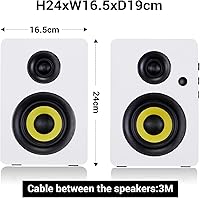
  • Dimensions: Each speaker unit measures 7.48″ deep by 6.5″ wide by 9.45″ tall, making it practical for most desktop or shelf arrangements.
  • Weight: The combined weight of the speaker pair is 12.94 pounds, which means they stay firmly planted on a desk but are not truly portable.
  • Configuration: The system is a 2.0 stereo setup with no built-in subwoofer; low-frequency extension is handled entirely by the 4-inch woofer in each cabinet.
  • Remote Control: An infrared remote is included and supports volume adjustment, input source switching, and power on/standby — but requires unobstructed line of sight.
  • Color & Finish: Available in White only, with a smooth matte frosted PVC wrap applied over the MDF cabinet for a clean, minimal appearance.
  • Input Voltage: The unit is rated for 240V input, and buyers in regions with different mains voltage standards should verify adapter compatibility before use.
  • Bluetooth Range: Bluetooth range is rated at 10 meters under ideal open-air conditions; walls and interference sources will reduce effective range in practice.
  • Included Cables: The box includes a fiber optical cable, a USB audio cable, a 3.5mm-to-RCA cable, a speaker interconnect cable, and a power cord.
  • Warranty: The SW206 ships with a limited warranty; buyers should confirm the specific duration and coverage terms with the seller at time of purchase.
  • Speaker Type: This is an active (powered) bookshelf speaker system, meaning amplification is built in and no external amplifier or receiver is required.

Related Reviews
Sanyun SW209
Sanyun SW209
79%
83%
Sound Clarity
61%
Bass Performance
86%
USB DAC Quality
78%
Bluetooth Stability
72%
EQ Modes Usefulness
More
Sanyun SW203
Sanyun SW203
80%
86%
Sound Clarity
63%
Bass Response
82%
Soundstage & Imaging
91%
Connectivity & Input Options
78%
Bluetooth Stability
More
Sanyun SW205
Sanyun SW205
78%
83%
Sound Quality
61%
Bass Performance
87%
Soundstage & Imaging
89%
Connectivity & Inputs
84%
Bluetooth Performance
More
Sanyun SW208 3″ Bookshelf Speakers
86%
88%
Build Quality
84%
High-Frequency Clarity
91%
Mid-Range Warmth
78%
Bass Performance
93%
Control Ergonomics
More
Sanyun SW102 Computer Speakers
79%
74%
Sound Quality
71%
Bass Performance
78%
Build Quality
66%
Cable & Controls
93%
Setup & Ease of Use
More

FAQ

You can, but only if your turntable has a built-in phono preamp. The Sanyun SW206 does not include a phono stage, so a turntable with a raw phono-level output will sound very quiet and thin. Most modern budget turntables include a switchable preamp, so check your turntable's specs before connecting.

Yes, Bluetooth latency is a real concern here. Several users report an audible sync gap when streaming video over Bluetooth directly to these speakers. For video content, connecting via optical, USB, or AUX will eliminate that delay entirely. Save Bluetooth for music playback where sync is not critical.

HiFi mode adds a gentle warmth to the low-mids and a slight bass lift that makes music feel fuller and more engaging for casual listening. Studio mode pulls that back and delivers a flatter, more neutral response — it is noticeably more honest about the mix, which is useful when editing audio or checking a recording. The difference is real, though not dramatic enough to replace a dedicated monitor.

Absolutely — the optical input and IR remote make this a solid TV speaker option. You can sit across the room and use the remote to adjust volume or switch inputs without getting up. Just keep in mind there is no dedicated wall-mount option, so they will need to sit on a shelf or stand near your display.

Only the primary (active) speaker connects to mains power. The secondary speaker connects to the main unit via the included speaker interconnect cable. This is standard for powered 2.0 speaker systems, and the cable is included in the box.

Yes, and this is one of the stronger use cases for this speaker set. The balanced 6.35mm TRS inputs let you connect directly from most audio interfaces without any adapters, which keeps the signal path clean. It is a feature you rarely find in speakers at this price range.

Plenty loud for a desk. At typical sitting distance, most users find themselves at 30 to 50 percent volume for comfortable listening. The 80W figure is a peak rating, not a continuous output number, so treat it as a ceiling rather than a daily operating level.

Honestly, not without a subwoofer. A 4-inch driver simply cannot move enough air to reproduce deep bass frequencies convincingly. For genres that rely heavily on sub-bass, the low end will feel thin and incomplete. Adding a subwoofer with a line-level input would significantly improve that experience.

The speakers do support simultaneous multi-source playback, which is an unusual feature. In practice though, a small number of users report that having multiple active inputs can occasionally confuse the source priority logic. If that happens, a quick power cycle usually resolves it.

The MDF cabinet gives these a noticeably more solid feel than the thin-wall plastic shells common at this price tier. The finish is clean and the cabinet does not rattle at higher volumes, which is a real differentiator. The one weak point most users flag is the volume knob, which feels lighter and cheaper than the rest of the unit.