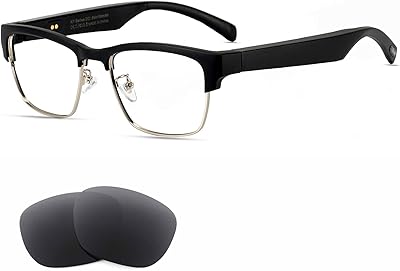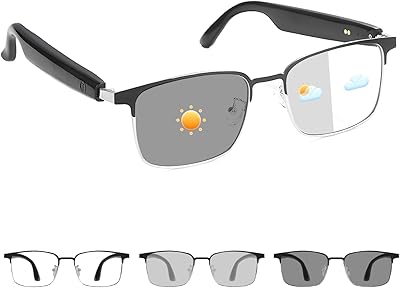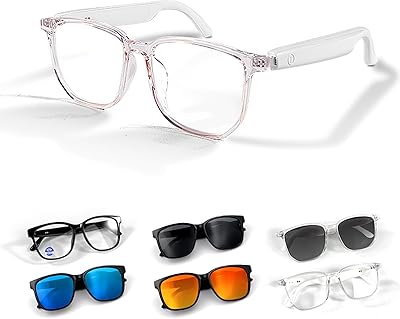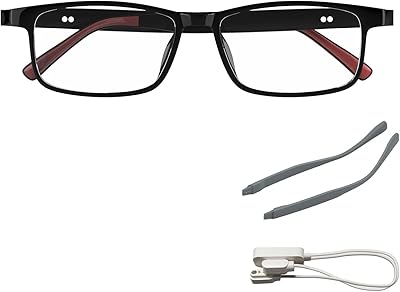



Overview

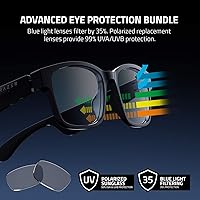
The Razer Anzu Large Smart Glasses are Razer's attempt to carve out a space in the crowded smart eyewear market — and it's a more considered attempt than you might expect from a brand known for RGB keyboards. These smart glasses ship with two sets of lenses in the box: blue light filtering for screen-heavy days and polarized lenses for outdoor use. At just 1.6 oz, they sit on your face without the fatigue that comes from wearing over-ear headphones for hours. They're positioned as a lifestyle accessory — think remote worker and commuter first, gamer second.

Features & Benefits

The headline spec here is a 60ms Bluetooth connection, which is low enough that audio feels reasonably in sync during video calls and YouTube — though audiophiles chasing lossless quality should look elsewhere. The touch-sensitive temple lets you skip tracks, pause, and pull up a voice assistant without touching your phone, which is genuinely useful during a packed commute. The built-in mic is unobtrusive — it's part of the frame, so there's nothing hanging near your chin. For screen workers, the blue light lenses take the edge off long monitor sessions, and the polarized pair swaps in within seconds for outdoor use.

Best For

These audio eyewear are a strong fit for anyone who has quietly given up on earbuds — people who find in-ears uncomfortable after an hour, or who simply need to stay aware of their surroundings on a train or in an open office. Remote workers juggling back-to-back video calls will appreciate having a mic ready without reaching for a headset. Commuters get open-ear awareness while still hearing music or podcasts. The Razer Anzu also suits casual gamers who want a low-key audio option at the desk, though it's not a replacement for a dedicated headset. Razer fans get the branding without the aggressive gamer aesthetic.

User Feedback

Owners of these smart glasses consistently praise how light and comfortable they are over long wear periods, and many note that getting two lens types in a single purchase feels like genuine value rather than a marketing gimmick. That said, audio leakage is a real issue at higher volumes — in quiet rooms or libraries, people nearby will hear what you're listening to, so this is not an earphone replacement in every context. The large size fits well for bigger head shapes, but some users with narrower faces find the standard size a better match. Battery life lands close to the advertised figure for most, though heavy Bluetooth use can trim it. Mic clarity draws mixed reactions — call recipients describe it as acceptable but not impressive.

Pros

  • Both blue light and polarized lenses are included in the box — a rare bundle that adds real everyday versatility.
  • At 1.6 oz, the Razer Anzu sits on your face all day without the fatigue that builds with over-ear headphones.
  • The 60ms Bluetooth latency keeps audio and video reasonably in sync during calls and streaming content.
  • Touch controls on the temple arm let you manage music and calls without pulling out your phone.
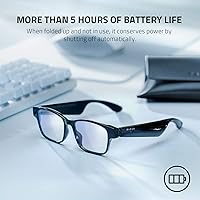
  • Auto power-off when folded is a small but practical feature that genuinely helps stretch battery life.
  • The open-ear design keeps you aware of your environment — useful on transit, in offices, or when watching kids.
  • The frame design is clean and low-key enough to wear in professional settings without looking like gaming hardware.
  • Setup requires no proprietary app — standard Bluetooth pairing works out of the box with minimal friction.
  • The carrying case is a proper fit, not an afterthought, which helps protect the lenses during daily transport.
  • For buyers who cannot tolerate in-ear devices, these audio eyewear offer one of the few genuinely wearable wireless alternatives.

Cons

  • Audio leakage at higher volumes is noticeable to people nearby — not suitable for quiet shared spaces.
  • Bass response is thin compared to any dedicated audio hardware in a similar price range.
  • The microphone picks up wind and ambient noise aggressively in outdoor or loud indoor environments.
  • Hinge loosening and temple coating wear have been reported after several months of heavy daily use.
  • The proprietary charging cable is an inconvenience for travelers already managing multiple USB-C devices.
  • No companion app means there is no EQ adjustment, battery percentage display, or firmware management available.
  • Buyers with narrower faces may find the Large size variant sits loosely and slips during movement.
  • Prescription lens compatibility is not available, which eliminates these glasses for a significant portion of potential buyers.
  • Continuous heavy streaming can push real battery life below the advertised five-hour figure.
  • There is no way to adjust the audio profile, so what you hear out of the box is what you get permanently.

Ratings

The scores below for the Razer Anzu Large Smart Glasses were generated by our AI after analyzing thousands of verified buyer reviews from global markets, with spam, bot-submitted, and incentivized feedback actively filtered out before any scoring was applied. The result is an honest, data-driven picture of where these audio eyewear genuinely impress and where real-world use reveals friction. Both the strengths and the recurring frustrations are reflected transparently in each category.

Comfort & Wearability
88%
At 1.6 oz, these smart glasses are light enough that most wearers report forgetting they have them on during multi-hour work sessions or commutes. The weight distribution is well-balanced across the nose and temples, which is a real advantage over heavier over-ear alternatives.
A subset of users with narrower faces find the Large size variant sits too loosely, causing minor slipping during head movement. The fit issue is specific to the size, not the design — those between sizes have fewer ideal options.
Audio Quality
71%
29%
For casual listening — podcasts, music at moderate volumes, background audio during work — the open-ear speakers deliver clear enough sound with decent mid-range presence. Most users find it perfectly adequate for daily commutes and work calls.
Bass response is thin, and at higher volumes the audio becomes noticeably compressed. Buyers migrating from even budget in-ear headphones will feel the drop in audio fidelity fairly quickly, especially with music-heavy use.
Audio Leakage
54%
46%
The open-ear design is intentional and useful in contexts where situational awareness matters — crossing streets, working in open offices, or traveling by transit. Users specifically seeking that trade-off appreciate the transparency.
At volumes above roughly 60 percent, audio leakage becomes an issue that affects people nearby in quiet spaces like libraries or meeting rooms. This is a structural limitation of all open-ear speaker designs, but it catches some buyers off guard.
Microphone Clarity
67%
33%
The omnidirectional mic handles voice calls well enough in calm environments — most call recipients describe the audio as clear and natural without any noticeable echo or frame interference. Hands-free use during walking commutes works reliably.
In windy outdoor conditions or louder indoor settings, the mic picks up ambient noise more aggressively than directional alternatives. Call recipients on the other end notice the quality dip in noisy environments, which matters for professional video calls.
Battery Life
79%
21%
Real-world battery performance lands close to the advertised figure for typical mixed use — a few hours of audio, some calls, and idle time with auto-shutoff doing its job when the glasses are folded. The auto power-off feature is genuinely useful and not just a spec-sheet checkbox.
Heavy continuous Bluetooth streaming can push the actual runtime noticeably below five hours. Users who stream audio for an entire workday without folding the glasses in between will likely need a midday top-up.
Build Quality & Durability
73%
27%
The frame feels solid for its weight class, and the hinge action is smooth on initial use. Most users report no structural issues during the first several months of daily wear, which is a reasonable baseline for a wearable at this tier.
After extended daily use, some owners report hinge loosening and coating wear around the temples where contact is heaviest. The glasses hold up fine with occasional use, but as an everyday item the long-term durability story is mixed.
Lens Quality
83%
Getting both blue light filtering and polarized lenses in a single purchase is a genuine differentiator — users appreciate not having to buy accessories or a second product for outdoor use. The polarized lenses in particular draw consistent praise for glare reduction in direct sunlight.
The blue light lenses have a slight tint that some users find distracting in color-sensitive work like photo editing or design. Neither lens type offers prescription compatibility, which narrows the audience considerably.
Touch Controls
76%
24%
The temple-based touch interface handles the basics — play, pause, skip, and call answering — without requiring any companion app intervention. Most users get comfortable with the gesture set within a day or two of use.
Accidental touches happen more often than they should, particularly when adjusting the glasses on the nose or removing them. The control surface is not always responsive in cold weather, which a few commuters flagged as a seasonal annoyance.
Bluetooth Connectivity
82%
18%
The 60ms latency figure holds up in practice for video calls and streaming content, where lip sync issues are the most noticeable pain point on competing devices. Pairing is quick and the connection stays stable within normal room-to-device distances.
Range drops off faster than a traditional Bluetooth headset when obstacles like walls or a phone in a bag pocket are in the path. A small number of users report occasional audio stuttering during initial pairing sessions.
Value for Money
78%
22%
The dual-lens bundle genuinely helps the value proposition — buyers are effectively getting a pair of blue light glasses and polarized sunglasses alongside functional audio hardware. For the specific buyer this targets, the all-in-one appeal justifies the price point.
Buyers comparing purely on audio quality will find dedicated wireless earbuds in a similar price range that outperform these glasses acoustically by a meaningful margin. The value argument only holds if the eyewear functionality is part of the equation.
Design & Aesthetics
84%
Razer managed to keep the design restrained enough that these do not read as overtly gamer hardware in everyday settings. The profile is clean and low-key, which matters for wearers who want to use them in professional or social environments without drawing attention.
The frame shape is fairly generic, and style-conscious buyers may want more design variety. The color options are limited, and the overall look does not have the premium feel of some rivals in this category.
Ease of Use
86%
Setup involves standard Bluetooth pairing with no proprietary app required for basic use, which removes a common friction point. Voice assistant access works through the touch interface without any additional configuration on most Android and iOS devices.
The lack of a dedicated companion app means there is no EQ adjustment, firmware update notification, or battery percentage readout available — features that competing products in this space have started to normalize.
Portability
81%
19%
The included carrying case is well-fitted and adds reasonable protection without being bulky. At its weight and size, the Razer Anzu folds down to something that fits in a jacket pocket or a small bag compartment without drama.
The charging cable is proprietary, which means forgetting it while traveling creates a problem. Users who already carry USB-C devices find the additional cable a minor but recurring inconvenience.

Suitable for:

The Razer Anzu Large Smart Glasses are built for a specific kind of buyer, and if you fit the profile, they make a lot of sense. Remote workers who spend six or more hours a day in front of a monitor will appreciate having blue light protection and hands-free call capability in a single wearable — no switching between glasses and a headset, no ear fatigue from in-ear buds by mid-afternoon. Commuters who need to stay aware of their surroundings on busy transit will find the open-ear audio a genuinely practical fit, since you can hear platform announcements and still catch a podcast. If you have always hated the physical sensation of anything sitting in your ear canal, these smart glasses are one of the few wireless audio options that sidestep that problem entirely. The included polarized lenses also make them a two-environment tool — swap the lenses for outdoor use and you have a functional pair of sunglasses without buying a second product. Razer fans who want something from the brand that does not announce itself as gaming hardware in a boardroom or coffee shop will find the design refreshingly understated.

Not suitable for:

The Razer Anzu Large Smart Glasses are a poor fit for anyone whose primary goal is audio quality — if you are comparing these against wireless earbuds or over-ear headphones on sound alone, they will lose that comparison at every price point. People who regularly take calls in loud outdoor environments or open-plan offices should know that the microphone struggles with ambient noise pickup, which call recipients will notice. Anyone who needs prescription lenses is out of luck entirely, since neither the blue light nor the polarized lenses are available in corrective options. Buyers with narrower faces should strongly consider the standard size before defaulting to the Large variant, since the fit difference affects comfort and stability more than expected. The open-ear speaker design also means audio leakage is a structural reality — using these at volume in a library, a quiet meeting room, or next to a sleeping partner is not a realistic option. Finally, if you are looking for an all-day professional audio solution with a companion app, EQ controls, or long-range Bluetooth, these glasses will feel underpowered for that role.

Specifications

  • Dimensions: The frame measures 6.42 x 1.87 x 6.07 inches, sized for larger head shapes in the Large variant.
  • Weight: The glasses weigh 1.6 oz, making them light enough for extended all-day wear without noticeable pressure on the nose or temples.
  • Connectivity: Bluetooth is the sole wireless protocol used, with no wired audio output available.
  • Audio Latency: The Bluetooth connection operates at 60ms latency, which keeps audio reasonably synchronized during video playback and calls.
  • Battery Life: Rated for more than 5 hours of continuous use on a single charge under typical mixed-use conditions.
  • Auto Power-Off: The glasses automatically shut off when folded to conserve battery when not in active use.
  • Microphone: An omnidirectional microphone is embedded directly into the frame for hands-free call handling without external accessories.
  • Speaker Type: Open-ear speakers are built into the temple arms, delivering audio without any in-ear or on-ear contact.
  • Touch Controls: Capacitive touch controls on the temple arm support playback management, call handling, and voice assistant activation.
  • Voice Assistant: Compatible with both Google Assistant and Siri via the touch interface on the temple without additional configuration.
  • Lenses Included: Two sets of lenses are included in the box: blue light filtering lenses for screen use and polarized lenses for outdoor sunlight conditions.
  • Lens Type: Neither lens type is available in prescription or corrective options; both are non-corrective only.
  • Charging: The glasses charge via a proprietary magnetic charging cable included in the box.
  • In the Box: Purchase includes the glasses, blue light filtering lenses, polarized lenses, a carrying case, a cleaning cloth, and a charging cable.
  • Battery Type: Two built-in lithium-ion batteries power the device and are not user-replaceable.
  • Fit & Gender: The glasses are designed as a unisex accessory, with the Large variant intended for wider or larger head shapes.
  • Manufacturer: Designed and manufactured by Razer, with the product first available in July 2021.
  • Best Sellers Rank: Ranked #26 in Wearable Tech Glasses on Amazon at the time of data collection, indicating solid category traction.

Related Reviews
Emerhome E13 Bluetooth Smart Glasses
70%
83%
Ease of Pairing
79%
Call Clarity
58%
Audio Volume & Quality
54%
Battery Life
71%
Touch Control Accuracy
More
TnoxHD Smart Glasses
85%
85%
Audio Quality
90%
Battery Life
80%
Comfort and Fit
78%
Sound Clarity for Calls
88%
Ease of Use
More
AIRMARS SG8 Bluetooth Smart Glasses
74%
88%
Value for Money
83%
Lens Performance
58%
Audio Quality
61%
Call Quality
79%
Comfort & Fit
More
ITHUGE UF-09(ai) AI Smart Translation Glasses
70%
67%
Translation Accuracy
62%
Build Quality
78%
Battery Life
53%
Ease of Setup
59%
Audio Quality
More
DOVIICO KY02 Smart Glasses
81%
73%
Sound Quality
88%
Comfort & Fit
80%
Battery Life
85%
Waterproof Durability
90%
Ease of Use & Setup
More
Tulbeys G07 Bluetooth Audio Glasses
70%
91%
Wearing Comfort
83%
Bluetooth Connectivity
61%
Audio Quality
48%
Sound Leakage
57%
Microphone & Call Quality
More
Smart Bluetooth Glasses GS038
85%
88%
Comfort & Wearability
82%
Sound Quality
86%
Battery Life
83%
Build Quality
70%
Connectivity Stability
More
Tulbeys GS06 Photochromic Bluetooth Smart Glasses
73%
83%
Value for Money
78%
Lens Performance
61%
Audio Quality
72%
Comfort & Fit
54%
Charging Experience
More
OhO A8 Pro Bluetooth Smart Sunglasses
76%
67%
Open-Ear Audio Quality
88%
Situational Awareness Design
71%
Transitional Lens Performance
83%
Voice Control & Smart Assistant Integration
78%
Call Quality & Microphone
More
AMZISH AI Smart Glasses with Camera
85%
89%
Video Recording Quality
91%
AI Translation Performance
83%
Audio Quality (Calls & Media)
80%
Battery Life
88%
Build Quality & Durability
More

FAQ

Both lenses are included with your purchase — no add-ons needed. You get the blue light filtering set for screen use and the polarized set for outdoor wear, along with a cleaning cloth to handle the swap cleanly.

At moderate volumes, most people nearby will not notice much. Once you push past roughly 60 percent volume in a quiet room, audio leakage becomes real and people nearby will hear what you are listening to. These are open-ear speakers by design, so some leakage is expected — just factor that in if you plan to use them in libraries, quiet offices, or shared spaces.

The lenses pop out and click back in without tools. Most users get the hang of the swap within their first few tries, and it takes under a minute once you are familiar with the mechanism. Just handle the lenses by the edges to avoid smudging.

No — neither lens type is available in corrective options, and the frame is not designed to accept prescription inserts. If you need vision correction, these will not work as a standalone solution without wearing contact lenses underneath.

For most users doing a mix of audio streaming, a few calls, and idle time with auto-shutoff active, the runtime lands close to the five-hour mark. Continuous high-volume streaming without folding the glasses will trim that figure. Plan for a top-up if you are using them heavily across a full workday.

In calm indoor settings, call quality is generally fine and recipients report clear audio. In windy conditions or noisy open environments, the omnidirectional mic picks up quite a bit of background noise. If most of your calls happen outdoors or in loud spaces, this is worth factoring into your decision.

The touch-sensitive area sits on the right temple arm. A single tap plays or pauses, a double tap skips forward, and holding activates your voice assistant — the exact gestures can vary slightly depending on your connected device. Most people adjust within a day or two, though accidental touches when adjusting the glasses on your face do happen with some regularity.

The Large is specifically built for wider head shapes and larger facial structures. If you have a narrower or average-width face and pick the Large variant, you may find it sits loosely or slides down with movement. When in doubt, Razer's sizing guidance or a direct comparison of frame width measurements to glasses you already own is the best starting point.

Charging uses a proprietary magnetic cable included in the box, not a standard USB-C connection. This is the main travel inconvenience users flag — if you forget the cable, you cannot improvise with another charger. Keeping a spare in your bag is a practical workaround.

It depends on what you prioritize. Bose Frames generally edge ahead on audio quality and have a more refined app ecosystem. The Razer Anzu counters with the dual-lens bundle — getting both blue light and polarized lenses included at purchase adds genuine everyday value that Bose does not match out of the box. If screen-time eye protection is part of your use case, the Razer option makes a stronger all-in-one argument at its price point.