Overview

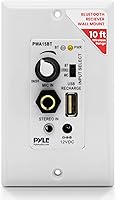
The Pyle PWA15BT is a wall-mount Bluetooth amplifier receiver built for anyone who wants real speaker audio without the clutter of a shelf-mounted stereo. Made by Sound Around and available since mid-2015, this wall amplifier drops into a standard wall gang box and sits flush behind a clean white plate — a tidy result most buyers genuinely appreciate. It drives two passive speakers and fits equally well in a home kitchen, small office, or sunroom. At under four ounces and roughly 3×4×4 inches, it is surprisingly compact for what it does, offering a solid budget entry point into wired whole-room audio.

Features & Benefits

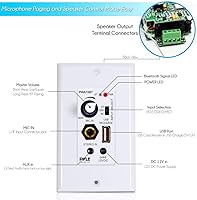
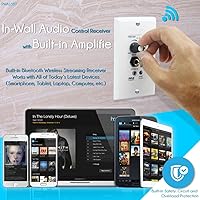
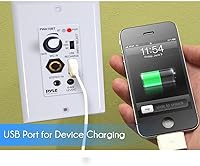
The in-wall Bluetooth receiver packs a fair number of connection options into its small footprint. Bluetooth handles wireless streaming from phones or tablets up to about 30 feet away, while a 3.5mm aux input lets you wire in a TV or media player when you prefer a fixed source. Around back, the speaker terminal block makes connecting a passive stereo pair clean and straightforward. There is also a 1/4-inch mic input for basic paging — useful in a small shop or office but not suited for anything elaborate. The USB port is for device charging only, not audio, and the rotary volume knob keeps daily adjustments tactile and intuitive.

Best For

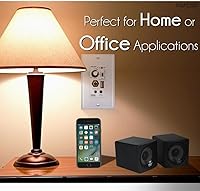
This Pyle wall unit is a natural pick for DIY-confident homeowners who already own a pair of passive ceiling or bookshelf speakers and just need something to drive them without mounting a receiver on a shelf. Think kitchens, garages, sunrooms — spaces where you want background music accessible but not in the way. It also works well in small retail spaces or offices where light paging alongside music playback covers all the audio needs. If you are chasing audiophile-grade sound reproduction, look elsewhere. But if clean installation, Bluetooth convenience, and a tidy wall-plate finish matter more than sonic perfection, this wall amplifier checks the right boxes.

User Feedback

Owners tend to highlight easy installation and the clean look once the plate is mounted — two things that matter a lot when you are putting something permanent in a wall. Bluetooth pairing gets consistent praise for being quick and holding steady at typical room distances. On the critical side, buyers familiar with amplifier specs point out that the advertised 100W figure is a peak rating, not continuous RMS, so real-world output is more modest. Sound quality lands solidly in the background-listening category rather than anything demanding. A handful of users also note that older walls may need minor drywall trimming for a proper flush fit, so factor that in before you start cutting.

Pros

  • Installs into a standard wall gang box for a clean, cable-free finished appearance.
  • Bluetooth pairing is fast and holds reliably at typical room distances.
  • Drives a passive stereo speaker pair directly via the rear terminal block.
  • The Pyle PWA15BT offers an unusually tidy in-wall form factor at its price point.
  • A wired 3.5mm aux input provides a dependable fallback when Bluetooth is not preferred.
  • The rotary volume knob makes day-to-day level adjustments quick and intuitive.
  • Built-in USB port adds a convenient device charging spot right on the wall.
  • Basic microphone paging is available for simple voice announcements without extra hardware.
  • Compact dimensions mean it takes up no shelf or counter space whatsoever.
  • A solid entry point for anyone adding audio to a room that currently has none.

Cons

  • The 100W power claim is a peak figure — real continuous output is significantly lower.
  • Only one wired input means swapping cables every time you change source devices.
  • Sound quality tops out at background listening; it cannot satisfy higher-volume or critical listening needs.
  • Bluetooth range weakens noticeably through walls or in larger open-plan spaces.
  • The microphone input lacks any gain control, EQ, or feedback suppression.
  • Some older wall boxes require drywall trimming before the plate sits flush.
  • The plastic housing feels lightweight, which raises durability questions over multi-year use.
  • White is the only color option, limiting compatibility with darker or non-standard room decor.
  • No visual indicator shows which input is currently active, adding confusion in shared spaces.
  • Long-term reliability reports are mixed, with some units showing issues after 12 to 18 months.

Ratings

The Pyle PWA15BT has been scored by our AI engine after systematically analyzing verified global buyer reviews, actively filtering out incentivized, bot-generated, and duplicate feedback to surface what real users actually experience. Scores across every category reflect an honest balance of genuine praise and recurring frustrations — nothing has been smoothed over. Whether this wall amplifier lands in your shortlist or gets passed over depends heavily on how well its strengths align with your specific setup, and the breakdown below makes that call much easier.

Ease of Installation
83%
Most buyers with basic DIY confidence report a smooth installation process, describing the wiring and gang-box fit as intuitive enough to complete without an electrician. The included terminal block and clear rear-panel layout help even first-timers feel oriented quickly.
Older walls with non-standard box depths can require drywall trimming before the plate sits flush, which catches some buyers off guard. A small but consistent group of reviewers notes this fitting issue adds unexpected time to what should be a quick job.
Bluetooth Connectivity
78%
22%
Pairing with a smartphone or tablet is consistently described as fast and hassle-free, typically completing in seconds. At normal room distances — across a kitchen or small office — the connection holds reliably without dropout complaints dominating the feedback.
The 30-plus foot range claim holds up in open spaces but weakens through walls or in larger rooms with obstructions. A portion of users report occasional reconnection hiccups when switching between source devices, which is a minor but real inconvenience.
Sound Quality
61%
39%
For background music in a kitchen, garage, or small retail space, the audio output is widely described as clean and perfectly adequate. Buyers using quality passive bookshelf or ceiling speakers report a noticeably better result than the price point might suggest.
This wall amplifier is not built for critical listening, and buyers who push it toward higher volumes or expect hi-fi reproduction are regularly disappointed. Dynamics feel compressed at louder levels, and the stereo separation, while functional, lacks the depth more dedicated amplifiers provide.
Amplifier Power & Output
54%
46%
For ambient or background listening at moderate volumes, the real-world output is sufficient to fill a small-to-medium room without strain. Paired with efficient speakers, the unit handles typical daily use — music during cooking, soft background audio in a waiting room — without obvious clipping.
The advertised 100W figure is a peak rating, not continuous RMS, so actual sustained output is considerably lower than the spec implies. Buyers who researched this before purchasing feel misled, and those who did not often discover the limitation the first time they push the volume past halfway.
Build Quality & Materials
67%
33%
The white wall plate has a clean, professional appearance once mounted, and the overall construction feels adequate for a fixed installation that will not be handled daily. The rotary volume knob has a satisfying tactile feel that holds up well according to long-term owners.
The plastic housing feels noticeably lightweight, and some buyers describe it as less premium than expected even at this price tier. A few reviewers mention that the terminal block connections feel slightly loose if cables are not seated firmly and checked after installation.
Value for Money
81%
19%
For buyers who already own passive speakers and simply need a compact, Bluetooth-capable amplifier source that disappears into a wall, the price-to-function ratio is genuinely strong. The in-wall form factor alone — something that typically costs far more — makes the value proposition clear for the right use case.
Buyers expecting a full-featured receiver at this price will feel the compromises quickly, particularly around output power and audio fidelity. If you factor in the cost of compatible passive speakers, the total outlay starts to compete with self-powered alternatives that outperform it on sound.
Microphone & Paging Function
52%
48%
Small office managers and retail owners using this wall amplifier for simple verbal announcements report that the 1/4-inch mic input does its basic job adequately. For low-stakes paging — calling staff, greeting customers — it covers the need without requiring a separate system.
The paging functionality is genuinely rudimentary, and buyers hoping for anything beyond basic voice announcements will hit its limits fast. There is no EQ, no feedback suppression, and no gain control worth mentioning, making it unsuitable for anything resembling a professional PA application.
Input Versatility
74%
26%
Having both Bluetooth and a wired 3.5mm aux input covers the two most common audio source scenarios without overcomplicating the setup. Buyers appreciate being able to hardwire a TV or media player as a fallback when Bluetooth is not the preferred option.
Two inputs is functional but limiting if your setup involves multiple wired sources. There is no optical input, no RCA option, and no input-switching indicator, so users with more than one wired device have to physically swap cables rather than toggle between sources.
USB Charging Port
63%
37%
Having a USB charging port built into a wall amplifier is a practical bonus that buyers genuinely use, particularly in kitchens and offices where charging spots are always in demand. It adds small but real everyday utility to what is otherwise a purely audio-focused device.
The USB port is strictly for charging and carries no audio functionality — a point that confuses some buyers who assume it supports audio playback from a USB drive. Output current is modest, so charging speeds for larger devices like tablets are noticeably slow.
Aesthetic & Wall Integration
86%
Once properly seated and painted around if needed, the unit blends into a wall convincingly and looks significantly cleaner than any shelf-mounted receiver alternative. Buyers frequently mention the finished appearance as one of the main reasons they chose this over a standalone unit.
The white-only color option limits compatibility with darker-painted rooms or non-standard decor schemes. Some buyers also note that the plate dimensions do not align with standard decorator-style outlet covers, making mixed-panel installations look slightly inconsistent.
Compatibility with Passive Speakers
77%
23%
The rear terminal block handles bare-wire speaker connections cleanly, and the unit works reliably with a wide range of 4-ohm and 8-ohm passive speakers. Buyers pairing it with ceiling speakers for distributed audio in a single room report solid, stable performance.
There is no impedance selector or protection circuitry mentioned in the documentation, which makes cautious buyers nervous about long-term reliability when running lower-impedance loads. Multi-room or daisy-chained speaker setups are not supported, limiting scalability for more ambitious installations.
Setup & Pairing Experience
79%
21%
Out of the box, the initial Bluetooth pairing and basic wiring process is described by most buyers as taking under 30 minutes total, assuming the wall box is already prepared. The rotary volume control and straightforward input layout mean there is almost no learning curve for daily use.
There is no companion app, no input labeling on the face plate, and no visual indicator for active input source, which adds minor friction for shared households or offices where multiple people interact with the unit. Advanced users may find the lack of configuration options frustrating over time.
Reliability & Longevity
66%
34%
A meaningful number of buyers report using the unit for two or more years without issues, which is reassuring for a budget-tier fixed installation. The absence of moving parts beyond the volume knob reduces the most common mechanical failure points.
The long-term reliability picture is mixed, with a recurring subset of reviews describing Bluetooth module failures or volume control degradation after 12 to 18 months of regular use. As a budget product with no warranty reputation to speak of, replacement rather than repair is the likely outcome if something fails.

Suitable for:

The Pyle PWA15BT is a strong fit for DIY-confident homeowners who want to add background music to a kitchen, garage, sunroom, or workshop without the bulk and visible cables of a traditional shelf-mounted receiver. If you already own a pair of passive bookshelf or ceiling speakers and just need an affordable, tidy amplifier source to bring them to life, this wall amplifier slots neatly into that gap. It works equally well in small commercial settings — a boutique, a yoga studio, a small waiting room — where light background audio and occasional voice announcements cover all the audio requirements. Anyone prioritizing a clean, built-in aesthetic over raw audio performance will find the finished wall-plate look genuinely satisfying. The combination of Bluetooth streaming and a wired aux fallback also makes it practical in shared spaces where different people use different source devices throughout the day.

Not suitable for:

Buyers expecting a powerful, full-featured audio receiver should look elsewhere — the advertised 100W figure is a peak rating, and the real-world continuous output is modest enough that this wall amplifier will struggle to fill larger rooms or satisfy anyone who listens at elevated volumes. The Pyle PWA15BT is also not a good match for audiophiles or anyone prioritizing sound fidelity, since the output quality is firmly in the background-listening category and lacks the dynamic range or stereo depth that more demanding listeners expect. If your installation involves multiple wired audio sources, the single aux input will quickly become a frustration, as there is no input switching beyond physically swapping cables. The microphone paging function is too rudimentary for anyone needing a real PA solution — no feedback control, no gain adjustment, and no EQ means it is useful only for the simplest voice announcements. Finally, buyers working with older walls or non-standard gang boxes should be aware that fitting this unit flush may require drywall modifications that add time and effort beyond what most people anticipate.

Specifications

  • Brand & Model: Manufactured by Sound Around and sold under the Pyle brand as model PWA15BT.
  • Amplifier Power: Rated at 100W peak output; continuous RMS power is lower and more representative of real-world listening levels.
  • Channel Config: Two-channel stereo (2.0) output designed to drive one pair of passive speakers simultaneously.
  • Wireless: Built-in Bluetooth with a stated wireless range of 30 or more feet in open-space conditions.
  • Audio Inputs: Accepts audio via Bluetooth streaming and a wired 3.5mm aux jack for connecting external devices such as TVs or media players.
  • Mic Input: Includes a 1/4-inch microphone input jack for basic voice paging or announcement use.
  • Speaker Output: Rear-panel screw-terminal speaker block supports bare-wire connections for a single passive stereo speaker pair.
  • USB Port: One USB port is included for device charging only and does not support audio playback from USB drives or storage media.
  • Volume Control: Front-facing rotary knob provides tactile manual volume adjustment without digital menus or remote operation.
  • Dimensions: The unit measures 3″ deep by 4″ wide by 4″ tall, sized to fit inside a standard in-wall gang box.
  • Weight: The unit weighs 3.53 oz, making it light enough for a single-person wall installation without structural concerns.
  • Mount Style: Designed as an in-wall gang box plate mount, replacing a standard wall outlet or switch cover for a flush finish.
  • Color: Available exclusively in white; no alternative color options are offered by the manufacturer.
  • Compatibility: Works with Bluetooth-enabled smartphones, tablets, and laptops running current mobile and desktop operating systems.
  • Manufacturer: Produced by Sound Around, a consumer electronics company based in the United States with a broad budget AV product catalog.
  • First Available: This product was first listed for sale in June 2015 and has remained in continuous production since then.
  • Product Status: As of the latest available information, the PWA15BT has not been discontinued by the manufacturer.

Related Reviews
Pyle PDWR30B Outdoor Speakers
85%
88%
Sound Quality
94%
Weatherproof Durability
85%
Ease of Installation
78%
Design and Aesthetics
91%
Build Quality
More
Pyle PVTC320U Step Up and Down Converter
84%
87%
Value for Money
85%
Performance
90%
Ease of Use
65%
Portability
91%
Safety Features
More
Pyle PLMR57W Marine Speakers
85%
84%
Sound Quality
91%
Durability
89%
Ease of Installation
90%
Weather Resistance
75%
Bass Performance
More
Pyle PLMR652W Marine Speakers
86%
88%
Sound Quality
91%
Ease of Installation
93%
Durability (Waterproof & Weather Resistance)
87%
Build Quality
75%
Performance at High Volumes
More
Pyle PLMRA200 Marine Amplifier
86%
94%
Waterproof Performance
88%
Ease of Installation
83%
Power Output
85%
Build Quality
90%
Size and Space Efficiency
More
Pyle PLMR82 Marine Speakers
84%
83%
Sound Quality
89%
Durability
90%
Ease of Installation
80%
Power Handling
87%
Build Quality
More
Pyle PLATV65BT Bluetooth Speakers
86%
88%
Sound Quality
91%
LED Light Features
85%
Water Resistance
89%
Ease of Installation
87%
Build Quality
More
Pyle PLMR692 Marine Speakers
85%
88%
Sound Clarity
91%
Build Quality & Durability
94%
Waterproof Performance
85%
Installation Ease
73%
Bass Response
More
Pyle PLMRMB2CW Marine Amplifier
86%
85%
Sound Quality
92%
Waterproof Durability
88%
Bluetooth Connectivity
80%
Power Output
87%
Installation Ease
More
Pyle PLMRS4W Marine Speakers
84%
80%
Sound Quality
90%
Build Quality
88%
Durability in Harsh Weather
85%
Installation Ease
65%
Bass Response
More

FAQ

Yes, the unit is designed to mount into a standard in-wall gang box, much like a typical outlet or light switch. That said, a few buyers with older walls or shallower boxes have needed to make minor drywall adjustments to get the plate to sit fully flush, so it is worth measuring your box depth before starting the install.

No, the speaker terminal block on the rear is set up for a single stereo pair only — one left channel and one right channel. If you want to run speakers in multiple rooms, you would need additional amplifier units, one per zone.

It does not. The USB port on this in-wall Bluetooth receiver is strictly for charging devices like phones and tablets. If you want to play audio from a USB drive, you will need to use the Bluetooth or aux input instead.

That is a fair concern. The 100W figure is a peak rating, not a continuous RMS measurement, which means the real sustained output under normal listening conditions is meaningfully lower. For background music in a small-to-medium room the power is adequate, but if you are expecting to drive large or inefficient speakers at high volumes, you may find it falls short.

Yes, this is actually one of the most popular use cases for the Pyle PWA15BT. As long as your ceiling speakers are passive (not powered) and have standard bare-wire or spade connections, you can run them directly to the rear terminal block. Just confirm your speakers fall within a compatible impedance range, typically 4 to 8 ohms.

At typical in-room distances — say, across a kitchen or small office — the connection is reported as stable and quick to pair. Where it gets less reliable is through walls or at the outer edge of the stated 30-foot range, so plan on keeping your source device reasonably close to the unit for the best experience.

For very basic announcements — calling a staff member or greeting customers over speakers — it will do the job. However, it has no feedback suppression, no gain knob to speak of, and no EQ, so do not expect anything approaching a proper PA system. If clear, controlled voice paging is important to your setup, a dedicated PA solution would serve you better.

The unit is designed to be hardwired directly into your wall's electrical supply, which is part of what allows it to sit flush behind a wall plate. This means you should be comfortable working with household wiring or hire a qualified electrician for the power connection portion of the install.

Bluetooth on this unit supports one active source device at a time. Switching between phones or tablets requires either disconnecting the current device or pairing a new one, which is standard behavior for budget Bluetooth receivers at this level. It is not ideal in high-turnover shared environments where many people want to take control of the music.

Most standard 4-ohm or 8-ohm passive bookshelf or ceiling speakers will work fine for background listening purposes. You do not need anything fancy — in fact, a modest but efficient pair of speakers will often get better results than pushing expensive speakers with this level of amplification. The key is matching expectations: this wall amplifier is built for ambient audio, not audiophile playback.