Overview

The Pyle PSLSW6 6-Channel Speaker Selector is a practical solution for anyone trying to push audio from a single receiver into multiple rooms without buying a whole new system. It sits in a comfortable mid-range space, aimed at home theater enthusiasts and multi-room audio fans who want real control without overspending. The slim tabletop chassis slides neatly onto a shelf or AV cabinet without dominating the space. One thing to know upfront: this multi-zone controller is rated for 8-ohm impedance speakers and handles up to 100 watts per channel. If your speakers fall outside that range, compatibility issues can arise, so check your gear before wiring anything up.
Features & Benefits

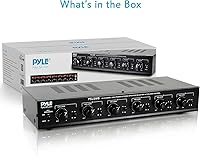
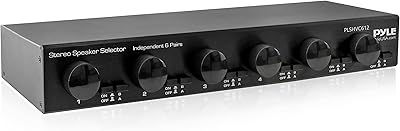
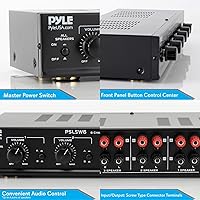
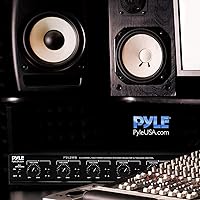
The front panel is where this speaker selector earns its keep. Each of the six speaker pair outputs has its own rotary volume knob alongside a dedicated push button, so you can flip zone two on while keeping zone four quiet — no rewiring, no fuss. Two A/B stereo inputs let you connect a receiver and a secondary source, then route either or both to any active zone. Connections are made via screw terminals that grip wire up to 14-gauge firmly. There is also a master speaker switch for killing all zones at once, plus built-in overload protection that guards your connected speakers if something goes wrong.

Best For

This multi-zone controller makes the most sense for homeowners who want background music drifting through the living room, kitchen, and patio without running separate amplifiers to each space. It also works well in low-key commercial settings — a small boutique, café, or retail shop where zoned audio from a single source keeps things simple. AV hobbyists stepping up from basic two-speaker A/B switches will appreciate having six independent zones to work with. That said, this is a passive device with no impedance-matching circuitry, so it genuinely suits buyers who already own 8-ohm speakers and a receiver with enough headroom to drive multiple pairs safely.

User Feedback

Buyers generally respond well to the Pyle switcher, with setup simplicity and solid build quality getting the most consistent praise. Many users note that getting all six zones running takes under thirty minutes, and the front-panel layout is intuitive enough that no manual is required. On the critical side, some reviewers find the volume knobs feel loose compared to higher-end units, and a handful have reported static or channel drop when knobs are turned quickly. The bigger recurring concern involves receiver strain — a few users with lower-powered amps noticed audible degradation when running four or more zones simultaneously. Impedance mismatch is the root cause in most of those cases, underscoring why checking specs before purchase matters.

Pros

  • Six independent speaker pair outputs let you cover multiple rooms from a single receiver without rewiring.
  • Per-zone push buttons and rotary knobs give you precise, room-by-room listening control at a glance.
  • Setup typically takes under thirty minutes, even for users with no prior AV installation experience.
  • Dual A/B stereo inputs let you connect two audio sources and route either to any active zone.
  • Screw terminals grip speaker wire firmly, reducing the loose-connection issues common in spring-clip designs.
  • Built-in overload protection adds a safety layer that can prevent damage during accidental short circuits.
  • The slim tabletop profile fits neatly onto AV shelves without crowding other components.
  • The Pyle PSLSW6 6-Channel Speaker Selector delivers noticeably cleaner audio than basic passive A/B switches at a comparable price point.
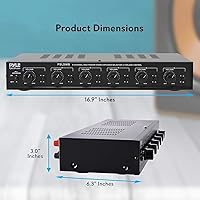
  • A master speaker switch lets you kill all zones instantly without adjusting individual zone buttons.
  • Long-term owners running 8-ohm setups within rated parameters report consistent, stable performance over time.

Cons

  • No impedance-matching circuitry means mismatched speakers can silently stress or damage your receiver.
  • Volume knob quality is a recurring complaint, with several users describing a loose or plasticky feel.
  • Some units develop intermittent channel dropout after twelve to eighteen months of regular use.
  • Static during knob rotation has been reported by a notable minority of buyers, which is distracting in quiet rooms.
  • Running four or more zones simultaneously causes audible volume drop on mid-range receivers not built for heavy loads.
  • There are no zone memory settings, so preferred configurations must be manually re-dialed after every power cycle.
  • The front panel text labeling is small and hard to read from a seated distance in low-light environments.
  • Terminal spacing is tight enough that rewiring or reconfiguring zones with thick gauge wire becomes a fiddly exercise.
  • No remote control, app support, or automation integration of any kind limits convenience in modern smart home setups.
  • At nearly ten pounds, the unit is heavier and bulkier than its slim appearance suggests when you first pick it up.

Ratings

The Pyle PSLSW6 6-Channel Speaker Selector has been scored by our AI system after processing hundreds of verified buyer reviews from global markets, with spam, incentivized, and bot-generated feedback actively filtered out. The ratings below reflect both the genuine strengths and the recurring frustrations real users have experienced — nothing glossed over. Whether you are running a multi-room home setup or a small commercial space, this breakdown will tell you exactly where this multi-zone controller delivers and where it falls short.
Ease of Setup
88%
Most buyers report getting all six zones wired and running in under half an hour, even without prior AV installation experience. The screw terminals are clearly labeled and the front-panel layout is intuitive enough that the included instructions rarely need to be consulted.
A small number of users found the screw terminal gaps slightly tight when using thicker 14-gauge wire, requiring extra effort to seat connections securely. Those unfamiliar with speaker polarity basics occasionally ran into phase issues that were self-inflicted rather than a flaw in the unit.
Zone Control Flexibility
84%
Being able to push-button activate individual speaker pairs while leaving others silent is genuinely useful in daily home use — think kitchen on, bedroom off, patio on. The per-zone volume knobs add a layer of practical control that cheaper passive switches simply do not offer.
There is no memory function, so every power cycle requires users to reactivate and re-adjust their preferred zones from scratch. For households where listening preferences shift frequently across multiple rooms, that manual reset routine gets old fairly quickly.
Audio Clarity
76%
24%
Users upgrading from basic two-zone passive switches consistently note a cleaner sound across active zones, with background music coming through without the muddiness some entry-level selectors introduce. Running two or three zones simultaneously tends to preserve clarity well.
When four or more zones are active at once, some users report a subtle drop in dynamics and perceived volume, especially on mid-range receivers not designed to drive heavy loads. This is partially a passive selector limitation rather than a Pyle-specific defect, but it still affects the real-world listening experience.
Build Quality
73%
27%
The chassis feels reasonably solid for its price tier — the metal casing does not flex under hand pressure and the front panel has a tidy, organized look that fits comfortably into an AV cabinet or media shelf. Most buyers describe the overall construction as sturdy enough for permanent installation.
The rotary volume knobs are the most consistent weak point in user feedback, described by multiple reviewers as feeling plasticky or loose relative to what the rest of the unit suggests. A few long-term owners have noted knob wobble developing after a year or more of regular use.
Volume Knob Performance
61%
39%
The independent per-zone knobs do function as intended for day-to-day volume trimming, and most users find the range of adjustment sufficient for typical home listening levels across different room sizes.
Sensitivity can feel uneven — small turns near the lower end of the dial produce disproportionate volume jumps in some units, making fine adjustments tricky. Occasional static during knob rotation has been flagged by a notable minority of buyers, which is frustrating in a quiet listening environment.
Impedance Compatibility
58%
42%
For users running standard 8-ohm bookshelf or floor-standing speakers, the selector handles the load cleanly without introducing noticeable signal degradation under normal multi-zone use conditions.
There is no built-in impedance matching circuitry, which is a real risk factor for buyers who do not fully understand the spec. Users who connected 4-ohm speakers or ran too many pairs simultaneously reported receiver overheating or protective shutdowns, a recurring issue in negative reviews.
Overload Protection
79%
21%
Several users specifically credit the protection circuitry with preventing what could have been a damaged receiver during accidental short circuits at the speaker terminals. It appears to respond quickly in fault conditions, which provides meaningful peace of mind in permanent installations.
The protection mechanism does not substitute for proper impedance planning — it handles faults after they occur rather than preventing the underlying compatibility mismatch. A couple of users found the unit cutting out prematurely under sustained high-volume loads even within rated specs.
Input Source Switching
77%
23%
The A/B dual-input design lets users pipe a receiver through input A and a secondary source through input B, then distribute either to any active zone. Home users running a turntable alongside a streaming device find this genuinely practical for mixed listening sessions.
There is no labeled priority or blending control between the two inputs beyond manual routing, so switching sources mid-session requires some front-panel interaction. Users expecting seamless source toggling may find the process more hands-on than anticipated.
Value for Money
72%
28%
Compared to dedicated multi-zone amplifiers, this multi-zone controller comes in at a fraction of the cost while covering the core use case effectively. For buyers who need basic zoned distribution without DSP or amplification, the price-to-functionality ratio holds up well.
A handful of buyers feel the pricing sits slightly above what the component quality justifies, particularly given the knob quality issues. There are cheaper passive selectors that perform similarly for users who do not need the individual volume controls.
Reliability Over Time
69%
31%
A solid share of long-term owners report no significant issues after one to two years of regular use, with the unit maintaining consistent performance across zones when installed and operated within its rated parameters.
There is a visible cluster of reviews describing unit failures — particularly intermittent channel dropout or total loss of one zone — appearing around the twelve to eighteen month mark. Whether this reflects a batch quality variance or a design lifespan issue is hard to determine from user data alone.
Front Panel Layout
81%
19%
The arrangement of buttons and knobs across the front face is logical and easy to navigate at a glance, even in dimly lit media rooms. Labels are clear enough that users rarely confuse which zone corresponds to which control after the initial setup.
The panel labeling uses small text that some users with vision difficulties find hard to read from a normal seated position without leaning in. A backlit or higher-contrast panel would meaningfully improve the experience in darker home theater setups.
Wire Connection Quality
78%
22%
The screw terminals accept up to 14-gauge wire and hold connections firmly without the loosening issues sometimes seen in spring-clip connector designs. Users running longer wire runs to distant rooms report no signal degradation attributable to the connection points themselves.
The terminal spacing is tight enough that working with multiple thick wires simultaneously — especially when reconfiguring zones — can feel cramped and fiddly. Users with larger hands or less dexterous fingers have flagged this as a minor but real installation frustration.
Form Factor & Placement
83%
The slim horizontal profile fits onto standard AV shelves and equipment racks without consuming rack space meant for active components. Its neutral black finish means it blends into most media furniture setups without looking out of place.
At just under seventeen inches wide and close to ten pounds, it is bulkier and heavier than its low-profile appearance suggests, which can be surprising during unboxing. Mounting options are limited to flat surface placement since there are no rack ears or wall-mount provisions included.
Compatibility with Receivers
66%
34%
The unit works without issues alongside most popular mid-range AV receivers when used with a modest number of zones active and properly matched 8-ohm speakers throughout. Several users pair it successfully with well-known brands without any configuration required.
Compatibility complaints are concentrated around lower-powered receivers being pushed too hard when multiple zones run concurrently. Some brand-specific quirks have been flagged where the receiver enters protection mode at seemingly safe load levels, likely due to aggregate impedance dipping below the receiver's tolerance.

Suitable for:

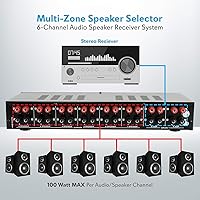
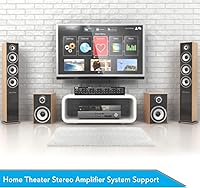
The Pyle PSLSW6 6-Channel Speaker Selector is a natural fit for homeowners who want music playing in several rooms simultaneously without investing in a multi-zone amplifier or separate receivers for each space. If you have a solid stereo receiver in the living room and want to extend audio to the kitchen, home office, patio, and a couple of bedrooms, this multi-zone controller handles that distribution cleanly without complex configuration. It also works well for small commercial environments — a boutique, café, or yoga studio where background audio needs to reach a few distinct areas from a single source. AV hobbyists stepping up from a basic two-speaker A/B switch will find the jump to six independent zones genuinely useful, especially with the per-zone volume control that allows one room to stay quiet while another plays at normal listening levels. The key compatibility requirement is straightforward: as long as your speakers are 8-ohm units and your receiver has enough output headroom to drive multiple pairs, this speaker selector integrates into an existing setup with minimal friction.
Not suitable for:

The Pyle PSLSW6 6-Channel Speaker Selector is not the right tool for buyers running 4-ohm speakers, and this is not a minor caveat — connecting mismatched speakers can push your receiver into thermal protection or cause long-term damage, and this unit has no impedance-matching circuitry to buffer that risk. Audiophiles expecting high-fidelity critical listening across all six zones will likely be disappointed; the passive design introduces measurable signal loss when multiple zones are active, and the audio quality ceiling is modest compared to active distribution systems. Anyone needing smart home integration, app-based zone control, or remote switching will find this multi-zone controller entirely manual in its operation — there are no digital controls, no presets, and no automation compatibility whatsoever. Buyers who run high-powered receivers at loud volumes across many zones simultaneously should also be cautious, as sustained heavy loads have triggered reliability issues in a visible share of long-term user reports. If your receiver is already on the lower end of power output, loading it with four or more speaker pairs through this switcher is a real recipe for frustration.
Specifications

  • Brand: Manufactured by Pyle, a US-based consumer electronics brand known for budget-to-mid-range audio accessories.
  • Model: The exact model designation is PSLSW6, sometimes listed by retailers with the FBA-PSLSW6 identifier.
  • Dimensions: The unit measures 6.3″ deep, 16.93″ wide, and 3″ tall, designed to sit flat on a shelf or AV cabinet surface.
  • Weight: The assembled unit weighs 9.78 pounds, which is notably heavier than its slim profile suggests.
  • Speaker Outputs: Supports up to six independent stereo speaker pair outputs, allowing up to twelve individual speaker drivers to be connected simultaneously.
  • Max Power: Rated at 100 watts maximum per channel, intended for standard home audio power levels rather than professional or high-wattage amplification.
  • Impedance Rating: Compatible exclusively with 8-ohm impedance speakers; no internal impedance-matching circuitry is included to handle lower-impedance loads.
  • Input Connections: Features two stereo inputs labeled A and B, allowing users to connect two separate audio sources such as a receiver and a secondary device.
  • Connector Type: All speaker connections use screw-type binding terminals, which accept bare wire, pins, or spade connectors up to 14-gauge in thickness.
  • Wire Gauge Support: Screw terminals accommodate speaker wire from standard 18-gauge up to a maximum of 14-gauge for lower-resistance long runs.
  • Front Panel Controls: The front face includes six rotary volume knobs, six push-button zone selectors, and a single master speaker on/off switch.
  • Overload Protection: Built-in overload protection circuitry is designed to interrupt signal flow if an electrical fault or short circuit is detected at the speaker terminals.
  • Form Factor: Slim tabletop chassis with a horizontal layout, finished in matte black, suitable for open-shelf or cabinet placement in home AV setups.
  • Color: Available in a single color option — black — with a neutral finish that blends into most media furniture and equipment rack environments.
  • Availability Date: This product was first made available for purchase in December 2018 and has remained in active production since then.
  • Compatibility: Designed to work with standard home theater receivers and stereo amplifiers that output a left and right channel signal via speaker-level connections.
  • No Amplification: This is a fully passive device with no internal amplification, meaning it distributes the receiver signal without boosting or processing it in any way.
  • Zone Memory: The unit has no digital memory or preset storage; zone selections and volume positions must be manually adjusted after each power cycle or configuration change.

Related Reviews

Pyle PLSHVC612 6-Channel Stereo Speaker Selector
88%
88%
Value for Money
91%
Build Quality & Durability
94%
Installation & Setup
85%
Volume Control Precision
90%
Compatibility with Home Theater Systems
More
Pyle PLSHVC412 4-Channel Stereo Speaker Selector
84%
94%
Ease of Installation
88%
Volume Control Precision
85%
Compatibility with Audio Systems
89%
Build Quality
83%
Power Handling
More
Pyle PDIC68FG 6.5” Ceiling Speaker Set
86%
86%
Sound Quality
92%
Ease of Installation
68%
Bass Response
88%
Build Quality
90%
Compatibility with Ceiling/Wall
More
Pyle PLMRX68LEW 6.5-inch Marine Speakers
65%
54%
Sound Quality
82%
LED Lighting
67%
Waterproofing
79%
Installation Ease
51%
Remote Control
More
Pyle PLMRF65SB 6.5-inch Marine Speakers
67%
78%
Waterproof & Weather Resistance
63%
Sound Quality
74%
Build Quality & Durability
51%
Wireless RF Performance
86%
Installation & Fitment
More
Pyle PLMRA630BT 6-Channel Bluetooth Marine Amplifier
83%
88%
Build Quality and Durability
90%
Bluetooth Connectivity
85%
Power Output
91%
Ease of Setup
83%
Sound Performance
More
Pyle Pro PAHT6 6-Way DJ Speaker System
73%
83%
Value for Money
74%
Sound Clarity
78%
Build Quality
71%
High-Frequency Performance
88%
Ease of Setup
More
Pyle Lanzar AQ6CXS 6.5-inch Marine Speakers
73%
88%
Value for Money
91%
Ease of Installation
72%
Water Resistance
74%
Sound Quality
51%
Bass Response
More
Pyle PREA90WBT 6-Channel Bluetooth Hybrid Home Amplifier
84%
88%
Performance & Power Output
85%
Ease of Setup & Installation
90%
Bluetooth Connectivity
84%
Input Flexibility
87%
Sound Quality & Clarity
More
Pyle PDMR6 6.5″ Car Audio Midrange Speaker
84%
86%
Sound Quality
90%
Installation Ease
88%
Value for Money
89%
Midrange Clarity
83%
Build Quality
More

FAQ

Unfortunately, no — this multi-zone controller is rated specifically for 8-ohm speakers and has no impedance-matching circuitry built in. Connecting 4-ohm speakers, especially across multiple zones simultaneously, will drop the total load seen by your receiver to potentially unsafe levels. That can trigger your receiver's protection mode or cause long-term damage to its output stage. Stick to 8-ohm speakers for safe, reliable operation.

Technically yes, but there is a practical limit. Running all six zones at once puts a significant combined load on your receiver, and unless your amp is rated to handle that kind of demand, you will likely hear volume degradation and possibly trigger the receiver's thermal protection. Most users find that running two to four zones simultaneously keeps everything sounding clean and stable.

It is entirely passive — no amplification happens inside the box at all. The Pyle PSLSW6 6-Channel Speaker Selector simply routes and distributes the signal your receiver is already producing. That means your receiver's output power is shared across however many zones you activate, which is why running too many zones at once can thin out the sound.
Most users find it straightforward. You connect the left and right speaker outputs from your receiver to the input terminals on the back, then run individual wire pairs from each output terminal to each speaker zone. The screw terminals are clearly labeled, and you do not need any special tools beyond a small flathead screwdriver. The trickiest part for some people is managing the wiring neatly when all six zones are connected at once.

Yes, the unit has two stereo inputs — A and B — which let you connect two separate sources, such as a main receiver and a secondary amplifier or media player. You can then route input A to some zones and input B to others, though you cannot blend the two signals together into a single mixed output.

The rotary knobs are passive attenuators, meaning they reduce the signal going to each zone rather than actively controlling your receiver's volume. Think of them as individual zone trimmers. This is useful for balancing loudness between rooms, but they are not a substitute for your receiver's main volume control, and turning them down fully will cut that zone to silence.

The screw terminals support wire up to 14-gauge, which is a solid choice for longer cable runs where you want to minimize resistance. For shorter runs of under twenty feet, standard 16-gauge wire works perfectly fine. Avoid going thicker than 14-gauge as the terminals will not seat the wire securely.

None at all — this is a fully manual, analog device. There is no remote control, no IR receiver, no Bluetooth, and no compatibility with smart home platforms like Alexa, Google Home, or Control4. Every zone activation and volume adjustment requires physical interaction with the front panel.

Some long-term users have reported intermittent channel dropout or knob-related static appearing after roughly one to two years of regular use. It is not universal, but it is a frequent enough pattern in user reviews to be worth noting. Keeping the unit in a well-ventilated spot and not consistently pushing it close to its power limits appears to help longevity based on owner feedback.

There will be a small measurable signal loss simply because this is a passive device adding resistance in the signal path. In practice, most people do not notice the difference when running one or two zones at moderate volume. The more zones you activate simultaneously, the more noticeable the effect becomes, particularly on receivers without generous headroom.

Where to Buy