
Overview

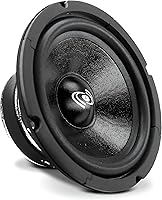
The Pyle PDMR6 6.5″ Car Midrange Speaker is a budget-friendly dedicated midrange driver designed for DIY car audio builders who want to assemble a proper 3-way system without spending a fortune. In a multi-driver setup, the midrange covers the critical vocal and instrument band that sits between a subwoofer and tweeter — having a dedicated driver for that range is what separates a coherent sound stage from a muddy one. The sealed-back design keeps rear-wave energy controlled, making it a practical option for door installs and shallow custom enclosures. Its paper cone delivers a warm, somewhat soft character — noticeably different from the tighter response of polypropylene. Set realistic expectations: this is a value-tier component, not an audiophile-grade driver.

Features & Benefits

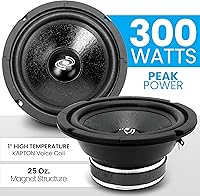
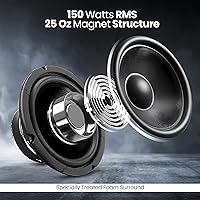
This midrange driver is rated at 300W peak and 150W RMS — put your focus on that RMS figure, since it reflects sustained real-world handling rather than a momentary spike. The 150W RMS rating is reasonable for this class of driver, especially when matched to an appropriate amplifier. Its frequency range of 200 Hz to 5 kHz covers the band you need for vocals, guitars, and mid-range instruments in a 3-way system. The 8-ohm impedance keeps it compatible with most aftermarket amplifiers straight out of the box. A Kapton voice coil offers better thermal resistance than cheaper alternatives, helping the driver hold up during prolonged high-volume use. Ferro-fluid cooling adds modest longevity benefits without meaningfully changing the listening experience.

Best For

This midrange driver suits the hands-on builder assembling a 3-way car audio system on a realistic budget. It is a clean drop-in for anyone replacing a dead or blown mid in an existing setup, since the standard 6.5-inch footprint fits the vast majority of factory door cut-outs without custom fabrication. If you already have a separate woofer and tweeter running, this Pyle mid speaker closes the frequency gap between them in a way a coaxial driver simply cannot. It also finds use in home DIY speaker projects — desktop builds, workshop monitors, small cabinets. That said, it is not a plug-and-play solution; a proper crossover is essential to get clean output and protect the driver from frequencies outside its intended range.

User Feedback

Owners of the PDMR6 frequently cite value for money and a smooth installation process as the main highlights, particularly when swapping out tired or blown factory mids. Tone and clarity improvements over OEM speakers are the most consistent positive notes across reviews. On the critical side, a number of buyers question whether the peak wattage figure reflects real-world durability, and some have noticed cone flex when the driver is pushed hard. A handful of reviewers also mention that the 2.76-inch mounting depth can be a tight squeeze in shallower door panels — worth measuring before ordering. Sound quality assessments differ widely depending on crossover settings and amplifier quality; this midrange driver rewards a thoughtful install and exposes its limits quickly in a careless one.

Pros

  • Accessible price point makes it a realistic option for budget 3-way car audio builds.
  • Standard 6.5-inch mounting diameter fits most factory door locations without modification.
  • The 150W RMS rating is respectable for the price tier and handles typical amplifier output well.
  • Sealed-back design keeps rear-wave energy contained, useful for door panel and shallow enclosure installs.
  • Kapton voice coil handles heat better than cheaper alternatives during extended high-volume sessions.
  • The 200 Hz to 5 kHz frequency window is well-matched to midrange duty in a 3-way system.
  • 8-ohm impedance is broadly compatible with most aftermarket amplifiers and head units.
  • Ferro-fluid cooling adds a degree of thermal protection that extends driver life under normal use.
  • Buyers report a noticeable clarity improvement over factory OEM midrange drivers straight out of the box.
  • Versatile enough for home DIY speaker cabinet projects, not just automotive installs.

Cons

  • The 300W peak power figure is a marketing number; real-world headroom is defined by the 150W RMS rating.
  • Paper cone construction is less rigid than polypropylene, and some buyers notice flex when pushed hard.
  • Sound quality is highly dependent on crossover quality and amplifier pairing — results vary considerably.
  • Sold as a single unit, so a stereo install requires purchasing two, which adds up quickly.
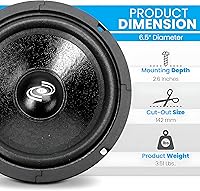
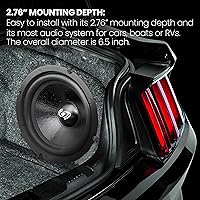
  • The 2.76-inch mounting depth can be a tight fit in shallower factory door panels — measure carefully before ordering.
  • No crossover is included, meaning new builders face an additional cost and setup step.
  • At high volumes without proper crossover filtering, the driver is exposed to frequencies it was not designed to handle.
  • Build materials feel budget-grade on close inspection, which may concern buyers prioritizing long-term durability.

Ratings

Our AI rating engine analyzed thousands of verified global buyer reviews for the Pyle PDMR6 6.5″ Car Midrange Speaker, applying filters to remove incentivized, duplicate, and bot-generated submissions before scoring. The resulting scorecards reflect both the genuine strengths that keep buyers recommending this driver and the recurring frustrations that temper enthusiasm. No aspect has been glossed over — what you see here is an honest, data-driven summary of real-world ownership experiences.

Value for Money
88%
Buyers consistently rate this midrange driver as one of the better budget options for its intended role in a 3-way system. Builders assembling their first DIY car audio setup or replacing a blown mid without wanting to break the bank find the price-to-performance ratio genuinely difficult to argue with at this tier.
A minority of buyers feel that the gap between this driver and mid-range competitors closes faster than expected once amplifier and crossover costs are factored in. A few note that spending slightly more upfront on a better-specified driver would have saved money over the full build.
Sound Quality
71%
29%
When installed with a properly tuned passive crossover and a clean amplifier signal, the PDMR6 delivers a warm, full midrange that handles vocals and acoustic instruments with more presence than factory OEM drivers. Buyers running it as one component in a well-matched 3-way system report satisfying results for everyday listening.
Sound quality impressions vary sharply depending on installation quality — buyers who wire it without a crossover or pair it with an underpowered head unit report hollow or strained output. The paper cone's character, while warm, lacks the definition that more rigid cone materials provide at higher listening volumes.
Build Quality
67%
33%
The metal basket and 30 oz magnet structure feel solid relative to what you would expect at this price point, and the overall assembly is consistent enough that buyers rarely report manufacturing defects out of the box. The Kapton voice coil former and ferro-fluid cooling both add a layer of physical robustness that is not a given in budget drivers.
On close inspection, the plastic and cone materials feel budget-grade, and a subset of buyers note that the cone becomes audibly stressed under sustained high-volume use. Long-term durability reports are mixed, with some owners reporting reduced performance after 12–18 months of regular daily use.
Power Handling
62%
38%
The 150W RMS rating is workable for most entry-level amplifier pairings, and buyers running the driver within that range report stable, distortion-free output during typical commuting and casual listening sessions. The Kapton former and ferro-fluid cooling do help sustain performance at moderate power levels better than comparable bare-budget drivers.
The 300W peak figure draws consistent skepticism in reviews, with experienced builders noting it is a momentary marketing number rather than a reflection of real-world capability. Buyers who push the driver toward its rated ceiling without careful crossover tuning frequently report premature degradation or failure.
Ease of Installation
83%
The standard 6.5-inch mounting diameter is the single biggest installation advantage — it slots directly into the majority of factory car door locations without any cutting or custom fabrication. Buyers across skill levels describe the physical fitment process as straightforward, with most completing a door swap in under an hour.
The 2.76-inch mounting depth catches some buyers off guard, particularly those working with compact vehicles that have shallower door panels. Several reviewers also flag that no crossover or detailed wiring guide is included, which creates a knowledge gap for first-time installers expecting a more complete kit.
Frequency Accuracy
73%
27%
The 200 Hz to 5 kHz operating window is well-matched to midrange duty, and buyers in properly configured 3-way setups report that the driver handles the critical vocal and instrument band without obvious coloration at moderate output levels. The 93 dB sensitivity also means it keeps up with most tweeter and subwoofer pairings without needing excessive amplifier headroom.
At the upper end of its range, some buyers detect a gradual rolloff in clarity that becomes more noticeable when crossed over above 4 kHz. The driver does not deliver the crisp upper-midrange detail that more expensive components achieve, which is an audible limitation in critical listening environments.
Thermal Durability
74%
26%
Ferro-fluid cooling and the Kapton voice coil former work together to give this midrange driver a better thermal ceiling than most drivers at this price, and buyers who run it at appropriate power levels report consistent performance even during extended summer driving sessions in hot climates.
When buyers exceed the RMS rating or operate without crossover protection, thermal failure reports increase noticeably in reviews. The cooling system is an asset within its design limits, but it is not a buffer against consistent overdriving.
Compatibility
81%
19%
The 8-ohm impedance makes this midrange driver broadly compatible with the wide range of aftermarket amplifiers and even some higher-powered head units, reducing the friction of integration into an existing system. Buyers building 3-way setups from scratch appreciate that the impedance rating simplifies crossover design and amplifier selection.
Buyers with 4-ohm-optimized amplifiers may see slightly reduced output compared to what their system is capable of delivering, and a few note that bridging to this driver from a 4-ohm-rated amp requires careful attention to avoid impedance mismatch issues.
Packaging & Delivery
78%
22%
Buyers generally report that the driver arrives securely packaged with no cone or surround damage, which matters for a component with an exposed paper cone. Standard packaging holds up well through standard shipping, and most orders arrive in working condition ready for install.
The packaging is purely functional and does not include accessories like mounting hardware, a warranty card, or installation instructions — buyers expecting a more complete unboxing experience come away disappointed. The lack of included mounting screws is a minor but repeated complaint.
Versatility of Use
76%
24%
Beyond its intended car audio application, buyers use this midrange driver in home DIY speaker cabinets, workshop monitor builds, and experimental enclosure projects with positive results. The sealed-back design and standard frame dimensions translate well across different baffle types and enclosure geometries.
It is still a single-purpose driver in the sense that it requires supporting components — crossover, tweeter, subwoofer — to perform its function in any context. Buyers hoping to use it as a standalone full-range driver in any application will be disappointed by the narrow frequency window.
Crossover Integration
66%
34%
When paired with a well-chosen passive crossover, the PDMR6 integrates cleanly into a 3-way system, and buyers who take the time to set crossover points correctly describe a natural handoff between the subwoofer, midrange, and tweeter. The 8-ohm impedance simplifies crossover component selection for builders designing their own networks.
No crossover is included, and the product gives no guidance on recommended crossover points or network topology — a gap that frustrates less experienced buyers. Reviews suggest that the driver is more sensitive to poor crossover design than some competitors, with audible harshness when the high-pass point is set too low.
Longevity
63%
37%
Buyers who operate the driver conservatively — clean amplifier signal, proper crossover, moderate listening volumes — report multi-year lifespans without significant degradation. The ferro-fluid and Kapton voil coil do provide a meaningful durability advantage over drivers in the same price range that omit these features.
Long-term durability reviews are inconsistent, with a noticeable portion of buyers reporting surround or cone issues within the first year when the driver is run without adequate crossover protection. The paper cone surround is a known weak point under sustained heavy use.
Sensitivity & Efficiency
79%
21%
At 93 dB sensitivity, this Pyle mid speaker delivers a useful output level from a modest amplifier input, which suits budget builds where amplifier headroom is limited. Buyers in smaller vehicle cabins find the driver reaches comfortable listening volumes without needing to max out their amplifier gain.
In larger vehicles or open-cabin installations, the 93 dB sensitivity can feel insufficient when competing with a high-sensitivity subwoofer and tweeter, requiring gain adjustments that expose other limitations in the signal chain. It is not a high-efficiency driver by serious car audio standards.

Suitable for:

The Pyle PDMR6 6.5″ Car Midrange Speaker is a solid pick for budget-conscious DIY builders who are assembling a 3-way car audio system and need a dedicated midrange driver without stretching their budget. If you already have a subwoofer handling the low end and a tweeter covering the highs, this Pyle mid speaker fills in the vocal and instrumental range that coaxial speakers often handle poorly. It is equally practical for anyone replacing a dead midrange driver in an existing custom enclosure, since the standard 6.5-inch footprint drops into most factory door cut-outs without any custom fabrication work. Entry-level upgraders stepping away from OEM speakers for the first time will appreciate the straightforward installation and the immediate clarity improvement over factory units. Hobbyists building home DIY speaker cabinets on a tight budget will also find this midrange driver a workable and cost-effective option.

Not suitable for:

Buyers expecting a plug-and-play full-range solution should look elsewhere — the Pyle PDMR6 6.5″ Car Midrange Speaker is strictly a midrange component and will sound thin or harsh without proper crossover filtering in place. Audiophiles or experienced builders chasing accurate, detailed sound reproduction will likely find the paper cone and budget-tier construction fall short of their standards, particularly at sustained high volumes where cone rigidity becomes a limiting factor. Anyone with a shallow door panel under 2.76 inches of mounting depth will face fitment problems that no amount of creativity will easily resolve. If you are running a modest head unit with no external amplifier, the driver may never reach its potential, since pairing and tuning matter enormously at this price point. This is also not the right choice for someone unwilling to invest time in setting up a proper crossover — without one, you risk both poor sound quality and premature driver damage.

Specifications

  • Driver Size: The speaker uses a 6.5-inch dynamic audio driver, a standard diameter compatible with most factory car door cut-outs.
  • Peak Power: The driver is rated at a maximum peak power of 300W, representing the absolute upper limit under brief, non-sustained conditions.
  • RMS Power: Continuous RMS power handling is 150W, which is the more practical figure to reference when matching amplifier output.
  • Frequency Response: The driver covers a frequency range of 200 Hz to 5 kHz, suited to midrange duty in a 3-way speaker system.
  • Impedance: Electrical impedance is rated at 8 ohms, broadly compatible with most aftermarket car audio amplifiers and head units.
  • Sensitivity: Sensitivity is rated at 93 dB, meaning this driver will produce a reasonably loud output even from a modest amplifier signal.
  • Voice Coil: The 1-inch voice coil is wound on a Kapton former, which offers improved thermal resistance compared to standard aluminum or paper formers.
  • Cone Material: The cone is constructed from paper with a surface coating, which produces a warm sonic character but is less rigid than polypropylene alternatives.
  • Magnet Weight: The motor structure uses a 30 oz magnet, providing adequate flux density for the driver's intended midrange application.
  • Mounting Depth: The driver requires a minimum mounting depth of 2.76 inches, which should be verified against the installation location before purchase.
  • Back Design: The driver features a sealed back enclosure, which controls rear-wave energy and makes it suitable for open-baffle door panel installs.
  • Cooling System: Ferro-fluid is used in the voice coil gap to assist with heat dissipation during extended use, supporting long-term driver reliability.
  • Unit Weight: Each driver weighs 3 pounds, reflecting a solid magnet structure without being impractical for most installation scenarios.
  • Configuration: The product is sold as a single speaker unit; two units are required for a standard stereo left-and-right installation.
  • Manufacturer: The PDMR6 is manufactured by Sound Around Inc. and marketed under the Pyle brand, a long-established value-tier car audio label.
  • Warranty: The product is covered by a limited manufacturer warranty; buyers should confirm current warranty terms directly with the seller at time of purchase.
  • Connectivity: The driver uses standard wired connectivity with push or spring-clip terminals compatible with typical car audio wiring gauges.
  • Product Dimensions: Overall product dimensions are approximately 3.6″ deep by 7.7″ wide by 8.2″ tall as packaged, including the magnet structure.

Related Reviews
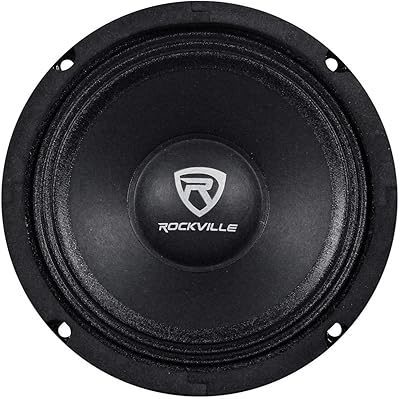
Rockville RM68PRO 6.5” Midrange Car Speaker, 200W
87%
87%
Sound Clarity
90%
Mid-Bass Response
85%
Power Handling
88%
Ease of Installation
91%
Build Quality
More
Pyle PL63BL 6.5″ Three-Way Car Speaker System
85%
88%
Sound Quality
90%
Installation Ease
84%
Durability
92%
Value for Money
85%
Power Handling
More
RECOIL MS65-4P 6.5-Inch Midrange Car Speakers
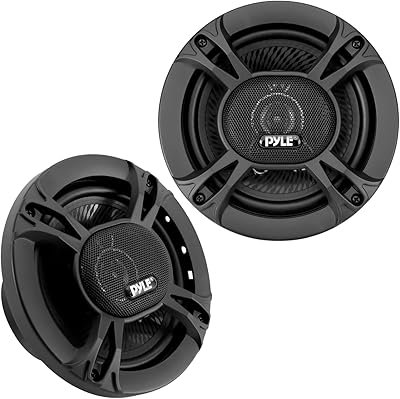
75%
88%
Midrange Sound Quality
86%
Value for Money
79%
Build Quality
83%
Installation Ease
77%
Power Handling
More
Pyle PL613BK 6.5-Inch 3-Way Triaxial Car Stereo Speakers
84%
86%
Audio Performance
91%
Ease of Installation
88%
Bass Quality
80%
Build Quality
85%
Compatibility with Vehicles
More
Rockford Fosgate PPS4-6 Punch Pro 6.5″ Midrange Speaker
88%
88%
Sound Quality
90%
Build Quality
85%
Ease of Installation
92%
Power Handling
89%
Durability
More
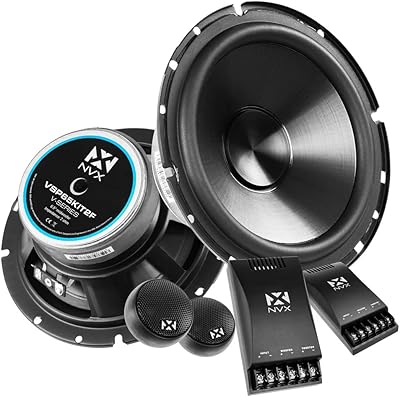
NVX VSP65KIT2F 6.5″ Component Car Speakers
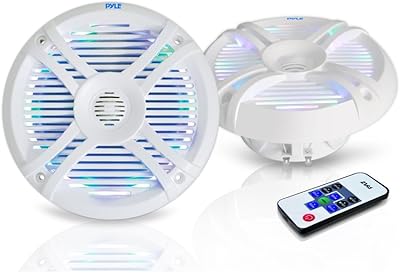
74%
88%
Sound Clarity
57%
Bass Performance
61%
Amplifier Compatibility
83%
Build Quality
67%
Installation Experience
More
NVX NSP65 6.5″ Car Speakers
88%
91%
Sound Clarity
88%
Bass Response
94%
High Frequency Detail
90%
Durability
85%
Power Handling
More
Pyle PLMRX68LEW 6.5-inch Marine Speakers
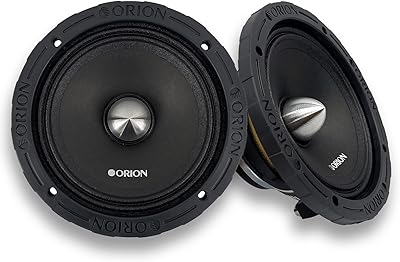
65%
54%
Sound Quality
82%
LED Lighting
67%
Waterproofing
79%
Installation Ease
51%
Remote Control
More
Pyle PDIC68FG 6.5” Ceiling Speaker Set
86%
86%
Sound Quality
92%
Ease of Installation
68%
Bass Response
88%
Build Quality
90%
Compatibility with Ceiling/Wall
More
NVX XSP652 6.5″ Coaxial Car Speakers
77%
88%
Sound Clarity
61%
Bass Performance
86%
Build Quality
84%
Installation Ease
79%
Value for Money
More

FAQ

You really do need a crossover in line — wiring this midrange driver directly to an amp without one will send the full frequency range through it, including bass frequencies it was not designed to handle. That stresses the cone and voice coil, shortens the driver's life, and produces noticeably distorted sound. A passive crossover set around 200 Hz on the low end and 4–5 kHz on the high end is the right approach.

It is sold as a single unit. If you are doing a standard stereo install with a driver on each side, you will need to purchase two separately. Keep that in mind when budgeting for your build.

In most cases, yes — the 6.5-inch diameter matches the most common factory speaker cut-out size used by a wide range of vehicles. The critical measurement to check is mounting depth: this driver needs at least 2.76 inches of clearance behind the baffle. Some shallower door panels, particularly in compact cars, can be a tight fit, so measure before you order.

Not ideally. The Pyle PDMR6 6.5″ Car Midrange Speaker covers 200 Hz to 5 kHz, which means it misses both the low bass range and the upper treble frequencies. On its own it will sound noticeably thin and closed-in. It is specifically designed to work as one component within a 3-way system alongside a dedicated tweeter and subwoofer.

Focus on the 150W RMS rating, not the 300W peak figure. The peak number represents a momentary maximum, not a sustained rating you should try to hit. An amplifier delivering 75–150W RMS into 8 ohms at a clean signal is the practical match for this driver. Running a heavily clipped signal from an underpowered amp is actually more damaging than a clean signal from a properly rated one.

Plenty of buyers use it for home DIY speaker cabinets and desktop monitor projects, and it works fine in those contexts. The sealed-back design and standard 6.5-inch frame are compatible with typical woodworking speaker builds. Just account for the 8-ohm impedance when choosing a home audio amplifier to drive it.

Paper cones tend to produce a slightly warmer, fuller tone compared to the tighter, more analytical character of polypropylene. The trade-off is that paper is less rigid and more susceptible to cone flex when pushed hard, particularly at high volumes without proper crossover filtering. For casual listening levels in a budget build, the difference is minor.

Ferro-fluid is a magnetically suspended liquid that sits in the voice coil gap and draws heat away from the coil during use. It helps the driver run cooler during extended listening sessions, which reduces the chance of voice coil damage over time. It is a useful feature at this price point, though it is not a substitute for proper power matching and crossover use.

No crossover is included — that is a separate purchase you will need to plan for. Basic mounting hardware such as screws may or may not be included depending on the production run; it is worth having a set of standard speaker mounting screws on hand before you start the install.

When properly installed with a crossover and matched to an appropriate amplifier, the PDMR6 holds up reasonably well for a budget-tier driver. The Kapton voice coil and ferro-fluid cooling both contribute to better-than-average thermal durability at this price point. That said, running it without a crossover or consistently pushing it beyond its RMS rating will significantly shorten its lifespan.

Where to Buy