Overview

The Pyle PCM20A has been a quiet workhorse in the budget PA space since it first appeared in 2009 — a run that few entry-level amplifiers can match. Made by Sound Around, this mini PA amplifier sits at an interesting crossroads: it offers genuinely commercial features like a 70V distributed output and dual microphone inputs, yet its price and compact footprint keep it accessible to buyers who have no interest in filling a rack with gear. That longevity is worth noting. A product that keeps selling for over a decade either gets things right or fills a niche nobody else bothers with. Here, it is clearly the former.

Features & Benefits

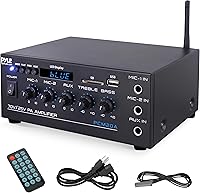
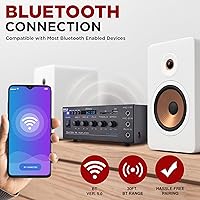
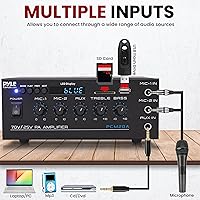
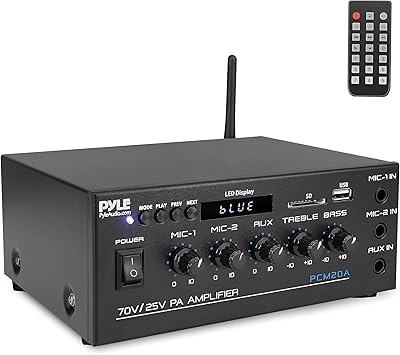
The PCM20A packs a surprising range of inputs into a box not much bigger than a hardback book. Bluetooth streaming handles casual wireless audio from a phone or tablet at up to 30 feet — workable for most small rooms, though not rock-solid. More practically useful is the USB and SD card playback, which lets you loop background music from a thumb drive without keeping a laptop running. The MIC 1 talkover priority is the standout feature: plug in a microphone and your voice automatically ducks the music, handy when a café needs to call out an order or a shop assistant wants to announce a flash sale.

Best For

This compact amp makes the most sense for buyers who need a functional PA solution without the complexity or cost of a full commercial system. Think small retail spaces, coffee shops, waiting rooms, or a community hall that just needs music and the occasional announcement. It also suits users who already have a 70V speaker network in place and need a budget-friendly head unit to drive it. Event organizers moving between small venues will appreciate the sub-5-pound weight and detachable power cable. It is not the right tool for demanding installations or audiophiles — but for practical everyday PA use, it checks the boxes that matter.

User Feedback

Across more than 200 ratings averaging 4.3 out of 5, buyers tend to agree on a few things. Setup is straightforward, and the value relative to cost comes up repeatedly as a selling point. The talkover function earns specific praise from hospitality and retail users who rely on it daily. On the other side, Bluetooth reliability draws occasional complaints — dropouts happen, and it is not something to depend on for critical audio. Build quality is another honest concern: the chassis feels lightweight, and a few long-term owners have flagged durability questions after extended use. For occasional or light-duty work, most buyers are happy. For heavy daily use, manage expectations.

Pros

  • 70V output connects directly to distributed ceiling speaker systems without requiring a separate transformer in most setups.
  • Automatic mic talkover on MIC 1 cuts background music the moment you speak — no manual fader adjustments needed.
  • USB and SD card playback lets you run a music loop all day from a thumb drive with zero ongoing effort.
  • Setup is genuinely straightforward; most buyers report being up and running within 30 minutes, even without prior PA experience.
  • At under 5 pounds with a detachable power cable, this compact amp travels easily between locations without dedicated equipment cases.
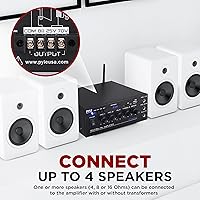
  • Compatible with 4–16 ohm speaker loads with or without transformers, giving real flexibility across different wiring configurations.
  • A 15-plus year market presence means accumulated user knowledge, community troubleshooting resources, and proven baseline reliability for light-duty use.
  • Consolidates Bluetooth, dual mic inputs, aux, USB, and SD card into one unit — removing the need for a separate mixer in simple setups.

Cons

  • Bluetooth drops out noticeably in environments with wireless interference, making it unreliable for critical or uninterrupted audio needs.
  • The chassis feels lightweight and plasticky; control knobs and rear panel connectors show wear faster than the price saving justifies for heavy daily use.
  • No XLR mic inputs limits compatibility with professional-grade dynamic and condenser microphones that use standard balanced connectors.
  • Mic preamp noise becomes audible when gain is pushed to cover larger spaces or when using sensitive condenser microphones.
  • The talkover sensitivity threshold is fixed and cannot be adjusted, causing inconsistent triggering in noisier operating environments.
  • USB and SD playback navigation is basic and cumbersome with large music libraries — no track name display and limited format support beyond MP3.
  • The included documentation is thin and leaves first-time PA users without enough guidance for non-standard wiring or troubleshooting scenarios.
  • No RCA inputs means older audio sources require an adapter, which is an avoidable friction point that rivals at this price tier sometimes solve.
  • Long-term durability concerns appear often enough in older reviews that buyers planning multi-year daily commercial use should factor in potential replacement costs.

Ratings

The Pyle PCM20A has been scored by our AI system after analyzing verified buyer reviews from multiple global sources, with spam, bot-generated, and incentivized feedback actively filtered out. The result is a transparent breakdown of where this compact PA amplifier genuinely delivers and where it falls short — no softening of real pain points, no inflation of strengths.

Value for Money
88%
For small business owners who need a functional PA setup without a large upfront investment, the price-to-feature ratio here is hard to argue with. Buyers repeatedly note that getting 70V output, Bluetooth, dual mic inputs, and USB playback in a single unit at this price point would have cost significantly more a decade ago.
Buyers who push the unit hard in daily commercial environments sometimes feel the hardware does not quite match the financial savings over time. A few long-term owners suggest the total cost of ownership creeps up if reliability issues emerge after extended use.
Ease of Setup
91%
This is one of the most consistently praised aspects across the review pool. Users with no professional audio background report getting the unit running in under 30 minutes, including connecting to existing 70V speaker lines. The labeled rear panel and straightforward input layout make it accessible even for first-time PA buyers.
A small number of users found the manual thin on detail for edge-case wiring scenarios, particularly when mixing transformer and non-transformer speaker loads. Those without any prior PA experience occasionally needed to consult outside resources to complete their setup confidently.
Talkover / Mic Priority
86%
The automatic talkover on MIC 1 is the feature that earns the most specific praise in real-world contexts. Retail staff and hospitality workers describe using it to cut through background music for announcements without fumbling with volume controls — a café calling out an order or a boutique running a flash sale being common examples.
The talkover sensitivity is not adjustable on this unit, which frustrates users in louder environments where the threshold does not trigger as cleanly as expected. A handful of buyers in noisier spaces report the function behaving inconsistently, requiring mic placement adjustments to get reliable results.
Bluetooth Reliability
61%
39%
For casual background music streaming from a phone or tablet, Bluetooth works well enough in compact spaces. Users in small offices and waiting rooms report consistent enough performance when the source device stays within roughly 20 feet and line-of-sight is maintained.
Dropout complaints are frequent enough to take seriously. Several buyers note that Bluetooth becomes noticeably unstable in environments with wireless interference, or when the source device moves around — a real issue in active retail settings. This is not a unit to rely on for uninterrupted Bluetooth audio during critical events.
Build Quality
58%
42%
The PCM20A is compact and light enough to carry between locations without much effort, and the panel controls feel reasonably responsive for the price tier. Users who treat it gently and use it in fixed installations tend to report fewer complaints about the physical construction.
The chassis feels lightweight and plasticky compared to even modestly priced rack-mount commercial alternatives, and this comes up consistently in reviews. Buyers who have handled professional PA gear describe the unit as feeling fragile, and a subset of longer-term owners report wear on controls and connectors after sustained daily use.
Audio Output Quality
74%
26%
For background music in small venues — a shop floor, a waiting room, a small chapel — the 40-watt output is more than adequate and sounds clean at moderate volumes. Users driving 70V ceiling speaker arrays in small-to-medium rooms report satisfying coverage without audible distortion under normal conditions.
At higher output levels, some users detect a loss of clarity, particularly in the high frequencies. Audiophiles or users with discerning listening environments will find the sonic character underwhelming, though this unit is not aimed at that audience.
Input Versatility
83%
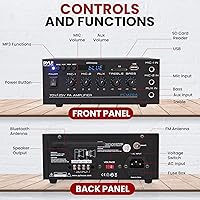
Having two quarter-inch mic inputs, a quarter-inch aux jack, USB-A, and an SD card slot in one unit removes a lot of the adapter juggling that plagues simpler amplifiers. Users who need to switch between a phone playlist, a laptop presentation audio, and a live microphone in the same session genuinely benefit from this flexibility.
There is no RCA input, which catches some buyers off guard when connecting older audio sources. The absence of a dedicated line-level input beyond the aux jack limits compatibility in more complex signal chains where balanced connections would be preferable.
USB and SD Playback
79%
21%
The ability to play MP3s directly from a thumb drive or SD card is a practical feature that small business owners appreciate. A coffee shop owner can load a playlist onto a USB stick, plug it in, and walk away — no phone, no streaming subscription, no connectivity worries.
Playback controls are basic, and there is no display showing track information beyond rudimentary LED feedback. Users with large music libraries find navigation cumbersome, and format compatibility beyond MP3 is limited, which occasionally catches buyers out.
70V Compatibility
87%
The 70V output is the technical centerpiece that makes this unit genuinely useful in distributed speaker installations. Schools, small offices, and retail chains with existing ceiling speaker wiring can connect this amp directly without sourcing a separate transformer, simplifying both installation and ongoing management.
Users new to 70V systems sometimes find the impedance matching requirements confusing, and the manual does not walk through the math in enough detail. Buyers coming from standard home audio setups occasionally miswire their speaker loads and then attribute poor performance to the unit rather than the setup.
Portability
82%
18%
At 4.5 pounds with a detachable power cable, this compact amp is genuinely easy to move between locations. Event coordinators who cover multiple small venues appreciate not needing a dedicated equipment case — it fits in a backpack alongside other gear without dominating the load.
The lightweight chassis that aids portability also contributes to the build quality concerns flagged elsewhere. Users who transport it frequently report that repeated handling accelerates wear on the rear panel connections, which is worth factoring in for high-mobility use cases.
LED Display Legibility
67%
33%
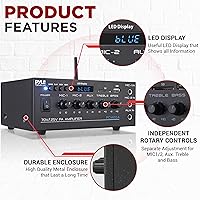
The LED display gives users a basic at-a-glance reference for input levels and active source selection, which is more useful than having no display at all. In dimly lit venues like bars or event spaces, the illuminated indicators are visible from a short distance.
The display is minimal and not particularly informative compared to units even slightly further up the price ladder. Users who want real-time level metering or clear source labeling find the feedback too sparse to be genuinely useful during active operation.
Long-Term Durability
54%
46%
The product has a 15-plus year market history, which suggests a baseline level of reliability for buyers using it in light-duty, fixed installations. Some owners report trouble-free operation over multiple years when the unit is installed in a stable environment and not subjected to frequent handling.
Durability concerns appear more frequently in older reviews than newer ones, which may reflect either product evolution or survivorship bias. Users running the unit in demanding daily commercial environments — full retail-hours usage, frequent source switching — report a shorter useful lifespan than the price point might imply.
Microphone Input Quality
71%
29%
For speech intelligibility in a small venue — announcements, basic presentations, or background narration — the mic inputs perform adequately. Users in house-of-worship and classroom settings report that voices come through clearly enough for their practical needs without noticeable hum or distortion at moderate gain settings.
The mic preamps are not quiet enough for sensitive condenser microphones, and users who push the gain to cover larger spaces report audible noise floor issues. This is a dynamic mic unit at its best; expecting studio-grade mic performance at this price is unrealistic.
Customer Support & Documentation
52%
48%
Pyle has a broad product catalog and a reasonable online presence, making it easier to find community-sourced setup tips and forum discussions for this specific model. The long market lifespan means there is accumulated user knowledge available outside official channels.
The included documentation is thin and the manufacturer support experience draws mixed feedback in reviews, with some buyers reporting slow or unhelpful responses when troubleshooting issues. For a product aimed at non-technical users, better documentation would meaningfully reduce post-purchase frustration.

Suitable for:

The Pyle PCM20A is a practical fit for small business owners, community organizers, and venue managers who need a no-fuss PA solution without the cost or complexity of a full commercial audio rack. A coffee shop that wants to play background music from a USB drive and occasionally cut in with a staff announcement over the speakers is exactly the kind of use case this unit was built for. It also makes sense for houses of worship, small classrooms, and community halls that already have 70V ceiling speaker systems installed and simply need an affordable, functional head unit to drive them. Event coordinators who move between small venues will appreciate the sub-5-pound weight and the self-contained input options — Bluetooth, aux, USB, and two mic inputs cover most real-world scenarios without needing an external mixer. Budget-conscious buyers stepping up from consumer-grade gear for the first time will find the learning curve manageable and the feature set genuinely useful for light-to-moderate duty work.

Not suitable for:

Buyers who need rock-solid reliability for daily high-intensity commercial use should think carefully before committing to this compact amp. The build quality — while acceptable for occasional or fixed light-duty installations — has drawn consistent criticism from users who subject it to frequent handling or full retail-hours operation, and long-term durability is a documented concern rather than speculation. Anyone planning to rely heavily on Bluetooth for uninterrupted audio, such as a DJ or an event host streaming a curated playlist throughout an important function, will likely find the occasional dropouts frustrating and unprofessional. The PCM20A is also not the right choice for users who need balanced XLR connections, studio-grade mic preamps, or high-fidelity output for discerning listening environments — the audio chain is functional, not refined. Finally, if your installation involves a large space, multiple speaker zones, or more than two simultaneous microphone inputs, this unit will hit its ceiling quickly and you will need to look further up the product ladder.

Specifications

  • Power Output: The amplifier delivers 40 watts of continuous power for driving small to medium distributed speaker installations.
  • Output Configuration: Equipped with a 70-volt public address output, compatible with standard distributed speaker systems used in commercial and institutional settings.
  • Speaker Impedance: Accepts speaker loads between 4 and 16 ohms, with or without line transformers, accommodating a range of speaker wiring setups.
  • Bluetooth Range: Bluetooth wireless streaming supports connections from phones and tablets at distances of 30 feet or more under typical conditions.
  • Mic Inputs: Two quarter-inch microphone inputs are included, with MIC 1 featuring an automatic talkover priority function that ducks background audio when the mic is active.
  • Aux Input: A single quarter-inch auxiliary input accepts line-level signals from external audio sources such as media players or laptops.
  • Media Playback: A USB-A port and SD/MMC card slot enable direct MP3 playback from thumb drives or memory cards without a connected playback device.
  • Display: An LED display provides at-a-glance monitoring of active input selection and basic level feedback during operation.
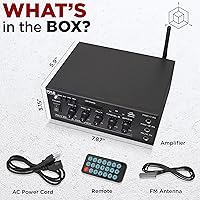
  • Dimensions: The unit measures 7.87″ x 3.15″ x 5.9″ per product specifications, with shipping box dimensions of 8.7″ x 5.1″ x 9.4″.
  • Weight: The amplifier weighs 4.5 pounds, making it practical for transport between locations without dedicated equipment cases.
  • Power Supply: Operates on standard AC mains power via a detachable power cable included with the unit.
  • Model Number: The official manufacturer model number is PCM20A, produced by Sound Around under the Pyle brand.
  • Market Availability: This model has been commercially available since October 2009, giving it one of the longer continuous production runs in its price category.
  • Certifications: Listed under the Electronics department on major retail platforms; specific regional safety certifications should be confirmed with the manufacturer prior to installation in regulated environments.
  • Manufacturer: Designed and sold by Sound Around, a US-based consumer and commercial audio brand operating primarily in the entry-level and mid-range segments.

Related Reviews
Pyle PCM20A.5 Compact Mini Home Power Amplifier
85%
86%
Sound Performance
91%
Portability
90%
Ease of Setup
83%
Build Quality
88%
Microphone Priority Feature
More
Pyle PLMR652W Marine Speakers
86%
88%
Sound Quality
91%
Ease of Installation
93%
Durability (Waterproof & Weather Resistance)
87%
Build Quality
75%
Performance at High Volumes
More
Pyle PDWR30B Outdoor Speakers
85%
88%
Sound Quality
94%
Weatherproof Durability
85%
Ease of Installation
78%
Design and Aesthetics
91%
Build Quality
More
Pyle PVTC320U Step Up and Down Converter
84%
87%
Value for Money
85%
Performance
90%
Ease of Use
65%
Portability
91%
Safety Features
More
Pyle PLMR91UB Marine Stereo
82%
89%
Waterproof Performance
76%
Bluetooth Connectivity
83%
Sound Quality
90%
Ease of Installation
85%
Durability in Marine Environments
More
Pyle PLMR82 Marine Speakers
84%
83%
Sound Quality
89%
Durability
90%
Ease of Installation
80%
Power Handling
87%
Build Quality
More
Pyle PLMRA200 Marine Amplifier
86%
94%
Waterproof Performance
88%
Ease of Installation
83%
Power Output
85%
Build Quality
90%
Size and Space Efficiency
More
Pyle PLMRMB2CW Marine Amplifier
86%
85%
Sound Quality
92%
Waterproof Durability
88%
Bluetooth Connectivity
80%
Power Output
87%
Installation Ease
More
Pyle PLMRS4W Marine Speakers
84%
80%
Sound Quality
90%
Build Quality
88%
Durability in Harsh Weather
85%
Installation Ease
65%
Bass Response
More
Pyle PLMR692 Marine Speakers
85%
88%
Sound Clarity
91%
Build Quality & Durability
94%
Waterproof Performance
85%
Installation Ease
73%
Bass Response
More

FAQ

It depends on how your ceiling speakers are wired. If they are standard 8-ohm speakers connected in a conventional low-impedance setup, you can connect them directly within the 4–16 ohm range. If they are wired as a 70V distributed system with line transformers already on each speaker, those transformers stay in place and the amp drives the line at 70 volts. Either configuration is supported, but you should not mix the two approaches without understanding your existing wiring first.

Honest answer: it is adequate for casual use but not something to depend on for uninterrupted all-day playback in a busy commercial environment. Short-range streaming from a stationary phone or tablet in a small room tends to work fine, but users report occasional dropouts, especially in spaces with a lot of wireless interference from other devices. If consistent, hands-off background music is the priority, the USB thumb drive or SD card playback option is more dependable for daily shop use.

It is fully automatic on MIC 1. The moment audio signal hits that input above a threshold level, the unit ducks the background music source so your voice comes through clearly. When you stop speaking, the music returns. There is no button to press mid-announcement, which is genuinely useful when your hands are occupied during a busy service period.

Standard dynamic microphones with a quarter-inch connector work well with this unit. If your mic has an XLR connector, you will need a simple XLR-to-quarter-inch adapter, which is inexpensive and widely available. Sensitive condenser microphones are less ideal — the mic preamps are not particularly quiet, and you may notice background noise if you push the gain up, especially with condenser mics that pick up everything.

For a small restaurant with standard commercial ceiling speakers on a 70V line, 40 watts is typically sufficient for comfortable background music levels across 6 to 10 speakers, depending on the wattage taps set on each speaker transformer. If you are trying to fill a large open dining room or compete with significant ambient noise, you may find yourself wanting more headroom. For a compact dining room or cafe, it generally handles the load without issue.

This compact amp is not designed for rack mounting — it does not have rack ears and its dimensions do not match standard 19-inch rack widths. It is intended as a freestanding desktop unit. If you need rack-mounted PA amplification, you would need to look at a different product class entirely.

MP3 is the confirmed supported format for both USB and SD card playback. Support for other formats such as WAV or FLAC is not officially specified and should not be assumed. For reliable, trouble-free playback, stick to standard MP3 files encoded at common bitrates.

This is one area where buyer experiences genuinely diverge. Users who install it in a fixed location and treat it gently tend to report reliable operation over several years. Those who use it in more demanding conditions — full business-hours operation every day, frequent source switching, or regular transport — are more likely to encounter wear on controls or connectors over time. The build quality is functional rather than robust, so the expected lifespan scales with how hard you push it.

Both quarter-inch mic inputs are simultaneously active, so two microphones can be used at once. The key distinction is that MIC 1 carries the automatic talkover priority function, so in most setups it makes sense to assign the primary announcement microphone to MIC 1 and use MIC 2 for secondary purposes.

There is no dedicated subwoofer output or preamp output on this unit, which limits its expandability within a larger audio chain. The output terminals are speaker-level, so integrating it with a separate power amp in a conventional way is not straightforward. If you anticipate needing to expand your system significantly, this compact amp is better treated as a self-contained solution for small spaces rather than a building block in a larger setup.