Overview

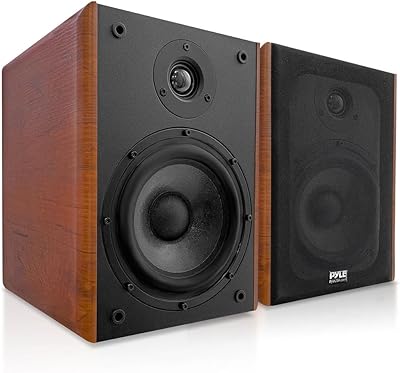
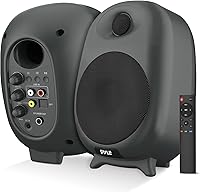
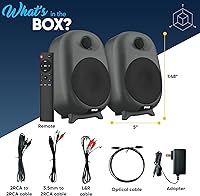
The Pyle PBKSR40 Bookshelf Speaker Set is a budget-conscious powered stereo system built for desktop listeners and small rooms who want more than what a laptop or monitor can offer. It uses an active-plus-passive configuration, meaning one speaker houses the amplifier and controls while the other is driven passively — so don’t expect individual volume knobs on both units. What makes these bookshelf speakers stand out at this price is the variety of connections on offer: Bluetooth, optical, RCA, and auxiliary all come standard. The set ships with an optical cable, an RCA adapter, a connecting wire, and a remote, so you’re not hunting for extras out of the box.

Features & Benefits

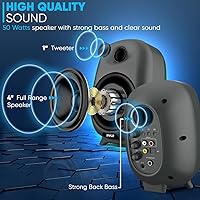
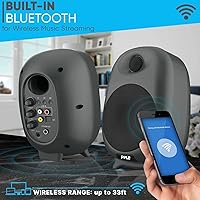
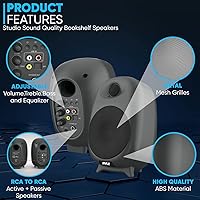
The advertised 60W is peak power, not continuous — keep that in mind when comparing specs on the shelf. That said, these bookshelf speakers deliver a reasonably full sound for their size, with 4-inch woofers handling the low-mids and 1-inch dome tweeters covering the high end across a 40Hz–20kHz range. Three audio modes let you tailor the sound profile slightly, and the bass and treble controls on the rear panel give you some hands-on tuning flexibility. Bluetooth works reliably within about 30 feet, making wireless streaming from a phone effortless. The optical input is a genuine bonus at this price, opening the door to TV and console hookups most competing sets skip entirely.

Best For

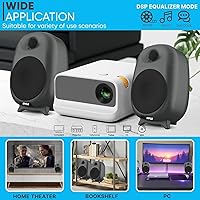
This Pyle speaker set punches above its weight for anyone upgrading from built-in laptop or monitor speakers. It suits home office setups particularly well — the compact 6.1 x 9-inch cabinet footprint fits comfortably on most desks without dominating the space. Students and renters will appreciate the all-in-one nature: one purchase covers Bluetooth, optical, and wired connections without needing a separate receiver. It also works well as a budget TV speaker solution if you have an optical output available. If you’re chasing precise audiophile imaging or deep sub-bass extension, look elsewhere — but casual listeners who want reliable, versatile sound will find plenty to like here.

User Feedback

With around 241 ratings and a 4.3-star average, the PBKSR40 set earns its score through consistent value delivery. Most buyers are pleasantly surprised by how much sound comes out of such compact cabinets, and the Bluetooth setup process gets frequent praise for being quick and intuitive. Where opinions diverge is bass performance — some listeners find it noticeably thin at moderate volumes, especially for bass-heavy music. Build quality is mostly solid, though a small number of buyers have flagged unit-to-unit variation in finish and assembly. The remote control works well for most people, with occasional complaints about range sensitivity when not pointed directly at the active speaker.

Pros

  • Exceptional input variety — Bluetooth, optical, RCA, aux, and USB — all on one affordable set.
  • Out-of-box accessories include an optical cable, RCA adapter, and remote, reducing extra purchases.
  • Bluetooth pairs quickly and holds a stable connection across most phones and laptops.
  • The optical input delivers noticeably cleaner TV audio compared to analog alternatives at this price.
  • Compact cabinet fits neatly on desks or shelves without dominating the space.
  • Rear-panel bass and treble controls let you compensate for room acoustics with minimal effort.
  • Three audio modes offer basic sound-profile variety without needing external software.
  • At this price point, the MDF cabinet construction feels more substantial than plastic-shell competitors.
  • Remote control adds real convenience for shelf-mounted setups where physical adjustment is awkward.
  • Strong value-to-feature ratio makes these bookshelf speakers hard to beat for casual everyday listening.

Cons

  • Bass performance is noticeably thin at moderate volumes without manual EQ compensation.
  • The 60W power rating is peak, not continuous — real-world loudness is more modest than it sounds on paper.
  • Build consistency is uneven; a minority of buyers have received units with cosmetic or assembly issues.
  • All controls sit on the rear of the active speaker, making real-time adjustments physically awkward.
  • Included cables are short, which can restrict speaker placement depending on your room layout.
  • Remote requires line-of-sight and has a shorter practical range than most users expect.
  • The differences between the three audio modes are subtle enough that many users struggle to notice them.
  • Replacement batteries for the remote are not included, a small but recurring complaint in user reviews.
  • Port noise becomes audible at higher volume levels, especially with bass-heavy content.
  • No subwoofer output means there is no straightforward upgrade path if you want more bass later.

Ratings

The Pyle PBKSR40 Bookshelf Speaker Set has been evaluated by our AI rating system after processing verified buyer reviews from global sources, with spam, bot activity, and incentivized feedback actively filtered out. The scores below reflect the honest consensus of real-world users across a range of listening environments and use cases. Both the standout strengths and the recurring frustrations are represented transparently so you can make an informed decision.

Value for Money
88%
For buyers who want more than bare-bones desktop audio without spending heavily, these bookshelf speakers consistently over-deliver. The inclusion of a remote, optical cable, and RCA adapter in the box means there are fewer hidden costs after purchase, which buyers repeatedly call out as a genuine plus.
At this price tier, expectations need to stay realistic. A handful of users felt the overall audio refinement lagged behind a couple of similarly priced competitors, suggesting the value proposition is strongest for casual listeners rather than anyone with a more critical ear.
Sound Quality
74%
26%
For a compact set in this price range, clarity in the midrange and high frequencies is surprisingly clean. Vocals and acoustic instruments reproduce with enough detail to make background music or podcast listening genuinely enjoyable during a long work session.
Bass extension is the weak link. Without bumping the bass control or using an external EQ, the low end feels thin, especially at lower volumes. Buyers who favor genres like hip-hop, EDM, or bass-heavy electronic music are the most likely to walk away disappointed.
Connectivity Options
91%
Few powered speakers at this price offer Bluetooth, optical, RCA, auxiliary, and USB inputs all at once. Users upgrading from a TV, connecting a turntable with an RCA output, or streaming wirelessly from a phone can do all three without swapping hardware, which is a practical everyday advantage.
Switching between inputs requires using the rear panel or remote, which some users found slightly clunky compared to front-facing controls. There is also no dedicated subwoofer output, which limits expansion options for those who might want to add bass later.
Bluetooth Performance
83%
Pairing is quick and stays stable across most Android and iOS devices according to a large portion of reviewers. The roughly 30-foot range holds up well in typical home office or bedroom scenarios without frequent dropout complaints.
A small but consistent group of users noted the Bluetooth connection occasionally drops when the source device goes to sleep or when multiple Bluetooth devices are nearby. Re-pairing is straightforward, but it can be disruptive mid-listening session.
Build Quality
67%
33%
The MDF cabinet with fabric grille gives these bookshelf speakers a more substantial feel than plastic-shell alternatives at the same price point. Most buyers describe the finish as clean and the grilles as tight-fitting when they arrive.
Unit-to-unit consistency is the real concern here. A noticeable minority of reviewers received sets with minor cosmetic blemishes, rattling grilles, or slightly misaligned drivers. It is not a widespread issue, but it is common enough to be worth mentioning before you order.
Remote Control
71%
29%
Having a remote at this price point is genuinely useful, particularly for users who mount the speakers on a shelf above or beside a monitor. Adjusting volume and switching audio modes from the couch or desk without getting up is a small convenience that adds up daily.
The remote requires fairly direct line-of-sight to the active speaker, and several users found the effective range shorter than expected in real-room conditions. The button feel is described as plasticky and cheap by a number of buyers, which does undercut the otherwise decent user experience.
Bass & Treble Controls
73%
27%
The rear-panel tone controls give listeners a meaningful way to compensate for room acoustics or personal preference. Users who took a few minutes to dial in the settings reported noticeably improved sound compared to leaving everything at default.
Because the controls sit on the back of the active speaker, adjusting them in real time while listening is awkward. They also lack a center-detent or visual indicator, so returning to a neutral starting point takes some trial and error.
Setup & Ease of Use
86%
The out-of-box experience is well thought out for a budget product. The included L&R connection wire links both speakers cleanly, and Bluetooth pairs on first attempt for the vast majority of users. Most buyers report being up and running in under ten minutes.
The active-passive setup confuses some first-time buyers who expect both speakers to have individual controls. The manual is brief and does not explain the configuration clearly enough, leading to a handful of support questions that a better-written guide would have prevented.
Audio Modes
66%
34%
Three selectable modes offer a basic way to shift the overall sound character without external software. Casual listeners appreciate having at least some built-in variety rather than a one-size-fits-all sound profile.
The differences between modes are subtle enough that several reviewers struggled to hear a meaningful distinction between them during back-to-back comparisons. For critical listeners, these modes feel more like a marketing checkbox than a functional feature.
Optical Input Quality
81%
19%
The optical input is what separates this set from many competing budget speakers. Users connecting to a TV via optical report a noticeably cleaner signal compared to the analog alternatives, with less background hiss during quiet passages.
The optical cable included in the box is functional but short, which creates placement constraints depending on where the TV and speakers sit relative to each other. A longer cable is a cheap fix, but it is an extra step buyers should anticipate.
Cabinet Acoustics
69%
31%
The bass reflex port design helps the 4-inch drivers produce more low-end body than a sealed cabinet of the same size would allow. In a small room or on a desk, this translates to a warmer, fuller sound than the driver size alone would suggest.
Port noise becomes audible at higher volumes, particularly with bass-heavy content. A few users described a subtle chuffing or resonance at louder listening levels, which is a known trade-off with ported designs in compact, value-tier enclosures.
Design & Aesthetics
77%
23%
The black fabric-grille finish looks tidy on a desk or shelf and blends well with most home office or entertainment setups. The rectangular form factor is unobtrusive, and the compact footprint earns consistent praise from users with limited desk space.
The design is strictly functional rather than stylish. Buyers who care about premium finishes or want something that draws attention will find these speakers visually underwhelming, particularly when placed next to higher-end desktop audio gear.
Included Accessories
84%
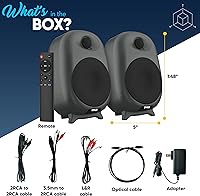
The accessory bundle is one of the more generous in this category. Getting an optical cable, a 3.5mm-to-RCA cable, a speaker interconnect wire, and a remote all in one box means buyers can connect to almost any source immediately without an extra trip to the store.
Cable lengths are on the shorter side across the board, which can limit speaker placement flexibility. The remote also requires batteries that are not included, a minor but mildly irritating omission that a few reviewers flagged in their feedback.
Volume & Output Power
72%
28%
For a desktop or bedroom setup, these bookshelf speakers get plenty loud before distortion becomes a real issue. Casual listening at conversational volumes and moderate background music levels is handled comfortably without pushing the amplifier hard.
The 60W figure is peak, not continuous RMS, so expectations around room-filling volume should be tempered. In larger living rooms or open-plan spaces, the output starts to feel strained at higher volume levels, and some thinning of the sound becomes apparent.

Suitable for:

The Pyle PBKSR40 Bookshelf Speaker Set is a practical pick for anyone who wants a meaningful audio upgrade without committing to a complex or expensive setup. Home office workers who spend long hours on calls and background music will notice an immediate improvement over built-in laptop or monitor speakers, and the compact cabinet footprint means it fits comfortably on most desks without taking over the workspace. Students and renters are another natural fit — the all-in-one design handles Bluetooth streaming, TV audio via optical, and wired sources through a single compact system that moves easily between apartments. Casual listeners who want the flexibility to connect a phone wirelessly, plug in a TV digitally, or run an aux cable from an older device will find the input range genuinely useful day-to-day. If your priority is getting clean, listenable stereo sound from a small shelf or desk without spending a lot or dealing with a separate receiver, these bookshelf speakers make a lot of sense.

Not suitable for:

The Pyle PBKSR40 Bookshelf Speaker Set is not the right choice for buyers with serious audio expectations or bass-forward listening habits. If you regularly listen to hip-hop, electronic, or any genre where low-end depth and punch matter, the 4-inch woofers will leave you wanting, and no amount of rear-panel EQ adjustment fully closes that gap. Audiophiles or even enthusiast-level listeners looking for precise stereo imaging, low distortion at higher volumes, or a well-defined soundstage should look at dedicated studio monitors or higher-tier powered bookshelf speakers instead. The active-passive configuration also means all controls live on one speaker, which can be an ergonomic frustration if that speaker ends up on a shelf or in an inconvenient spot. Buyers who need to fill a larger living room or open-plan space reliably at higher volumes will find the output starts to feel strained, and those who value rock-solid build consistency should know that quality control has produced the occasional sub-par unit.

Specifications

  • Peak Power: The system delivers up to 60 watts of peak power output, which is a marketing-rated figure rather than continuous RMS wattage.
  • Woofer Size: Each speaker houses a 4-inch woofer driver responsible for midrange and low-frequency reproduction.
  • Tweeter Size: A 1-inch dome tweeter handles high-frequency detail in each cabinet for a full stereo range.
  • Frequency Response: The system covers a frequency range of 40Hz to 20kHz, spanning from moderate bass through the upper limit of human hearing.
  • Impedance: Both speakers operate at 8 Ohm impedance, which is standard for passive and active home audio configurations.
  • Signal-to-Noise Ratio: The built-in amplifier achieves an 80dB signal-to-noise ratio, delivering reasonably clean audio at typical listening volumes.
  • Connectivity: Input options include Bluetooth, optical (TOSLINK), RCA, 3.5mm auxiliary, and USB for broad source compatibility.
  • Bluetooth Range: Wireless Bluetooth pairing is supported up to approximately 33 feet under open-air conditions.
  • Cabinet Material: Cabinets are constructed from MDF and ABS plastic with a fabric grille cloth finish on the front baffle.
  • Dimensions: Each speaker measures 6.1″ deep by 6.1″ wide by 9″ tall, making them suitable for desktop or shelf placement.
  • Weight: The complete two-speaker set weighs approximately 7.88 pounds in total.
  • Configuration: The system uses an active-plus-passive setup, with the amplifier, controls, and all inputs housed in the active (primary) speaker only.
  • Audio Modes: Three selectable audio modes are available to adjust the overall sound character to suit different content types.
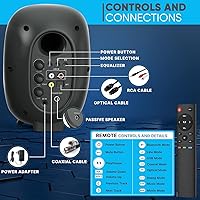
  • Tone Controls: Manual bass and treble adjustment dials are located on the rear panel of the active speaker.
  • Remote Control: A handheld remote control is included for adjusting volume and switching audio modes without touching the speaker.
  • Included Accessories: The set ships with an optical cable, a 3.5mm-to-RCA cable, an L&R speaker connection wire, a US power adapter, and a remote control.
  • Surround Config: The system outputs in standard 2.0 stereo with no surround sound processing or subwoofer channel.
  • Warranty: Pyle provides a limited warranty on this speaker set; buyers should confirm current terms directly with the manufacturer or retailer.

Related Reviews
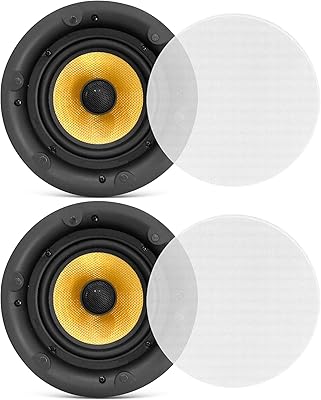
Pyle Home PCB4BK Mini Cube Bookshelf Speakers
81%
85%
Sound Quality
92%
Value for Money
65%
Bass Performance
80%
Build Quality
90%
Size/Compactness
More
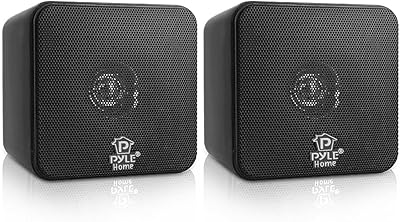
Pyle PDIC68FG 6.5” Ceiling Speaker Set
86%
86%
Sound Quality
92%
Ease of Installation
68%
Bass Response
88%
Build Quality
90%
Compatibility with Ceiling/Wall
More
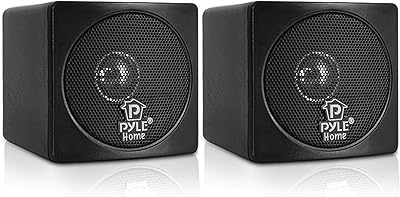
Pyle PHQBS62 6.5″ Bookshelf Speakers
76%
78%
Sound Clarity
61%
Bass Performance
67%
Build Quality
83%
Value for Money
88%
Setup & Connectivity
More
Pyle PCB3BK 3″ Mini Cube Bookshelf Speakers
71%
78%
Sound Clarity
41%
Bass Response
83%
Value for Money
57%
Build Quality
86%
Ease of Setup
More
Pyle PLMR652W Marine Speakers
86%
88%
Sound Quality
91%
Ease of Installation
93%
Durability (Waterproof & Weather Resistance)
87%
Build Quality
75%
Performance at High Volumes
More
Edifier S2000MKIII Bookshelf Speakers
86%
92%
Sound Quality
89%
Bluetooth Performance
88%
Build Quality
85%
Ease of Use
91%
Connectivity Options
More
Pyle PLMRS4W Marine Speakers
84%
80%
Sound Quality
90%
Build Quality
88%
Durability in Harsh Weather
85%
Installation Ease
65%
Bass Response
More
Pyle PLMR57W Marine Speakers
85%
84%
Sound Quality
91%
Durability
89%
Ease of Installation
90%
Weather Resistance
75%
Bass Performance
More
Sanyun SW205
Sanyun SW205
78%
83%
Sound Quality
61%
Bass Performance
87%
Soundstage & Imaging
89%
Connectivity & Inputs
84%
Bluetooth Performance
More
Probox BT16 Bookshelf Speakers
75%
78%
Sound Clarity
54%
Bass Performance
84%
Bluetooth Stability
82%
USB DAC Quality
63%
Build Quality
More

FAQ

Only the active speaker has controls. That is the larger unit with the rear panel featuring the input selector, bass and treble dials, and power connection. The passive speaker connects to it via the included wire and has no controls of its own. It is a pretty common setup at this price point, but worth knowing before you decide where to place them.

Yes, and the optical input is actually the cleanest way to do it. If your TV has a TOSLINK optical output, just use the included optical cable and you are set. If your TV only has an RCA or headphone output, the included cables cover those connections too.

Very straightforward. Power on the active speaker, select the Bluetooth input, and it goes into pairing mode automatically. Most phones and laptops find it within a few seconds. Reconnection on subsequent uses is generally automatic once the initial pairing is done.

It depends heavily on what you listen to. For vocals, podcasts, acoustic music, and general background listening, the bass is perfectly adequate. If you regularly listen to hip-hop, EDM, or bass-heavy electronic music, you will likely find the low end underwhelming even with the bass dial turned up. The 4-inch drivers have physical limits that EQ cannot fully overcome.

Most users find it functional for everyday use, but it does require a reasonably direct line of sight to the active speaker. The practical range is shorter than the spec suggests in real room conditions. A few buyers found the button feel a bit cheap, but it gets the job done for volume and mode switching.

The modes are designed to shift the overall sound character slightly — think of them as basic presets rather than dramatic transformations. In practice, the differences are subtle, and some users struggle to hear a clear distinction between them. They are a useful starting point but should not be the main reason you buy these speakers.

Unfortunately there is no dedicated subwoofer output on the Pyle PBKSR40 Bookshelf Speaker Set, so there is no clean, built-in upgrade path for adding a sub. You could potentially use an RCA splitter on the input side to feed a powered subwoofer simultaneously, but that is a workaround rather than an intended feature.

The cables that come in the box are on the shorter side, which can limit your placement options depending on where your TV, computer, or audio source sits relative to the speakers. If you are placing the speakers more than a few feet away from the source, picking up a longer optical or RCA cable separately is a smart move.

They work well for casual gaming, especially through the optical input connected to a console or PC. The soundstage is decent for a desktop setup, and dialogue and effects come through clearly. Competitive gamers looking for precise positional audio or deep bass impact will want a more specialized solution, but for relaxed gaming sessions they are solid.

For most buyers, yes. The MDF cabinet feels solid and the fabric grille is well-attached on units that arrive in good condition. The main concern from user feedback is not long-term durability but rather inconsistency at the factory level — a minority of buyers have received units with minor cosmetic or assembly issues. If yours arrives in good shape, longevity is generally not a reported problem.