Overview

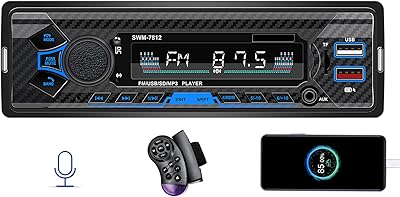
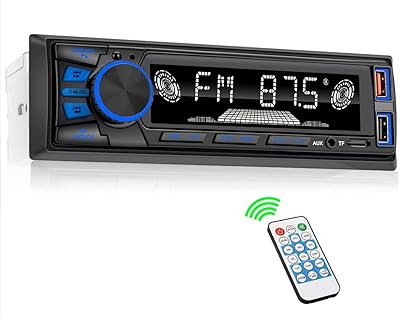
The PolarLander 1-Din Bluetooth Car Stereo Receiver is the kind of no-fuss upgrade that makes sense for an aging daily driver or a work truck that came from the factory with nothing but an AM/FM dial. It drops into any standard single-DIN dash slot and gives older vehicles a basic but functional connection to modern smartphones. There's no touchscreen, no Android Auto, no navigation — and that's entirely by design. This single-DIN receiver is built around mechanical knob controls that are genuinely easier to operate while driving than most touchscreen alternatives. Think of it as a practical bridge rather than a full-blown overhaul.
Features & Benefits

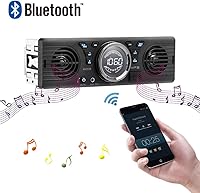
The most practical addition here is built-in Bluetooth, which handles both hands-free calling and wireless audio streaming without needing an adapter or extra wiring. The unit also packs two integrated speakers, so you don't have to wire up external ones if your car's original speakers are shot or simply missing — a useful touch for utility vehicles. An FM tuner stores up to 18 presets, and there's both a USB port and a TF/SD card slot for playing locally saved tracks. A front-facing AUX input covers anything else: GPS units, older MP3 players, or a phone that doesn't pair easily over Bluetooth. Control is handled entirely by physical knobs.

Best For

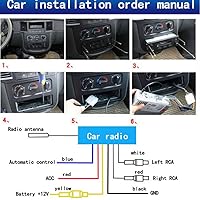
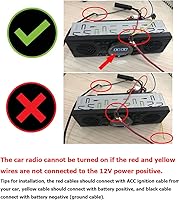
This budget car stereo makes the most sense for a very specific type of buyer. If you're refreshing an older commuter car, a work van, or a project vehicle that's never going to see a premium audio setup, this hits the right notes. It's also well-suited to drivers who spend most of their time on FM radio and don't need streaming app integration. DIY installers will appreciate the color-coded wiring harness — red for ACC ignition, yellow for battery positive, black for ground — which follows the standard most aftermarket stereos use. What it won't do is support CarPlay, Android Auto, or navigation, so if any of those matter to you, keep looking.

User Feedback

With a 4.2-star average across more than 1,100 ratings, the PolarLander head unit lands where you'd expect for an entry-level car audio upgrade — mostly satisfied buyers with a few understandable frustrations. People consistently praise how fast it installs and how reliably Bluetooth pairs on the first try, and FM reception gets positive mentions too. The most common headache is wiring: if both the red and yellow leads aren't connected to 12V simultaneously, the unit won't power on properly — something that trips up first-timers who only connect one wire. A few owners also note that the built-in speaker output feels underpowered in larger vehicle cabins. Set realistic expectations upfront and most buyers come away reasonably satisfied.

Pros

  • Bluetooth pairs quickly and reliably with most smartphones for hands-free calls and audio streaming.
  • Built-in dual speakers mean you can get sound without wiring up external ones — useful for utility vehicles.
  • FM tuner is clean and stores up to 18 presets, covering most listeners’ daily radio habits.
  • USB and SD card playback works well for drivers who keep a curated offline music library.
  • Standard color-coded wiring harness makes DIY installation straightforward even for first-timers.
  • Mechanical knob controls are genuinely easy to use without taking your eyes off the road.
  • Front-facing AUX input handles older devices like GPS units or MP3 players without any fuss.
  • Fits any standard single-DIN dash slot, making it compatible with a wide range of older vehicles.
  • At its price point, the feature count is hard to argue with for a basic connectivity upgrade.

Cons

  • Built-in speaker output struggles in larger cabins — volume and clarity drop off noticeably at higher levels.
  • Both the red and yellow wires must connect to 12V simultaneously, or the unit simply will not power on — a confusing gotcha for new installers.
  • No touchscreen means navigating presets and settings feels dated compared to even modestly priced competitors.
  • No support for Apple CarPlay, Android Auto, or any app-based navigation integration.
  • Sound quality from the built-in speakers will not satisfy anyone used to even a mid-range external speaker setup.
  • The product listing and manual can be unclear, leaving some buyers to troubleshoot wiring issues on their own.
  • No subwoofer pre-out or dedicated bass control limits audio customization for those who want more from their system.
  • Build materials feel lightweight, which raises durability questions for vehicles used in demanding conditions.

Ratings

The scores below for the PolarLander 1-Din Bluetooth Car Stereo Receiver were generated by AI after analyzing verified buyer reviews from multiple global markets, with spam, bot-submitted, and incentivized feedback actively filtered out. Each category reflects the honest consensus of real drivers — from daily commuters to weekend DIY installers — capturing both what works well and where the unit falls short. Nothing here is glossed over: the wins and the frustrations are weighted equally.
Value for Money
83%
For what this budget car stereo costs, the feature count is genuinely hard to fault. Bluetooth, FM radio, USB and SD card playback, AUX input, and two built-in speakers in a single unit represents solid value for older vehicles that had nothing to begin with. Most buyers feel they got more than they paid for.
A small number of buyers felt the unit underdelivered on durability over time, questioning whether the long-term value holds up after a year or two of daily use. If you factor in potential replacement costs, the initial savings may feel less impressive.
Ease of Installation
78%
22%
The color-coded wiring harness follows the standard most aftermarket head units use, and many first-time installers reported completing the job in under an hour with basic tools. The compact form factor slides into a single-DIN slot without requiring dash modifications in most vehicles.
The dual 12V wiring requirement — both the red and yellow leads must be connected simultaneously — is a persistent source of confusion that trips up a meaningful portion of buyers. The included instructions do not always explain this clearly enough, leading to frustration before the unit even powers on.
Bluetooth Performance
76%
24%
Pairing reliability is one of the most consistently praised aspects across user reviews. Most smartphones connect on the first attempt, and several buyers noted the unit reconnects automatically each time the car starts, which is exactly what you want on a daily commuter.
A portion of users reported occasional audio stuttering or dropped connections, particularly on longer drives or when the phone is placed farther from the unit. Call audio quality through the built-in microphone is functional but not particularly crisp, which is noticeable on noisier roads.
FM Radio Quality
81%
19%
FM reception comes up repeatedly as a genuine bright spot. The tuner locks onto stations cleanly, auto-scan works reliably across the 87.5–108MHz range, and storing 18 presets covers most drivers well. For everyday radio listeners, this part of the unit performs above expectations for the price.
In areas with weaker signal coverage, a few users noted occasional static that a better-shielded tuner might suppress. The FM performance is good rather than outstanding, and buyers in rural or signal-sparse areas should temper expectations slightly.
Sound Quality
57%
43%
For background listening in a compact car at moderate volumes, the two integrated speakers handle casual radio and streaming audio adequately. Drivers upgrading from a completely dead or absent factory radio will notice an immediate improvement in audio accessibility.
The built-in speakers hit a clear ceiling in larger vehicle cabins — volume drops off, bass thins out, and clarity degrades at higher output levels. Anyone with even modest audio standards will want to route sound through external speakers via the RCA outputs rather than relying on the integrated ones.
Build Quality
61%
39%
The mechanical knob controls feel tactile and responsive, and several buyers appreciated having physical buttons instead of a touchscreen that can be hard to operate while driving. The unit holds its position securely once properly mounted in the dash.
The overall construction feels lightweight in hand, with plastic components that do not inspire long-term confidence. A handful of reviewers reported issues with buttons or connectors after extended use, suggesting the internal hardware may not be engineered for high-mileage durability.
Ease of Use
84%
The mechanical knob interface genuinely simplifies day-to-day operation. Switching sources, adjusting volume, and scanning FM stations can all be done without looking away from the road, which is a meaningful safety advantage over touchscreen alternatives in the same price range.
Without any visual display of meaningful depth, navigating between stored SD card tracks or finding a specific USB file can feel like guesswork. Users accustomed to even basic touchscreen feedback may find the tactile-only interface limiting after a while.
Connectivity Options
79%
21%
For a single-DIN unit at this price, the connectivity lineup is well-rounded: Bluetooth, USB, TF/SD card, front AUX, and RCA output cover the main scenarios most drivers encounter. The front-facing AUX jack in particular is a convenient touch that many competing units place awkwardly at the rear.
There is no digital optical output, no subwoofer-specific preamp channel, and no way to integrate with smartphone apps directly. For anyone beyond basic connectivity needs, the options feel adequate but not expandable.
Compatibility
77%
23%
The standard 1-DIN form factor and color-coded harness mean this head unit works with a wide range of vehicles from the 1990s onward. Most buyers found it a clean fit with a compatible wiring harness adapter for their specific make and model.
Vehicles with non-standard dash configurations, proprietary factory wiring, or built-in steering wheel audio controls will require additional adapters — and some owners found that steering wheel control integration is not supported at all without extra hardware that may not be available for all cars.
Setup Documentation
52%
48%
The included color-coded wiring guide gives enough basic information for someone familiar with aftermarket installs to get started. The logical layout of the harness itself does most of the communicating for buyers with any prior experience.
The printed manual is minimal and does not adequately explain the critical dual 12V connection requirement, which is the single biggest source of reported installation failures. Buyers without prior car audio experience often end up relying on community forums or YouTube rather than the documentation provided.
Hands-Free Calling
69%
31%
The hands-free function works reliably for call initiation and answer, and integrating it into a vehicle that previously had no Bluetooth at all is a genuine upgrade for driving safety. Most callers on the other end found the audio acceptable for brief calls.
Road and engine noise bleed noticeably into the microphone pickup, making longer calls on highways more of a challenge. The microphone placement is fixed and not adjustable, which means optimal voice capture depends heavily on where the unit ends up mounted in the dash.
USB & SD Playback
73%
27%
Playback from USB drives and TF/SD cards is straightforward and responsive for standard MP3 files. Drivers who keep a curated library of music on a card or stick get reliable, fuss-free playback without needing a phone or data connection.
Format support is limited to common file types, and the unit does not handle folders or large track libraries particularly gracefully — navigating through a large USB drive can be tedious without a display. File compatibility issues have been reported with less common audio formats.
Aesthetic & Design
66%
34%
The clean, minimal face of this single-DIN receiver blends unobtrusively into older dash interiors that were never designed for modern touchscreen panels. The low-profile knob layout does not look out of place in a classic or utilitarian vehicle.
The overall visual presentation is dated, and buyers used to backlit, modern-looking head units may find the aesthetic underwhelming. Button illumination is basic, and the unit does not offer color customization or any display brightness adjustment.

Suitable for:

The PolarLander 1-Din Bluetooth Car Stereo Receiver is a solid pick for anyone who owns an older vehicle and simply wants to add hands-free calling and wireless audio without spending much. It fits naturally into work trucks, older commuter cars, and secondary vehicles where the factory radio has either died or never offered Bluetooth in the first place. Drivers who spend most of their time listening to FM radio or playing music from a USB stick or SD card will find everything they need here, with nothing unnecessary cluttering the experience. DIY-minded installers will appreciate the straightforward color-coded wiring harness, which follows the same standard as most aftermarket head units and makes a Saturday afternoon install genuinely achievable. If your goal is basic, reliable connectivity in a no-frills package, this single-DIN receiver checks the right boxes.
Not suitable for:

The PolarLander 1-Din Bluetooth Car Stereo Receiver is a poor fit for anyone who relies heavily on smartphone integration for daily driving. There is no Apple CarPlay, no Android Auto, and no navigation support — so if you depend on Waze or Google Maps routed through your stereo, this unit simply cannot deliver that. Audiophiles or even casual listeners with higher sound quality expectations will likely feel let down by the built-in speakers in larger vehicle cabins, where volume and bass depth hit a ceiling fairly quickly. Buyers who want a modern touchscreen interface or app-based streaming controls will find the mechanical knob setup limiting rather than refreshing. This budget car stereo is intentionally minimal, and anyone expecting a feature set beyond what a basic head unit provides is going to be disappointed.
Specifications

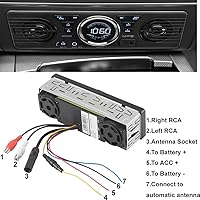
  • Form Factor: This is a standard 1-DIN head unit, designed to fit any vehicle with a single-DIN (approximately 2″ x 7″) dash opening.
  • Operating Voltage: The unit runs on 12V DC, which is the standard electrical system voltage found in most passenger cars, trucks, and vans.
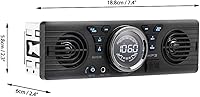
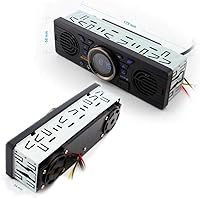
  • Dimensions: The unit measures 8.6 x 4.5 x 3.3 inches, making it a compact fit for standard single-DIN mounting bays.
  • Weight: At 12.8 ounces, this head unit is lightweight and easy to handle during installation.
  • Bluetooth: Built-in Bluetooth supports hands-free calling and wireless audio streaming directly from a paired smartphone.
  • FM Tuner: The FM tuner covers a frequency range of 87.5–108MHz and can store up to 18 user-defined preset stations.
  • Built-In Speakers: Two integrated speakers are included inside the unit, allowing basic audio output without requiring external speaker connections.
  • USB Support: A USB port on the unit accepts USB flash drives for direct playback of stored audio files.
  • Card Slot: A TF/SD card slot supports memory cards loaded with audio files, providing an alternative to USB storage playback.
  • AUX Input: A front-facing 3.5mm AUX input allows wired audio connection from external devices such as phones, GPS units, or MP3 players.
  • RCA Output: RCA preamp outputs are included, enabling connection to external amplifiers or subwoofers if a more powerful audio setup is desired.
  • Audio Output: Audio output mode is stereo, with a 2.1 channel configuration supporting both left/right stereo and basic bass output.
  • Controller Type: All functions are operated via physical mechanical knobs, with no touchscreen or digital display interface included.
  • Wiring Harness: The standard color-coded harness uses red for ACC ignition, yellow for battery positive, and black for ground, following the common aftermarket wiring convention.
  • Power Requirement: Both the red (ACC) and yellow (battery) wires must be connected to 12V positive simultaneously for the unit to power on correctly.
  • Audio Encoding: The unit decodes and plays stereo-encoded audio from FM broadcasts, USB drives, SD cards, and AUX or Bluetooth sources.
  • Availability: This model has been commercially available since July 2017 and is listed as not discontinued by the manufacturer.
  • ASIN: The Amazon product identifier for this unit is B073VHLRNQ, useful for cross-referencing listings and compatible accessories.

Related Reviews

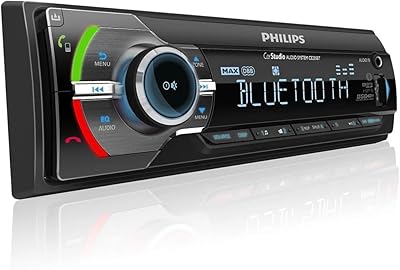
Philips Single Din Bluetooth Car Stereo
74%
78%
Sound Quality
74%
Bluetooth Performance
83%
AM/FM Reception
67%
Hands-Free Calling
76%
Ease of Installation
More
Sony DSX-A410BT Single Din Car Stereo Receiver
79%
91%
Bluetooth Connectivity
83%
Sound Quality
88%
Ease of Installation
62%
Voice Control Performance
58%
User Interface & Controls
More
JVC KW-R950BTS Car Stereo Receiver
79%
83%
Sound Quality
86%
Bluetooth Performance
84%
Value for Money
61%
Display Readability
88%
Multi-Device Pairing
More
DWMM Single Din Bluetooth Car Stereo System
83%
87%
Ease of Installation
91%
Bluetooth Connectivity
75%
Sound Quality
89%
Value for Money
84%
User Interface & Display
More
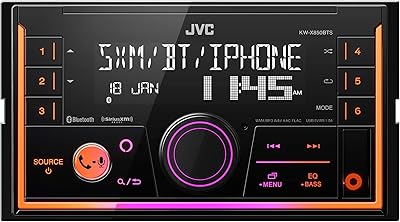
JVC KW-X850BTS
JVC KW-X850BTS
87%
92%
Bluetooth Stability
78%
Voice Assistant Integration
89%
Sound Customization
94%
Device Charging Speed
86%
Display Visibility
More
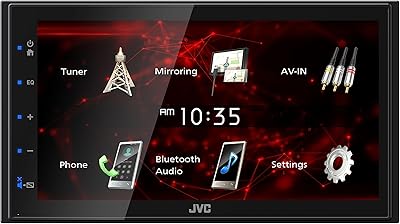
JVC KW-M180BT Double DIN Car Stereo Receiver
78%
81%
Touchscreen Quality
84%
Bluetooth Performance
73%
Android Integration
88%
Audio Tuning Depth
79%
Value for Money
More
JVC KW-R940BTS Double DIN Car Stereo Receiver
82%
88%
Bluetooth Performance
91%
Sound Quality
61%
Display Readability
83%
Ease of Installation
87%
Value for Money
More
JVC KW-M150BT Bluetooth Car Stereo Receiver
75%
83%
Sound Quality
79%
Touchscreen Responsiveness
86%
Bluetooth Performance
88%
Value for Money
66%
USB Compatibility
More
REAKOSOUND 820s Single DIN Car Stereo
69%
88%
Value for Money
83%
Bluetooth Performance
56%
FM Radio Reception
67%
Sound Quality
76%
Ease of Installation
More
JVC KW-SX88BT Double Din Car Stereo
78%
88%
Fitment & Installation
86%
Bluetooth Reliability
83%
Sound Quality
91%
Equalizer & Tuning
77%
Hands-Free Calling
More
Soundstream VR-65B 6.2″ Double-DIN Car Stereo
67%
83%
Value for Money
78%
Bluetooth Performance
61%
Touchscreen Responsiveness
67%
Audio Quality
71%
Ease of Installation
More

FAQ

It depends on your vehicle. As long as your car has a standard single-DIN opening in the dash — which is common in most vehicles made before roughly 2010 — it should drop right in. If your car has a double-DIN slot, you would need a single-DIN mounting adapter kit, which is widely available and inexpensive. Always measure your dash opening before ordering.

It comes with two built-in speakers inside the unit itself, so you can get audio output right out of the box without wiring up door or dash speakers. That said, the built-in speakers are modest in volume and clarity, so if you are installing this in a larger cabin like a truck or van, you may want to connect external speakers via the RCA outputs for better coverage.

This is almost always a wiring issue. Both the red wire (ACC ignition) and the yellow wire (battery positive) need to be connected to 12V power at the same time. If only one is connected, the unit will partially power on but not function properly. Double-check both connections before assuming the unit is defective — this resolves the issue in the vast majority of reported cases.

Put the unit into Bluetooth pairing mode using the controls on the face of the unit, then search for available devices on your phone and select it from the list. Most users report that pairing is quick and the connection is stable. Once paired, your phone will typically reconnect automatically each time you start the car.

No — the PolarLander 1-Din Bluetooth Car Stereo Receiver does not support Apple CarPlay, Android Auto, or any screen mirroring from a smartphone. It is a basic head unit without a display, so any navigation or app-based features would need to run on your phone independently, with audio passed through via Bluetooth or AUX.

The unit supports standard audio formats commonly stored on USB drives and TF/SD cards, including MP3. For best results, stick to widely used formats and avoid obscure or high-resolution audio file types that budget head units typically do not decode. Most users playing standard MP3 files report no issues.

Yes, the unit includes RCA outputs, which allow you to run a signal to an external amplifier or powered subwoofer. This is actually a practical option for anyone who finds the built-in speakers lacking — the head unit handles the source and controls while a separate amp drives the speakers with more power.

Most buyers with basic mechanical confidence manage the install themselves in an afternoon. The wiring harness uses the standard color-coded system — red, yellow, and black — that matches up with most aftermarket wiring harness adapters sold for specific vehicle makes. The main thing to get right is connecting both the red and yellow wires to 12V, which trips up a few first-timers. If you are comfortable using a trim removal tool and following simple wiring instructions, you should be fine.

FM reception and clarity are among the most consistently praised aspects of this budget car stereo in real user reviews. It stores up to 18 presets and the auto-scan function works reliably. For everyday radio listening — news, talk, or music — it performs well. Do not expect audiophile-grade sound from the built-in speakers, but for casual listening it gets the job done.

Keep expectations in line with the price tier and you will not be disappointed. The built-in speakers are adequate for smaller cabins at moderate volume, but they do struggle at higher levels or in larger vehicles. The unit is more about connectivity and convenience than audio performance. If sound quality is a priority, plan to connect external speakers via the RCA outputs rather than relying solely on the integrated ones.