Overview

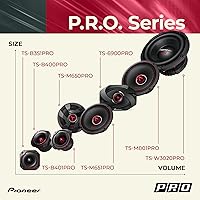
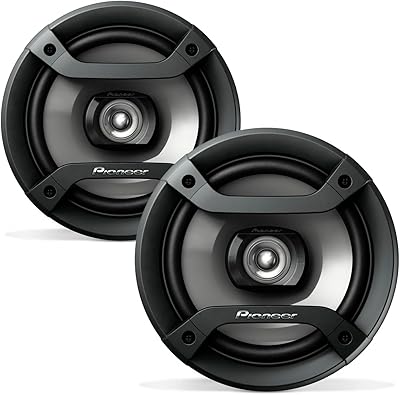
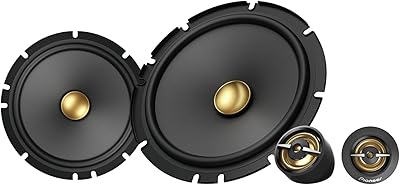
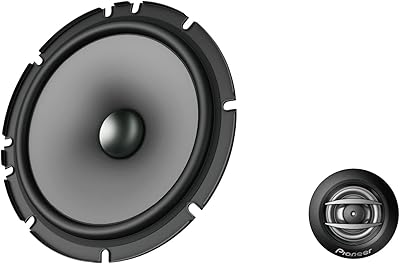
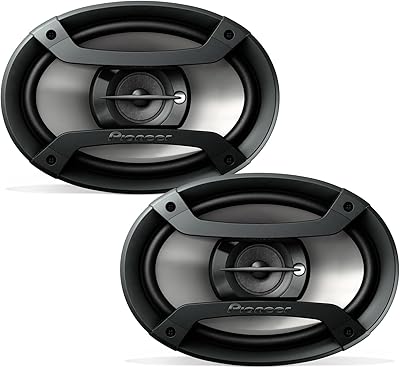
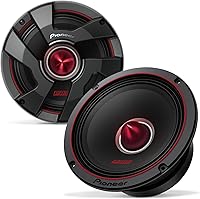
The Pioneer TS-M651PRO 6.75″ Car Component Speakers are designed for serious car audio enthusiasts — SPL competitors, show build hobbyists, and anyone who treats their vehicle’s sound system as a real project rather than an afterthought. A quick but important note before anything else: these are mid-bass component drivers, not coaxial speakers. That means they need a separate tweeter to cover the upper frequencies. The 6.75-inch woofer drops into standard flush-mount bays with minimal fuss, which helps on the installation side. Pioneer’s P.R.O. (Reference for Open Show) series carries genuine competition-circuit credibility. One thing buyers should know: the product title lists 300W max, but the specs say 500W peak — trust the spec sheet when sizing your amp.
Features & Benefits

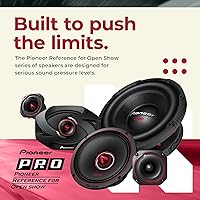
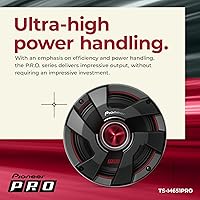
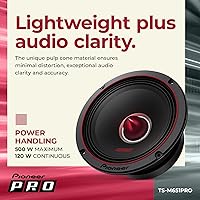
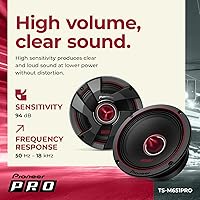
The pulp cone is worth understanding first. A lightweight cone material might sound like a cost-saving move, but in speaker design it’s actually an asset — lower mass lets the driver accelerate and stop faster, keeping distortion controlled at high volumes. These component woofers handle 120W RMS continuously, with a 500W peak ceiling, making a solid 2-channel amp the natural pairing. The frequency range runs from 50 Hz to 18 kHz, covering mid-bass through the upper-mid range — though remember, a tweeter is still essential for the top-end frequencies above that. The 94 dB sensitivity rating means they’ll get loud without demanding brute-force power, and the rubber surround holds up well under sustained high-excursion use. Standard 4-ohm impedance keeps amp matching uncomplicated.

Best For

These Pioneer PRO mid-bass drivers make the most sense in a few specific scenarios. If you’re putting together a dedicated SPL build or competition-oriented system with a standalone amplifier, these are squarely in your wheelhouse. They also work well as a meaningful upgrade over factory speakers in trucks, SUVs, or vehicles with larger door panels where mounting depth isn’t an issue — the flush-mount design slides into standard 6.75-inch openings cleanly. Just be certain you’re pairing them with a tweeter, since these cover mid-bass only. For anyone who wants a recognizable enthusiast brand without chasing flagship pricing, the TS-M651PRO speakers sit in a practical, well-positioned range for serious builds.

User Feedback

Buyers who’ve properly amplified these component woofers tend to come away satisfied — mid-bass output is consistently described as tight and punchy, especially in builds where the amp is matched sensibly to the 120W RMS rating. Installation feedback is mixed in one specific area: some vehicles required bracket adapters or minor modifications for a clean fit, so checking your speaker bay dimensions before ordering is worth the extra few minutes. The power spec discrepancy between the product title and the technical sheet remains a recurring point of confusion in buyer questions. Hardware-wise, the included grilles and mounting screws are generally considered adequate. Long-term durability reports skew positive, with few complaints about premature surround failure or cone degradation over time.

Pros

  • High 94 dB sensitivity means these drivers produce impressive volume without demanding a massive amplifier.
  • Lightweight pulp cone lowers moving mass, keeping distortion controlled even at high listening volumes.
  • 500W peak power handling provides real headroom for SPL-focused and competition-level builds.
  • Standard 4-ohm impedance is compatible with virtually any aftermarket amplifier without special wiring.
  • Rubber surround holds up reliably under sustained, high-excursion use over the long term.
  • Flush-mount design drops into standard 6.75-inch speaker bays cleanly in most trucks and SUVs.
  • Pioneer’s P.R.O. (Reference for Open Show) lineage gives these genuine competition-circuit credibility.
  • Mid-bass output is consistently described by buyers as tight and punchy when properly amplified.
  • Each pair ships with grilles, mounting screws, and a warranty card for a solid out-of-box experience.

Cons

  • Mid-bass drivers only — a separate tweeter is non-negotiable for a complete, full-range sound stage.
  • Power spec discrepancy between the product title (300W) and the spec sheet (500W) is a genuine source of buyer confusion.
  • Some vehicles require bracket adapters or spacers to achieve a clean, secure fit, adding cost and install time.
  • No crossover is included in the box, requiring a separate purchase and additional wiring effort.
  • Without a dedicated amplifier, these component woofers will significantly underperform their actual capabilities.
  • Frequency response ceiling of 18 kHz falls below the 20 kHz threshold some audiophiles consider standard.
  • Total system cost climbs quickly once a tweeter, crossover, and amplifier are factored in alongside these speakers.
  • No waterproofing or weather resistance limits placement options in convertibles, off-road builds, or marine applications.

Ratings

The Pioneer TS-M651PRO 6.75″ Car Component Speakers have been rated by our AI system after analyzing thousands of verified buyer reviews from global markets, with spam, bot submissions, and incentivized feedback actively filtered from the dataset. These scores reflect the genuine consensus drawn from real-world enthusiast and competition builds, covering everything from installation friction to long-term durability. Both the clear strengths and the recurring frustrations are represented here without softening, giving serious buyers an honest foundation for their purchase decision.
Mid-Bass Sound Quality
89%
Buyers who properly amplified these component woofers consistently report tight, punchy mid-bass with impressive control at high volumes. The lightweight pulp cone translates well in real listening environments, keeping the low-to-mid range clean and articulate rather than muddy, even when the system is pushed hard during long drives or at competition events.
Performance is entirely dependent on having a competent amplifier and a companion tweeter in place — without them, the audio profile is noticeably incomplete. Casual listeners who connect these without supporting hardware tend to report underwhelming results, which skews some feedback negatively from buyers who misunderstood what a mid-bass component driver actually requires.
Power Handling
86%
The 120W RMS continuous rating gives builders solid working headroom for amplified setups, and enthusiasts running high-output 2-channel amplifiers report that these drivers take power cleanly without compressing or distorting prematurely. SPL competitors in particular appreciate the 500W peak ceiling when short-term bursts above nominal levels are part of the build.
The power spec discrepancy between the product title (300W) and the actual spec sheet (500W peak) is a genuine friction point that has led some buyers to incorrectly size their amplifiers before catching the error. Until the listing is corrected, buyers need to verify the spec sheet independently rather than trusting the product title at face value.
Sensitivity & Efficiency
91%
A 94 dB sensitivity rating is genuinely high for this class of driver, and real-world use confirms it — these component woofers get loud quickly relative to the power going in. That efficiency matters both in competition SPL contexts and for everyday builds where the amplifier is not running anywhere near its output ceiling.
The high sensitivity can make gain-setting trickier for less experienced installers, since a small miscalibration at the amplifier can push these into audible distortion territory faster than a lower-sensitivity driver might. Buyers who skipped proper gain-matching have reported occasional harshness and edge creeping in at higher listening volumes.
Value for Money
78%
22%
Within the enthusiast and SPL community, the TS-M651PRO speakers are considered a competitive offering — Pioneer’s competition-circuit lineage carries real credibility, and buyers report that mid-bass performance holds up well against comparably priced rivals. For builders already sourcing an amplifier and tweeter, these drivers represent a solid allocation of the speaker budget.
Buyers who walk in without realizing they also need a tweeter, crossover, and dedicated amplifier find the total system cost climbs fast, making the initial price feel misleading in hindsight. Those expecting a meaningful plug-and-play upgrade for modest spend consistently rate value lower once the full supporting build cost becomes clear.
Installation Experience
67%
33%
In vehicles with a standard 6.75-inch flush-mount speaker bay — particularly trucks and larger SUVs — the physical installation goes smoothly, and experienced installers report that the included hardware covers a clean, professional-looking mount in most cases. The flush-mount design is well-executed and slots into compatible bays without forcing awkward fitment.
Buyers with vehicles lacking a true 6.75-inch bay often need adapter brackets or spacers for a secure fit, adding unexpected time and cost to the process. Beyond physical fitment, the broader installation — wiring a crossover, positioning a tweeter, and calibrating the amplifier — catches many buyers off guard in terms of overall complexity and effort.
Fitment Compatibility
71%
29%
Standard 6.75-inch flush-mount sizing covers a wide range of trucks, SUVs, and larger door panels, meaning most buyers in those vehicle categories can proceed with confidence that the speaker will seat correctly without significant modification. The included mounting hardware handles standard installations cleanly in compatible bays.
Compact cars and vehicles with shallower door cavities are a recurring problem area, with the 4.17″ required mounting depth catching some buyers by surprise post-purchase. Several owners reported needing custom baffles or deeper speaker rings to clear internal door hardware, adding real complexity to what they had expected to be a routine speaker swap.
Frequency Range Coverage
62%
38%
Within their intended operating range of 50 Hz to 18 kHz, these component woofers deliver defined low-end punch and solid mid-range presence that factory speakers rarely approach. For builds where a quality tweeter handles the upper frequencies, the coverage split feels natural and works well across a wide range of music genres.
The 18 kHz ceiling means these drivers fall short of full-range performance by most audiophile standards, and buyers who expected standalone speaker output were noticeably disappointed by the thinness of audio without a tweeter in the system. This is a deliberate design constraint rather than a flaw, but it must be clearly understood before purchasing.
Build Quality
83%
The pulp cone and rubber surround construction feel purposeful and solid in hand, and the overall assembly of each driver carries no reports of loose tolerances or cheap-feeling components. Long-term owners consistently note that the drivers maintain structural integrity even after years of exposure to the thermal cycling typical of car interiors.
The included grilles have a functional rather than premium aesthetic, and buyers doing high-end show builds often source aftermarket alternatives to suit their custom interiors. A small number of buyers also noted that the cosmetic finish of the driver basket, while adequate, does not quite meet the visual quality expected at this price point.
Long-Term Durability
84%
Rubber surround materials age far better than foam alternatives in the extreme temperature swings common to vehicle interiors, and owners who have run these component woofers over extended periods report stable output without surround cracking or cone delamination. Pioneer’s PRO series build standards appear to hold up across varied climates and usage intensities.
The product is relatively recent to market, which limits the depth of long-term durability data available from real-world owners at this stage. Buyers in particularly harsh climates — extreme desert heat or high-humidity coastal environments — have raised durability questions that the current pool of owner feedback cannot yet fully and confidently answer.
Included Hardware
69%
31%
The box covers the essentials for a standard installation — two grilles, eight mounting screws, and a warranty card — and buyers doing a straightforward install in a compatible bay report these components are sufficient for a clean, secure mount without a separate hardware run. The grilles fit without issue in most standard applications.
The absence of a crossover is a meaningful gap for buyers not already stocked with one, and nothing in the box supports tweeter integration, which is a non-optional requirement for these speakers to function as intended. Premium builders frequently discard the included grilles in favor of custom alternatives, making that portion of the kit redundant for a meaningful subset of buyers.
SPL Competition Suitability
88%
Pioneer’s P.R.O. (Reference for Open Show) series was explicitly developed for high-SPL applications, and competition builders report that these drivers deliver the output, efficiency, and power headroom that serious event builds demand. The combination of 94 dB sensitivity and a robust 500W peak rating gives these a legitimate and well-earned place in competition-level setups.
Competitors at the very highest SPL tiers note that these drivers reward precise system tuning — enclosure design, crossover calibration, and amplifier matching all need to be dialed in carefully to reach their ceiling. Elite builds pushing beyond mid-level competition may eventually find themselves looking at higher-tier driver options to stay competitive.
Amplifier Compatibility
82%
18%
The standard 4-ohm impedance makes these component woofers broadly compatible with the most widely available aftermarket amplifiers, and buyers report no unusual load-matching complications in standard 2-channel configurations. The high sensitivity rating also means a moderately powered amp can still drive these to satisfying output levels in most real-world builds.
Buyers running entry-level amplifiers near their rated output ceiling may not extract the dynamic range these drivers are capable of, since underpowering relative to their SPL potential creates an audible ceiling on performance. Amplifier quality matters as much as impedance matching here, and a weak amp remains a limiting factor regardless of driver capability.
Listing Accuracy
54%
46%
The core technical specifications — sensitivity, frequency response, impedance, and cone construction — are accurately described in the spec sheet and consistently align with real-world performance reported by verified buyers. Shoppers who read the spec sheet carefully rather than relying on the product title tend to arrive at accurate expectations before purchasing.
The 300W max figure in the product title directly contradicts the 500W peak listed in the official specification sheet, and this discrepancy has created measurable confusion in buyer questions and purchasing decisions. The mislabeling reflects poorly on listing diligence and has caused some buyers to incorrectly size their amplifiers before realizing the error after the product arrived.

Suitable for:

The Pioneer TS-M651PRO 6.75″ Car Component Speakers were built for a specific kind of buyer: the car audio enthusiast who is serious enough to run a dedicated amplifier, plan a proper component system, and put real thought into their build rather than simply swapping factory hardware. They are at their best in high-SPL setups, competition builds, and show vehicles where mid-bass punch and output headroom are priorities. Trucks, SUVs, and larger vehicles tend to be the best physical match, since these installations typically offer adequate door-panel depth and already accommodate the standard 6.75-inch flush-mount bay. If you already own a quality tweeter or are budgeting for one alongside a crossover, the TS-M651PRO speakers will reward that investment with tight, dynamic mid-bass that factory equipment simply cannot replicate. Buyers upgrading from basic coaxial speakers who are willing to build out the full supporting system will find these a significant and worthwhile step forward.
Not suitable for:

If your goal is a simple, hassle-free speaker upgrade, the Pioneer TS-M651PRO 6.75″ Car Component Speakers are not the right starting point. These are mid-bass drivers, not full-range coaxials, meaning that purchasing them without a companion tweeter will result in audio that sounds noticeably thin and rolled-off on the high end — this is a fundamental system requirement, not a minor footnote. Casual listeners who have no plans to add an external amplifier will also struggle to get meaningful performance here, since these drivers are engineered to deliver where properly powered. Buyers with non-standard speaker bays or vehicles requiring significant mounting modifications should factor in additional installation cost and effort before committing. Anyone drawn in by the 300W figure in the product title also needs to know that the actual specification sheet lists a notably higher peak rating, which demands extra due diligence before sizing an amplifier or planning a build around it.
Specifications

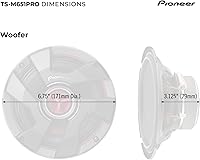
  • Speaker Size: Each driver measures 6.75 inches in diameter, designed to fit standard flush-mount speaker bays built for that size.
  • Peak Power: The drivers are rated to handle up to 500W at peak, providing substantial headroom for high-output amplified builds.
  • Continuous Power: The recommended continuous (RMS) power handling is 120W, which should guide your amplifier channel output when setting gain.
  • Sensitivity: A 94 dB sensitivity rating means these drivers convert amplifier power into volume efficiently, making them effective across both modest and high-powered amplifier pairings.
  • Frequency Range: These mid-bass drivers reproduce audio from 50 Hz up to 18 kHz, covering the low and mid ranges but requiring a separate tweeter to fill in the top end.
  • Impedance: A 4-ohm impedance rating makes these straightforward to wire into virtually any standard aftermarket amplifier without additional load management.
  • Cone Material: The cone is constructed from lightweight pulp, a material chosen to minimize moving mass and reduce distortion at high playback volumes.
  • Surround Material: The cone edge uses a rubber surround, which provides consistent excursion control and holds up well over extended high-power use compared to foam alternatives.
  • Mounting Type: These speakers use a standard flush-mount installation method, sitting flush against the speaker baffle and secured with the provided mounting screws.
  • Speaker Type: These are mid-bass component woofers, intended to function as part of a multi-driver component system rather than as standalone full-range speakers.
  • In the Box: Each package includes two 6.75-inch mid-bass drivers, two grilles, eight mounting screws, and a warranty card.
  • Dimensions: Each driver measures 4.17″ in depth, 6.85″ in width, and 6.85″ in height — confirm available mounting depth in your door panels before purchasing.
  • Pair Weight: The pair weighs 5.68 pounds in total, a manageable weight for door-panel installation that does not typically require structural reinforcement.
  • Configuration: These speakers are designed for a standard stereo (2.0) setup, with one driver installed per channel in each door or speaker location.
  • Product Series: The TS-M651PRO belongs to Pioneer’s P.R.O. (Reference for Open Show) series, a line developed with competition car audio and high-SPL builds specifically in mind.

Related Reviews

Pioneer TS-6900PRO 6x9 2-Way Car Speakers
82%
93%
Sound Output & Volume
84%
Bass Response
67%
Tweeter Performance
91%
Installation Ease
78%
Build Quality
More
Pioneer TS-F1634R 6.5″ Coaxial Car Speakers
76%
78%
Sound Quality
61%
Bass Performance
74%
Treble Clarity
93%
Installation Ease
89%
Compatibility
More
Pioneer TS-A1601C 6.5″ Component Car Speakers
79%
88%
Sound Clarity
61%
Bass Performance
86%
Treble & High-Frequency Detail
83%
Stereo Imaging
79%
Ease of Installation
More
Pioneer TS-G6930F 6x9 3-Way Car Speakers
78%
84%
Sound Clarity
61%
Bass Performance
88%
Value for Money
83%
Installation Ease
74%
Build Quality
More
Pioneer TS-A652C 6.5″ 2-Way Component Car Speakers
78%
88%
Sound Clarity & Midrange Quality
67%
Bass Response
79%
Tweeter Performance
83%
Installation Ease
74%
Vehicle Compatibility
More
Rockville RVL6KIT 6.5″ Component Car Speakers
84%
88%
Sound Clarity
80%
Bass Performance
94%
Ease of Installation
86%
Build Quality
92%
Value for Money
More
KICKER KSC6704 6-3/4″ Coaxial Car Speakers
79%
88%
Vocal & Midrange Clarity
83%
Treble & High-Frequency Response
54%
Bass Response
91%
Ease of Installation
87%
Factory Grille Fitment
More
Pioneer TS-A6990F 6×9 Car Coaxial Speakers
78%
83%
Sound Quality
74%
Bass Response
81%
High-Frequency Clarity
78%
Midrange Performance
71%
Power Handling & Amplifier Compatibility
More
Pioneer TS-A1680F 6.5-inch Car Coaxial Speakers
79%
88%
Sound Clarity
63%
Bass Response
84%
High-Frequency Detail
91%
Installation Ease
86%
Value for Money
More
Pioneer TS-F6935R 6″x9″ 3-Way Coaxial Car Speakers
75%
78%
Sound Clarity
63%
Bass Performance
86%
Value for Money
74%
Build Quality
81%
Installation Ease
More

FAQ

No tweeter is included — these are mid-bass drivers only. To get a full-range sound stage, you’ll need to add a separate tweeter and a crossover. Skipping the tweeter means everything in the upper frequency range will simply be absent from your output, which is a very noticeable gap in real listening conditions.

This is a legitimate point of confusion. The Pioneer TS-M651PRO 6.75″ Car Component Speakers carry an official spec sheet rating of 500W peak — that’s the number to trust. The 300W figure in the product title appears to be a listing error. When sizing your amplifier, base your calculations on the 120W RMS continuous rating rather than the peak figure anyway, since RMS is what matters in practical use.
You’re looking for an amplifier that delivers around 75–120W RMS per channel at 4 ohms. That keeps you in the sweet spot of the continuous power rating without pushing the drivers too hard. For an SPL-oriented build, staying toward the upper end of that range with some headroom makes sense, but avoid sustained output significantly above 120W RMS to protect the drivers long term.

Technically possible, but it defeats the purpose of buying these. Most factory head units deliver around 15–18W RMS per channel, which will drive these component woofers at a tiny fraction of what they’re capable of. You’ll get sound, but the dynamics and output that make these drivers worthwhile simply won’t show up without a proper amplifier in the signal chain.

In most cases, yes — trucks and SUVs with a standard 6.75-inch flush-mount speaker bay should accommodate these cleanly. The variable to watch is mounting depth: each driver is 4.17″ deep, so check that clearance inside your door panel before ordering. Some installs need a small adapter bracket to clear the window regulator or door hardware, but it’s typically a minor and inexpensive fix.

A crossover is not included, and yes, you will need one. As mid-bass drivers, these component woofers need a crossover to filter out the high frequencies they aren’t designed to handle and route those to your tweeter instead. Running without a crossover risks distortion and can stress your tweeter. Most buyers either pick up a passive external crossover or use an amplifier with built-in crossover controls.

These component woofers will work for daily driving, but they were clearly designed with competition and enthusiast systems in mind. For casual listeners, the total build investment — amplifier, tweeter, crossover, and installation time — can feel like more than the goal warrants. If you just want cleaner sound for a relaxed commute, a straightforward full-range coaxial set is a simpler and less expensive path.

The rubber surround is a strong indicator of longevity here. Rubber holds up significantly better than foam over time, particularly in car interiors that cycle through extreme temperature swings. Long-term feedback from users of these drivers is generally positive, with few reports of premature material breakdown, cone degradation, or surround failure even after extended use.

For a standard installation, the included hardware is sufficient. The grilles fit cleanly and the eight mounting screws handle a typical flush-mount install without issue. If you’re doing a high-end custom build with specialty baffles or flush trim rings, you may want to source upgraded hardware, but for most everyday installs the included parts do the job adequately.

Each driver requires 4.17″ of clearance behind the mounting surface, which is the depth inside the door cavity that the speaker body will occupy. This is one of the most important measurements to verify before buying — window regulators, wiring runs, and internal door bracing can all interfere. Check your specific vehicle’s door cavity specs and measure the available depth before committing, especially on compact cars or vehicles with tight door structures.