
Overview

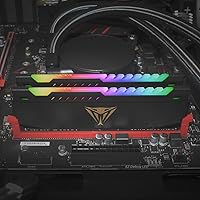
The Patriot Viper Steel RGB 16GB DDR4 RAM entered the market in late 2020 as a solid mid-tier option for desktop builders who want real performance gains without crossing into enthusiast pricing. The dual-channel 2x8GB setup clocked at 3600MHz is the defining pitch here — fast enough to matter, especially on AMD platforms, but priced where most gaming builders actually shop. It has since earned a reliable reputation across both Intel and AMD systems. Worth being clear upfront, though: this Viper Steel kit is built for dependable daily performance, not for pushing the limits of what DDR4 can do in extreme overclocking scenarios.

Features & Benefits

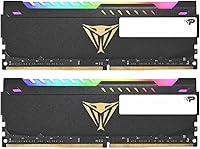
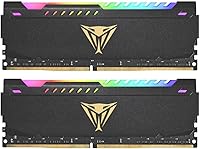
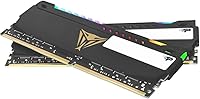
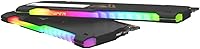
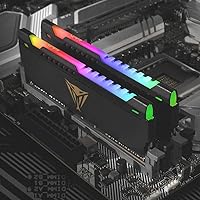
Running at 3600MHz with CL20 timings and a 1.35v draw, this DDR4 memory kit sits at a sensible point on the performance curve. The frequency boost over standard JEDEC speeds translates to real throughput gains, particularly on Ryzen systems where the memory controller thrives at higher clocks. The looser CL20 latency is a fair trade-off for the price, though builders benchmarking competitively will notice the difference against tighter alternatives. XMP 2.0 handles the overclock automatically — one BIOS toggle and you are done. The black aluminum heat shield looks purposeful and keeps things cool under load. The RGB lightbar on top integrates cleanly with ASUS, MSI, ASRock, and Gigabyte ecosystems, covering most mid-range build scenarios without any real configuration effort.

Best For

This Viper Steel kit makes the most sense for AMD Ryzen builds — 3600MHz has long been the Ryzen memory sweet spot, and this kit hits it without requiring manual tuning. First-time builders will appreciate how straightforward the XMP process is: no spreadsheet of sub-timings required. If your board is from ASUS, MSI, ASRock, or Gigabyte, the RGB sync is a low-effort bonus that pulls a build together visually. On the other hand, if you are chasing benchmark scores or running a high-end platform with room for tighter timings, the CL20 spec is worth weighing against alternatives before committing, since more aggressively tuned kits exist at comparable prices.

User Feedback

Over 2,200 buyers have weighed in on the Viper Steel RGB, landing it at a 4.6-star average — a score that has held up consistently rather than fading after an initial wave of reviews. Its #415 rank in Computer Memory on Amazon reflects steady, ongoing demand from real builders. Positive feedback clusters around hassle-free XMP activation and stable everyday operation. Criticism is narrower: some users report instability at rated speeds on specific boards, and occasional RGB software conflicts do surface. Most of these trace back to compatibility edge cases rather than defective hardware, so checking the manufacturer QVL list before purchasing will head off the majority of potential issues.

Pros

  • 3600MHz rated speed is a practical performance upgrade over standard JEDEC-spec DDR4 kits.
  • XMP 2.0 support means hitting the rated speed requires a single BIOS change — no manual tuning needed.
  • Dual-channel 2x8GB configuration maximizes memory bandwidth out of the box.
  • Low 1.35v operating voltage supports stable long-term operation and keeps thermals in check.
  • RGB sync works reliably with ASUS, MSI, ASRock, and Gigabyte motherboard apps without extra setup.
  • Aluminum heat shield does real thermal work while giving the sticks a clean, purposeful look.
  • Broad Intel and AMD platform compatibility reduces pre-purchase compatibility research.
  • A 4.6-star average across over 2,200 ratings reflects consistent real-world satisfaction.
  • Ranks inside the top 500 in Computer Memory on Amazon, signaling sustained buyer trust.
  • Offers a solid entry point into RGB-equipped DDR4 without a significant price premium.

Cons

  • CL20 latency is noticeably looser than competing kits in the same price range that offer CL16 or CL18.
  • Some users report XMP instability at rated speed on specific motherboard and CPU combinations.
  • RGB software conflicts have been flagged by a minority of users, particularly on mixed-brand setups.
  • 16GB total capacity may feel restrictive within a year or two as gaming and software demands climb.
  • Manual overclocking headroom beyond the XMP profile is limited compared to higher-binned alternatives.
  • Buyers outside the four supported RGB ecosystems get no lighting control benefits from the lightbar.
  • Checking the QVL list is strongly recommended — compatibility is not guaranteed on every supported platform.
  • The gold Viper logo aesthetic will not appeal to builders going for a minimalist or all-black look.

Ratings

The scores below reflect an AI-driven analysis of thousands of verified global buyer reviews for the Patriot Viper Steel RGB 16GB DDR4 RAM, with spam, bot-generated, and incentivized feedback actively filtered out before scoring. Each category is weighted against real-world usage patterns across a diverse range of desktop builds and use cases. Both the genuine strengths and the honest pain points are factored in — nothing is smoothed over.

Value for Money
88%
Most buyers feel the price-to-performance ratio is one of the strongest arguments for this kit. Getting dual-channel DDR4 at 3600MHz with RGB included — without paying enthusiast-tier prices — is a combination that holds up well against competing options at similar price points.
A small but vocal group of buyers noted that tighter-timed alternatives occasionally go on sale at comparable prices, which makes the CL20 latency harder to justify by pure numbers. For purely budget-focused shoppers, non-RGB kits at the same speed can undercut it.
Performance
81%
19%
Running at 3600MHz delivers a real, measurable jump over JEDEC default speeds — especially on Ryzen builds where the memory controller responds well to higher frequencies. Daily gaming and multitasking feel snappy, and users rarely encounter bottlenecks attributable to the RAM itself.
The CL20 latency is the persistent asterisk in performance discussions. In latency-sensitive benchmarks, this DDR4 memory kit trails CL16 and CL18 alternatives, and enthusiasts doing direct comparisons will notice. It is a mid-range performer, not a top-tier one.
XMP Reliability
74%
26%
For the majority of users, enabling XMP 2.0 is genuinely painless — one BIOS toggle and the kit boots cleanly at 3600MHz without any further intervention. First-time builders in particular praised how confidently the kit held the rated speed across standard Intel and AMD configurations.
A meaningful minority of buyers ran into XMP instability, ranging from occasional crashes to full failure to post at rated speed on specific board and CPU pairings. These issues are concentrated on less common motherboard revisions, but they are real enough to warrant checking the QVL before purchasing.
RGB Quality
79%
21%
The top-mounted lightbar produces clean, even illumination that reads well through tempered glass side panels. Users with ASUS, MSI, ASRock, or Gigabyte boards found the sync integration worked on first try in most cases, adding a cohesive visual touch without requiring any dedicated Patriot software.
A portion of users reported inconsistent RGB behavior after system sleep or cold boot cycles, requiring a software refresh to restore lighting states. Those on motherboard platforms outside the four supported ecosystems get no sync functionality, leaving them with a static default cycle they cannot customize.
Compatibility
77%
23%
The Viper Steel RGB handles a broad range of Intel and AMD desktop platforms confidently, and most users slot it in without incident. Its track record across Ryzen 5000 and recent Intel Core generations gives it practical versatility that newer or more niche kits sometimes lack.
Edge-case compatibility failures do surface often enough to be a documented concern, particularly with certain B-series AMD boards and some budget Intel motherboards. The fix is usually a BIOS update or manual timing entry, but it adds friction that plug-and-play buyers are not expecting.
Build Quality
86%
The aluminum heatspreader feels solid in hand and looks purpose-built rather than decorative. Several users who have swapped RAM kits across multiple builds noted that the Viper Steel RGB holds up without any visible wear, flex, or contact pin degradation over extended use.
A few buyers felt the heatspreader finish showed micro-scratches more readily than expected after handling during installation. The gold Viper logo is a stylistic choice that not everyone appreciates, and there is no matte or neutral colorway option for builders going for a cleaner look.
Ease of Installation
91%
The physical installation is as straightforward as DDR4 gets — standard UDIMM form factor, clearly marked notch alignment, and a satisfying click into place. Buyers with zero prior build experience consistently described the hardware side as one of the easiest parts of their first PC build.
The only friction comes after physical installation, when new builders sometimes miss the XMP enable step in BIOS and wonder why their system is running at lower speeds. This is a user education gap rather than a hardware flaw, but it generates a recurring category of confused early reviews.
Thermal Management
83%
Operating at 1.35v keeps heat output modest, and the aluminum heatspreader does a competent job dissipating what warmth the sticks do generate under sustained workloads. Users running memory-intensive tasks for extended sessions rarely reported thermal throttling or heat-related instability.
In tight cases with limited airflow, the heatspreader alone provides modest but not exceptional thermal headroom compared to higher-end kits with more aggressive fin designs. It is not a concern under normal gaming conditions, but dense workstation workloads in poorly ventilated cases could stress it.
Long-Term Stability
84%
The broad consensus from buyers who have used this DDR4 memory kit for a year or more is that it runs reliably without degradation. Stability scores on stress-testing tools like MemTest86 are consistently clean for the vast majority of users once the kit is properly seated and XMP is dialed in.
The small subset of users who experienced XMP instability from the start often found the issue persisted even after troubleshooting, suggesting a compatibility ceiling with certain platform combinations that does not resolve cleanly. Long-term stability is strong for compatible systems, less predictable for others.
Aesthetics
78%
22%
The black heatspreader with gold Viper branding and a top-mounted RGB bar fits naturally into most gaming-oriented mid-tower builds. The lighting diffusion is smooth rather than harsh, and the overall profile is compact enough not to clash with adjacent components.
The gold logo is a divisive design choice — builders going for an all-black or stealthy aesthetic will find it harder to ignore than in product photos. There is also no height-variant or low-profile version for ultra-compact builds with strict clearance constraints.
Software Integration
69%
31%
Within the supported RGB ecosystems, the Viper Steel RGB integrates cleanly without requiring a standalone Patriot application. Users who already run ASUS Aura Sync or MSI Mystic Light found the sticks appeared in their dashboard automatically during first setup.
Outside those four ecosystems, software control is simply absent. Even within supported platforms, some users encountered sync dropouts after driver updates that required re-pairing. Patriot does not offer its own lighting software as a fallback, which limits options when motherboard apps misbehave.
Overclocking Headroom
62%
38%
For buyers who are content to run the XMP profile and leave it there, the kit performs exactly as rated. Some users with high-end AMD platforms managed minor sub-timing tightening beyond the XMP defaults, which yielded modest latency improvements without sacrificing stability.
As an overclocking platform this kit has a relatively low ceiling. Pushing significantly beyond the rated XMP profile tends to hit a wall quickly, and the CL20 base timings leave limited room for the kind of manual tuning that enthusiasts expect from a kit positioned in this speed category.
Packaging & Delivery
87%
The kit arrives in a clean retail blister pack that protects the sticks well in transit. Buyers ordering directly from reputable sellers reported no DOA incidents at a meaningful rate, and the packaging presentation feels appropriate for a product sitting above the budget tier.
The packaging itself is fairly minimal — no extras like installation guides, cable ties, or QVL reference cards that some competing brands include. A few buyers receiving third-party fulfilled orders noted minor dents to the outer packaging, though the sticks inside were unaffected.

Suitable for:

The Patriot Viper Steel RGB 16GB DDR4 RAM is a strong pick for anyone building or upgrading a mid-range gaming desktop, particularly on AMD Ryzen platforms where 3600MHz hits a well-documented performance sweet spot for the memory controller. First-time builders will feel at home here — XMP 2.0 makes hitting the rated speed as simple as toggling one BIOS option, with no manual timing adjustments required. If your motherboard comes from ASUS, MSI, ASRock, or Gigabyte, the RGB lightbar will sync into your existing ecosystem without extra software headaches. Budget-conscious builders who want a dual-channel 2x8GB configuration without overspending on enthusiast-tier branding will find the value proposition genuinely compelling. It also suits anyone who wants a visually cohesive build without treating lighting as the main event.

Not suitable for:

Builders chasing tight latency performance should look elsewhere — the CL20 timings on the Patriot Viper Steel RGB 16GB DDR4 RAM are reasonable for the price tier, but competing kits at similar prices offer CL16 or CL18 profiles that deliver meaningfully better latency in benchmarks and latency-sensitive workloads. Workstation users or content creators running memory-intensive applications like video editing or 3D rendering may find 16GB limiting as a long-term ceiling, especially as software demands grow. Enthusiast overclockers who want to push sub-timings manually and squeeze out every ounce of performance will likely feel constrained by the headroom this kit offers. Users on non-mainstream motherboards or older platform variants should verify QVL compatibility carefully, since XMP instability at rated speed has been reported on certain board and CPU combinations. If RGB lighting is not part of your build plan at all, you can probably find equivalent raw performance at a lower cost from a non-illuminated alternative.

Specifications

  • Capacity: The kit provides 16GB of total memory across two 8GB UDIMM modules configured for dual-channel operation.
  • Memory Type: Both modules use DDR4 SDRAM, the standard desktop memory technology for Intel and AMD platforms released through the early 2020s.
  • Rated Speed: The kit is rated at 3600MHz when operating under the XMP 2.0 profile.
  • Latency: Primary latency is CL20, which represents a standard timing profile for DDR4 kits operating in the 3600MHz range.
  • Voltage: Operating voltage is 1.35v, which sits below the 1.5v ceiling common in older DDR4 kits and supports stable low-heat operation.
  • Form Factor: Each module is a standard UDIMM, compatible with full-size ATX, Micro-ATX, and Mini-ITX desktop motherboards that accept DDR4.
  • XMP Support: XMP 2.0 is supported, allowing the motherboard BIOS to automatically apply the 3600MHz profile without manual timing configuration.
  • RGB Compatibility: The top-mounted RGB lightbar is compatible with ASUS Aura Sync, MSI Mystic Light, ASRock Polychrome Sync, and Gigabyte RGB Fusion software.
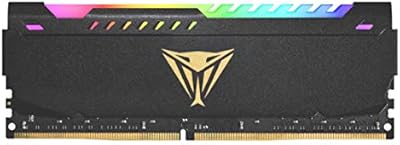
  • Heatspreader: Each stick is fitted with a low-profile aluminum heat shield finished in black with a gold Viper logo along the side.
  • Dimensions: Each module measures 0.28 x 5.31 x 1.73 inches, keeping it within standard clearance for most CPU coolers.
  • Weight: The total kit weighs approximately 1.69 ounces, typical for a dual-stick DDR4 package with heatspreaders.
  • Platform Support: The kit has been tested for compatibility across current Intel and AMD desktop platforms, including Ryzen 5000 and 12th/13th Gen Intel Core series.
  • Module Count: The kit ships as two individual 8GB sticks, intended to be installed in matching slots for dual-channel bandwidth.
  • Series: This kit belongs to the Patriot Viper Steel RGB lineup, model number PVSR416G360C0K.
  • Release Date: The kit was first made available in November 2020 and has remained in active distribution since.

Related Reviews
Patriot Viper Steel RGB 16GB DDR4 RAM
80%
93%
Setup & Installation
91%
Stability & Reliability
78%
Value for Money
74%
Memory Performance
82%
RGB Lighting Quality
More
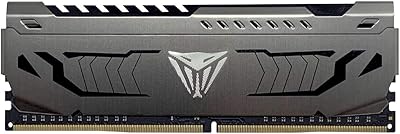
Patriot Viper Elite II 16GB DDR4 RAM
78%
88%
XMP Profile Reliability
83%
Value for Money
67%
Compatibility Range
71%
Single-Channel Trade-off
81%
Heat & Thermal Performance
More
Patriot Viper Steel DDR4 RAM 64GB (2x32GB) 3200MHz CL16
87%
92%
Gaming Performance
89%
System Stability
88%
Compatibility
84%
Ease of Installation
90%
Overclocking Potential
More
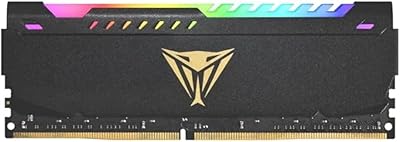
Patriot Viper Elite II DDR4 RAM 16GB 2666MHz CL16
87%
88%
Performance
94%
Ease of Installation
85%
Overclocking Capability
92%
Compatibility with Desktop Systems
91%
Energy Efficiency (1.2V)
More
Patriot Viper Steel RGB DDR4 64GB (2 x 32GB) 3600MHz CL 19-19-19-43 UDIMM
87%
88%
Performance for Gaming
85%
Multitasking Efficiency
91%
Ease of Installation
92%
RGB Lighting Customization
87%
Overclocking Capability (XMP 2.0)
More
Patriot Viper Elite II 16GB DDR4 RAM
81%
91%
Value for Money
94%
Installation Ease
86%
XMP Performance
93%
System Stability
88%
Thermal Performance
More
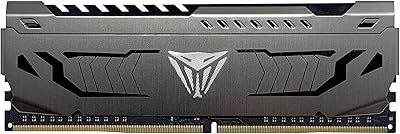
KingBank RGB DDR4 16GB (2x8GB) 3200MHz RAM
86%
91%
Performance
88%
RGB Lighting Customization
87%
Overclocking Ease
84%
Heat Dissipation
92%
Compatibility (Intel & AMD)
More
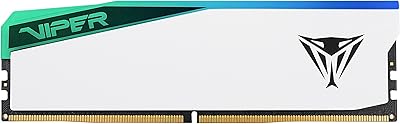
Patriot Viper Steel DDR4 32GB (2x16GB) 3600MHz
88%
90%
Performance
88%
Ease of Installation
91%
Overclocking Performance
89%
Gaming Performance
85%
Build Quality
More
Patriot Viper Elite 5 16GB DDR5 RAM
70%
78%
Speed & Performance
84%
XMP & EXPO Setup
71%
Platform Compatibility
74%
Value for Money
47%
Spec Accuracy & Transparency
More
Patriot Memory Viper 3 DDR3 16GB (2x8GB) 1866MHz CL10 UDIMM RAM
85%
91%
Performance in Gaming
88%
Overclocking Capability
87%
Value for Money
65%
Heat Management
90%
System Stability under Load
More

FAQ

It will not run at 3600MHz automatically — out of the box, your system will default to a lower JEDEC-standard speed. To hit the rated speed, go into your BIOS and enable the XMP profile. It is usually a single toggle and takes about 30 seconds. After a reboot, you are running at the full speed Patriot intended.

Yes, and it is actually one of the better fits for Ryzen builds. The 3600MHz speed sits right at the sweet spot for AMD memory controllers, where you get strong bandwidth without stressing the Infinity Fabric. Just make sure your specific motherboard lists this kit or a compatible profile on its QVL page to avoid any XMP hiccups.

The sticks will still light up — they default to a built-in lighting pattern. You just lose the ability to customize or sync colors if your board does not run ASUS Aura Sync, MSI Mystic Light, ASRock Polychrome Sync, or Gigabyte RGB Fusion. For most people, the default cycle looks fine.

Technically yes, but mixing kits is always a bit of a gamble. If you add a different brand or speed, the system may drop both kits to a lower common speed, or you could run into stability issues. The safest move is to buy a second identical kit — same model, same revision — if you plan to expand to 32GB down the line.

For most gaming use cases right now, 16GB is adequate, but the buffer is getting thinner. A handful of recent titles have started recommending 16GB as a minimum, not a comfortable ceiling. If you are building for the long haul or plan to stream or run background apps while gaming, 32GB would give you more breathing room.

It is not a widespread defect, but it does happen on certain motherboard and CPU combinations. If your system crashes or fails to post with XMP enabled, first make sure your BIOS is updated to the latest version. You can also try manually entering the rated timings rather than relying on the XMP profile automatically. Checking Patriot's compatibility list or your motherboard's QVL before purchasing will save you most of this trouble.

Each stick stands 1.73 inches tall, which is fairly standard for a heatspreader-equipped DDR4 module. Most tower coolers and all-in-one liquid coolers should clear this without issue, but if you are running a large low-profile cooler with a wide heatsink base, it is worth double-checking the cooler manufacturer's clearance specs.

It works on both. Patriot has tested the kit across current Intel platforms, and users report stable performance on 12th and 13th Gen Intel Core builds as well as recent Ryzen systems. XMP 2.0 is an Intel-originated standard, so if anything, enabling it on Intel boards is sometimes slightly more straightforward.

This varies by motherboard, but most boards want you to use slots 2 and 4 rather than 1 and 2 for dual-channel operation. Check your motherboard manual — there is usually a diagram showing the recommended slots. Installing them incorrectly will not damage anything, but you will miss out on the dual-channel bandwidth the kit is designed to deliver.

Patriot covers their Viper Steel RAM with a lifetime warranty, which is standard for their Viper line. If a stick fails, you go through their RMA process. User experiences with Patriot support are generally positive for straightforward defect claims, though like most memory manufacturers, they will distinguish between manufacturing failures and issues caused by incompatible platform configurations.

Where to Buy