Overview

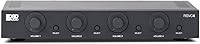
The OSD Audio RSVC4 is a 4-zone speaker selector built for anyone running background music through multiple rooms from a single stereo amplifier. It sits in OSD Audio's lineup as a resistor-based, impedance-matching unit — a practical choice for home installs, small offices, cafes, or any space needing distributed audio without a complex setup. The metal chassis feels reassuringly solid, and it slots into a standard equipment rack or parks neatly on a shelf. One important caveat upfront: this 4-zone audio switch handles a single source only, so buyers hoping to toggle between two amplifiers should look elsewhere before committing.

Features & Benefits

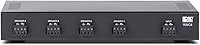
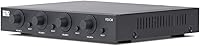
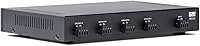
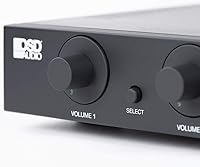
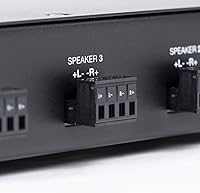
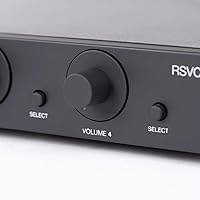
Each of the four zones gets its own rotary volume knob, which means you can dial back the kitchen speakers while leaving the living room at full tilt — no walking back to the receiver. The resistor-based impedance matching is the real workhorse here: it lets you safely connect up to four passive speaker pairs to amplifiers rated down to 2 ohms, handling 160W (2 x 80W RMS) total without stressing the amp. Binding-post terminals on the back accept bare wire, banana plugs, or spade connectors. You can run just one zone, a handful, or all four at once — fully independent control throughout.

Best For

This speaker selector is a strong fit for homeowners who want whole-home background music running off a single receiver — think kitchen, patio, bedroom, and living room all pulling from the same source. Small commercial spaces benefit too: a cafe or gym that does not need elaborate zone scheduling will find the per-zone volume knobs far more practical than adjusting levels at the amp. AV installers will appreciate that no external impedance box is required. DIY first-timers tackling a multi-room audio project also land well here — the wiring is intuitive and the learning curve is genuinely short. Just keep that single-source limitation firmly in mind.

User Feedback

Owners consistently point to the build quality as a standout — the all-metal enclosure feels noticeably sturdier than the plastic-bodied alternatives at this tier. The per-zone volume knobs earn regular praise for the time they save; nobody misses walking back to the receiver to adjust a single room. That said, a few buyers report the knobs feel stiff right out of the box, though most say they loosen with regular use. More notably, some users with discerning ears detect a slight high-frequency roll-off at lower volume settings — an expected trade-off with resistor-based designs. A handful of buyers also wish for dual-source input, which this unit simply does not offer.

Pros

  • All-metal enclosure feels noticeably more durable than plastic competitors at the same price tier.
  • Four independent volume knobs mean you never have to walk back to the amplifier just to adjust one room.
  • Built-in impedance matching protects your amplifier when running multiple speaker pairs simultaneously.
  • Supports any combination of zones — one pair, two, three, or all four — without reconfiguration.
  • Binding-post terminals accept bare wire, banana plugs, and spade connectors right out of the box.
  • Compact footprint fits neatly inside a standard AV rack or on a shelf without dominating the space.
  • Installation is approachable enough for first-time multi-room audio builders with no prior experience.
  • The RSVC4 selector eliminates the need for a separate external impedance matching device, simplifying the overall setup.
  • Passive internal components mean no firmware, no active parts to fail, and stable long-term reliability.
  • Flexible for both residential and light commercial use without requiring any special configuration.

Cons

  • Rotary knobs ship stiff on many units and require days of regular use before turning smoothly.
  • Single-source input only — no ability to switch between two amplifiers or audio sources.
  • Resistor-based attenuation causes audible high-frequency roll-off at lower volume positions.
  • Documentation is minimal; a proper setup guide is essentially absent from the package.
  • Binding-post terminals feel functional but lack the tactile confidence of premium-grade hardware.
  • Not a true rack-mount unit — no included mounting ears or rack-ready hardware.
  • At lower volume settings, some users detect a slight channel imbalance that requires fine-tuning.
  • Power handling ceiling limits usefulness for high-output speaker setups beyond background listening levels.

Ratings

Our AI rating engine analyzed verified global buyer reviews for the OSD Audio RSVC4, actively filtering out incentivized, bot-generated, and low-signal feedback to surface what real users consistently experienced. The scores below reflect both where this 4-zone audio switch genuinely delivers and where it falls short — no inflated praise, no buried complaints. Strengths and pain points are weighted equally so you can make a confident, informed decision.

Build Quality
88%
The all-metal enclosure is the first thing buyers comment on after unboxing — it sits noticeably heavier and sturdier than plastic-bodied competitors in the same category. For rack-mounted installs in a home theater closet or AV cabinet, that solidity translates to long-term confidence rather than creaky, flex-prone hardware.
A small number of users noted that the front panel labeling can look utilitarian up close, and the overall finish, while solid, lacks the refined aesthetic of higher-end rack gear. It is functional rather than premium-looking, which matters if the unit sits in a visible entertainment setup.
Impedance Protection
91%
The resistor-based impedance matching is the core safety feature here, and it performs reliably. Users running budget receivers or older amplifiers report no overheating or protection shutdowns even after months of continuous multi-zone operation — a genuine relief for anyone wary of daisy-chaining speakers without protection.
Resistor-based designs introduce a known trade-off: some buyers with sensitive ears detect a slight dulling of high frequencies, especially at lower volume settings. It is not dramatic, but audiophiles comparing this to a transformer-based selector will notice the difference in treble clarity.
Volume Control Per Zone
93%
Having four independent rotary knobs — one per zone — is the feature buyers return to praise most often. Running dinner music quietly in the dining room while the living room stays at full volume, all without touching the amplifier, is exactly the kind of convenience that justifies the purchase for most home users.
The knobs ship with noticeable stiffness on some units, requiring a break-in period of several days of regular use before they turn smoothly. A handful of buyers found the resistance frustrating enough during initial setup that they questioned whether the unit was faulty.
Ease of Installation
89%
First-time multi-room audio builders consistently highlight how approachable the wiring process is. Binding-post terminals accept bare wire, banana plugs, and spade connectors without adapters, and the rear-panel layout is logical enough that most users complete a four-zone install without consulting a manual more than once.
The included documentation is minimal — essentially a diagram rather than a step-by-step guide. More advanced questions around speaker pairing or amplifier compatibility require users to seek answers externally, which can slow down first-timers who are less comfortable improvising.
Audio Fidelity
71%
29%
For background music in commercial spaces, kitchens, patios, and multi-room residential installs, the audio performance is entirely adequate. Most buyers using this selector for ambient listening report clean, uncolored sound at moderate to high volume settings across all four zones simultaneously.
The resistor-based attenuation does introduce measurable high-frequency roll-off at lower volume positions — a well-documented limitation of this design approach. Users who prioritize critical listening or audiophile-grade transparency will find the sound less faithful compared to transformer-based alternatives.
Zone Flexibility
86%
The ability to activate any single zone, any combination of zones, or all four at once without reconfiguring anything is a practical advantage for dynamic spaces. A gym that needs only the front-floor speakers during off-hours, for example, benefits from simply leaving the other zones turned down rather than disconnected.
The selector is strictly single-source — one amplifier feeds all four zones. Users managing two separate audio sources, such as a turntable and a streaming receiver, cannot switch between them here. That limitation surfaces repeatedly in feedback and catches some buyers off guard post-purchase.
Power Handling
84%
A 160W total rating (2 x 80W RMS) comfortably covers the vast majority of passive bookshelf and in-ceiling speakers used in residential and light commercial installs. Users pairing this selector with mid-wattage receivers report no clipping or strain even when all four zones run simultaneously at moderate levels.
For users driving high-efficiency outdoor speakers or large floor-standers, the 80W-per-channel ceiling can feel limiting during louder social events. The selector is sized for background-level listening rather than high-output party scenarios, and buyers should calibrate expectations accordingly.
Amplifier Compatibility
87%
Compatibility with amplifiers rated as low as 2 ohms makes this selector unusually flexible for its tier. Owners of budget integrated amplifiers and older AV receivers — which often lack impedance safeguards — report being able to run four speaker pairs without triggering protection circuits or causing audible distortion.
The selector does not support multi-room receivers with dedicated speaker-selector outputs that already manage impedance internally. In those configurations, double impedance correction can actually degrade performance, and a few technically informed buyers flagged this as a setup trap for uninformed users.
Form Factor & Rack Fit
82%
18%
The compact dimensions make it genuinely versatile — it drops neatly into a standard equipment rack in a media closet or sits flat on a shelf without dominating the space. The weight feels proportional to the metal build, and the footprint is small enough that installers can tuck it alongside other components without cable-management headaches.
It is not a true 1U rack unit by strict AV rack standards, so buyers expecting clean rack alignment with ears and screws will need to improvise a mounting solution. The physical dimensions work, but the unit is not designed with rack-mounting hardware included.
Terminal & Connector Quality
79%
21%
The binding-post terminals on the rear accept a solid range of connector types — bare wire, banana plugs, and spade terminals — without adapters. Users who run banana-terminated cables throughout their home wiring report clean, snug connections that do not loosen over time with normal handling.
The binding posts feel adequate rather than robust. Compared to higher-end selectors with gold-plated or larger-diameter posts, these have a functional but slightly plasticky action when tightening, which gives pause to installers who prefer the confidence of premium-grade terminations.
Value for Money
83%
At its mid-range price point, this 4-zone audio switch delivers a feature set — built-in impedance matching, independent zone volume, and solid metal construction — that would otherwise require buying a basic selector plus a separate impedance protection device. For buyers on a realistic home-audio budget, that consolidation has clear appeal.
The pricing sits noticeably above the cheapest plastic speaker selectors, which do not offer impedance protection but cost a fraction of the price. Buyers who are not planning to connect more than two speaker pairs, or who already own an impedance-safe amplifier, may find the premium harder to justify.
Single-Source Limitation
58%
42%
For users with a single amplifier or receiver — which covers most residential background-music scenarios — the single-source topology is completely invisible as a limitation. The selector does exactly what it promises in those setups, and the constraint simply never becomes relevant.
Anyone wanting to route two audio sources — a TV and a turntable, for instance — to the same speaker zones is immediately blocked. This is not a workaround-friendly limitation; it requires either a separate source-switching device upstream or a different product entirely. Several buyers discovered this only after purchase.
Long-Term Reliability
81%
19%
The metal construction and passive resistor-based internals mean there are no active components to burn out or firmware to update. Users who have owned the unit for a year or more consistently report stable performance with no degradation in switching behavior or terminal contact quality.
The rotary knobs remain the most cited long-term concern — stiffness that does not fully resolve for some units, and occasional channel imbalance at very low volume positions after extended use. Nothing catastrophic, but worth monitoring in high-traffic commercial deployments where knobs are adjusted frequently.

Suitable for:

The OSD Audio RSVC4 is purpose-built for anyone running a single amplifier or receiver and wanting to push audio into multiple rooms without the complexity of a full multi-zone system. Homeowners who want background music in the kitchen, patio, bedroom, and living room simultaneously — all controlled from one spot — will find the per-zone volume knobs genuinely useful in daily life. Small commercial spaces like independent cafes, yoga studios, waiting rooms, and small gyms are an equally natural fit, especially where staff need to nudge individual zone levels without accessing the back-of-house equipment rack. DIY enthusiasts tackling their first distributed-audio project will appreciate that impedance protection is already baked in, removing one of the more intimidating variables from the planning process. AV installers looking for a clean, rack-friendly solution that avoids the extra cost and wiring of a standalone impedance matching box will find this selector a practical time-saver on straightforward residential jobs.

Not suitable for:

Buyers who need to route two separate audio sources — say, a streaming receiver in one room and a turntable in another — to the same speaker zones will hit an immediate wall with this 4-zone audio switch, as it strictly supports a single input source with no workaround. Audiophiles or critical listeners who prioritize transparent high-frequency reproduction should also think carefully before committing: the resistor-based design introduces measurable treble roll-off at lower volume settings, which is inherent to the technology rather than a defect that varies by unit. Anyone building a system that eventually needs more than four zones will outgrow this selector faster than expected, since there is no daisy-chaining path to expand zone count cleanly. Users pairing this with a high-output amplifier and large floor-standing speakers for louder, party-level listening may find the 80W-per-channel ceiling constraining. And buyers expecting true 1U rack-mount integration with included ears and hardware will need to improvise, as the unit is rack-friendly in size but not rack-ready in hardware terms.

Specifications

  • Brand: Manufactured by OSD Audio, a brand specializing in distributed audio and home installation equipment.
  • Model: The unit carries the model designation RSVC4, identifying it as a 4-zone resistor-based volume-control selector in the OSD Audio lineup.
  • Zones: Supports four independent speaker zones, each individually switchable and volume-adjustable from the front panel.
  • Power Handling: Rated at 160W total (2 x 80W RMS), compatible with a wide range of passive bookshelf, in-ceiling, and outdoor speakers.
  • Impedance Matching: Uses a resistor-based impedance matching circuit to maintain safe load levels for amplifiers rated down to a 2-ohm minimum.
  • Source Inputs: Accepts a single stereo audio source input; dual-source or multi-source switching is not supported.
  • Volume Control: Features four independent front-panel rotary knobs, one per zone, for individual level attenuation without adjusting the amplifier.
  • Speaker Terminals: Rear-panel binding posts accept bare wire, banana plugs, and spade connectors for flexible speaker cable termination.
  • Enclosure Material: Constructed from metal cast material, providing structural rigidity and resistance to flex compared to plastic-chassis alternatives.
  • Dimensions: Measures 15.75 x 12.24 x 3.58 inches, sized to fit on a tabletop, inside a cabinet, or within an equipment rack.
  • Weight: Weighs 4.25 pounds, reflecting the density of its metal enclosure rather than lightweight plastic construction.
  • Rack Compatibility: Form factor is compatible with standard equipment racks and AV cabinets, though dedicated rack-mount ears are not included.
  • Color: Available in black, suited for blending into standard AV rack or media cabinet environments.
  • Zone Operation: Allows any single zone, any combination of zones, or all four zones to operate simultaneously from the same source.
  • Connector Type: Classified as a speaker selector type, handling passive speaker-level signals rather than line-level or digital audio signals.
  • Compatible Devices: Works with any standard stereo amplifier or AV receiver with speaker-level outputs rated within the unit's power handling specification.
  • Date Available: First made available for purchase on August 29, 2019, indicating an established product with a multi-year sales and review history.
  • BSR Ranking: Holds a Best Sellers Rank of #435 in the Audio and Video Selector Boxes category on Amazon at time of review.

Related Reviews
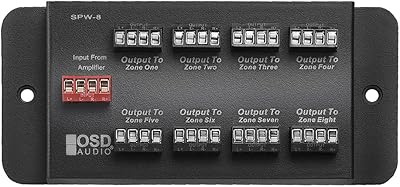
OSD Audio SPW-8 8-Zone Speaker Distribution Panel
77%
91%
Ease of Installation
74%
Build Quality
61%
Impedance Handling
88%
Value for Money
83%
Audio Signal Quality
More
OSD Audio SMP300 Subwoofer Amplifier
76%
74%
Value for Money
88%
Input Flexibility
81%
Crossover & Tuning Controls
86%
Heat Management
83%
Ease of Installation
More
OSD Audio IWS8 In-Wall Subwoofer
84%
89%
Bass Performance
78%
Installation Ease
93%
Space-Saving Design
84%
Sound Clarity
87%
Build Quality
More
OSD Audio IWS10 In-Wall Subwoofer 10″
84%
87%
Sound Quality
90%
Bass Performance
78%
Ease of Installation
85%
Value for Money
92%
Design & Aesthetics
More
OSD Audio XSUB12 12″ Outdoor Subwoofer
85%
90%
Sound Quality
88%
Weather Resistance
85%
Installation Flexibility
92%
Bass Depth & Clarity
75%
Size & Dimensions
More
OSD Audio Forza 10 Outdoor Subwoofer
77%
88%
Bass Performance
91%
Build Quality
86%
Weather Resistance
58%
Ease of Setup
72%
Value for Money
More
OSD Audio RX805 8″ Outdoor Rock Speakers
74%
92%
Aesthetic Integration
83%
Weather & Durability
74%
Sound Quality
78%
Bass Performance
58%
Setup & Installation
More
OSD Audio Pre-1 Stereo Preamplifier
79%
83%
Build Quality
76%
Sound Quality
72%
Phono Stage
51%
Mic Preamp Quality
81%
Tone Controls
More
OSD Audio AP490 Outdoor Patio Speakers Pair
87%
88%
Sound Quality
91%
Ease of Installation
89%
Build Quality
93%
Durability (Weather Resistance)
85%
Sound Clarity Outdoors
More
OSD Audio Forza 8 Outdoor Subwoofer
73%
91%
Weather & Moisture Resistance
88%
Sound Dispersion
84%
Build Quality & Materials
67%
Bass Output & Performance
58%
Installation Experience
More

FAQ

No — the OSD Audio RSVC4 is strictly a single-source device, meaning it takes one stereo amplifier input and distributes it across up to four speaker zones. If you need to switch between two sources, you would need a separate source-selector device upstream of this unit.

That is exactly what the built-in impedance matching is designed to prevent. The resistor-based circuit keeps the load presented to your amplifier within a safe range even with all four zones active simultaneously, which protects receivers that are not rated for low-impedance multi-speaker loads.

Yes, each of the four rotary knobs on the front panel controls only its corresponding zone. You can run zone one at full volume, zone two at half, and leave zones three and four silent — all at the same time, without touching your amplifier.

This is a widely reported out-of-box characteristic rather than a defect. Most users find the knobs loosen noticeably after several days of regular use. If stiffness persists beyond a few weeks of normal operation, that would be worth raising with OSD Audio support.

It works with any passive speakers — in-ceiling, in-wall, outdoor, or bookshelf — as long as they fall within the 160W total (2 x 80W RMS) power handling range and are connected via the binding-post terminals on the rear panel.

For background music listening at moderate to high volume, most users hear no meaningful difference. However, the resistor-based design does introduce a slight high-frequency roll-off at lower volume positions, which is a known trade-off with this type of circuit. Critical listeners or audiophiles comparing this directly to a transformer-based selector may notice the difference.

The dimensions are compatible with standard rack enclosures in terms of width and depth, and it sits cleanly inside a rack bay. That said, the unit does not include rack-mount ears, so you would need to source a rack shelf or mounting bracket separately for a clean fixed installation.

The binding-post terminals on the rear accept bare wire twisted and inserted directly, banana plugs, and spade connectors — so most standard speaker cable terminations will work without adapters or modifications.

It is specifically designed to work with budget and mid-range receivers, including those that would otherwise struggle with the low impedance load of multiple speaker pairs. The impedance matching circuit is the key feature for protecting entry-level amplifiers that lack built-in speaker-selector support.

None at all — this is a fully passive, analog device with no software, apps, or power supply required. You wire your amplifier to the input, connect your speakers to each zone output, and the front-panel switches and knobs handle everything from there.