Overview

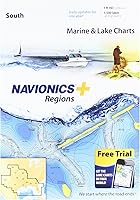
The Navionics Plus South Region Marine Lake Chart SD Card is a navigation solution built for serious boaters and anglers working the southern U.S. — from Gulf coastal waters out to Bimini and West End, down through more than 1,400 lakes spread across twelve states including Texas, Florida, Louisiana, and Mississippi. The card slots directly into most chartplotters in SD or MSD format, so setup takes seconds. Bundled with the card is daily updates for one year, keeping your charts current without any extra effort. This is premium-tier chart data, not a budget product — and it performs accordingly.
Features & Benefits

The standout feature here is 1-foot HD SonarChart bathymetry — that means depth contour maps drawn at one-foot intervals, which makes a real difference when you're fishing shallow flats or navigating tight channels. Those contours are refreshed daily using sonar logs contributed by fellow boaters, so the maps actually reflect current conditions rather than a snapshot from five years ago. On freshwater lakes, you get structure detail that anglers care about: creek channels, brush piles, roadbeds, and culverts. Tides and currents data is baked in for coastal work, and Community Edits layer in crowd-sourced local knowledge — marinas, ramps, hazards — that official charts simply don't carry.

Best For

This chart card is squarely aimed at anglers fishing southern reservoirs — think bass, crappie, and catfish lakes in Texas, Florida, and Louisiana where water levels and bottom structure shift seasonally. If you trailer your boat across multiple states, having one card covering twelve states is genuinely convenient. Coastal cruisers heading toward the Bahamas or threading Gulf inlets will appreciate the detailed marine coverage. It's also a strong upgrade for anyone whose plotter is still running factory-installed maps, which tend to lag years behind real conditions. If the southern U.S. is your water, this marine chart is built around your needs.

User Feedback

Most buyers call out two things immediately: the accuracy of lake contours and how painless the installation is — slide the card in, power up the plotter, and you're ready to go. Anglers frequently note that the freshwater structure detail holds up well against competing chart brands for southern lakes specifically. On the downside, the one-year update period does not renew for free, and that ongoing cost catches some owners off guard. The more pressing concern, though, is plotter compatibility — this card does not work with every brand or model, and a notable share of returns come from buyers who skipped that check. Verify your device before purchasing.

Pros

  • One-foot HD depth contours give anglers a real edge when reading unfamiliar lake structure.
  • Daily chart updates keep this marine chart more current than most competitors on the market.
  • Coverage spans twelve southern states, making it genuinely useful for multi-state boaters.
  • Plug-and-play SD format means setup takes seconds on compatible chartplotters.
  • Community Edits add local hazard and marina data that official hydrographic charts rarely include.
  • Integrated tides and currents data supports safer planning for coastal and inlet navigation.
  • Freshwater fishing detail — creek channels, brush piles, culverts — is unusually thorough for a chart card.
  • Highly rated by anglers specifically for southern reservoir accuracy compared to rival chart brands.
  • One year of daily updates is bundled with purchase, delivering ongoing value from day one.

Cons

  • Compatibility is not universal — buyers must verify their specific plotter model before purchasing.
  • Update subscription requires renewal fees after the first year, adding long-term cost.
  • Regional scope excludes all waters outside the twelve covered southern states.
  • Users who rarely update their plotter lose much of the core value proposition over time.
  • Advanced features like Dock-to-Dock Autorouting are locked to select Raymarine models only.
  • No printed documentation or setup guide is included — first-time Navionics users may face a learning curve.
  • Subscription renewal pricing is not fixed and may increase over time without notice.
  • The physical card is extremely small and easy to lose if not stored carefully when not in use.

Ratings

Our AI rating system analyzed thousands of verified global reviews for the Navionics Plus South Region Marine Lake Chart SD Card, actively filtering out incentivized, duplicate, and bot-generated submissions to surface what real boaters and anglers actually experience on the water. Scores reflect an honest synthesis of both what users celebrate and what genuinely frustrates them, so you can make a clear-headed decision before buying.

Chart Accuracy
88%
Anglers consistently praise how closely the lake contours match actual bottom structure — particularly on southern reservoirs in Texas, Florida, and Louisiana. Boaters who have run the same lakes for years report that SonarChart depth lines align well with real-world features like creek channel drops and submerged points.
A small but vocal group of users fishing less-trafficked or newer reservoirs find contour detail thinner than expected, since SonarChart accuracy depends heavily on how many community sonar logs exist for that specific body of water.
Freshwater Fishing Detail
91%
The granular structure data — brush piles, culverts, roadbeds, creek channels — gives freshwater anglers a real competitive edge when targeting bass and crappie on unfamiliar lakes. Many users describe finding productive spots they would never have located without this level of underwater mapping.
Coverage depth varies between lakes; high-traffic reservoirs in FL and TX tend to be extremely detailed, while smaller or less-popular lakes in states like NE or NM may feel sparse compared to what southern anglers expect from a premium chart card.
Marine Coverage
84%
Coastal boaters navigating Gulf waters, inlets, and runs toward Bimini report that the marine charts hold up well in real conditions, with accurate shoreline detail and hazard markers that match on-water observations. The extension to West End and Bimini is a genuine plus for offshore and Bahamas-bound cruisers.
A handful of coastal users note occasional lag in reflecting very recent inlet or sandbar changes, even with daily updates active — a limitation inherent to any chart system that relies on data contribution cycles rather than real-time satellite input.
Update System
79%
21%
The daily update cadence is one of the more tangible advantages over static chart cards, and most users who actively sync their plotter notice a meaningful improvement in chart freshness over time. Community Edits in particular add local knowledge — new hazards, closed ramps, shifted buoys — that official charts rarely capture quickly.
The update system requires internet access and an active subscription, and after the first year renewal fees kick in. Users who do not regularly connect their plotter to Wi-Fi or the Navionics app effectively lose the primary benefit that justifies the premium price point.
Ease of Installation
93%
Near-universal praise for setup simplicity — slide the card in, power on, and the charts are immediately accessible on compatible plotters. First-time Navionics users and experienced chartplotter operators alike describe it as one of the easiest hardware upgrades they have made on their boat.
The simplicity breaks down when a buyer has not verified compatibility in advance; on unsupported devices the card simply does not load, which feels like a complete failure even though it is a pre-purchase research gap rather than a product defect.
Device Compatibility
62%
38%
For boaters who own supported Humminbird, Lowrance, Garmin, or Raymarine units, the card integrates cleanly without any driver installation or setup beyond the physical insertion. Navionics has a wide compatibility list that covers most mainstream plotters sold in North America.
Compatibility is the single biggest source of negative reviews, with buyers discovering after purchase that their specific plotter model is not supported. The burden of checking the compatibility list falls entirely on the buyer, and the consequences of skipping that step are a frustrating return process.
Value for Money
71%
29%
For active boaters who fish across multiple southern states and regularly sync updates, the regional coverage across twelve states represents solid value compared to buying multiple single-lake or single-region charts separately. The bundled first-year update subscription adds meaningful ongoing utility.
Casual boaters or those who use charts infrequently may find it hard to justify the price, especially when renewal fees are factored in beyond year one. The cost-per-use calculation shifts significantly depending on how often you actually update and how many of the covered states you navigate.
Coastal Navigation Data
82%
18%
Tides, currents, and detailed shoreline data including docks, marinas, and ramp locations give coastal cruisers a well-rounded dataset for planning and executing passages. Boaters heading into unfamiliar Gulf inlets report that the hazard and shallow-water markers provide useful early awareness.
Some experienced coastal navigators note that the marine chart detail, while solid, does not dramatically exceed what competing premium chart brands offer in the same region — it is very good but not uniquely dominant for purely coastal use compared to freshwater fishing, where it stands out more clearly.
Community Edits Quality
76%
24%
The crowd-sourced layer adds genuinely useful real-world context that static official charts lack — things like newly dredged ramps, seasonal hazards, or updated fuel dock hours. Boaters in heavily trafficked areas like Central Florida or the Texas Gulf Coast benefit most from the density of local contributions.
Community Edit quality is inherently uneven and depends on how active local boaters are in contributing. In rural or lightly trafficked areas, the layer can feel thin or outdated, which undermines confidence in its usefulness for less-popular waterways.
SonarChart Live
73%
27%
For anglers who want to map their own private or underpublished fishing holes in real time, SonarChart Live is a genuinely useful capability that few competing chart cards offer. Users who contribute sonar logs also help improve chart accuracy for the entire community over time.
SonarChart Live requires a compatible plotter or mobile device, and the resulting maps are only as useful as the sonar hardware providing the input data. Casual users and those without compatible hardware may never engage with this feature at all.
Card Build and Portability
86%
The micro form factor means it adds zero weight or bulk to any setup, and the solid-state design holds up to typical marine environments including humidity and vibration without reported reliability issues under normal use conditions.
The card is small enough to lose easily if removed from the plotter and set aside without a dedicated case. A few users have reported misplacing the card during off-season storage, which is a minor but real inconvenience given the replacement cost.
Raymarine Advanced Features
67%
33%
For Raymarine plotter owners specifically, the addition of Dock-to-Dock Autorouting — which calculates a safe navigable path between two points automatically — adds a layer of convenience that serious cruisers appreciate, particularly in unfamiliar coastal waters.
These advanced features are locked exclusively to select Raymarine models, which means the majority of users on other brands never access them at all. Buyers who purchase partly based on these capabilities without confirming Raymarine compatibility are routinely disappointed.
Freshwater State Coverage
83%
Covering over 1,400 lakes across twelve states in one card removes the frustration of managing multiple region-specific chart purchases for boaters who regularly cross state lines. The breadth of coverage is frequently cited as a primary reason buyers choose this card over narrower alternatives.
The twelve-state scope, while broad for the South, still excludes states bordering the covered region, which can leave multi-state trailering anglers needing a second card for northern or western waters that fall just outside the coverage boundary.

Suitable for:

The Navionics Plus South Region Marine Lake Chart SD Card is an excellent fit for boaters and anglers who spend serious time on southern U.S. waters and need chart data they can actually trust. Bass, crappie, and catfish anglers working Texas, Florida, or Louisiana reservoirs will get the most out of the one-foot depth contours, which reveal bottom structure that general-purpose maps simply skip over. Trailerable boaters who hop between lakes across multiple states — say, hitting Oklahoma one weekend and Mississippi the next — benefit enormously from having a single card covering twelve states without any gaps. Coastal cruisers planning Gulf passages or runs toward the Bahamas will appreciate the detailed marine coverage and the integrated tides and currents data that helps with timing inlets and channels safely. Anyone whose chartplotter is still running the maps it shipped with years ago will notice an immediate, meaningful upgrade in both accuracy and freshness.
Not suitable for:

The Navionics Plus South Region Marine Lake Chart SD Card is not the right buy for everyone, and a few situations are clear dealbreakers. Boaters who primarily navigate northern or mid-Atlantic waters will find the regional coverage irrelevant — this card simply does not include those areas. Buyers who own chartplotters outside the supported device list risk purchasing something they cannot actually use, and that compatibility check must happen before ordering, not after. The ongoing subscription cost for updates beyond the first year is also a genuine consideration; if you are not the kind of boater who updates charts regularly or values real-time community data, a one-time chart purchase from another provider may suit your habits better. Casual, occasional boaters on familiar local water may also find the depth of data here exceeds what they realistically need, making the premium price harder to justify.

Specifications

  • Format: The card ships in SD/MSD dual format, compatible with standard and micro SD chartplotter slots.
  • Dimensions: The physical card measures 1 x 0.1 x 1 inches, making it compact enough to store in a tackle box or chart bag.
  • Weight: The card weighs just 0.16 ounces, adding virtually no bulk to any gear setup.
  • Marine Coverage: Coastal coverage extends from the southern U.S. shoreline out to Bimini and West End in the Bahamas.
  • Lake Coverage: More than 1,400 freshwater lakes are included across AL, AR, FL, GA, KS, LA, MO, MS, NE, NM, OK, and TX.
  • Bathymetry: SonarChart depth contours are rendered at 1-foot HD resolution, providing highly detailed underwater terrain mapping.
  • Update Frequency: Chart data receives daily updates for one full year from activation, drawing on sonar logs from the Navionics boating community.
  • Community Edits: The Community Edits layer incorporates crowd-sourced local data including hazard markers, marina details, dock locations, and boat ramp positions.
  • Tides and Currents: Integrated tides and currents data is preloaded on the card for coastal and inlet navigation planning.
  • Included Data: Preloaded data covers shoals, rocks, wrecks, marinas, docks, boat ramps, roadbeds, brush piles, creek channels, and culverts.
  • SonarChart Live: SonarChart Live functionality allows compatible plotters or mobile devices to generate real-time personal 1-foot HD bathymetry maps while underway.
  • Autorouting: Dock-to-Dock Autorouting, which automatically calculates a safe navigable route between two points, is available on select Raymarine chartplotter models.
  • Plotter Sync: Plotter Sync, which keeps chart data consistent across multiple Navionics-compatible devices, is supported on select Raymarine units.
  • Manufacturer: This chart card is manufactured by Navionics, a Garmin company and one of the most established names in marine cartography.
  • Model Number: The manufacturer part number is 010-C1369-30, which should be cross-referenced against your plotter compatibility list before purchase.
  • First Available: This card was first made available in July 2016 and has received ongoing data and software improvements since release.
  • Discontinuation: As of the latest available product information, this card has not been discontinued by the manufacturer.

Related Reviews
Navionics Plus West Marine Chart SD Card
80%
91%
Chart Detail & Accuracy
88%
Lake Bathymetry
86%
Marine Coverage
74%
Update System
83%
Ease of Setup
More
Navionics Plus North Lakes SD Chart Card
78%
91%
Bathymetric Accuracy
88%
Lake Coverage Breadth
86%
Chartplotter Compatibility
74%
Chart Update System
69%
Community Edits Quality
More
C-MAP M-NA-Y214-MS Reveal Inland US Lakes South East Chart Card
87%
92%
Mapping Detail
89%
Navigation Accuracy
94%
Ease of Use
90%
3D Bathymetric Data
85%
Custom Depth Shading
More
vebiliki H10 Hidden Spy Camera
69%
74%
Video Clarity
71%
Night Vision Performance
77%
Motion Detection Accuracy
81%
Battery Life & Standby
53%
App Experience (UBox)
More
StriVectin SD Advanced™ Plus Intensive Moisturizer 118mL
87%
88%
Effectiveness in Reducing Wrinkles
83%
Stretch Mark Reduction
91%
Hydration & Moisturizing
84%
Skin Texture Improvement
93%
Absorption Speed
More
Avokadol Dual Dash Cam with 32GB SD Card
84%
87%
Video Quality
91%
Ease of Installation
85%
Night Vision Performance
79%
Rear Camera Visibility
88%
Field of View
More
ZTTAOLII Z20 5G Security Camera with 64GB SD Card
87%
88%
Value for Money
93%
Video Quality (4K Resolution)
85%
Battery Life
90%
Ease of Setup
87%
Motion Detection Accuracy
More
LYPXYYDS 1080P Small Nanny Camera Pen with 64GB SD Card
85%
89%
Battery Life
87%
Video Quality
90%
Ease of Use
94%
Design & Portability
78%
Storage Capacity
More
TKECWOB M8 Kids Instant Print Camera
68%
88%
Ease of Use
54%
Print Quality
76%
Value for Money
67%
Build Durability
71%
Battery Life
More
SEMIER Small Cassette Tape Player Converter
73%
86%
Ease of Setup
67%
Audio Conversion Quality
81%
SD Card Recording
58%
Built-in Speaker
63%
Motor Speed Consistency
More

FAQ

Compatibility varies by brand and model, and this is genuinely the most important thing to check before buying. Navionics publishes a compatibility checker on their website where you can enter your exact plotter model. Do not assume it works based on the brand name alone — specific models within a brand can differ, and a mismatch is the most common reason buyers return this card.

The nautical chart and SonarChart data come preloaded on the card, so you can slot it into your compatible plotter and start navigating right away. The daily chart updates and Community Edits require a connection to download over Wi-Fi or via the Navionics app, but the core charts are there from the moment you insert the card.

The charts already on your card do not disappear — you keep whatever data was last downloaded. What you lose is access to new daily updates and fresh Community Edits. Navionics offers a paid renewal subscription if you want to continue receiving updates, but the card remains usable with its existing data indefinitely.

Honestly, if you fish a single lake and never venture elsewhere, the value proposition is harder to justify. This marine chart is built for boaters who cover a wide range of southern waters. For a single-lake angler, a more affordable lake-specific chart or a free app with basic contours might serve just as well — unless that one lake has complex structure where the 1-foot HD contours would make a real difference.

Bathymetry just means underwater depth mapping. SonarChart builds its maps by collecting sonar readings from thousands of boaters who contribute their depth data to Navionics. Those logs are processed and merged to create detailed contour maps showing the shape of the lake or river bottom at 1-foot intervals. The more boaters who fish and contribute data on a given body of water, the more accurate and detailed that lake's map becomes.

The physical SD card is designed for chartplotters, not smartphones. However, Navionics also offers the Navionics Boating app for iOS and Android, which uses a separate subscription model and works with your phone or tablet. The two platforms share some community data but are distinct products, so the SD card itself will not slot into a mobile device.

It covers southern U.S. coastal waters thoroughly, including Gulf Coast regions, and extends marine coverage out to Bimini and West End in the Bahamas. That said, it is a regionally scoped product focused on the southern U.S., so if you need Atlantic coverage north of the included states or Pacific waters, this card will not have those areas.

The preloaded data reflects the state of Navionics charts at the time the card was manufactured, which can vary. Once you activate the card and connect to Wi-Fi, the daily update system will bring the charts up to current within the first sync. Most users find that pulling the first update shortly after receiving the card is a good habit.

It is very small — about the size of a fingernail — so yes, it is easy to misplace if you remove it from the plotter. Keeping it in the plotter slot when in use and in a labeled SD card case when stored is the most practical approach. The card itself is solid-state with no moving parts, so it is reasonably durable under normal handling conditions.

Both are strong options and the comparison comes down to regional depth data quality and your existing hardware ecosystem. Anglers familiar with southern reservoirs often cite the Navionics SD card as having competitive or superior freshwater contour detail for this specific region, particularly on lakes where community sonar contributions are dense. If your plotter is a Garmin unit, BlueChart may offer tighter integration, so it is worth checking both before deciding.