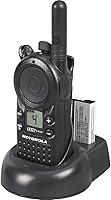
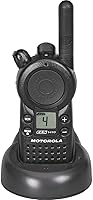
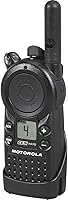
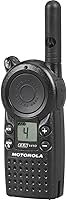
Overview

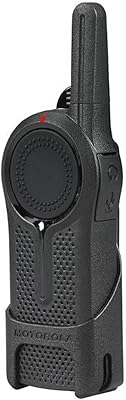
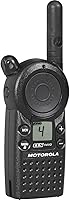
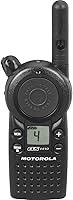
The Motorola CLS1410 UHF Two-Way Radio has been a staple in professional environments since 2005, and the fact that it still sells well today says a lot about its staying power. Unlike the consumer-grade radios you'd grab at a big-box store, this business UHF radio operates on licensed UHF frequencies — which means you'll need an FCC license before you can legally use it. That's a genuine barrier for some buyers, so it's worth knowing upfront. Built for employees who carry a radio all day, not weekend campers, it prioritizes reliability and audio clarity over flashy features or extreme range claims.

Features & Benefits

The CLS1410 runs across 4 channels with access to 56 business-exclusive frequencies, which matters on busy job sites where neighboring businesses often bleed onto shared consumer bands. On top of that, 121 interference eliminator codes — split between digital and analog private lines — give teams a real layer of conversation privacy. The keypad lock is a small but practical touch; accidental channel changes mid-shift are a genuine nuisance in fast-paced workplaces. VOX hands-free transmit works well with compatible accessories, though those are sold separately. At under 14 ounces, the radio is genuinely comfortable for all-day wear, and the water-resistant housing handles the occasional kitchen splash or warehouse spill without issue.

Best For

This Motorola walkie-talkie fits best in structured indoor or semi-indoor professional settings — think hotel floors, restaurant kitchens, retail stockrooms, or distribution warehouses where staff coordination is constant but coverage areas are relatively contained. It's a natural fit for operations already running Motorola Spirit GT or XTN radios, since the CLS1410 is compatible with those systems. Managers who need clean, private channels away from neighboring businesses will appreciate the frequency options. Smaller and mid-size teams willing to handle the FCC licensing process will get the most value here. If your priority is long outdoor range, this isn't the right tool — but for indoor workplace communication, it holds up well.

User Feedback

Buyers consistently praise the audio clarity and compact build, and many note that non-technical staff pick it up quickly with minimal training. The included battery, charger, and swivel belt holster are a welcome addition at this price tier. That said, the most common frustration is the range. The marketed five-mile figure is, by most real-world accounts, nowhere close to accurate — expect roughly one mile under typical indoor or mixed conditions. Battery life during full shifts gets mixed reviews, with some users finding it adequate and others wishing for a higher-capacity option. Long-term Motorola users tend to trust the build quality, and for that segment, the CLS1410 rarely disappoints.

Pros

  • Audio clarity is consistently strong in indoor professional settings like kitchens, stockrooms, and hotel corridors.
  • At under 14 ounces, the CLS1410 is light enough that staff genuinely forget they are wearing it after an hour.
  • Fifty-six business-exclusive UHF frequencies reduce the channel-crowding common with consumer-band radios.
  • The water-resistant build handles everyday workplace hazards — splashes, humidity, and minor drops — without fuss.
  • Battery, charger, and swivel belt holster are all included, so a unit is ready to deploy immediately out of the box.
  • Non-technical employees get comfortable with the controls quickly, reducing onboarding friction in high-turnover workplaces.
  • 121 interference eliminator codes provide meaningful conversation separation in dense commercial environments.
  • Longtime Motorola UHF users rate the build quality and long-term durability well above budget-tier alternatives.
  • Keypad lock prevents accidental channel changes during busy shifts — a small feature with a real daily impact.
  • Direct compatibility with Motorola Spirit GT, GT+, and XTN UHF radios makes fleet expansion straightforward.

Cons

  • Real-world range tops out around one mile indoors — far short of the five-mile figure used in marketing.
  • An FCC license is legally required before use, and first-time buyers often discover this only after purchase.
  • VOX hands-free operation requires a separately purchased accessory, which adds unexpected cost to the setup.
  • Only four channels available, which becomes limiting as team size and departmental complexity grow.
  • Battery capacity degrades noticeably over many charge cycles, and no high-capacity battery variant ships in the box.
  • Speaker volume may be insufficient in very loud industrial or construction environments without an audio accessory.
  • The slim grip can feel awkward for users wearing gloves, particularly in colder warehouse or outdoor settings.
  • No encryption on transmissions — interference codes provide separation but not true signal security.
  • Belt clip attachment points can loosen with months of daily heavy use, requiring inspection or replacement.
  • Compliance and licensing overhead makes this business UHF radio a harder sell for very small or single-location operations.

Ratings

The Motorola CLS1410 UHF Two-Way Radio has been scored by our AI system after analyzing thousands of verified buyer reviews from global markets, with spam, bot-generated, and incentivized feedback actively filtered out. The scores below reflect a realistic cross-section of real professional users — hotel managers, warehouse supervisors, retail floor staff — and honestly represent both what this business UHF radio does well and where it falls short.

Audio Clarity
88%
Staff in loud retail and restaurant environments consistently report that voice transmission comes through clean and without significant distortion, even in busy kitchens or stockrooms. The UHF frequency range handles indoor signal bounce better than FRS alternatives, which translates to fewer repeated messages during a shift.
In environments with heavy structural interference, like multi-story concrete buildings, some users notice audio degradation at mid-to-far range. A handful of reviewers also mention that the speaker volume, while adequate, could be stronger for very loud industrial settings.
Range & Coverage
51%
49%
For compact indoor venues — a single-floor restaurant, a hotel lobby and adjacent service corridors, or a retail floor — the CLS1410 handles coverage reliably without dropouts. Within those contained spaces, it performs consistently across a full shift.
The marketed five-mile range is widely disputed by real-world users. Most report effective communication topping out around one mile under typical indoor or mixed conditions, and even less through multiple concrete floors. Buyers expecting outdoor campus-wide coverage will be genuinely disappointed.
Build Quality
84%
The housing feels solid without being bulky, and longtime Motorola users specifically call out the construction as noticeably more robust than budget alternatives. The water-resistant build has earned praise from users in kitchens and outdoor markets where incidental moisture exposure is routine.
The plastic casing, while durable enough for daily drops and handling, shows cosmetic wear faster than some competitors at this price tier. A few buyers noted that belt clip attachment points can loosen over months of heavy daily use.
Ease of Use
91%
Non-technical employees — seasonal hires, floor associates, new restaurant staff — reportedly get comfortable with the CLS1410 within minutes. The straightforward channel controls and audible call tones make it accessible without any training overhead, which matters significantly in high-turnover environments.
The keypad lock, while useful, occasionally confuses new users who accidentally activate it and then cannot figure out how to unlock it mid-shift. The user manual is not particularly detailed, which can be a friction point for first-time radio deployments.
Battery Life
67%
33%
For moderate-use shifts of six to eight hours, the included lithium-ion battery typically holds up without needing a mid-shift recharge. Users in hotel and retail settings who do not transmit continuously report reliable all-day performance under normal workloads.
Heavy-use environments — busy warehouse coordination, continuous event staffing — expose the battery's limits, with some users seeing capacity drop noticeably after several months of daily charging cycles. The lack of a higher-capacity battery option as an included variant is a recurring complaint at this price point.
Value for Money
62%
38%
For organizations that already understand the UHF business radio market, the CLS1410 represents a known quantity with proven longevity — it has been in professional use since 2005, which itself signals durability and parts availability. Teams building out a Motorola-compatible fleet find the per-unit cost justified.
For buyers comparing it to unlicensed FRS options without the FCC requirement, the total cost of ownership — including licensing fees and potentially higher per-unit price — can feel steep, especially for small businesses deploying just a handful of units.
FCC Licensing Complexity
44%
56%
For organizations with an existing FCC license or a compliance team experienced with Part 90 licensing, the process is routine and the frequency exclusivity genuinely improves day-to-day communication quality. Licensed users appreciate the business-only channel access.
For small business owners unfamiliar with FCC licensing, this requirement is a real obstacle — one that catches many buyers off guard after purchase. The licensing process takes time and involves fees, and several reviewers specifically wished the product page made this prerequisite more prominent before checkout.
Comfort & Wearability
86%
At 14.1 ounces, the radio sits in a practical weight range for all-day carry on a belt holster, which is included in the box. Retail associates and hotel staff repeatedly mention that it does not feel fatiguing during extended shifts the way heavier radios can.
The slim form factor, while great for carry, makes it slightly less grippy than wider-bodied radios, particularly with gloves on. Users in colder warehouse environments or those wearing work gloves noted occasional handling awkwardness during fast-paced tasks.
Channel & Frequency Options
83%
Fifty-six business-exclusive frequencies give network administrators meaningful flexibility when setting up a multi-team deployment. The 121 interference eliminator codes — covering both digital and analog private lines — add a genuine layer of conversation separation in dense commercial areas.
Four channels is workable for small teams but becomes limiting in larger operations where departments need dedicated lines. Some enterprise buyers noted they outgrew the channel count as their team size expanded, eventually moving to more capable hardware.
In-Box Accessories
79%
21%
Including the battery, charger, and swivel belt holster out of the box is a practical touch that buyers genuinely appreciate — it means a single unit is ready to deploy immediately without additional purchases. The holster quality is considered above average for what typically ships with business radios.
VOX hands-free operation requires a separately purchased compatible headset, which some buyers discover only after unboxing. The absence of any included audio accessory feels like a missed opportunity at this price level, especially for hospitality and kitchen staff who need hands-free operation most.
Compatibility
81%
19%
Direct compatibility with Motorola Spirit GT, GT+, and XTN UHF radios is a significant practical benefit for teams expanding an existing fleet rather than replacing it entirely. Organizations already invested in Motorola infrastructure can add CLS1410 units without disrupting their current setup.
Compatibility is limited to specific Motorola UHF models, which creates vendor lock-in that some procurement managers find restrictive. Teams using non-Motorola or FRS-based radios cannot integrate the CLS1410 without a full hardware transition.
Privacy & Interference Rejection
85%
In shared commercial spaces like strip malls or hotel convention centers where multiple organizations may be operating radios simultaneously, the interference eliminator codes demonstrably reduce bleed-through from neighboring teams. Users in high-density urban venues specifically call this out as a day-to-day benefit.
The privacy codes do not encrypt transmissions — determined listeners with compatible scanners could still intercept conversations. For most business use cases this is a non-issue, but organizations handling sensitive operational communications should be aware of this limitation.
Durability Over Time
82%
18%
Long-term owners — some reporting two or more years of daily professional use — consistently rate the CLS1410 as holding up well compared to cheaper alternatives that degrade faster under the same conditions. The brand's track record with business-tier hardware is reflected in repeat purchases.
Battery capacity degradation over many charge cycles is the most commonly cited long-term durability concern. Replacement batteries are available but represent an added cost that some buyers factor in when evaluating total ownership over a multi-year deployment.

Suitable for:

The Motorola CLS1410 UHF Two-Way Radio is purpose-built for professional environments where staff coordination happens constantly and communication breakdowns have real operational consequences. Hotel managers coordinating housekeeping and front-desk teams, restaurant floor supervisors keeping kitchen and service staff in sync, and retail operations running across a warehouse and sales floor will all find this business UHF radio genuinely useful. It works especially well for organizations already operating within the Motorola UHF ecosystem — specifically those using Spirit GT, GT+, or XTN radios — since adding CLS1410 units to an existing fleet requires no infrastructure overhaul. Teams that need frequency privacy from neighboring businesses, whether in a strip mall, convention center, or multi-tenant building, will appreciate the deep pool of business-exclusive frequencies and interference eliminator codes. Small to mid-size operations that prioritize durable, day-in day-out reliability over cutting-edge features, and that are prepared to navigate the FCC licensing process, will get the strongest return from this radio.

Not suitable for:

The Motorola CLS1410 UHF Two-Way Radio is a poor fit for anyone who needs genuine long-range outdoor coverage — the marketed five-mile range is simply not what real-world users experience, and buyers expecting campus-wide or outdoor event coordination will run into frustrating limitations. Casual or recreational users — hikers, campers, families at theme parks — should look at consumer FRS radios entirely, since those require no license and serve that use case far better. The FCC licensing requirement is a genuine deal-breaker for small businesses or individuals who are not prepared to invest time and fees into the application process before the radio is even legally usable. Organizations running large teams that need more than four dedicated channels will also find this Motorola walkie-talkie constraining as headcount grows. And buyers hoping for hands-free VOX operation out of the box will be disappointed — compatible audio accessories are sold separately, adding to the total cost.

Specifications

  • Frequency Range: Operates across the 450–512 MHz UHF band, which provides strong signal penetration through walls and interior structures common in commercial buildings.
  • Channels: Supports 4 channels, allowing teams to separate communication groups or departments within the same facility.
  • Business Frequencies: Provides access to 56 business-exclusive UHF frequencies, reducing the channel conflicts common on shared consumer FRS bands.
  • Interference Codes: Includes 121 interference eliminator codes — 83 digital private lines and 38 analog private lines — for conversation separation in dense radio environments.
  • Dimensions: Measures 1.1″ deep by 2″ wide by 5.8″ tall, making it one of the slimmer professional-grade UHF radios in its class.
  • Weight: Weighs 14.1 oz with battery installed, which falls within a comfortable range for employees carrying the unit clipped to a belt for an entire shift.
  • Battery Type: Powered by a single rechargeable 3.7V lithium-ion battery, which is included in the box along with a desktop charger.
  • Water Resistance: Rated as water-resistant, providing protection against incidental splashes and humidity typical in kitchen, warehouse, or outdoor service environments.
  • VOX Capability: Supports VOX voice-activated transmit for hands-free operation, though a compatible audio accessory — sold separately — is required to enable this feature.
  • Keypad Lock: Features a keypad lock function that prevents accidental channel or setting changes during active use in fast-paced work environments.
  • Call Tones: Equipped with audible call tones that allow users to alert a specific channel or group before speaking, useful in noisy workplace settings.
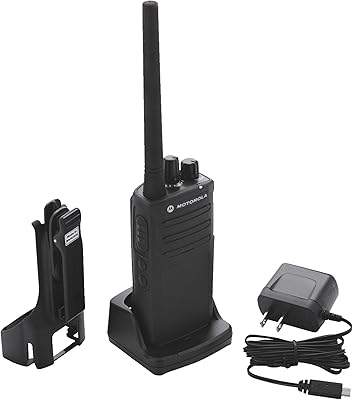
  • In-Box Contents: Ships with a lithium-ion battery, desktop charger, and swivel belt holster, providing everything needed for a single unit to be operational immediately.
  • Marketed Range: The manufacturer lists a maximum range of 5 miles, which applies only under ideal open-air conditions with no obstructions.
  • Real-World Range: In typical indoor or mixed-use professional environments, effective communication range is approximately 1 mile based on aggregated user reports.
  • FCC Requirement: Requires a valid FCC Part 90 license to operate legally in the United States; this radio is not license-free like consumer FRS walkie-talkies.
  • Compatibility: Fully compatible with Motorola Spirit GT, Spirit GT+, and XTN series UHF radios, enabling integration into existing Motorola UHF radio fleets.
  • Voltage: Operates at 3.7 volts AC via the included lithium-ion battery, which is recharged through the bundled desktop charger unit.
  • Model Number: The official model designation is CLS1410, manufactured by Motorola Solutions and first made available in July 2005.

Related Reviews
Motorola T803 Two-Way Radio
83%
84%
Range Performance
88%
Battery Life
78%
Bluetooth Functionality
90%
Build Quality & Durability
85%
Ease of Use
More
Motorola T470 Talkabout Two Way Radios
84%
88%
Range Performance
91%
Ease of Use
85%
Build Quality & Durability
83%
Weather Resistance
80%
Battery Life
More
Motorola DLR1060 Business Two Way Radios
85%
92%
Battery Life
88%
Ease of Use
75%
Range
87%
Build Quality
90%
Portability
More
Motorola RMV2080 Two-Way Radio VHF 8 Channels
84%
93%
Durability
88%
Audio Quality
60%
Range
91%
Weather Alert Feature
92%
Build Quality
More
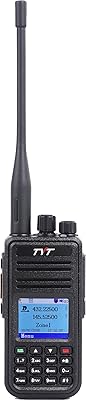
TYT MD-UV380 Dual Band VHF/UHF Two-Way Radio
77%
92%
Value for Money
88%
Range and Performance
85%
Build Quality and Durability
80%
Ease of Use
65%
Software and Setup Experience
More
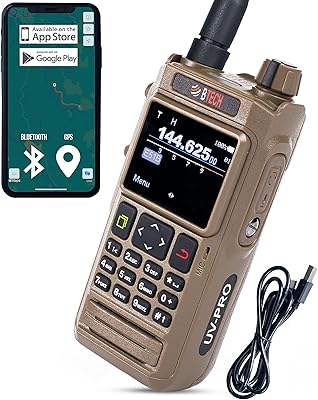
BTECH UV-PRO Dual Band Two-Way Radio
79%
86%
Build Quality
88%
Waterproofing & Durability
78%
Bluetooth App Integration
81%
APRS & GPS Performance
67%
Range & Signal Clarity
More
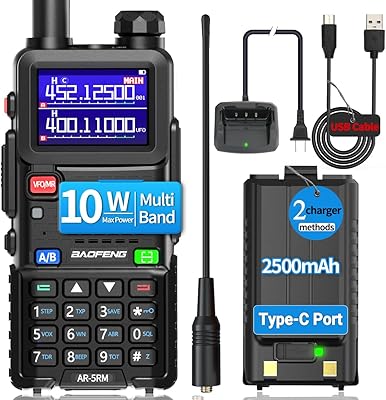
Baofeng AR-5RM Handheld Ham Radio
77%
93%
Value for Money
78%
Ease of Use
61%
Transmission Range
67%
Build Quality
74%
Battery Life
More
Midland MXT115VP3 GMRS MicroMobile Radio
76%
78%
Transmission Range
84%
Audio Clarity
81%
Repeater Functionality
76%
Ease of Installation
79%
Build Quality
More
Wouxun KG-805G GMRS Two Way Radio
81%
88%
Battery Life
91%
Water Resistance
75%
Communication Range
85%
Portability
70%
Ease of Use
More
BTECH DMR-6X2 PRO Two-Way Radio
87%
88%
Performance & Signal Quality
91%
Bluetooth Functionality
85%
GPS & APRS Features
83%
Battery Life
92%
Build Quality & Durability
More

FAQ

It is legally required, not optional. The Motorola CLS1410 UHF Two-Way Radio operates on licensed UHF business frequencies under FCC Part 90 rules, which means you must obtain a license before transmitting. The application process involves a fee and some paperwork, but for most small businesses it is straightforward. Operating without a license exposes you to FCC penalties, so do not skip this step.

Realistically, plan for around one mile in a typical indoor environment — think a mid-size hotel, a restaurant with a connected kitchen and dining area, or a single-floor retail store. The five-mile figure on the packaging assumes completely open terrain with zero obstructions, which almost never describes a real workplace. If your team is spread across multiple concrete floors or a large campus, you may hit range limits faster than expected.

It only communicates with compatible UHF radios programmed to the same frequency and interference eliminator code. Within the Motorola lineup, it works with Spirit GT, Spirit GT+, and XTN UHF models. Cross-brand compatibility is generally not reliable, and it will not work with consumer FRS or GMRS radios at all since those operate on different frequencies and protocols.

Yes, a lithium-ion battery and desktop charger are both included in the box. For moderate-use shifts — staff transmitting periodically but not continuously — most users get through a standard eight-hour day without needing a recharge. Heavy, near-continuous use in a busy warehouse or event environment may require a mid-shift charge or a spare battery on hand.

Yes, but not completely out of the box. The radio supports VOX voice-activated transmit, which lets it broadcast automatically when it detects your voice — but this only works when paired with a compatible audio accessory like a headset or earpiece, which is sold separately. If hands-free operation is a priority for your team, budget for those accessories when placing your order.

It handles noisy environments reasonably well. The UHF frequency range cuts through indoor interference better than consumer-band radios, and the audible call tones help alert recipients before a message comes through. That said, the built-in speaker volume may not be sufficient in extremely loud industrial settings — a compatible earpiece or speaker-microphone accessory would help significantly in those cases.

It is genuinely built for daily professional handling — not just casual occasional use. The housing is water-resistant, so incidental splashes from a kitchen or a light rain during an outdoor handoff are not a concern. Users who have run these units for two or more years of daily use generally report that the radio holds up well, though the belt clip attachment points can show wear over time with very heavy use.

If your existing radios are Motorola Spirit GT, Spirit GT+, or XTN UHF models, then yes — the CLS1410 is directly compatible and can be added to your fleet without replacing what you already have. Just make sure both units are set to the same channel and interference eliminator code, and they will communicate normally.

It can be, but the FCC licensing requirement adds a layer of overhead that some very small operations find disproportionate. If you are coordinating a team of two or three people within a contained space, a license-free FRS radio might honestly serve you just as well with far less administrative friction. The CLS1410 starts to make more sense once you have a larger team, need frequency privacy from neighboring businesses, or are operating in an environment where audio clarity is non-negotiable.

Each unit ships with the radio itself, one lithium-ion battery, a desktop charger, and a swivel belt holster. There are no audio accessories included — no earpiece, headset, or speaker-microphone — so if you need hands-free or discreet audio, plan to purchase those separately. The included holster is solid quality and ready for immediate daily use.

Where to Buy