Overview

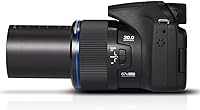
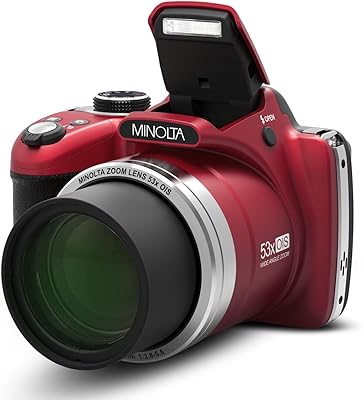
The Minolta MN67Z 67x Zoom Digital Camera is a bridge camera aimed at casual photographers and travelers who want serious reach without serious spending. Its headline attraction is that extraordinary 67x optical zoom — a spec you would rarely find at this price point in any form factor. Worth noting: today's Minolta is a licensed brand revival, not the original Japanese manufacturer, though the cameras have built a genuine following on their own merits. This is not a tool for pixel-peeping professionals; it is a capable all-rounder. It ships with a 16GB SD card and battery included, which keeps the upfront cost of getting started refreshingly low.
Features & Benefits

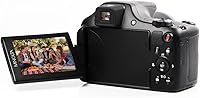
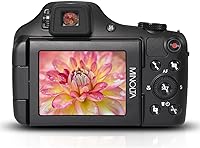
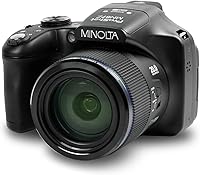
The standout spec here is the 67x optical zoom, which delivers a reach equivalent to 281mm — plenty of distance to fill the frame with a perched hawk or a player at the far end of a field. The 20MP sensor sits in a small 1/2.3-inch CMOS housing, standard for this category; resolution is generous, but the sensor struggles when light gets scarce. Optical image stabilization genuinely helps at longer focal lengths, where even a minor tremor turns into a blurry shot. The articulating LCD is a practical win for awkward angles, and 27 scene modes let newcomers hand the heavy lifting to the camera. Wi-Fi handles photo transfer and remote control — useful, though not a deep mobile integration.

Best For

This superzoom camera hits a sweet spot for a specific kind of buyer. Travelers who refuse to carry a bag of lenses will appreciate having wide-angle to extreme telephoto covered in one compact body. Birdwatchers and casual wildlife photographers on a modest budget get reach that would cost considerably more from a mirrorless or DSLR system. It also works well for parents shooting school plays and sports days, where zoom flexibility matters more than technical perfection. Less experienced shooters benefit from the auto-heavy feature set — scene modes and face detection remove a lot of guesswork. And if you are upgrading from a smartphone and want a camera that feels meaningfully more capable, this bridge camera is a satisfying step up.

User Feedback

Owners consistently highlight the zoom range and value as the strongest arguments in its favor — getting this much reach for the price is genuinely hard to argue with. The flip-out screen also earns regular praise for its convenience in tricky shooting positions. On the critical side, recurring complaints center on low-light performance: the small sensor produces noticeably noisy images in dim environments. Autofocus can lag at the far end of the zoom range, frustrating users trying to track moving subjects. The plastic build feels less substantial than some expect, and battery life draws mixed remarks under heavy use. In context, most criticism is proportional to the price tier — set calibrated expectations and the Minolta MN67Z largely delivers.

Pros

  • 67x optical zoom delivers genuine wildlife and sports reach without carrying extra lenses.
  • Optical image stabilization keeps handheld shots usable even at extreme focal lengths.
  • The articulating LCD makes low-angle, overhead, and self-portrait shooting genuinely practical.
  • 27 intelligent scene modes remove guesswork for beginners and less technical photographers.
  • RAW file support offers more post-processing flexibility than most cameras at this price tier.
  • Bundled 16GB SD card and battery mean you can start shooting straight out of the box.
  • Wi-Fi enables wireless photo transfers and remote shutter control via the companion app.
  • At 2.1 pounds, this superzoom camera is light enough to carry comfortably through a full travel day.
  • 1080p video at 30fps handles casual holiday footage and family events without needing a separate camcorder.
  • Face, smile, and blink detection simplify portrait shooting for users who prefer not to adjust settings manually.

Cons

  • Image noise becomes intrusive above ISO 800, making dim-light photos visibly degraded.
  • Autofocus hunts noticeably at maximum zoom, causing missed shots of fast or erratic subjects.
  • The plastic body feels less substantial than the price tag suggests during extended handling.
  • Battery drains faster under heavy zoom use and video recording than the specs imply.
  • The companion Wi-Fi app feels dated and pairing can be unreliable across different phone models.
  • Dynamic range is narrow, causing highlight clipping in high-contrast outdoor scenes.
  • No external microphone port limits video audio quality, particularly in windy outdoor conditions.
  • Charging only via USB means no dedicated wall charger — slower and inconvenient when traveling.
  • Maximum zoom images can appear soft or hazy in poor atmospheric conditions or flat light.
  • Manual exposure controls are shallow, leaving experienced shooters with limited creative flexibility.

Ratings

The scores below reflect an AI-driven analysis of verified global user reviews for the Minolta MN67Z 67x Zoom Digital Camera, with spam, incentivized submissions, and bot activity actively filtered out before any scoring was applied. Each category captures both the genuine enthusiasm and the honest frustrations real buyers have shared — nothing is glossed over. Whether this superzoom camera earns a place in your bag ultimately depends on how well its particular strengths align with what you actually shoot.

Zoom Range & Reach
93%
The 67x optical zoom is the single feature users praise most consistently and enthusiastically. Birdwatchers report pulling in sharp details of distant perched birds, and parents at outdoor sports events describe finally getting usable close-up shots from the bleachers — all without a second lens in tow.
At the absolute far end of the zoom range, diffraction and atmospheric haze can soften fine detail, particularly on overcast days. A small number of users expected DSLR-level sharpness at maximum reach and came away disappointed, which is a realistic limitation of any sensor in this class.
Image Quality in Good Light
78%
22%
Under daylight or bright indoor conditions, the 20MP sensor produces clean, detailed JPEGs that look excellent on screen and hold up well when printed at modest sizes. Colors tend to be vivid and punchy, which suits travel and family photography where pleasing results matter more than clinical accuracy.
The 1/2.3-inch sensor is physically small, and at high pixel density that means less light per pixel than larger-sensor alternatives. Edges and fine textures at full zoom can appear slightly soft, and dynamic range leaves some shadow detail behind on high-contrast sunny scenes.
Low-Light Performance
54%
46%
The camera does offer ISO settings up to 6400, and in well-lit indoor environments like living rooms or restaurants with overhead lighting, results are perfectly usable for casual snapshots. The night scene mode does attempt to compensate automatically, which helps less experienced shooters avoid total failures.
This is the category that generates the most buyer frustration. Noise becomes visible and intrusive above ISO 800, and evening or poorly lit indoor shots often come out muddy or smeared with noise reduction. It is not a camera for concerts, dim venues, or twilight shooting without accepting a significant quality trade-off.
Optical Image Stabilization
82%
18%
Optical stabilization makes a meaningful real-world difference, especially when shooting handheld at 30x to 50x zoom — a range where even a steady hand produces blur without it. Travelers on moving boats or shaky platforms report noticeably sharper results compared to cameras with only digital stabilization.
At the full 67x zoom, stabilization can only do so much against motion blur when shutter speeds drop. Some users note that the system occasionally introduces a subtle jitter of its own in video, and fast-moving subjects at extreme focal lengths remain genuinely challenging to freeze cleanly.
Autofocus Speed & Accuracy
63%
37%
In standard shooting conditions at moderate zoom levels, autofocus locks quickly enough for everyday use. The 171-point contrast-detection system handles static and slow-moving subjects well, and face detection reliably picks up subjects in portrait situations without requiring manual adjustment.
At the far end of the zoom range, focus hunting becomes noticeably sluggish — the camera can take a frustrating moment to commit, and by the time it does, a bird in flight or a child running has already moved. Action and sports photography expose this weakness most acutely, and it is a genuine limitation to factor in.
Build Quality & Handling
61%
39%
The grip is well-shaped and sits comfortably in medium to large hands during extended shooting sessions. Button placement is intuitive enough that most users figure out the core controls within an hour of unboxing, and the overall weight feels balanced without being tiring on a day out.
The exterior is predominantly plastic, and it reads that way when you hold it — it lacks the solid, confidence-inspiring feel of metal-bodied cameras even at comparable price points. A few users have reported creaking or play in the zoom barrel over time, raising questions about long-term durability with frequent use.
Articulating LCD Screen
84%
The 3-inch flip-out screen earns consistent praise from users who shoot in unconventional positions. Holding the camera overhead at a crowded event, angling it low to the ground for wildlife, or flipping it forward for a self-portrait — all become genuinely practical rather than awkward guesswork.
Screen resolution at 921,600 dots is adequate but not sharp enough to reliably judge critical focus in bright sunlight, where glare also becomes a real obstacle. A few users note that the hinge mechanism, while functional, does not feel like it was built for thousands of open-and-close cycles.
Video Quality
71%
29%
For casual video — holiday footage, school events, family moments — the 1080p output at 30fps is genuinely solid. Stabilization keeps handheld clips watchable, and the built-in microphone handles outdoor audio well enough that users do not feel the immediate need to add external gear.
The built-in mic picks up wind noise quite readily outdoors, and there is no option to attach an external microphone, which caps its ceiling for vlog-style content. Rolling shutter is present when panning quickly, and anyone expecting broadcast-level quality will find the footage competent but clearly from a stills-first camera.
Wi-Fi & Connectivity
67%
33%
Wireless photo transfer to a smartphone via the companion app works reliably once it is set up, and remote shutter control is a useful bonus for tripod self-portraits or wildlife setups where getting close would disturb the subject. Having HDMI output for TV playback is a practical extra that older users in particular appreciate.
The app experience is described as clunky by a noticeable portion of users — pairing can be inconsistent, and the interface feels dated compared to modern smartphone camera apps. Transfer speeds for large RAW files over Wi-Fi are slow, and there is no Bluetooth for low-power persistent connection as found on newer camera platforms.
Ease of Use & Scene Modes
88%
The 27 scene modes and strong automatic behavior make this bridge camera genuinely approachable for buyers stepping up from a smartphone. Modes for fireworks, portraits, panorama, and beach scenes handle the heavy lifting intelligently, and the menu system is organized clearly enough that a new owner rarely needs the manual.
Experienced photographers looking for manual exposure control will find the options somewhat shallow. Aperture and shutter priority are present but limited, and the camera clearly prioritizes automated simplicity over creative flexibility — a deliberate design choice that serves its audience but has a real ceiling.
Battery Life
66%
34%
For a half-day of mixed shooting — some video, moderate zoom use, and Wi-Fi off — the lithium-ion battery holds up reasonably well and supports a full morning excursion without needing a spare. Users who primarily shoot stills on shorter outings report no particular anxiety about running out mid-session.
Heavy zoom use and video recording drain the battery noticeably faster than casual still shooting, and a full day in the field with active Wi-Fi can leave users hunting for a charge before the afternoon is over. The camera does not ship with a dedicated external charger, meaning it charges via USB — slower and less convenient when traveling.
Value for Money
86%
Combining 67x optical zoom, stabilization, an articulating screen, and a 16GB card bundle into a single mid-range purchase price is objectively strong value by the standards of this camera category. Users who shopped around consistently note that matching this zoom range elsewhere pushes the cost substantially higher.
A handful of buyers feel that image quality in challenging conditions does not fully justify the pricing relative to cheaper superzooms that perform similarly. The expectation gap is real: buyers who research only the spec sheet and skip realistic sample images sometimes feel the real-world output does not match the impressive-sounding numbers.
Portability & Travel Friendliness
79%
21%
At 2.1 pounds, this superzoom camera is light enough to carry in a shoulder bag or a medium-sized backpack without fatigue on long walking days. It fits comfortably in an overhead compartment and does not draw the kind of airport-security attention that a DSLR kit tends to attract.
It is too large for a jacket pocket or small day bag, which means it requires a dedicated camera bag or compartment on any outing. Travelers used to truly pocketable point-and-shoot cameras find the bulkier form factor an adjustment, even if the zoom trade-off is clearly worth it in practical terms.
RAW File Support
72%
28%
Having RAW file support at this price tier is a genuine bonus that more advanced users appreciate. It opens the door to meaningful post-processing recovery — pulling back blown highlights on a bright beach shot or lifting shadows in a shaded forest scene — that JPEG-only cameras simply cannot offer.
The RAW files from the small CMOS sensor have limited dynamic range to begin with, which reduces how much post-processing headroom is actually available. Users expecting the editing latitude of an APS-C or full-frame RAW file will find the files somewhat constrained, though the feature is still better than not having it at all.

Suitable for:

The Minolta MN67Z 67x Zoom Digital Camera is built for buyers whose priority is maximum zoom versatility without the complexity or cost of an interchangeable-lens system. Travelers who want a single camera that handles everything from wide street scenes to distant architecture will find it a genuinely practical companion. Birdwatchers and casual wildlife enthusiasts on a modest budget get a level of telephoto reach that would otherwise require a much more expensive lens-and-body combination. Parents shooting school sports days, stage performances, or outdoor events will appreciate being able to close the distance optically from a fixed spot in the stands. The intelligent scene modes and straightforward menu also make this bridge camera an excellent choice for older buyers or first-time camera owners who want noticeably better results than a smartphone without needing to learn manual exposure settings.

Not suitable for:

The Minolta MN67Z 67x Zoom Digital Camera has real limitations that make it the wrong tool for certain buyers, and it is worth being direct about them. Photographers who regularly shoot in low-light environments — concerts, evening events, dimly lit interiors — will find the small 1/2.3-inch sensor produces noisy, flat images that no amount of post-processing fully rescues. Action sports photographers or anyone trying to track fast, unpredictable movement at full zoom will run into the autofocus lag that is a known trade-off at this price tier. Serious enthusiasts who want meaningful manual control, wide aperture options, or the post-processing latitude of a larger-sensor RAW file will hit a ceiling quickly. Anyone expecting the build solidity and weather resistance of a professional or even prosumer camera will also be disappointed — this is a plastic-bodied consumer device, and it performs at that level.
Specifications

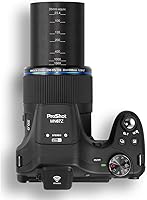
  • Sensor: 20.68MP 1/2.3-inch CMOS sensor captures stills at up to 20.1MP effective resolution with support for both JPEG and RAW file formats.
  • Optical Zoom: 67x optical zoom covers a focal range up to 281mm equivalent, supported by optical image stabilization to reduce blur at longer reach.
  • Autofocus: 171-point contrast-detection autofocus system with face, smile, and blink detection operates in fully automatic AF mode.
  • ISO Range: Expanded ISO sensitivity runs from 100 to 6400, covering bright daylight through moderately low-light conditions.
  • Shutter Speed: Shutter speed range spans from 1/2000s at the fast end down to 30 seconds for long-exposure shooting scenarios.
  • Aperture Range: Lens aperture ranges from f/2.8 at wide angle to f/5.6 at maximum telephoto zoom, typical of this superzoom class.
  • Video: Records Full HD 1080p video at 30fps in MP4 format with a built-in microphone; no external microphone input is available.
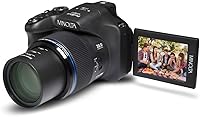
  • Display: 3-inch articulating LCD screen resolves 921,600 dots (1440x960) and flips out for low-angle, overhead, and self-portrait shooting.
  • Continuous Shooting: Continuous burst shooting reaches up to 10 frames per second with a delay of approximately 0.2 seconds between shots.
  • Connectivity: Built-in Wi-Fi supports photo transfer and remote shutter control via companion app; HDMI and USB ports are also included.
  • Storage: Single SD card slot accepts cards up to 64GB (UHS-I U1 compatible); a 16GB SD card is included in the box.
  • Battery: Rechargeable lithium-ion battery charges via USB and supports approximately 1.6 hours of continuous video recording per charge.
  • Weight: Camera body weighs 2.1 pounds, with the battery accounting for approximately 1.7 ounces of that total.
  • Form Factor: Compact bridge camera body measures 4.5 inches in height with an integrated non-interchangeable zoom lens.
  • Scene Modes: 27 intelligent scene modes cover subjects including portraits, fireworks, panorama, night scenes, and beach environments.
  • Bit Depth: Image files are captured at 8-bit depth, which is standard for JPEG output and applies to RAW capture at this sensor tier.
  • Viewfinder: Electronic viewfinder is built in as an alternative to the articulating LCD for composing shots in bright conditions.
  • Warranty: Covered by a 1-year manufacturer warranty from Minolta (licensed brand), limited to defects in materials and workmanship.

Related Reviews

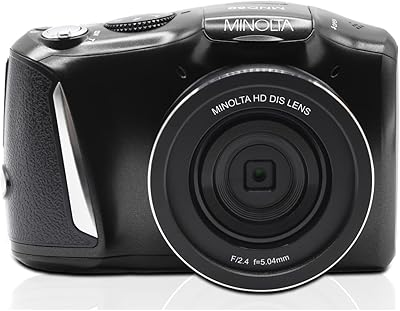
Minolta MND50 48MP Digital Camera
82%
86%
Image Quality
88%
Video Quality
91%
Portability
89%
Ease of Use
80%
Build Quality
More
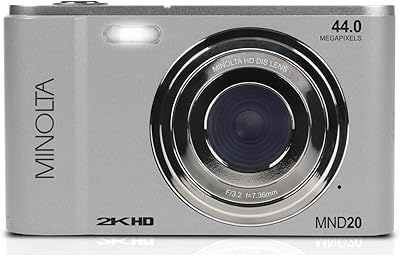
Minolta MND20 44MP Digital Camera
83%
88%
Image Quality
85%
Video Recording Quality
90%
Ease of Use
92%
Portability/Size
80%
Stabilization Performance
More
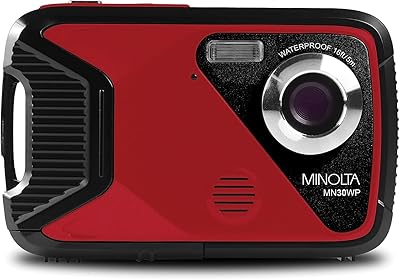
Minolta MN30WP-R Waterproof Digital Camera
84%
89%
Waterproof Performance
91%
Ease of Use
82%
Image Quality
88%
Build Quality
85%
Portability
More
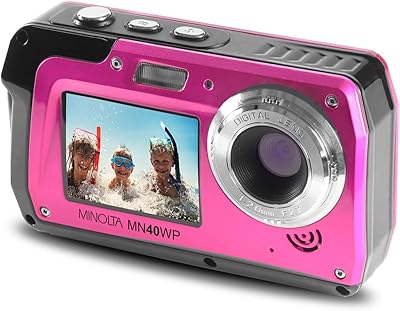
Minolta MN40WP Waterproof Digital Camera
69%
73%
Waterproof Reliability
61%
Image Quality
67%
Video Performance
82%
Dual Screen Usability
44%
Zoom Capability
More
Minolta Pro Shot MN53Z 16MP HD Digital Camera
83%
86%
Image Quality
91%
Zoom Performance
88%
Ease of Use
92%
Portability
65%
Low-Light Performance
More
Kimire 604S Full HD Camcorder
67%
54%
Video Quality
88%
Ease of Use
57%
Build Quality
63%
Battery Life
79%
Value for Money
More
AVKANS AV-E20-NDI PTZ Camera
79%
88%
Image Quality
91%
NDI Integration
93%
Connectivity & Output Options
82%
Low-Light Performance
74%
PTZ Motor & Movement Smoothness
More
myFirst Camera 3 Kids Digital Camera
72%
76%
Image Quality (Daylight)
51%
Low-Light Performance
74%
Video Quality
83%
Macro Lens
81%
Ease of Use
More
AOREGRE 5K Digital Camera WiFi Autofocus Vlogging Camera
83%
92%
Value for Money
89%
Image Quality
87%
Ease of Use
90%
Video Quality (5K)
85%
Portability & Size
More
ROQIOO A9
ROQIOO A9
67%
83%
Value for Money
61%
Image Quality
58%
Video Quality
81%
Flip Screen Usability
54%
Build Quality & Durability
More

FAQ

Yes, it is one of the stronger options at this price point for that use case. The 67x optical zoom gets you genuinely close to distant subjects — perched birds, deer at the edge of a field, that sort of thing. Just keep in mind that autofocus can be a little slow at maximum zoom on fast-moving animals, so patience helps.

Honestly, low light is where this bridge camera shows its biggest limitation. The small 1/2.3-inch sensor produces noticeable noise at ISO 800 and above, and images in dim environments can look muddy or over-smoothed. It handles well-lit indoor settings fine, but evening events, concerts, or twilight shots are a real challenge for it.

No — the Wi-Fi on the Minolta MN67Z 67x Zoom Digital Camera is for photo and video file transfer to a smartphone and for using your phone as a remote shutter trigger. It does not support live streaming to any platform, so if that is something you need, this camera will not cover it.
Both are supported. You can shoot RAW, JPEG, or RAW plus JPEG simultaneously. RAW gives you more control in post-processing — useful for recovering highlights or lifting shadows — though the editing headroom from a sensor this size is more limited than what you get from a larger-sensor camera.

Expect a solid half-day of mixed use — say, a morning of sightseeing with varied zoom and some video clips. If you are shooting video heavily or leaving Wi-Fi on, it drains faster. Carrying a USB power bank as backup is a smart move for full-day outings, since the camera only charges via USB rather than a dedicated wall charger.

A 16GB SD card is included in the box, so you can start shooting right away. That said, 16GB fills up quickly if you are shooting RAW files or recording a lot of video, so picking up a 32GB or 64GB card as a spare is worth considering.

It is a very natural step up. The automatic scene modes and simple menu mean you do not need to understand aperture or shutter speed to get noticeably better results than a phone — especially for distant subjects. The zoom alone will feel like a revelation compared to pinch-and-crop digital zoom on a smartphone.

There is a real difference. At moderate zoom lengths — say, 10x to 20x — images are sharp and clean in good light. At the full 67x end, you will see some softening and increased susceptibility to atmospheric haze or heat shimmer, especially at distance. It is still very usable, but the sharpest results come at the middle of the zoom range.

Definitely. Being able to flip the screen out and angle it means you can monitor your frame without holding the camera awkwardly at arm's length. It also helps when shooting low to the ground or above a crowd. For anyone doing casual video work, it is one of the most practically useful features on this superzoom camera.

It is worth knowing that the current Minolta is a licensed brand name being used by a different company — it is not a continuation of the original Japanese manufacturer. That does not automatically make the cameras bad, and this bridge camera has earned a genuine following based on its own merits, but you are buying on the product's current track record rather than the heritage of the original Minolta.

Where to Buy