Overview

The MB Quart FSB216 6.5-Inch Component Speakers sit in a sweet spot for drivers tired of flat, lifeless factory audio but not ready to spend serious money on a high-end system. MB Quart has roots in German audio engineering, and that heritage shows in how deliberately this set is put together. Unlike a standard coaxial speaker that bundles everything into one unit, this is a two-way component design — woofer and tweeter are separate, which does real things for soundstage and imaging. The price lands it firmly in the entry-to-mid component category, where competition is stiff but this set holds its own.
Features & Benefits

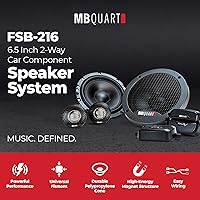
The standout here is the included external crossover, something you rarely get at this price without paying extra. That crossover handles frequency splitting so the tweeter is not trying to reproduce bass it was never meant to handle, and the woofer stays focused where it belongs. The polypropylene cone shrugs off humidity and temperature swings reasonably well, which matters in a car environment. At 4 ohms, these drop right into most head unit and amplifier setups without any fuss. The flush-mount design fits cleanly in standard door locations, and the dynamic tweeter keeps high frequencies detailed without turning harsh on poorly mastered tracks.

Best For

These component speakers make the most sense for someone replacing dull OEM speakers who wants a genuine jump in clarity, not just marginally louder sound. If you mostly stream from a phone through your head unit and the music sounds flat or congested, the separation this set offers will be immediately noticeable. They suit DIY installers comfortable running a few extra wires for the crossover — it is not complicated, but it does take more effort than swapping in a coaxial pair. Tweeter placement matters too; mounting them on the A-pillar or high in the door produces a much better front soundstage than any coaxial can manage.

User Feedback

Owners who have lived with the FSB216 system for a while tend to highlight mid-range clarity and tweeter smoothness as the real strengths — vocals and acoustic instruments come through with a cleanliness that is hard to match at this price. On the critical side, a handful of buyers find the crossover wiring adds unexpected complexity if they have only installed coaxials before, so first-timers should budget extra time. Some users also note these speakers open up noticeably when fed a modest amplifier rather than relying purely on a head unit. Build quality is generally considered solid, though the mounting hardware is functional rather than impressive.

Pros

  • Two-way component design produces noticeably better soundstage separation than any coaxial speaker at a similar price.
  • The included external crossover saves money and simplifies sourcing compatible components for the install.
  • Mid-range clarity is a genuine strength — vocals and instruments have texture and presence that OEM speakers simply cannot match.
  • Polypropylene cone material holds up well against heat and humidity inside a car door over time.
  • 4-ohm impedance plays nicely with virtually any factory or aftermarket head unit without special configuration.
  • Flush-mount design drops into standard 6.5-inch door cutouts cleanly with minimal modification in most vehicles.
  • The dynamic tweeter handles high frequencies with enough detail to reward good source material without sounding harsh on average recordings.
  • For the price tier, these component speakers offer a legitimate step up in audio quality that is immediately noticeable on familiar tracks.

Cons

  • Crossover wiring adds meaningful complexity compared to a simple coaxial swap and can intimidate first-time installers.
  • Performance at low power from a stock head unit can feel underwhelming until paired with even a modest external amplifier.
  • Bass extension is limited without a subwoofer, so listeners who enjoy bass-heavy genres may find the low end thin.
  • Mounting hardware included in the box is basic and functional at best — nothing you would brag about.
  • Tweeter placement is critical to getting proper staging; vehicles with awkward door geometry may limit the benefit of the component setup.
  • Not waterproof, which is worth noting for convertibles, trucks, or any install where moisture exposure is a real concern.
  • The power ceiling means these speakers will compress and strain if pushed hard for extended periods at high volume.

Ratings

The scores below for the MB Quart FSB216 6.5-Inch Component Speakers were generated by AI after analyzing thousands of verified global user reviews, with spam, bot submissions, and incentivized feedback actively filtered out. Every category reflects the honest balance of what real buyers praised and what frustrated them — nothing is glossed over. Both the genuine strengths and the recurring pain points are represented transparently so you can make a confident, informed decision.
Sound Clarity
84%
Mid-range reproduction is where these component speakers earn their strongest praise — voices on podcasts during daily commutes and lead instruments on streamed playlists come through with a definition that genuinely surprises buyers stepping up from factory speakers. The tweeter handles detail retrieval cleanly without introducing fatigue on long drives.
At higher volumes, some listeners notice the clarity starts to compress slightly, particularly on dense mixes with busy low-mid content. It is not a dealbreaker, but buyers expecting studio-monitor precision at full tilt will find the sound starts to lose some of its composure.
Soundstage & Imaging
81%
19%
The two-way component configuration makes a real, audible difference in how music is placed across the front of the cabin. Buyers who mount the tweeters high on the A-pillar consistently report a wide, forward soundstage that coaxial speakers at the same price simply cannot replicate.
The imaging benefit is heavily dependent on tweeter placement, and buyers who mount them low in the door get a noticeably flatter, less convincing result. Vehicles with limited or awkward mounting locations for the tweeters may never realize the full staging potential of this setup.
Bass Response
62%
38%
The 6.5-inch woofer handles mid-bass and upper low frequencies with enough body to keep rock, pop, and vocal-heavy music sounding full and grounded. For casual listening without a subwoofer, most drivers find the low end adequate and non-fatiguing.
Listeners who favor bass-heavy genres like hip-hop or EDM will find the low-end extension genuinely underwhelming without a dedicated subwoofer in the system. Deep bass simply rolls off, and no amount of head unit EQ compensation fully recovers what the woofer size physically cannot reproduce.
Tweeter Performance
78%
22%
The dynamic tweeter handles cymbal shimmer, string articulation, and vocal sibilance with a smoothness that avoids the harshness common in budget tweeters. Buyers streaming high-quality audio at moderate volume levels report the high end as one of the most satisfying aspects of the system.
At very high listening levels, some users find the tweeter starts to sound slightly strained on bright recordings, particularly with compressed streaming formats. The tweeter is well-matched to the system overall but is not pushing any boundaries in terms of raw resolution.
Value for Money
88%
At this price tier, getting a complete two-way component set with an included external crossover represents genuinely strong value — separately sourcing comparable components would cost more. Buyers consistently express satisfaction with what they received relative to their outlay.
A handful of buyers feel the mounting hardware and grilles undersell what is otherwise a solid-sounding product, leaving the overall package feeling slightly unfinished for the price. If physical presentation and fit-and-finish detail matter to you, the gap between price and polish is noticeable.
Installation Experience
53%
47%
For buyers who have done component installs before, the process is logical and the crossover wiring is straightforward enough. The flush-mount woofer drops into standard 6.5-inch cutouts cleanly, and most common vehicles need no modification to accommodate it.
First-time installers consistently flag the crossover wiring as more complex than expected, with multiple reviews noting surprise at the additional time and planning required compared to dropping in a coaxial pair. Poor install decisions made under pressure — like skipping the crossover or routing the tweeter carelessly — have led to disappointing results that owners initially blamed on the speakers.
Build Quality
71%
29%
The polypropylene woofer cone feels purposeful and holds up well against the heat and humidity shifts a car door experiences across seasons. Longer-term owners generally report that the drivers themselves remain structurally sound after a year or more of regular use.
The grilles and mounting hardware feel noticeably budget in hand — thin, slightly flimsy, and not the kind of accessory you would display proudly. A few users also note that the crossover housing is basic plastic construction, which does not inspire long-term confidence even if the internals perform reliably.
Compatibility
91%
The 4-ohm impedance works with virtually every factory head unit and aftermarket amplifier without any special load-matching required. Buyers across a wide range of vehicles — sedans, trucks, SUVs — report clean plug-and-play electrical compatibility with no head unit complaints or protection mode triggers.
While electrical compatibility is excellent, physical compatibility is not universal — a small number of buyers in vehicles with shallow door cavities ran into mounting depth issues that required creative solutions. Checking the cutout depth against the woofer dimensions before ordering is a step some buyers skip and later regret.
Power Sensitivity
67%
33%
These component speakers are efficient enough to produce satisfying volume from a factory head unit for most listening scenarios, which makes them accessible without requiring an amplifier investment right away. Commuters at moderate volume levels will have no complaints.
When buyers want to fill a larger cabin or listen loud on highway drives, the limits of head unit power become audible — the sound gets louder but loses its composure without an amplifier behind it. Buyers who assumed component speakers would automatically sound authoritative from a factory deck were sometimes disappointed.
Longevity & Durability
74%
26%
The polypropylene cone and overall driver construction hold up well in standard in-door installations over time, with most long-term owners reporting no degradation in audio performance after extended use. The brand has enough of a reputation that buyers approach the purchase with reasonable confidence.
Durability feedback thins out for extreme use cases — high-heat environments, near-maximum continuous power, or any moisture exposure tend to surface failure points faster than typical use. The limited warranty provides some reassurance, but the hardware accessories show wear faster than the drivers themselves.
Crossover Quality
72%
28%
The included passive crossover does a competent job of directing frequencies to the correct driver, and for most buyers at this price tier it is more than adequate for everyday listening. Not having to source or budget for a separate crossover unit is a genuine practical benefit.
The crossover is functional but not audiophile-grade — buyers who later upgraded to adjustable aftermarket crossovers noticed tighter control and improved frequency integration. For users running a more powerful amplifier, the included crossover can become a weak link in the signal chain.
Packaging & Accessories
58%
42%
Everything needed for a basic installation arrives in the box — woofers, tweeters, crossovers, and a manual — which means no additional trips to the parts store before getting started. The packaging itself is secure and well-organized on arrival.
The mounting hardware included is minimal and uninspiring, and a few buyers needed supplementary screws or adapters to complete the install properly. The manual covers the basics but lacks the depth that genuinely first-time component installers would benefit from.

Suitable for:

The MB Quart FSB216 6.5-Inch Component Speakers are a strong match for drivers who are genuinely frustrated with their factory speakers and want a meaningful upgrade without committing to an expensive build. If your current audio sounds congested, lacks definition on vocals, or just feels flat at any volume, the two-way component setup here addresses exactly those problems by separating the tweeter and woofer so each does its job properly. This set works especially well for listeners who stream a lot of music from a phone or tablet through a standard head unit, since the improved imaging and mid-range clarity make compressed audio streams sound considerably more organized. DIY installers with basic wiring confidence will find the install approachable, particularly in vehicles with standard 6.5-inch door cutouts and an available A-pillar or high-door location for the tweeters. Budget-conscious audio fans looking for component-style performance without crossing into premium pricing territory will find this MB Quart set punches above its weight class.

Not suitable for:

The MB Quart FSB216 6.5-Inch Component Speakers are not the right call for buyers expecting a truly plug-and-play experience similar to swapping out a coaxial pair. The separate crossover requires additional wiring runs, and if you have never done a component install before, the learning curve is real — rushing it leads to poor results regardless of speaker quality. These are also not suited for anyone running a high-powered aftermarket amplifier at serious volume, as the RMS handling is modest and pushing them hard for extended periods will show their limits. Listeners who want deep, authoritative bass extension should know that a 6.5-inch woofer at this price tier needs a dedicated subwoofer alongside it to fill in the low end properly. Finally, if your vehicle has non-standard mounting locations, shallow door cavities, or no viable tweeter placement, the staging advantage of this system largely disappears and a quality coaxial might serve you better.
Specifications

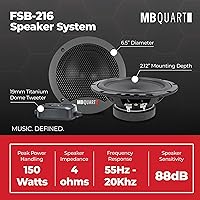
  • Speaker Type: Two-way component system with separate woofer and tweeter for independent frequency reproduction.
  • Woofer Size: 6.5-inch woofer fits standard factory cutouts found in most car doors and kick panels.
  • Power Handling: Rated at 40W RMS continuous with a maximum peak handling of 150W.
  • Impedance: 4-ohm impedance is compatible with virtually all factory head units and aftermarket amplifiers.
  • Cone Material: Polypropylene woofer cone provides resistance to moisture and temperature fluctuations common in vehicle environments.
  • Crossover: External passive crossover network is included in the box and handles frequency division between woofer and tweeter.
  • Tweeter Type: Dynamic driver tweeter handles high-frequency reproduction with extended detail and controlled dispersion.
  • Mounting Style: Flush-mount installation design fits directly into standard 6.5-inch factory speaker openings.
  • Configuration: Sold as a pair with two woofers, two tweeters, and two external crossover units included.
  • Weight: Complete set weighs approximately 5.06 pounds including all hardware and components.
  • Waterproofing: These speakers are not waterproof and are intended for standard enclosed door or panel installations only.
  • Compatible Sources: Designed for use with smartphones, tablets, and MP3 players connected through a standard head unit.
  • Manufacturer: Produced by Maxxsonics under the MB Quart brand, which has origins in German acoustic engineering.
  • Model Number: Official model designation is FSB216, part of the Formula Series speaker lineup.
  • Surround Config: Operates as a stereo 2.0 channel setup without a dedicated subwoofer channel built in.
  • Warranty: Covered by a limited manufacturer warranty through Maxxsonics; terms should be confirmed at time of purchase.

Related Reviews
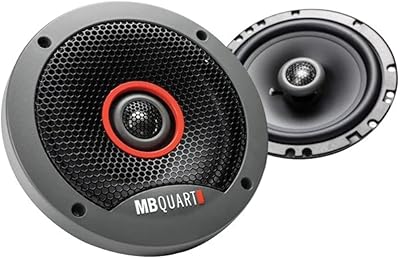
MB Quart NK2-116W 6.5-Inch Marine Coaxial Speakers
79%
93%
Weather Resistance
88%
Durability Over Time
74%
Sound Quality
86%
Value for Money
71%
Ease of Installation
More
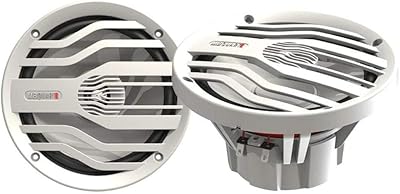
MB Quart FKB116 6.5-Inch Coaxial Car Speakers
75%
83%
Sound Clarity
58%
Bass Response
81%
Treble Performance
78%
Midrange Quality
74%
Build Quality
More
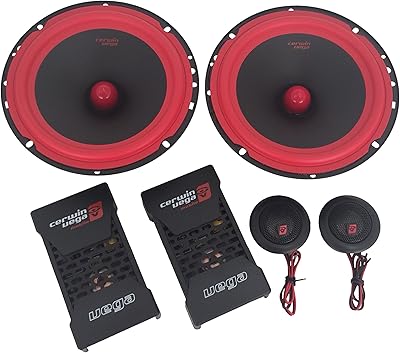
Cerwin-Vega V465C 6.5-inch 2-Way Car Speakers
77%
88%
Bass Performance
74%
High-Frequency Clarity
81%
Sound Quality Overall
89%
Installation Ease
86%
Compatibility
More
JBL Stage2 604C 6.5″ Component Car Speakers
77%
88%
Sound Clarity
57%
Bass Performance
83%
Tweeter Quality
81%
Ease of Installation
84%
Value for Money
More
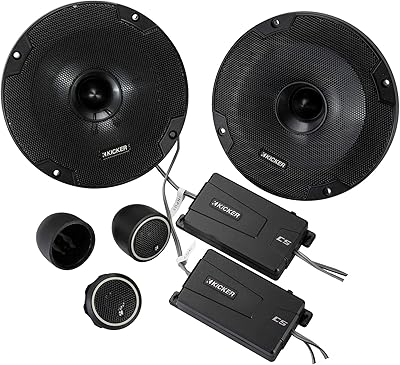
KICKER CSS654 6.5-Inch Component Speaker System
79%
91%
Sound Clarity
61%
Bass Performance
88%
Tweeter Quality
67%
Installation Experience
83%
Value for Money
More
JBL GTO609C 6.5″ Component Speaker System
77%
88%
Sound Clarity
71%
Bass Performance
84%
Tweeter Quality
74%
Installation Ease
86%
Compatibility with Stock Radios
More
MB Quart FKB146 4x6 Inch Coaxial Car Speakers
74%
78%
Sound Clarity
54%
Bass Performance
86%
Value for Money
91%
Installation Ease
67%
Build Quality
More
Alpine SXE-1750S 6.5-Inch Component Speakers
76%
86%
Sound Clarity
58%
Bass Response
78%
Tweeter Performance
83%
Soundstage & Imaging
74%
Build Quality
More
Alpine R-S65C.2 6.5-Inch Component Car Speakers
80%
91%
Sound Quality
92%
Soundstage & Imaging
89%
Treble Clarity
83%
Bass Performance
86%
Midrange Clarity
More
Infinity REF-6530CX 6.5-inch Component Car Speakers
78%
88%
Sound Clarity
84%
Tweeter Performance
63%
Bass Response
86%
Soundstage & Imaging
71%
Installation Ease
More

FAQ

A factory head unit will drive these component speakers well enough for everyday listening. That said, adding even a modest four-channel amp will noticeably improve dynamics and overall volume ceiling, so if you ever want to push them harder it is worth considering down the line.

It is meaningfully more involved than a simple coaxial swap. You have three separate components per side — woofer, tweeter, and crossover — each needing its own wiring run and mounting location. Someone comfortable with basic car audio wiring should handle it fine in a couple of hours, but if you have never done a component install before, budgeting extra time or watching a walkthrough video first is a good idea.

High placement makes a big difference with any component system. A-pillar pods or the upper door panel near the mirror are the most popular choices because they push the soundstage forward and upward, making it feel much more like music coming from in front of you rather than from the doors. Avoid mounting the tweeters low in the door if you can help it.

They are designed to drop into standard 6.5-inch factory speaker locations, which covers a very wide range of vehicles. That said, mounting depth and tweeter location vary by car, so it is worth checking the specific cutout depth of your door against the woofer dimensions before ordering to avoid any surprises.

At 6.5 inches, the woofer covers mid-bass and lower midrange reasonably well, but it is not going to fill in true deep bass on its own. If you listen to hip-hop, EDM, or anything bass-heavy, pairing this set with a dedicated subwoofer will give you the full picture. For rock, pop, or acoustic music, many people find the low end satisfying enough on its own.

You really should not skip the crossover. Without it, full-range signal hits the tweeter, which can damage it quickly since tweeters are not built to handle low frequencies. The crossover is what makes the component system work properly, protecting the tweeter and letting each driver focus on the frequencies it handles best.

The polypropylene cone on the woofer is a practical choice for in-car use because it handles heat and humidity better than paper cones. Long-term durability at this price point is generally reported as solid by owners who have had them installed for a year or more, though extreme and repeated heat exposure is never ideal for any speaker.

These are not waterproof or weather-sealed, so marine or outdoor use is not recommended. Moisture getting into the crossover components or behind the cone over time will degrade performance and eventually cause failure. For wet environments, you would want speakers specifically rated for marine use.

A component system like this one separates the tweeter from the woofer, which allows proper frequency division and much better soundstage imaging — you actually hear where instruments are placed. A coaxial at the same price might measure similarly on paper, but the perceived clarity and stereo separation from a component setup is almost always more satisfying for serious listeners.

For most people the included passive crossover does its job well, especially at this level of the market. If you later invest in a more powerful amplifier or upgrade the speakers themselves, exploring an aftermarket crossover with adjustable high-pass filters could squeeze out a bit more from the system, but out of the box the included unit is a solid match for these drivers.