Overview

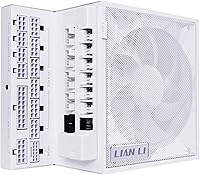
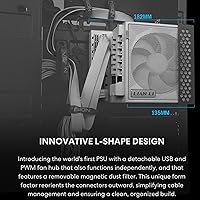
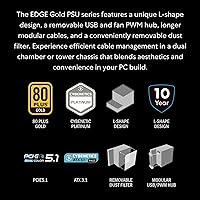
The Lian Li EDGE 1000W ATX Power Supply enters a competitive market with something genuinely different: an L-shaped chassis that repositions the fan intake perpendicular to the standard orientation, which can meaningfully change how cables exit and airflow moves inside tighter cases. Lian Li built this for builders who want a fully standards-forward foundation — ATX 3.1 and PCIe 5.1 compliance means it handles modern GPU power demands without compromise. Pair that with dual Gold efficiency ratings and a low-noise fan profile, and you have a PSU that earns its place in a premium build. The built-in USB and fan hub only adds to its appeal.

Features & Benefits

Going fully modular is the right call at this wattage — every cable you leave out of the build is one less thing heating up or blocking airflow. The EDGE 1000W takes it further with dual efficiency certifications: 80 PLUS Gold covers raw power conversion, while Cybenetics Gold adds acoustic-normalized testing, so the efficiency numbers hold up even when the fan ramps down. The 12V-2x6 connector handles RTX 40 and 50 series GPUs safely and correctly, sidestepping the melting concerns tied to older adapter dongles. And the built-in hub — six fan headers at 2A each, plus USB — means you can drop a separate fan controller from your parts list entirely.

Best For

This modular power supply makes the most sense for builders putting together a high-end system around an RTX 40 or 50 series card, where ATX 3.1 compliance and a proper 12V-2x6 connection are the baseline, not extras. It is also a strong pick for anyone who usually adds a fan hub PCIe card or a standalone USB controller to manage cooling and RGB — the EDGE Hub eliminates that extra slot and expense outright. Builders working with cases that have non-standard PSU bays may find the L-shape chassis offers more cable routing flexibility than a conventional unit. Less suited for budget-focused or low-wattage configurations.

User Feedback

Builders who have actually installed this Lian Li PSU consistently point to cable quality and flexibility as standout positives — the included cables are well-sleeved and long enough for larger towers without forcing awkward bends. The integrated hub earns genuine praise, particularly from users who previously ran a separate controller. On the critical side, a handful of builders have flagged that the L-shape orientation can conflict with PSU shroud designs in certain mid-tower cases, so checking clearance before buying is worthwhile. Fan noise earns mostly positive marks at light-to-moderate loads, though a few users note it becomes audible under sustained heavy demand. First-boot experience and packaging draw almost no complaints.

Pros

  • Fully modular design eliminates unused cables entirely, keeping the interior clean without any compromise.
  • Native 12V-2x6 connector means RTX 40 and 50 series GPUs are powered correctly out of the box, no dongle required.
  • Dual Gold certification from both 80 PLUS and Cybenetics confirms efficiency holds up under real-world acoustic conditions.
  • The integrated fan hub handles up to six cooling headers and USB devices, replacing a standalone controller most builders would otherwise buy separately.
  • ATX 3.1 compliance provides meaningful protection against the transient power spikes that high-draw GPUs generate during heavy workloads.
  • The magnetic dust filter is removable in seconds — a small detail that adds up to genuine long-term maintenance convenience.
  • Cable quality earns consistent praise from builders, with well-sleeved, flexible cables long enough for full-tower routing.
  • The L-shape chassis opens up routing options in cases where conventional PSU cable exits create tension or sharp bends.
  • Low fan noise at typical loads makes this Lian Li PSU a strong fit for quiet builds or acoustically treated spaces.
  • Packaging and first-boot experience are reliably reported as solid, with no common complaints about DOA units or missing accessories.

Cons

  • The L-shape form factor is not universally compatible — some mid-tower PSU shrouds and cable management cutouts conflict with it.
  • At sustained heavy loads, the fan noise increases noticeably, which may disappoint users expecting near-silent operation under stress.
  • The premium for dual certification, integrated hub, and L-shape engineering is real — budget builders are paying for features they may not use.
  • Case compatibility must be verified manually before buying; the unusual chassis dimensions do not fit all standard PSU bays without issue.
  • The EDGE Hub relies on USB and 4-pin headers, so builders using proprietary fan ecosystems may encounter software integration friction.
  • At 7.65 pounds, the EDGE 1000W is on the heavier side, which can be awkward during solo installation in cramped cases.
  • No semi-modular or lower-wattage variant is available in this line for builders who want the same feature set in a smaller package.
  • RTX 40 and 50 series users without a 12V-2x6 compatible GPU see no benefit from that connector, making it a feature they are paying for unnecessarily.

Ratings

The Lian Li EDGE 1000W ATX Power Supply was scored using AI-assisted analysis of verified global buyer reviews, with automated filtering applied to remove incentivized, bot-generated, and duplicate feedback before any category was scored. The resulting ratings reflect a genuinely balanced synthesis — standout strengths are credited where builders consistently agree, and recurring friction points are surfaced without being downplayed. Every score below represents the honest distribution of real-world satisfaction, not a promotional summary.

Build Quality
88%
Builders consistently describe the chassis as dense and premium-feeling from the moment it comes out of the box. The L-shape housing shows no flex or rattle during handling, and modular cable connectors seat firmly without wiggling loose after installation — a detail that inspires genuine long-term confidence.
A subset of users notes that the white finish picks up fingerprints and handling marks noticeably during installation, which is cosmetic but frustrating on a premium unit. A few also report that modular connector ports feel stiffer than expected on the first cable insertion, requiring firm, deliberate pressure.
Noise Level
76%
24%
During typical gaming or mixed productivity workloads, the fan operates below the threshold where most builders consciously register it over case fans and GPU coolers. Users in acoustically sensitive environments — home studios, shared apartments — report it does not draw attention at moderate loads.
Under sustained heavy loads like extended GPU rendering or prolonged stress testing, the fan ramps up noticeably enough to become a conscious presence in a quiet room. Builders expecting near-silent behavior at all times, especially those coming from passively cooled PSU alternatives, may find this a meaningful disappointment.
Power Stability
91%
Builders pairing this unit with RTX 40 and 50 series GPUs report rock-solid voltage delivery even during sudden power spikes that trip up older ATX designs. Several users specifically note that systems previously triggering BSOD or unexpected shutdown events under GPU load ran without issue after switching to this PSU.
A very small fraction of verified reviewers report occasional minor fluctuation events under extreme combined CPU and GPU loads simultaneously, though these cases appear tied to edge-case configurations rather than a systemic hardware issue. No pattern of widespread power delivery failures has emerged in the broader feedback pool.
Cable Quality
87%
The included cable set earns consistent praise for flexibility and reach — well-sleeved, manageable to route, and long enough for full-tower builds without the tension or rigidity that plagues some modular competitors. Builders frequently note that none of the included cables feel like afterthoughts in terms of finish or durability.
A few builders find that the cable selection, while comprehensive for standard builds, does not cover every niche peripheral configuration without separate purchases. The white sleeving, while attractive at first, is also reported to show grime and discoloration more visibly over time in dusty or high-airflow environments.
Modular Design
93%
The fully modular approach is the most celebrated aspect across verified builder reviews — routing only the cables a build actually needs results in measurably cleaner interiors, better airflow paths, and shorter overall build times. Enthusiasts upgrading from non-modular or semi-modular units consistently describe this as the most immediately noticeable improvement.
Managing a fully modular setup demands more upfront organization than a fixed-cable unit — keeping unused cables sorted and accessible before starting the build is more involved, and less experienced builders occasionally report losing track of which cable belongs where during mid-build adjustments.
Efficiency Performance
89%
The combination of 80 PLUS Gold and Cybenetics Gold gives this unit a credibility edge over single-certified competitors. Builders who measure system power draw with external meters report real-world efficiency figures that align closely with certified test results, rather than revealing a gap between controlled lab conditions and actual desktop use.
The practical efficiency advantage over a well-regarded 80 PLUS Gold-only competitor is real but not dramatic in everyday workloads — the Cybenetics certification matters most to builders actively balancing acoustic output against efficiency, and those indifferent to fan noise behavior may not notice a meaningful difference in real power bills.
Integrated Hub
78%
22%
For builders who would otherwise install a separate fan hub PCIe card or a standalone USB device, the EDGE Hub is a genuine space-saver and parts-list reducer. Users with straightforward setups — standard PWM fans, basic ARGB strips — report reliable out-of-the-box operation across most major motherboard brands without additional driver work.
Users relying on proprietary motherboard fan control software have found that hub-connected headers do not always surface the same advanced curve or synchronization options as headers wired directly to the board. A handful of verified buyers also report intermittent USB device recognition issues during the first connection that required a system restart to resolve.
Case Compatibility
64%
36%
In builds using open-frame chassis, non-standard PSU bay layouts, or bottom-mounted chambers with generous cable routing channels, the L-shape design can genuinely simplify cable management by repositioning connector exits relative to the build interior. Builders in these scenarios describe it as an unexpected practical advantage.
This is the most frequently cited pain point in verified feedback — the L-shape orientation conflicts with the PSU shroud or cable management cutout placement in a significant number of popular mid-tower cases, causing routing complications or outright installation difficulty. Checking specific case clearance before purchasing is not optional; it is essential.
Installation Experience
81%
19%
Outside of the case compatibility caveat, the installation process is generally described as clean and logical — connectors are clearly differentiated, cables seat without ambiguity, and the magnetic dust filter attaches and detaches without tools. First-boot success rates in verified feedback are high, with very few reports of out-of-box failures.
Builders unfamiliar with the L-shape form factor report that the initial mounting orientation is genuinely confusing, and several mention needing third-party guides rather than the included documentation to confirm the correct installation approach. The manual is considered insufficiently detailed for non-standard chassis scenarios.
Value for Money
72%
28%
For builders who actively use the integrated hub to replace a separate controller, need ATX 3.1 compliance for a current-gen GPU, and value dual efficiency certification, consolidating those features into one unit makes the all-in price defensible. The math works when the full feature set is genuinely exercised.
Builders running older GPUs, those indifferent to Cybenetics certification, or those who have no need for an integrated hub will find the premium over a standard fully modular Gold competitor difficult to rationalize. In those configurations, a meaningful portion of the purchase price buys features that contribute nothing to the actual build.
GPU Compatibility
94%
The native 12V-2x6 connector is the correct, safe solution for RTX 40 and 50 series cards — no adapter, no thermal risk, no workarounds. Combined with ATX 3.1 transient spike handling, verified builders consistently confirm this PSU is among the most purpose-fit options for current and next-generation NVIDIA GPU platforms.
For builders running older GPUs that use traditional 8-pin connectors, the 12V-2x6 port is inert hardware they are paying for anyway. There is no stripped-down version of this unit offered at a lower price point, meaning legacy GPU users subsidize future-compatibility features they have no practical use for today.
Thermal Management
83%
The fan curve is tuned to prioritize quiet operation at light-to-moderate loads before ramping in response to heat, which suits the majority of desktop usage scenarios well. The magnetic dust filter contributes meaningfully to long-term thermal consistency by preventing debris buildup in the fan assembly over extended ownership.
The fan does not offer a fully passive zero-RPM mode, which several competing units at this tier do support — an omission that matters specifically to builders chasing absolute silence. Under prolonged GPU-intensive workloads, thermal response can push fan speeds higher than users anticipate based on the low-noise positioning.
Dust Filter Design
84%
The magnetic attachment mechanism is a genuine quality-of-life win over time — no screws, no retaining clips, and no risk of losing small parts during routine cleaning. Builders in dusty environments especially appreciate that filter maintenance takes under sixty seconds and requires nothing but pulling the mesh free by hand.
The filter covers only the primary fan intake, leaving secondary ventilation points on the chassis unprotected — a limitation in environments with heavy particulate exposure. Several users also note the magnetic hold, while convenient, is not strong enough to resist vibration displacement in high-airflow cases running multiple fans at full speed.
Standards Compliance
96%
ATX 3.1 and PCIe 5.1 conformity, backed by dual efficiency certifications from two independent testing bodies, makes this one of the most thoroughly validated units in its wattage class. Builders who specifically prioritize long-term platform relevance consistently cite these credentials as the primary technical reason for selecting it over alternatives.
The compliance credentials, while objectively strong, are effectively invisible in everyday use unless the hardware actively exercises them — builders running mid-range or legacy components will not notice a tangible performance difference over a well-built ATX 2.x unit, making the compliance premium feel abstract rather than practical in those builds.

Suitable for:

The Lian Li EDGE 1000W ATX Power Supply is purpose-built for enthusiasts who are serious about their next high-end build and want a power foundation that keeps pace with current GPU standards without requiring workarounds. If you are pairing a system with an RTX 40 or 50 series graphics card, the native 12V-2x6 connector and ATX 3.1 compliance mean you are working with the right tool from the start, not adapting around it. Builders who typically budget extra for a discrete fan hub or RGB controller will find that the integrated EDGE Hub quietly absorbs that cost and frees up a PCIe slot. The L-shape chassis is particularly worth considering for anyone using a case with a bottom-mounted PSU chamber and limited cable routing depth, where the repositioned fan and connectors can genuinely reduce stress on cables. Anyone upgrading from an older non-modular or semi-modular unit will notice an immediate difference in how manageable the interior becomes.

Not suitable for:

The Lian Li EDGE 1000W ATX Power Supply is not the right call for builders on a strict budget — there are competent Gold-rated units at lower price points that cover basic needs without the integrated hub, L-shape engineering, or Cybenetics certification. If your case uses a conventional PSU shroud with a tight horizontal bay and fixed cable exit points, the L-shape orientation may actually complicate installation rather than help it, so case compatibility research is non-negotiable before purchasing. Builders running modest mid-range systems with a 650W or 750W power draw have no practical reason to invest in a 1000W unit of this caliber; the efficiency curve works best when the load justifies the headroom. Users who want a straightforward, no-frills PSU with a predictable rectangular footprint and standard cable routing will likely find this modular power supply over-engineered for their needs. It is also not ideal for small-form-factor or ITX builds, where ATX units simply do not apply.

Specifications

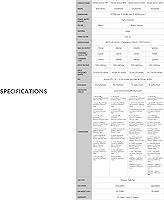
  • Output Wattage: Delivers a continuous 1000W output, providing ample headroom for high-end CPUs paired with power-hungry discrete graphics cards.
  • Form Factor: Built to the standard ATX form factor, compatible with the vast majority of full-tower and mid-tower desktop PC cases.
  • Modular Type: Fully modular design allows every cable to be detached when not in use, reducing interior clutter and supporting cleaner airflow paths.
  • Efficiency Ratings: Holds dual Gold-tier certifications from both 80 PLUS and Cybenetics, confirming high efficiency under both standard and noise-normalized testing conditions.
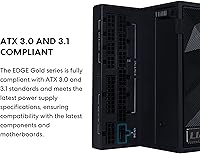
  • Compliance: Meets ATX 3.1 and PCIe 5.1 standards, ensuring stable power delivery and enhanced protection against transient load spikes generated by modern GPUs.
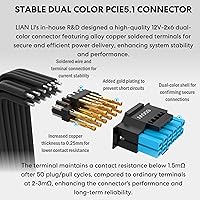
  • GPU Connector: Ships with a native 12V-2x6 connector, the current standard for RTX 40 and 50 series graphics cards, removing any need for adapter dongles.
  • Integrated Hub: The built-in EDGE Hub provides six 4-pin fan headers and USB connectivity supporting up to eight downstream devices, including RGB lighting controllers.
  • Hub Current Rating: Each of the six 4-pin fan connectors on the integrated hub is individually rated at 2A, sufficient for most 120mm and 140mm PWM fans.
  • Cooling Method: Cooled by a single air-cooled fan protected by a magnetically attached dust filter mesh that can be removed and cleaned without any tools.
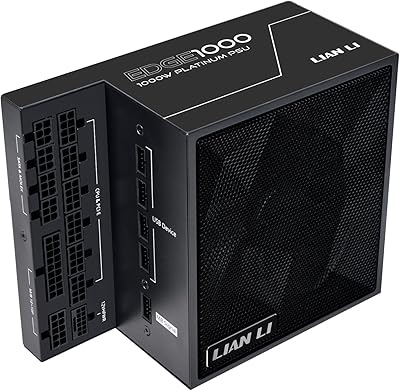
  • Chassis Design: Features an L-shaped chassis where the fan and primary cable connectors are oriented perpendicular to a conventional ATX layout, altering cable exit routing.
  • Dimensions: Measures 7.17″ x 3.39″ x 5.91″ (length x width x height), broadly comparable to standard ATX PSU sizing despite the unconventional L-shape chassis.
  • Weight: The unit weighs 7.65 pounds, placing it on the heavier end of 1000W ATX PSUs, partly due to the integrated hub components and robust internal build.
  • Max Input Voltage: Supports a maximum AC input of 240V, making it suitable for standard power grids across North America, Europe, and most of Asia.
  • Compatible Platform: Designed exclusively for standard desktop ATX builds and is not compatible with SFX, SFX-L, or any small-form-factor platform.
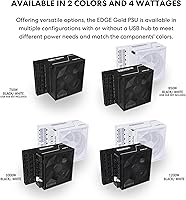
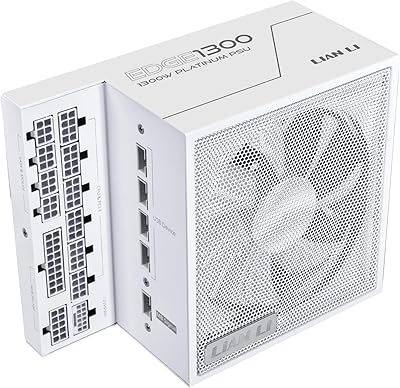
  • Color Variant: The reviewed model is the white colorway (EG1000G.WH), intended to complement cases and components with a bright or monochrome interior aesthetic.

Related Reviews
Lian Li Edge 1000W Power Supply
85%
93%
Build Quality
88%
Cable Quality & Flexibility
91%
L-Shape Design Functionality
86%
Noise Level
92%
PCIe 5.1 Connector Implementation
More
Lian Li Edge 850W Modular Power Supply
83%
89%
Build Quality
93%
Cable Management
94%
PCIe 5.1 Support
78%
Value for Money
72%
Fan Noise
More
Lian Li EDGE Series EG1300WE.US 1300W Full Modular Power Supply
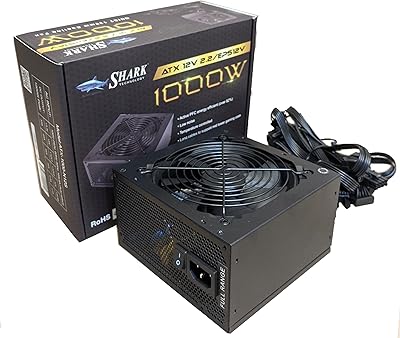
87%
93%
Power Delivery & Stability
90%
Modular Design & Cable Management
88%
Cooling Performance & Noise Levels
91%
Build Quality & Durability
85%
Compatibility with PC Components
More
Shark Technology ATX-1000-N12S 1000W ATX Power Supply
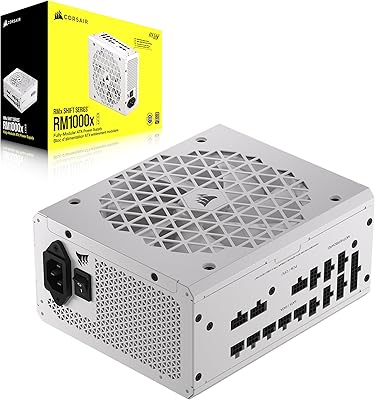
73%
74%
Value for Money
78%
Power Delivery
57%
Voltage Stability
47%
Brand Reliability
81%
Noise Level
More
Corsair RM1000x Shift 1000W ATX Power Supply
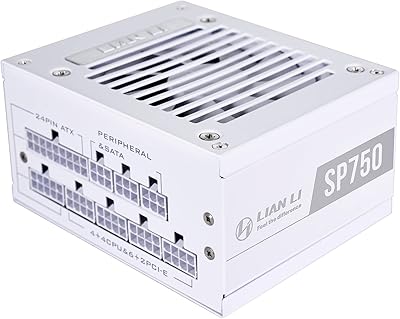
83%
93%
Build Quality
81%
Side-Connector Design
91%
Noise Level
67%
Cable Quality & Flexibility
89%
Efficiency & Power Delivery
More
Lian Li SP750 White SFX Power Supply
84%
92%
Power Efficiency
88%
Noise Level
90%
Build Quality
91%
Modular Cable Management
85%
Compactness for Small Builds
More
Lian Li SP850 850W SFX Power Supply
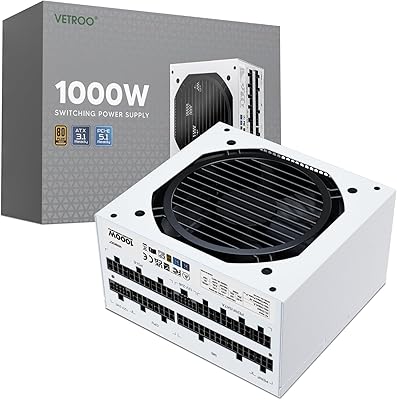
83%
91%
Build Quality
88%
Noise Level
89%
12VHPWR Connector Implementation
86%
Modular Cable Management
72%
Value for Money
More
MUSETEX MU1000 1000W ATX Power Supply
79%
88%
Value for Money
91%
Cable Management
84%
Noise Level
89%
Installation Ease
67%
Efficiency
More
Vetroo 1000G5 1000W ATX Power Supply
82%
88%
Voltage Stability & Power Delivery
86%
Efficiency & Heat Output
74%
PCIe 5.1 Cable & GPU Compatibility
91%
Modular Cable Management
89%
Noise Level & Fan Behavior
More
Apevia ATX-PR1000W-WH 1000W 80+ Gold Power Supply
85%
89%
Performance Under Load
94%
Energy Efficiency
85%
Build Quality
78%
Cooling and Noise
90%
Installation and Setup
More

FAQ

The Lian Li EDGE 1000W ATX Power Supply ships with a native 12V-2x6 connector, which is exactly what RTX 40 and 50 series cards require — no adapter involved. The ATX 3.1 certification also means the unit is built to handle the sudden power spikes these GPUs generate during heavy workloads, so you are covered on both fronts right from the first boot.

On a conventional PSU, cables exit from one end of the unit in a straight line. With the L-shape chassis, the fan and primary cable connectors are rotated, so the cable exit point is repositioned relative to the PSU body. This can improve routing flexibility in some cases, but it does mean the unit may not sit as expected in certain PSU shrouds or mid-tower bays with fixed cable cutouts. It is worth checking your case dimensions and cable management openings against the unit's specs before committing.

For most standard high-end builds, no. The built-in EDGE Hub covers six 4-pin PWM fan headers at 2A each, plus USB connectivity for up to eight downstream devices like RGB controllers or lighting strips. That is enough to handle cooling and lighting management in a typical enthusiast build without giving up a PCIe slot or adding another cable run to a standalone controller.

At typical gaming or productivity workloads, most builders report the fan is very quiet — often inaudible over the rest of the system. It does become more noticeable under sustained, high-load scenarios like extended GPU rendering or prolonged stress testing. That said, it performs within the expected range for a dual Gold-certified unit and is not a standout noise concern for normal use.

80 PLUS Gold measures power conversion efficiency at set load percentages but does not factor in how loud the fan needs to be to achieve those results. Cybenetics Gold adds acoustic testing to the process, verifying that the efficiency figures hold up even when the fan is intentionally kept at quieter speeds. For builders who want both low noise and genuine efficiency — not a trade-off between them — having both certifications is more meaningful than either alone.

The EDGE Hub uses standard 4-pin PWM fan headers and a standard internal USB connector, so it works with any ATX motherboard regardless of brand. There is no proprietary lock-in. One caveat: if your motherboard vendor's fan control software only recognizes headers directly connected to the board, the hub's headers may appear as generic fan inputs rather than offering advanced curve controls through that specific software ecosystem.

Yes, it is fully backward compatible. ATX 3.1 builds on earlier ATX standards rather than replacing them, so your existing CPU power connectors, SATA cables, and peripheral headers all work normally. The enhanced transient spike handling and 12V-2x6 GPU connector simply go unused in that scenario, which is perfectly fine — especially if you are planning a GPU upgrade down the line and want the power supply to be ready for it.

The front dust mesh snaps off magnetically, so no screwdrivers or disassembly are needed. Tap it clean, rinse it under water, and let it dry completely before reattaching. How often depends on your environment — a dusty room or a home with pets might need monthly cleaning, while a cleaner space can go longer. Checking it every couple of months as part of general system maintenance is a reasonable habit.

This modular power supply uses connector pinouts that follow common ATX modular standards, and many reputable third-party cable sets are compatible. That said, always cross-reference the pinout diagram from the cable manufacturer specifically against this unit before plugging anything in — incorrect wiring, even from a well-reviewed cable brand, can cause irreversible hardware damage. When in doubt, stick to the included cables or reach out to the cable manufacturer to confirm compatibility.

The color is purely cosmetic. The internal circuitry, efficiency certifications, hub functionality, and compliance ratings are the same across color variants of the same wattage model. Choosing white or black comes down entirely to how you want the interior of your build to look — there is no performance or reliability difference between them.

Where to Buy