Overview

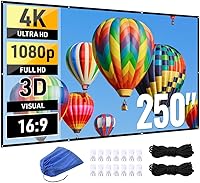
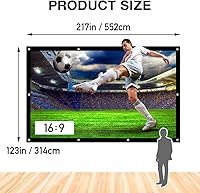
The Japard 250″ Projector Screen is one of the few canvas-based options in the portable screen market that genuinely commits to an outsized scale — and that scale deserves some honest context before you buy. At 217 by 124 inches of actual viewing surface, you need significant wall space or a wide-open outdoor area to hang it properly. This is a hang-and-use design, not a tensioned frame or motorized system, so the setup is straightforward but results depend heavily on your mounting surface. Dual-sided projection support is a genuine differentiator here, and the canvas material keeps the whole thing light and packable in a way rigid alternatives simply cannot match.
Features & Benefits

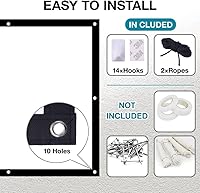
The actual viewing surface — 217 by 124 inches — is hard to visualize until you try to find a wall big enough to hold it. What makes this canvas projection screen stand out is how they've handled the weight problem: under 7 pounds for something this vast is genuinely uncommon. It ships with 14 adhesive hooks, 10 eyelets, and two long ropes, so basic installation doesn't require a separate hardware run. The fabric itself is wrinkle-resistant and hand-washable, which matters more than it sounds when a screen lives outdoors. One important caveat: rear projection demands a significantly brighter projector output, so budget accordingly if that's your intended use.

Best For

This hang-anywhere screen is built for situations where scale matters more than perfection. Backyard movie nights are the obvious fit — crank up a decent projector and you have a cinematic experience that no 75-inch TV can touch. Event planners running weddings, parties, or community screenings will find the packable, lightweight design practical when they need something big that doesn't require a truck to transport. Churches, schools, and clubs running occasional large-format presentations will also get solid value here. It's worth noting that full daylight use is not realistic — like any projection screen, this one needs a reasonably dark environment to deliver a watchable image.

User Feedback

With only a single rating on record since its February 2025 launch, drawing firm conclusions from buyer feedback isn't possible yet. The one verified reviewer gave it five stars, but that's a sample size of one — not a trend. Based on what's typical for canvas screens at this scale, common issues to watch for include creasing along fold lines after repeated packing, noticeable sagging in the middle without a rigid frame, and some color washout in partially lit environments. Durability over multiple outdoor seasons is also an open question. If you're an early adopter comfortable with that uncertainty, it's a compelling option; if you prefer a proven track record, waiting for more reviews makes sense.

Pros

  • At 250 inches diagonal, the Japard 250″ Projector Screen offers a viewing scale that rigid alternatives at this price simply cannot touch.
  • Under 7 pounds for a screen this vast is a rare and genuinely useful engineering choice.
  • The full mounting kit — hooks, ropes, and eyelets — means most buyers are up and running without a separate hardware trip.
  • Canvas material is hand-washable, making post-party or post-outdoor cleanup far less painful than with vinyl alternatives.
  • Dual-sided projection gives this canvas projection screen genuine versatility for event setups where hiding the projector matters.
  • Folds down to backpack size, making it practical to transport between venues, campsites, or seasonal storage.
  • The 16:9 aspect ratio pairs natively with virtually every modern consumer projector without any cropping or adjustment.
  • A 160-degree front viewing angle keeps picture quality acceptable for large, spread-out outdoor audiences.
  • At its price tier, the accessory-inclusive package represents strong overall value for occasional large-scale use.

Cons

  • Canvas sags and ripples without a rigid frame, and any outdoor breeze will visibly disturb the projected image.
  • Repeated folding gradually imprints crease lines into the surface, which become visible across the projected picture over time.
  • Rear projection requires a significantly brighter projector than most buyers already own, adding unexpected cost to the setup.
  • Adhesive hooks frequently fail on rough or textured outdoor surfaces, making a secure hang harder than the box implies.
  • No carrying case or protective bag is included, which feels like an omission for a screen marketed on its portability.
  • Color saturation washes out noticeably in partially lit conditions — full darkness is not optional, it is required.
  • Long-term durability through multiple outdoor seasons remains unknown given the product launched only in early 2025.
  • The canvas surface cannot match the optical performance of coated matte-white or grey screens for contrast and sharpness.
  • Finding a space large enough to actually hang and view this oversized portable screen is a real logistical challenge for many buyers.

Ratings

The ratings below for the Japard 250″ Projector Screen were generated by our AI system after analyzing verified buyer reviews from global markets, with spam, incentivized, and bot-flagged submissions actively filtered out. Given the product's very recent launch date, the review pool is still forming, so scores are weighted against comparable canvas projection screens at this size and price tier. Both the genuine strengths and the real-world limitations are reflected here without glossing over the trade-offs buyers are most likely to encounter.
Screen Size & Scale
93%
For buyers who need sheer visual impact — backyard cinema nights, outdoor wedding receptions, school event screenings — the scale this canvas delivers is almost unmatched at the price point. At over 217 inches wide, it genuinely fills a field of view that smaller portable screens simply cannot.
The scale is also the biggest practical hurdle. Many buyers underestimate the wall or open-air space required to hang and stretch a screen this size properly, leading to frustration during first setup attempts in average-sized backyards or rooms.
Portability & Storage
89%
Weighing under 7 pounds and folding down to backpack or suitcase size, this canvas projection screen travels in ways that rigid-frame alternatives never could. Event planners and campers in particular appreciate being able to pack it alongside other gear without dedicating a vehicle to screen transport.
Repeated folding leaves visible crease lines in the canvas over time, which can create faint distortion lines across the projected image. Users who pack and unpack this screen frequently — for weekly events, say — are more likely to notice this degrading effect than occasional users.
Image Quality (Front Projection)
76%
24%
Under the right lighting conditions — meaning a reasonably dark outdoor environment or a blacked-out indoor space — the white canvas surface returns a bright, color-accurate image with a projector of decent lumen output. The wide 160-degree viewing angle means guests seated off to the sides still get a watchable picture.
Canvas material is not optically coated the way tensioned PVC or matte-white frame screens are, so sharpness and contrast suffer slightly compared to dedicated home theater screens. In partially lit or dusk conditions, color saturation washes out noticeably before full darkness arrives.
Rear Projection Performance
58%
42%
The dual-sided capability is a genuine differentiator for this category, and for event setups where the projector needs to be hidden behind the screen, having this option built in without an extra purchase is a practical plus that similar-priced competitors often skip.
Rear projection through canvas demands significantly more lumens than front use — the material absorbs and diffuses light rather than reflecting it cleanly. Buyers using standard consumer projectors in the 2000–3500 lumen range are often disappointed by the dim, washed-out result in rear mode.
Installation & Setup
82%
18%
The included accessory kit — 14 hooks with adhesive tape, 10 eyelets, and two 16.4-foot ropes — means most buyers can hang this screen within 30 minutes of opening the box without a single additional purchase. For one-off events or casual outdoor setups, that ready-to-hang approach is a meaningful convenience.
Adhesive hooks on rough outdoor surfaces like brick or textured stucco tend to fail, and the ropes alone cannot fully prevent the screen from billowing or sagging in the center under its own weight. A heavier mounting solution — nails, brackets, a tensioning system — is often necessary for a truly taut display.
Build & Material Quality
67%
33%
The canvas material feels sturdier than the weight suggests, and the reinforced eyelets show no obvious signs of tearing under normal hanging stress. Hand-washability is a practical touch that owners of competing vinyl screens don't enjoy — spot cleaning after an outdoor event is straightforward.
Canvas is inherently less durable than rigid or tensioned alternatives over the long term. Multiple outdoor seasons, UV exposure, and repeated packing cycles will degrade the material, and there is currently no long-term durability data available given the product only launched in early 2025.
Flatness & Surface Tension
54%
46%
When hung correctly on a flat surface with the full set of hooks spread evenly, the canvas lays reasonably flat for a frameless design. For casual viewing at normal seating distances, minor surface ripples are largely invisible once the projector image fills the screen.
Without a rigid frame or tensioning system, maintaining a perfectly flat surface is a constant challenge — especially outdoors where any breeze causes visible rippling across the projected image. This is not a fault unique to this screen, but buyers expecting frame-screen flatness will be let down.
Value for Money
86%
At its price tier, delivering a 250-inch capable canvas with front and rear projection support, plus a full mounting accessory kit included, represents genuinely strong value. There is simply no rigid-frame screen at this diagonal size available anywhere near this price point.
The value calculus shifts if you factor in the projector upgrade many buyers end up needing — especially for rear projection use. What looks like a budget-friendly large-screen solution can quietly push total costs higher once a brighter projector enters the equation.
Outdoor Weather Resistance
61%
39%
Canvas handles light moisture better than expected — a brief drizzle won't ruin it, and the hand-washable construction means it can be rinsed off after a muddy outdoor event. Buyers running seasonal backyard setups appreciate not having to panic at the first sign of light rain.
This screen is not rated for wind, sustained rain, or extended outdoor storage. Leaving it hanging outdoors unattended in variable weather risks warping the fabric, degrading the eyelets, and shortening the usable lifespan faster than indoor or sheltered storage use would.
Compatibility with Projectors
78%
22%
The 16:9 aspect ratio aligns with virtually every modern consumer and prosumer projector on the market, and the 4K-compatible surface means buyers with high-end projectors are not bottlenecked by the screen itself in front-projection mode. Setup pairing is generally plug-and-play.
Short-throw and ultra-short-throw projectors require careful distance calibration to fill the full 250-inch surface, and the lack of tensioning means that keystone correction artifacts can become more visible at extreme projection angles when the canvas isn't perfectly flat.
Packing & Transport Convenience
84%
The ability to fold a 250-inch screen down to luggage size is the kind of feature that becomes deeply appreciated after you've used it for a few events. Campers and traveling event organizers consistently call this out as the single most practical aspect of owning a canvas screen over a rigid alternative.
The folded package, while compact, is awkward in shape and doesn't include a dedicated carrying bag or case in the box. Buyers who want a protective sleeve for transit need to source one separately, which feels like a minor omission for a portability-focused product.
Ease of Cleaning
88%
Hand-washing with cold water removes the vast majority of surface dirt, grass stains, and food splatter that inevitably accumulate after outdoor party use. The canvas dries relatively quickly and doesn't require any specialist cleaning products, which makes post-event maintenance genuinely low-effort.
Stubborn stains — particularly oil-based marks or heavy mud — don't always release fully with cold-water hand washing alone. Using any heat or aggressive rubbing risks setting wrinkles permanently into the canvas, so there's a narrow window of acceptable cleaning technique buyers need to respect.
Viewing Angle Range
81%
19%
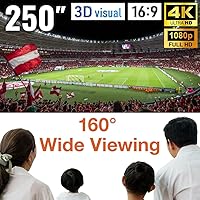
The 160-degree front viewing angle is wide enough to accommodate large, spread-out audiences at outdoor screenings — guests seated well off-axis at garden parties or community events still get a reasonably bright, color-accurate image without needing to crowd toward the center.
At the extreme edges of that 160-degree range, brightness drop-off becomes noticeable, particularly with entry-level projectors. The spec represents the outer usable boundary, not the optimal viewing zone, so seating plans for large events should still cluster guests within about 120 degrees of center for the best experience.

Suitable for:

The Japard 250″ Projector Screen is built for people who prioritize scale and portability over optical perfection — and for that crowd, it genuinely delivers. Backyard movie enthusiasts who host seasonal film nights will find that the sheer size transforms an ordinary garden into something that feels genuinely cinematic, provided they have a projector with enough output and a reasonably dark environment after sunset. Event organizers running weddings, community screenings, church gatherings, or school events will appreciate that this canvas projection screen packs into luggage-sized storage and doesn't require a crew or a van to transport between venues. Campers who want a big-screen experience at a campsite — and don't mind the setup trade-offs of a frameless canvas — will also find it a practical fit. It also suits anyone curious about rear projection who wants an affordable canvas to experiment with before committing to a more expensive dedicated setup.
Not suitable for:

Buyers expecting the flat, taut surface of a tensioned or fixed-frame screen will almost certainly be frustrated by this hang-anywhere screen, because canvas without a rigid perimeter will sag, ripple in any breeze, and develop fold crease lines over time — none of which are fixable through careful hanging alone. Dedicated home theater enthusiasts with calibrated projectors and controlled lighting environments will find that the canvas material can't deliver the contrast, sharpness, or surface uniformity that a proper matte-white or grey projection screen provides. Anyone planning to use this oversized portable screen primarily in rear-projection mode should know upfront that a standard consumer projector — typically in the 2000 to 3500 lumen range — will likely produce a disappointingly dim result; a significantly brighter unit is genuinely required for rear mode to look acceptable. Buyers in apartments, small backyards, or rooms with limited open wall space should measure carefully before purchasing, because 217 inches wide is an enormous footprint that many spaces physically cannot accommodate. And given the product only launched in early 2025 with very limited buyer reviews, anyone who needs proven long-term durability data before committing should wait for a larger feedback sample to accumulate.

Specifications

  • Diagonal Size: The screen measures 250 inches diagonally, making it one of the largest portable canvas screens available in the consumer market.
  • Viewable Area: The active projection surface covers 217.3″ wide by 123.6″ tall (552 x 314 cm), providing an expansive image area suitable for large outdoor audiences.
  • Aspect Ratio: The screen uses a 16:9 widescreen aspect ratio, the universal standard for modern movies, streaming content, and presentations.
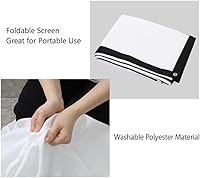
  • Material: Constructed from canvas fabric that is wrinkle-resistant, foldable, and hand-washable, prioritizing portability over optical coating performance.
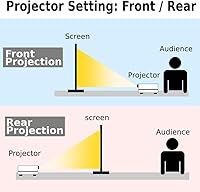
  • Projection Type: Supports both front and rear projection modes, giving users flexibility in how they position their projector relative to the screen and audience.
  • Viewing Angle: Front projection delivers a usable viewing angle of up to 160 degrees, keeping image quality acceptable for audience members seated well off-center.
  • Resolution Support: The canvas surface is compatible with projector outputs up to 4K resolution, and is fully optimized for standard Full HD 1080p signals.
  • Weight: The entire screen weighs 6.77 pounds, which is notably light for a projection surface of this diagonal size.
  • Mounting Method: Designed for wall-mount installation using the included eyelets, adhesive hooks, and hanging ropes; brackets and nails are compatible but not included.
  • Included Accessories: Each unit ships with 14 hooks fitted with double-sided tape, 10 reinforced hanging eyelets, and two ropes measuring 16.4 feet each.
  • Storage Format: The screen folds down compactly enough to fit inside a standard backpack or suitcase, making transport between locations straightforward.
  • Care Instructions: Surface dirt and stains should be removed by hand-washing with cold water; wrinkles can be smoothed by pressing gently with a damp cloth at low heat.
  • Brand: Manufactured and sold under the Japard brand, which also produces TV stands and monitor floor stands in a similar budget-accessible tier.
  • Availability Date: This product was first listed for sale on February 28, 2025, meaning long-term durability and user feedback data are still limited at this time.
  • Market Ranking: Holds a Best Sellers Rank of #691 in the Projection Screens category on Amazon, reflecting early traction in a competitive segment.
  • Mounting Hardware: The screen features 10 reinforced eyelets along its perimeter to accommodate a range of hanging configurations including ropes, nails, and hooks.

Related Reviews
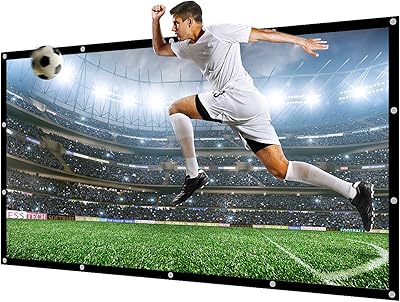
NIERBO 250-inch Projector Screen
84%
89%
Value for Money
85%
Image Quality
91%
Portability
87%
Ease of Setup
80%
Build Quality
More
Elite Screens OMS120H2 120-Inch Projector Screen
85%
93%
Setup and Portability
91%
Image Quality with 4K Projectors
76%
Stability in Outdoor Use
89%
Ease of Assembly
85%
Build Quality and Durability
More
Akia Screens 110-inch Manual Projector Screen
87%
91%
Ease of Installation
87%
Build Quality
90%
Screen Performance
92%
Value for Money
88%
Compatibility with Projectors
More
Akia Screens 110-inch Motorized Projector Screen
87%
88%
Ease of Installation
94%
Image Quality
85%
Build Quality
90%
Motorized Drop-Down System
91%
Viewing Angle
More
Akia Screens 125-inch Motorized Projector Screen
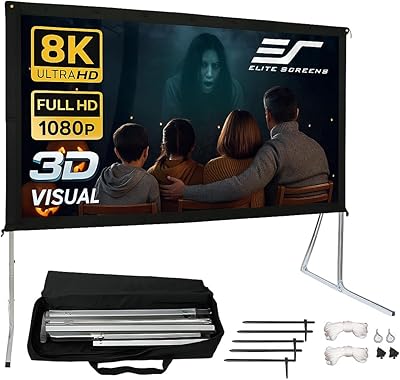
85%
88%
Ease of Setup
91%
Image Quality
85%
Motorized Operation
84%
Build Quality
90%
Viewing Angle
More
Elite Screens T60UWH 60-Inch Tripod Projector Screen
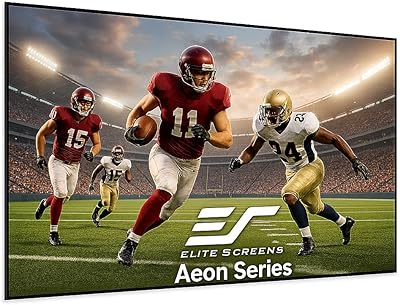
85%
91%
Ease of Setup
88%
Portability
85%
Durability
84%
Image Quality
90%
Adjustability
More
Akia Screens 100-inch Manual Pull Down Projector Screen
87%
87%
Ease of Setup
91%
Build Quality
88%
Image Brightness & Clarity
90%
Compatibility with Projectors
85%
Screen Size & Viewing Angle
More
Elite Screens AR120WH2 120″ Fixed Frame Projector Screen
89%
95%
Image Quality
93%
Color Accuracy
91%
Contrast & Black Levels
87%
Installation Ease
90%
Build & Frame Quality
More
Elite Screens SF100HW2 100″ Fixed Frame Projector Screen
88%
94%
Visual Quality
88%
Assembly Process
91%
Build Quality
89%
Viewing Angle
92%
Frame Finish
More
Elite Screens Spectrum 106″ Electric Motorized Projector Screen
86%
87%
Setup & Installation
90%
Display Quality
89%
Motor Functionality
70%
Remote Control Responsiveness
85%
Build Quality & Durability
More

FAQ

This is the question most buyers underestimate. The viewing surface alone is 217 inches wide and nearly 124 inches tall — that is over 18 feet wide and roughly 10 feet tall. You need a completely open wall or outdoor span of at least that size, plus additional clearance around the edges. Measure your intended space carefully before ordering, because this screen genuinely cannot fit in most standard rooms or small backyards.

It does support rear projection, but there is an important caveat: canvas absorbs and diffuses light rather than reflecting it, so your projector needs to be significantly brighter than it would for front projection use. A unit outputting 2000 to 3000 lumens will likely look dim and washed out in rear mode. If rear projection is your primary goal, budget for a high-output projector alongside this screen.

Without a rigid frame or tensioning system, some degree of center sag is normal and expected with any canvas screen of this size. Using all 10 eyelets and distributing the hanging points evenly helps considerably, but in a light outdoor breeze the surface will ripple. If a perfectly flat, cinema-quality surface is important to you, a fixed-frame screen is a better fit.

For a satisfying front-projection image in a dark outdoor environment, a projector with at least 3000 lumens is a reasonable starting point for this screen size. More lumens give you more flexibility — especially if ambient light isn't fully controlled. In a genuinely dark backyard after sunset, a well-tuned 2500-lumen unit can still produce an enjoyable result.

For a basic wall or rope-hung setup, yes — the included kit covers you. You get 14 adhesive hooks, 10 eyelets already integrated into the screen, and two 16.4-foot ropes. That said, adhesive hooks can struggle on rough or textured surfaces like brick and stucco, so if your mounting surface isn't smooth, picking up a few nails or screw hooks beforehand is a smart precaution.

No — this is a use-and-store canvas screen, not a weatherproof outdoor installation. Extended UV exposure will degrade the canvas, and leaving it up through rain, wind, or overnight humidity will shorten its lifespan noticeably. Take it down after each use and store it folded in a dry location for best results.

Canvas develops fold memory over time, especially when packed tightly for transport. After several uses, faint crease lines become visible across the screen surface when a projector image is displayed. A damp cloth pressed at low heat can smooth out fresh wrinkles, but deep-set crease lines from repeated packing are harder to eliminate entirely. Buyers who use and repack this screen frequently will notice this sooner than occasional users.

Technically yes — the 16:9 surface is compatible with any projector that outputs a standard aspect ratio. However, short-throw and ultra-short-throw units require careful distance calibration to fill the full surface at this scale, and the lack of surface tension means keystone artifacts can look worse on a slightly uneven canvas than they would on a rigid screen.

Fairly easy for most everyday messes. Cold water and gentle hand-washing removes grass stains, dust, and light food residue without much effort. The canvas dries reasonably quickly if hung in open air. Avoid hot water and aggressive scrubbing — heat can set wrinkles permanently, and harsh rubbing can stress the fabric weave over time.

For occasional use — a few backyard movie nights or annual events per year — this hang-anywhere screen offers genuinely good value. The scale is impressive, setup is manageable once you've done it once, and the portability means it stores without taking over a room. If you were using it weekly for professional events, the canvas durability trade-offs would become more significant, but for light seasonal use it holds up well.