

Overview

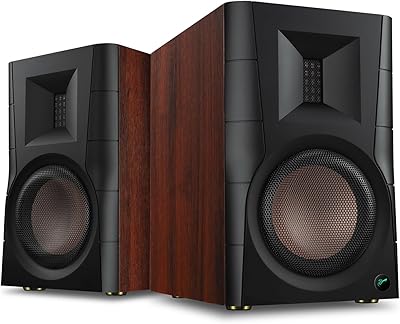
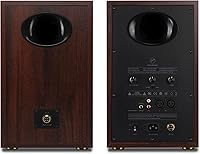
The HiVi-Swans D300 comes from a brand that has been engineering loudspeakers in China for over three decades, and that heritage shows in how seriously these powered bookshelf speakers are put together. This is not a casual Bluetooth speaker dressed up in wood grain — it sits in a price range where buyers expect real acoustic engineering, not marketing shortcuts. The cabinet has a warm, wood grain finish and a physical presence that demands thoughtful placement; at nearly 14 inches tall and 45 pounds, this HiVi-Swans speaker is built for a dedicated desk or shelf spot, not casual repositioning.

Features & Benefits

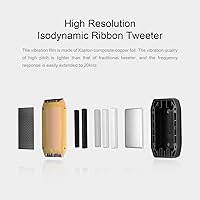
The driver pairing here is genuinely interesting. A large long-throw woofer handles the low and mid frequencies with control rather than boom, while the isodynamic ribbon tweeter — a design borrowed from studio and high-end consumer speakers — reproduces highs with an openness that conventional dome tweeters rarely match. Built-in class-D amplification delivers serious output headroom for a desktop speaker, making an external receiver unnecessary. Connectivity is impressively broad: Bluetooth 5.0 with aptX HD, optical, coaxial, balanced XLR, and analog line inputs are all on board. A signal-to-noise ratio exceeding 102dB means the background stays quiet even at low volumes.

Best For

These powered bookshelf speakers are a strong fit for music producers or home studio listeners who want near-field accuracy without giving up the convenience of multiple input types. Audiophile desktop setups — a turntable feeding a phono preamp, a standalone DAC, or a streaming device — slot in naturally through the balanced or analog inputs. Home office users who want serious sound quality without a separate amplifier will appreciate the all-in-one design. The D300 also works well as a secondary room TV speaker, using the optical or coaxial input for clean digital audio from a set-top box or soundbar bypass.

User Feedback

Owners consistently praise soundstage width and the ribbon tweeter's clarity — many note that high-frequency detail is more refined than they expected at this price point. Build quality gets positive marks too. That said, the rear-mounted tone controls draw regular complaints: on a packed desk against a wall, reaching back to adjust bass or treble becomes genuinely inconvenient, even with the remote. Several buyers flag the weight as a surprise — moving these around is a two-handed job. A few early listeners found the highs slightly bright at first, though most noted the sound settled with use. Warranty support experiences appear generally positive in owner feedback.

Pros

  • Ribbon tweeter delivers high-frequency clarity that most powered desktop speakers cannot match at this price point.
  • Exceptionally wide, well-defined soundstage makes critical listening and mixing reference genuinely rewarding.
  • Five distinct input types — including balanced XLR and optical — cover virtually every source device without adapters.
  • Built-in class-D amplification is powerful and quiet, with a noise floor that stays inaudible even at low listening volumes.
  • The 6.5-inch woofer produces tight, controlled bass that does not smear or bloat in near-field conditions.
  • Bluetooth 5.0 with aptX HD support delivers noticeably cleaner wireless audio than standard Bluetooth connections when the source is nearby.
  • Wood grain MDF cabinet looks and feels more premium than the typical vinyl-wrapped powered monitor.
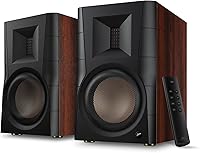
  • Wireless remote handles daily tasks — volume, mute, input switching — without requiring you to touch the speaker.
  • Build quality inspires long-term confidence; cabinet resonance is low and all connections feel solid after extended use.
  • Includes a practical cable kit that covers common connection scenarios right out of the box.

Cons

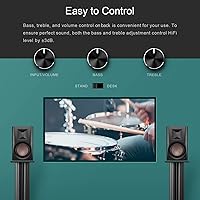
  • All three tone adjustment knobs sit on the rear panel, making quick tweaks inconvenient on a wall-adjacent desk.
  • At 45 pounds, repositioning or adjusting placement is a deliberate two-person task, not a casual one.
  • Bluetooth range is limited and real-world desk environments can shorten it further, frustrating wireless-first users.
  • Ribbon tweeters can sound slightly bright on certain recordings during the initial break-in period.
  • The remote control feels noticeably cheap relative to the quality of the main cabinet it accompanies.
  • No visible input indicator on the front panel makes it hard to confirm which source is currently active at a glance.
  • The narrow ribbon tweeter sweet spot means off-axis listening loses high-frequency detail faster than a dome tweeter would.
  • Replacement ribbon tweeters are less universally available than standard tweeter parts, adding a small long-term repair risk.
  • The instruction manual is unclear on input-switching priority, leading to trial-and-error for some buyers during setup.

Ratings

The HiVi-Swans D300 earns a strong overall reception among desktop audio enthusiasts, and the scores below reflect what our AI found after parsing verified buyer reviews from multiple global markets — filtering out incentivized posts and outlier feedback to surface the real consensus. Strengths in sound accuracy and input flexibility are clearly reflected, and so are the genuine frustrations around ergonomics and setup. Both sides of the ownership experience are represented here without softening the rough edges.

Sound Quality
91%
Owners consistently describe the listening experience as detailed and spacious — particularly on acoustic music, jazz, and vocal-heavy tracks where the ribbon tweeter renders texture that cheaper dome-tweeter speakers simply smear over. The low end is controlled rather than exaggerated, which serious listeners appreciate during long desktop sessions.
A handful of users found the high-frequency presentation slightly forward during the first weeks of use, describing the sound as borderline fatiguing on bright recordings until the drivers settled in. Those coming from warmer-sounding speakers may need time to adjust their expectations.
Ribbon Tweeter Performance
89%
The isodynamic ribbon tweeter is the most frequently praised single component in owner feedback. Listeners describe an airiness and separation in the upper frequencies that feels closer to a high-end bookshelf passive speaker than a powered desktop unit, making it a genuine differentiator in its price class.
Ribbon tweeters are more sensitive to placement angle than conventional domes, and some users noted the sweet spot is narrower than expected — move too far off-axis and the high-frequency detail softens noticeably. A minority also raised questions about long-term durability compared to a standard tweeter.
Bass Response
83%
The 6.5-inch woofer delivers bass that is punchy and well-defined for a near-field speaker of this size. Electronic music listeners and those using these as secondary studio monitors report satisfying low-end extension without the one-note bloat that plagues many ported desktop speakers.
At higher volumes, a few owners noted that bass can become slightly loose in smaller, acoustically untreated rooms. Those expecting the deep, room-filling low end of a subwoofer-equipped system will need to manage expectations — this is a 2.0 stereo design, not a bass-first experience.
Build Quality
88%
The wood grain MDF cabinet feels genuinely substantial and well-finished for a powered speaker in this category. Multiple reviewers mentioned the cabinet resonance is low and the overall assembly inspires confidence — nothing rattles, the inputs feel solid, and the fit and finish holds up to close inspection.
At 45 pounds for the pair, the sheer weight is both a quality signal and a practical inconvenience. Some buyers found the rear panel connections tight and slightly fiddly during initial setup, particularly when routing multiple cables in a crowded desk environment.
Input Versatility
93%
The breadth of connectivity options — Bluetooth, optical, coaxial, balanced XLR, and analog line in — is a genuine strength that separates these powered bookshelf speakers from most competitors. Turntable users, TV owners, and professional audio workers can all connect their primary source without adapters or compromises.
Having five input types is great until you realize the switching is handled via rear-panel controls and a small remote. A front-facing input indicator or a clearer source display would help users know at a glance which input is active, and this is a recurring request in the feedback.
Bluetooth Performance
74%
26%
Bluetooth 5.0 with aptX HD support means that when conditions are right — phone nearby, clear line of sight — the wireless audio quality is noticeably better than standard SBC connections. Streaming lossless-adjacent audio over Bluetooth from a compatible phone sounds genuinely clean and detailed.
The practical Bluetooth range caps out close to the rated 10 meters, and obstacles or desk clutter shorten that further. Several buyers who planned to use Bluetooth as a primary input found themselves defaulting to a wired connection after experiencing occasional dropout or connection interruption mid-session.
Amplifier Performance
87%
The built-in class-D amplification is powerful enough that most users never approach its upper limits in a normal desktop or near-field environment. The lack of audible noise floor at idle is specifically called out by users who have owned noisier powered monitors — the quiet background is a real benefit for critical listening.
A small number of experienced users noted that the built-in DAC and amplification, while capable, does not quite match what a dedicated external DAC feeding into the balanced input can achieve. For most buyers this will be irrelevant, but purists may find the internal processing a mild compromise.
Ergonomics & Controls
61%
39%
The wireless remote is a thoughtful addition that partially offsets the rear-panel control placement. For basic tasks — adjusting volume from across the room or switching inputs without reaching behind the speakers — the remote works reliably and is responsive enough for everyday use.
Placing all three tone adjustment knobs on the rear panel is the most common frustration in user feedback. Anyone with speakers pushed close to a wall — which is most desk users — has to pull the unit forward or blindly reach around every time they want to tweak bass or treble. It is a real usability compromise.
Setup & Installation
78%
22%
Most buyers report the initial unboxing and connection process is straightforward, especially compared to assembling a separate amplifier and passive speaker system. The included cable kit covers common connection scenarios, reducing the chance of an immediate trip to the electronics store before first use.
The weight and size make solo setup more cumbersome than typical compact powered speakers. A few users also noted that the instruction manual, while present, could be clearer on input priority and switching logic — there was some trial-and-error involved before the source-selection behavior was fully understood.
Value for Money
82%
18%
Compared to buying a separate pair of quality passive bookshelf speakers plus a matching stereo amplifier with equivalent specs, these powered bookshelf speakers represent a reasonable proposition. The ribbon tweeter alone is a component that typically commands a premium in the passive speaker market.
The price point places these in direct competition with some well-regarded separates and other premium powered monitors. Buyers who compare obsessively before purchasing sometimes feel the ergonomic shortcomings — particularly the rear controls — are harder to forgive at this spend level than they would be on a budget option.
Remote Control
76%
24%
The remote covers the key functions — volume, mute, input selection, and power — which is exactly what most users need day-to-day. Response is consistent and the range is adequate for typical desktop-to-couch distances in a home office or living room secondary setup.
The remote feels plasticky relative to the premium cabinet it accompanies, and a few buyers reported the remote stopped responding reliably after several months of use. It runs on a standard battery, but the build quality does not inspire the same confidence as the main unit itself.
Soundstage & Imaging
90%
Wide, well-defined soundstage placement is one of the most enthusiastically described qualities across owner reviews. Listeners using these for mixing reference or critical music listening report that instruments and vocals occupy distinct, stable positions in the stereo field — something not all powered desktop speakers can claim.
Achieving that wide soundstage requires deliberate placement: speakers need adequate space from side walls and some toe-in adjustment. Users who simply placed them straight ahead on a crowded desk without any positioning effort reported a noticeably less impressive result than those who took time to optimize the setup.
Aesthetics & Design
84%
The wood grain finish gives these a warmer, more furniture-like look than the ubiquitous black plastic or vinyl wrap on most powered monitors. On a wooden desk or alongside natural-material shelving, the visual result is distinctly more intentional than the typical studio-gray monitor aesthetic.
The brown wood grain colorway, while attractive to many, is a polarizing choice — some buyers wished for a darker walnut or matte black option. The rear-panel orientation of controls also slightly undermines the clean front-facing aesthetic that the cabinet design otherwise achieves.
Long-Term Reliability
79%
21%
The majority of owners who have used these for a year or more report no functional issues, and the brand has a service reputation that holds up reasonably well in English-language feedback for a Chinese audio manufacturer. The limited warranty appears to be honored without excessive friction in most documented cases.
The sample size of long-term reviews is smaller than for entry-level speakers — these are not yet a widely aged product. A minority of users have reported ribbon tweeter concerns after extended use, and since ribbon replacements are less universally available than standard tweeter parts, this carries slightly higher repair risk.

Suitable for:

The HiVi-Swans D300 is genuinely well-matched to listeners who take their desktop audio seriously and want a single, self-contained speaker system that does not require building a separate amplifier chain. Music producers and home studio enthusiasts will find the near-field accuracy and balanced XLR input particularly useful — it bridges the gap between a consumer speaker and a proper studio monitor in a way that few powered bookshelf options at this price manage. Audiophiles who already own a turntable, standalone DAC, or a high-quality streaming device will appreciate having multiple input options that let them connect everything cleanly without a switching box. Home office workers who spend long hours listening to music or podcasts and want fatigue-free, accurate sound rather than hyped-up bass will feel right at home with the D300's controlled, detailed presentation. It also works well as a secondary room TV speaker for anyone with an optical or coaxial output on their television, offering a meaningful audio upgrade over a soundbar without the complexity of a full surround setup.

Not suitable for:

The HiVi-Swans D300 is not the right pick for buyers who prioritize convenience and casual use above sound quality. Anyone planning to rely primarily on Bluetooth — streaming from a phone across a room, or using these at a gathering where the source device moves around — will run into the practical limitations of a roughly 10-meter wireless range and the occasional dropout that a few users have reported. People with desks pushed flush against a wall will find the rear-mounted tone controls a persistent frustration; if you frequently adjust bass or treble to suit different listening material, reaching blindly behind a 45-pound speaker becomes old quickly. Buyers in search of thunderous bass output or a speaker that fills a large open room will also be disappointed — these are optimized for near-field listening at relatively close range, not for powering a party or a large living space. Finally, anyone on a tight budget or shopping primarily for background music and casual listening should consider that the price point buys engineering and accuracy, not extra features or lifestyle convenience, and that trade-off only makes sense for listeners who will actually notice the difference.

Specifications

  • Woofer Driver: A 6.5-inch long-throw mid-woofer with an aluminum voice coil handles low and midrange frequencies with controlled, accurate reproduction.
  • Tweeter Driver: An isodynamic ribbon tweeter reproduces high frequencies with low distortion and an open, airy character uncommon at this price tier.
  • Total Power Output: The built-in dual-channel class-D amplifier delivers 300W RMS combined output, providing substantial headroom for near-field and desktop listening environments.
  • Signal-to-Noise Ratio: The measured signal-to-noise ratio exceeds 102dB, ensuring a very quiet background even during low-volume critical listening sessions.
  • Bluetooth Version: Bluetooth 5.0 with aptX HD codec support enables higher-resolution wireless audio transmission with lower latency than standard Bluetooth connections.
  • Bluetooth Range: Effective wireless range reaches approximately 10 meters under clear line-of-sight conditions, with real-world range depending on environmental obstacles.
  • Wired Inputs: Available wired inputs include optical (TOSLINK), coaxial digital, balanced XLR, and analog line-in, covering professional and consumer source devices.
  • Input Sensitivity: Input sensitivity is rated at 400mV, compatible with standard consumer and prosumer audio source output levels without preamplification.
  • Tone Controls: Three rear-mounted knobs allow independent adjustment of volume, bass, and treble directly on the speaker cabinet.
  • Remote Control: A wireless infrared remote control is included and handles volume adjustment, input source switching, mute, and power functions.
  • Dimensions: Each cabinet measures 12.4″ deep by 8.62″ wide by 13.86″ tall, requiring dedicated shelf or desk space for proper placement.
  • Weight: The combined weight of the speaker system is 45 pounds, making deliberate, stable placement essential before regular use.
  • Cabinet Material: Cabinets are constructed from MDF with a wood grain finish, reducing internal resonance while providing a warm, furniture-grade aesthetic.
  • Surround Configuration: The system operates in a 2.0 stereo configuration with no built-in subwoofer output, optimized for near-field and desktop listening.
  • Power Supply: A wide-voltage switching power supply is built in, supporting standard 120V AC power via a corded connection with no external power brick required.
  • Included Accessories: The package includes a remote control, power cord, analog audio cable, connecting cable between speakers, fiber optic cable, and an instruction manual.
  • Warranty: The D300 is covered by a limited manufacturer warranty; buyers should confirm current warranty terms and regional service availability directly with HiVi-Swans.
  • Indoor Use: These speakers are designed exclusively for indoor use and are not rated for outdoor or moisture-exposed environments.

Related Reviews
HiVi-Swans D200
HiVi-Swans D200
78%
92%
Sound Clarity & Treble Detail
61%
Bass Response
88%
Build Quality & Materials
83%
Amplifier Power & Headroom
74%
Bluetooth Performance
More
HiVi-Swans OS-10
HiVi-Swans OS-10
77%
88%
Sound Clarity
64%
Bass Response
91%
Build Quality
71%
Connectivity Range
83%
Value for Money
More
Flower Knows Swan Ballet Embossed Blush 02 Romanticism
88%
92%
Blendability & Application
88%
Long-lasting Wear
90%
Buildable Coverage
85%
Natural Finish
87%
Packaging Design
More
Nikon D300 DX 12.3MP Digital SLR Camera
85%
94%
Autofocus Performance
91%
Build Quality & Durability
88%
Image Quality
84%
Usability & Ergonomics
90%
Low-Light Performance
More
Flower Knows Swan Ballet Shine Lipstick B06 Blue Ribbon
86%
89%
Hydration & Comfort
92%
Packaging Design
91%
Gloss & Shine
85%
Shade & Color Payoff
78%
Longevity of Wear
More
Aume JA-D300 Wireless Solar Security Cameras 2-Cam Kit
86%
87%
Video Quality
91%
Ease of Setup
94%
Battery Life/Solar Power
85%
Motion Detection Accuracy
92%
Weatherproofing/Durability
More

FAQ

No, the D300 is a fully active system with a built-in amplifier, so you connect your source directly and you are ready to go. There is no need for a separate receiver or integrated amp.

Only if your turntable has a built-in phono preamp or a line-level output. Most turntables output a very low phono-level signal that needs a phono stage before it reaches these speakers. If your turntable has a built-in preamp and a standard RCA output, you can connect it to the analog line input without any additional hardware.

When your phone or laptop is close to the speakers — say, within five or six meters with no major obstacles — aptX HD Bluetooth sounds noticeably clean and detailed. That said, the range is not exceptional, and if you are walking around a larger room or have walls and furniture in the way, you may notice occasional dropouts. For primary desktop use with a device sitting nearby, it works well; for whole-room wireless use it is less reliable.

Honestly, it depends on your setup. If your speakers have open space behind them or sit on stands, reaching back is no big deal. But if they are pushed against a wall or tucked into a shelf — which is common on a desk — adjusting the bass or treble knobs requires physically pulling the speaker forward. The remote handles volume and input switching fine, but the tone knobs are not on the remote, so yes, it is a legitimate daily annoyance for some users.

Some owners report the high frequencies sound slightly forward or bright during the first several hours of use, which is fairly typical for ribbon tweeters. Most listeners find the sound settles into a more balanced presentation after 20 to 50 hours of normal listening. It is worth giving them time before drawing firm conclusions about the tonal character.

Yes, this is one of the most practical use cases for this speaker. Connect a TOSLINK optical cable from your TV's digital audio output to the speaker's optical input and you have a clean, high-quality stereo setup. Just make sure your TV is set to output PCM stereo over optical rather than Dolby Digital, as the speakers process stereo signals only.

The balanced XLR input is designed for professional audio equipment like audio interfaces, mixers, or high-end DACs with balanced outputs. It rejects electrical interference more effectively over longer cable runs and can result in a slightly cleaner signal in noisy environments. For typical home use with consumer gear, the standard analog line input performs perfectly well and the difference will be subtle or undetectable in most listening rooms.

Very loud — more than most desktop users will ever need. The amplifier has substantial output headroom, and at a typical near-field listening distance of one to two meters you will likely never go beyond 40 to 50 percent volume in a home environment. The extra power capacity is more about dynamic headroom and clean output at moderate levels than about raw volume.

This is worth thinking about before you buy. Ribbon tweeter replacements are generally less widely stocked than standard dome tweeter spares, and sourcing an exact replacement part for the HiVi-Swans D300 may require going through the manufacturer or a specialist audio parts supplier. It is not an immediate concern for most buyers, but it is worth noting compared to more universally serviceable speaker components.

They work fine for gaming, though the tuning priority is accurate stereo reproduction rather than cinematic surround effects. If you are playing through a PC or console with a stereo output — optical, coaxial, or USB DAC into the analog input — the wide soundstage and precise imaging actually help with positional audio cues in games. Do not expect virtual surround processing; these are a 2.0 stereo system and that is their strength.