Overview

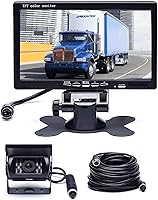
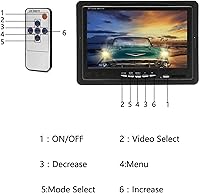
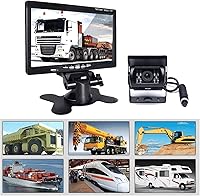
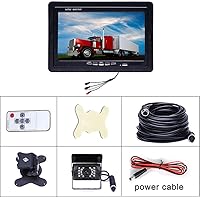
The Hikity 7″ Backup Camera Monitor Kit is a purpose-built rear visibility solution for drivers who spend serious time behind the wheel of an RV, truck, bus, or trailer. Unlike piecemeal setups that require sourcing a compatible camera, monitor, and cable separately, this backup camera kit ships as a complete, ready-to-wire package — 7-inch LCD monitor, IR night vision camera, 65ft aviation cable, remote controller, and all mounting hardware included. What gives it a practical edge over comparable wired alternatives is the 4-pin aviation connector, which creates a more secure, interference-resistant signal path than standard composite AV cables. With a top-200 rank in its Amazon subcategory and a steady track record since 2018, this is not a flash-in-the-pan listing.

Features & Benefits

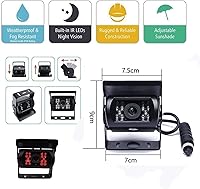
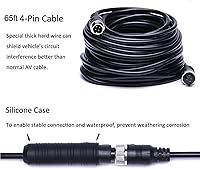
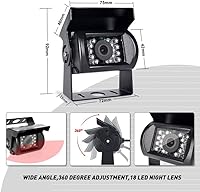
The camera housing is built from hard metal and carries an IP68 waterproof rating, meaning it holds up to full submersion, not just light rain. Eighteen infrared LEDs provide real low-light visibility without relying on ambient sources — which matters when you are backing a long rig into a dark loading bay. The 120-degree wide-angle lens, combined with 180-degree vertical tilt, puts enough of the scene in frame to confidently handle tight maneuvers. The 7-inch TFT LCD monitor handles two video inputs and flips between mirror and normal orientation. Meanwhile, the thick-shielded cable filters out the electromagnetic interference a truck or bus electrical system constantly generates.

Best For

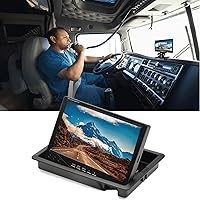
This rearview monitor system is built for working vehicles, not weekend road trips. RV and motorhome owners who want a hard-wired, always-on rear camera will find this far more reliable than a wireless alternative that depends on battery strength or a stable radio signal. The 65ft cable run covers most fifth-wheel and Class A motorhome configurations without splicing. Truck and bus operators managing loading dock maneuvers will appreciate the wide field of view. It also suits DIY installers well — everything needed to complete the job arrives in one box. If you are stepping up from a basic composite AV camera, the signal quality difference is immediately noticeable.

User Feedback

Across 110 ratings, the Hikity camera set holds a 4.5-star average — that kind of consistency over several years tells you the satisfaction is not a burst of early enthusiasm. Buyers installing it on Class A motorhomes and step-vans frequently mention how clean and clear the image looks during daytime reversing, and night vision performance gets specific praise from drivers navigating unlit driveways and rural roads. The installation is described as genuinely manageable for anyone comfortable with basic wiring. That said, the lack of guide lines is a real sticking point for some — if you rely on distance markers to judge clearance, you will notice their absence. A handful of longer semi-trailer owners also flagged that 65ft is a tight fit and may require an extension.

Pros

  • Complete kit ships with every component needed, cutting out the hassle of compatibility matching.
  • IP68 metal camera housing handles rain, mud, and road spray without degrading over time.
  • 18 IR LEDs provide real night vision even in completely dark environments like unlit lots or rural lanes.
  • The 4-pin aviation connector delivers a more stable signal than standard composite AV cables by actively rejecting vehicle electrical interference.
  • 120-degree wide-angle view covers the broad rear zones that long vehicles routinely struggle with.
  • The 65ft cable is sufficient for most Class A motorhomes and medium-length trailers without splicing.
  • A 12–24V voltage range means this backup camera kit works across both light passenger vehicles and heavy commercial trucks.
  • The 7-inch monitor is large enough to read clearly at a glance without leaning toward the dash.
  • Buyers consistently report a manageable installation process, even without professional assistance.
  • Sustained high ratings over several years suggest consistent real-world performance rather than a short burst of early enthusiasm.

Cons

  • No parking guide lines are included, which is a genuine drawback for drivers who rely on distance markers.
  • The 65ft cable may fall short on longer semi-trailers or full-size coaches, requiring a separate extension purchase.
  • Hard-wired installation rules out drivers who need a portable, temporary, or easily removable camera solution.
  • The dedicated dashboard monitor adds physical bulk that not every truck cab or RV cockpit can accommodate cleanly.
  • With around 110 reviews, long-term durability data is thinner compared to better-established brands in the category.
  • No wireless mode exists, making this impractical for trailers that are regularly decoupled from the tow vehicle.
  • Camera angle requires manual physical adjustment rather than any form of remote or in-cab repositioning.
  • The 4-pin aviation connector, while better for signal quality, is a less common format that can be harder to replace quickly if damaged on the road.

Ratings

Our AI scoring engine analyzed verified global buyer reviews for the Hikity 7″ Backup Camera Monitor Kit, actively filtering out incentivized, bot-flagged, and duplicate submissions to surface what genuine owners actually experience day to day. The scores below reflect sustained real-world feedback from a range of vehicle types — motorhomes, commercial trucks, transit buses, and trailers — capturing both the consistent strengths that have kept this rearview monitor system near the top of its subcategory for years and the honest trade-offs that could genuinely affect your decision.

Image Quality
83%
Daytime reversing images are sharp and color-accurate enough to read ground obstacles, lane markings, and vehicle clearance on a busy loading dock without straining. Buyers on Class A motorhomes frequently note that the 120-degree field of view captures the full rear zone without the barrel distortion that cheaper wide-angle lenses typically introduce at the edges.
In intermediate lighting conditions — dim parking garages or overcast dusk — image quality dips noticeably before the infrared LEDs take full effect, leaving a brief window where visibility is softer than expected. A handful of buyers also report that strong backlighting from an oncoming vehicle can temporarily wash out the display.
Night Vision Performance
78%
22%
In complete darkness — unlit rural turnarounds, ungated lots, and dark campground sites — the 18 IR LEDs produce a genuinely usable image rather than the murky wash many budget cameras deliver. Truck drivers who regularly back into unmarked bays at night specifically call out the night vision as a primary reason they chose this kit over wireless alternatives.
The infrared range is well-suited to parking maneuvers but does not extend far enough to identify objects or read signage beyond roughly 20 to 25 feet. Night vision output is grayscale by nature, which means color-coded distance markers or painted dock lines lose their meaning entirely once ambient light drops below a certain threshold.
Build & Weatherproofing
86%
The hard metal camera housing with IP68 certification holds up to pressure washing, standing water, and road grime in a way that plastic-bodied competitors at the same price simply do not. Buyers who run the camera through harsh winters report no degradation in image quality or housing integrity even after prolonged exposure to road salt, ice, and heavy rain.
Long-term field reports flag the connector junction — where the cable meets the camera body — as the most vulnerable point after sustained vehicle vibration and thermal cycling across seasons. A small number of buyers report moisture ingress at that join after 18 months or more, suggesting the seal is robust but not indefinitely maintenance-free.
Cable & Signal Quality
84%
The 4-pin aviation connector is what genuinely separates this kit from a standard composite AV cable setup — the thick shielded cable blocks the electrical interference that truck and bus electrical systems constantly generate, producing a stable, flicker-free image. Buyers who upgraded from RCA-based kits consistently mention the immediate absence of static and screen noise as the most noticeable improvement.
The aviation connector format, while technically superior, is a less common standard that is harder to source at a local auto parts store if the cable is damaged on a long haul. The connector can also work loose on vehicles with heavy cab vibration if it is not properly secured with cable ties during the initial installation.
Installation Experience
74%
26%
For anyone comfortable with basic vehicle wiring — tapping a reverse trigger wire, routing a cable through a firewall, and mounting a bracket — this backup camera kit installs in a reasonable afternoon. Everything arrives in a single box, eliminating the secondary orders and compatibility headaches that come with sourcing camera and monitor components separately.
The included manual is brief and lacks vehicle-specific guidance, so installers on unusual cab configurations or older RVs without a dedicated reverse signal wire often find themselves relying on third-party tutorials to fill the gaps. Neatly routing 65 feet of cable inside a large motorhome also takes considerably more time than first-time buyers tend to anticipate.
Monitor Display Quality
72%
28%
The 7-inch screen is large enough to read comfortably from the driver's seat of a truck or coach without leaning forward, and the adjustable brightness means it stays visible in direct afternoon sunlight without becoming a glare hazard at night. The two-channel input design is a practical detail that leaves room to add a side or front camera later without replacing the monitor.
Display resolution is functional rather than impressive — small details and text in the image are readable but not crisp, which becomes noticeable when compared side by side with higher-resolution monitors in competing kits. The mounting stand feels lightweight relative to the rest of the system and may need additional reinforcement in high-vibration cab environments.
Value for Money
81%
19%
This rearview monitor system delivers a feature set — IP68 camera, shielded cable, dedicated monitor, and all mounting hardware — that typically costs meaningfully more when components are matched and sourced separately. For RV and truck owners who need a permanent, practical reversing solution without a commercial-grade budget, the overall value calculation works strongly in its favor.
Buyers who compare against premium brands at two or three times the price will notice differences in display sharpness and connector build precision that are hard to overlook after extended use. The value equation also shifts for owners of very long vehicles who need a cable extension, adding an unexpected cost to what is marketed as a complete kit.
Cable Length Adequacy
66%
34%
For the most common use cases — 35-foot Class A motorhomes, single-unit delivery trucks, standard flatbed trailers, and transit buses — 65 feet is enough to complete a clean install without splicing. Buyers in these configurations routinely confirm a straightforward end-to-end run with a few feet to spare for routing flexibility.
For semi-trucks with full-length trailers, larger coaches, or any setup requiring exterior cable routing with slack for turns and bends, 65 feet consistently comes up short in buyer accounts. This is not a catastrophic limitation, but it does force some buyers into an additional purchase to complete what is sold as a self-contained kit.
Vehicle Compatibility
88%
The 12–24V operating range is a genuine differentiator — it covers light passenger cars at one end and heavy diesel trucks, coaches, and buses at the other without any additional converter or adapter. Most competing kits at this price point are 12V only, which disqualifies them outright for commercial fleet and agricultural vehicle applications.
Buyers on specialty vehicles — older farm equipment, non-standard electrical configurations, or marine applications — occasionally report needing extra wiring work to integrate the system cleanly beyond a basic tap-and-connect install. The proprietary 4-pin aviation connector format also limits plug-and-play compatibility with cameras or monitors from other manufacturers if a component needs replacing.
Package Completeness
83%
Opening the box and finding every component needed for a finished install — camera, monitor, cable, controller, bracket, adhesive tape, and manual — saves real time and eliminates the compatibility guesswork that comes with mixing components from different brands. First-time buyers consistently mention this as a genuine practical advantage over cheaper, camera-only listings.
The package does not include a cable extension, which is a meaningful omission for longer vehicle configurations, and the adhesive tape provided for monitor mounting is unlikely to hold reliably in a hot cab over a full summer without supplementary fasteners. The remote controller also feels noticeably cheaper in hand than the camera and monitor themselves.
Ease of Daily Use
77%
23%
Once installed, the system requires minimal daily interaction — the monitor activates automatically when reverse gear is engaged if wired to the reverse signal wire, and brightness adjusts via the remote without navigating complex menus. Drivers who run it in always-on mode report that it becomes a natural part of their driving routine within the first few trips.
The on-screen menu for adjusting image orientation and display settings is not particularly intuitive, and some buyers find themselves re-reading the manual to locate options they need to change more than once. The remote controller, while useful, is a small additional item to track inside a working truck cab and is easy to misplace during a busy day.
Long-term Durability
69%
31%
The metal camera housing and IP68 weatherproofing give the exterior components a meaningful advantage over plastic-shelled cameras at this price point, particularly for vehicles that work in wet or muddy conditions year-round. Buyers who have been running the Hikity camera set for one to two years generally report no visible degradation in camera performance or housing condition.
With roughly 110 ratings, the long-term reliability data beyond two years is thinner than what is available for better-established brands with thousands of reviews, making multi-year assessments less reliable. Some buyers report connector wear and image instability after 18 months or more of heavy-use installation, particularly on vehicles with persistent high-frequency cab vibration.

Suitable for:

The Hikity 7″ Backup Camera Monitor Kit was clearly built with large vehicle operators in mind, and that focus shows in every design decision. RV and motorhome owners who want a permanent, always-on rear camera — not a wireless alternative that loses stability when signal conditions change — will find this setup genuinely useful day to day. The 65ft aviation cable covers most Class A and Class C motorhome configurations without requiring a separate extension, and the wide-angle lens handles the kind of broad rear zones that routinely cause problems for long-vehicle drivers. Commercial truck and bus operators managing frequent dock maneuvers will value the IR night vision, which functions without relying on overhead lighting that simply may not exist at a loading bay. It is also a strong match for DIY installers: the kit arrives with every component needed for a clean hard-wired job, and the 12–24V compatibility makes it viable across a wide range of commercial and personal vehicles.

Not suitable for:

Buyers who depend on parking guide lines for daily reversing should know upfront that the Hikity 7″ Backup Camera Monitor Kit does not include them — and while some drivers adjust quickly, others find that absence a persistent frustration that no amount of image quality compensates for. If you are installing on a very long semi-trailer or a full-size coach, the 65ft cable may fall short, requiring you to source an extension before the install is complete. This rearview monitor system is also a poor fit for drivers who need a wireless or removable setup, since the entire design depends on a hard-wired physical connection that cannot be easily relocated or temporarily swapped between vehicles. Passenger car owners who simply want a basic reversing aid will likely find the dedicated dashboard monitor bulkier and more involved than a standard integrated head-unit solution. Anyone expecting built-in distance or lane markers as a standard feature will need to look at alternative kits.

Specifications

  • Monitor Size: The display is a 7″ TFT LCD panel with full-color output, adjustable brightness, contrast, and color settings.
  • Camera Sensor: The rear camera uses a CMOS optical sensor designed to deliver clear image capture across a wide range of lighting conditions.
  • Night Vision: Eighteen infrared LEDs surround the camera lens, providing active night vision without requiring any external light source.
  • Viewing Angle: The camera lens captures a 120-degree horizontal field of view, wide enough to cover the rear zones of most large vehicles.
  • Vertical Tilt: The camera bracket supports up to 180 degrees of vertical angle adjustment, allowing precise aim at the specific blind spot that matters most.
  • Waterproof Rating: The camera carries an IP68 rating, meaning it is fully sealed against dust ingress and can withstand prolonged water immersion under defined conditions.
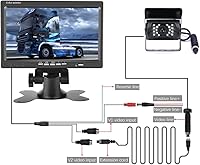
  • Cable Type: A 4-pin aviation-style video connector is used throughout, delivering a more interference-resistant and mechanically secure connection than standard RCA composite cables.
  • Cable Length: The included video cable runs 65 feet, which is sufficient for most Class A motorhomes, medium-length trailers, and standard commercial trucks.
  • Voltage Range: The system operates on 12–24V DC power, making it compatible with both light passenger vehicles and heavy-duty commercial vehicles without modification.
  • Video Inputs: The monitor accepts two separate video input channels, allowing a second camera to be added later if needed.
  • Image Modes: The monitor supports both mirror-image and normal viewing orientations, switchable to suit different mounting positions and driver preferences.
  • Camera Housing: The camera body is enclosed in a hard metal casing, providing more robust physical protection than plastic-housed alternatives in the same price range.
  • Monitor Dimensions: The monitor measures 7.48 x 1.18 x 5.12 inches, with a compact profile suited for dash-mounting in truck cabs or RV cockpits.
  • Package Weight: The complete kit weighs 2.99 pounds, inclusive of monitor, camera, full cable length, controller, and all mounting hardware.
  • Box Contents: The package includes the 7″ monitor, IR backup camera, 65ft aviation cable, remote controller, mount bracket, two-sided adhesive tape, and a user manual.

Related Reviews
ZEROXCLUB B7 7″ Wired Backup Camera Kit
79%
86%
Image Clarity
71%
Night Vision Performance
91%
Waterproof Durability
74%
Ease of Installation
78%
Monitor Quality
More
ZEROXCLUB B3C 3-Camera Wireless Backup Camera System
76%
84%
Video Signal Reliability
83%
Image Quality
76%
Night Vision Performance
71%
Installation Experience
88%
Weather & Build Durability
More
Camecho 7-Inch Monitor Backup Camera System
78%
71%
Image Quality
58%
Night Vision Performance
83%
Camera Durability
86%
Ease of Installation
88%
Cable Quality & Length
More
YEDDY RV Backup Camera and Monitor Kit
88%
91%
Image Quality
94%
Ease of Installation
88%
Weather Resistance
89%
Night Vision Performance
92%
Camera Coverage (Wide-Angle)
More
DVKNM TZ102 7″ Dual Backup Camera System
80%
88%
Image Clarity
83%
Night Vision Performance
91%
Ease of Installation
86%
Camera Build & Weatherproofing
67%
Monitor Build Quality
More
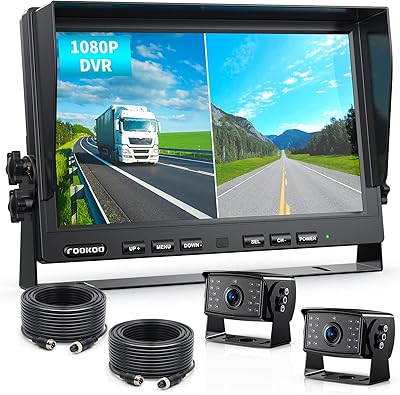
Fookoo II 10-Inch Wired Backup Camera System
78%
83%
Image Clarity (Daytime)
61%
Night Vision Performance
91%
Monitor Screen Size
88%
Waterproofing & Durability
47%
Installation Complexity
More
AISHICHEN Backup Camera with 5-Inch Monitor
85%
93%
Image Quality
89%
Night Vision Performance
88%
Ease of Installation
85%
Build Quality
91%
Waterproof Durability
More
Portkeys HD7T 7″ Field Monitor
77%
91%
Outdoor Brightness
88%
Value for Money
89%
Monitoring Tool Set
67%
Touchscreen Responsiveness
72%
Panel Resolution & Clarity
More
Lilliput A7S 7″ Camera Field Monitor
76%
84%
Image Clarity
61%
Build Quality
71%
Brightness & Outdoor Use
88%
Monitoring Assist Tools
57%
Menu Usability
More
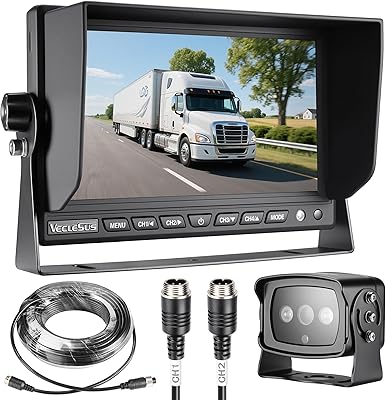
VECLESUS 7″ HD Backup Camera System
86%
89%
Image Quality
82%
Ease of Installation
90%
Night Vision Performance
94%
Weather Resistance (IP68)
85%
Overall Reliability
More

FAQ

For most Class A and Class C motorhomes in the 35-to-40-foot range, the included cable is just about sufficient when routed along the interior wall or undercarriage. If you have a longer coach or prefer exterior routing with extra slack, budget for a 4-pin aviation extension cable before you start the install. A handful of buyers on longer rigs have flagged the length as a tight fit.

No — and that is worth knowing before you buy. This rearview monitor system does not overlay parking or distance guide lines on the image. For many truck and RV drivers, the wide field of view is enough to judge clearance, but if you rely on those markers for parking in tight urban spaces, you should look at a kit that includes them.

Yes. If you wire the camera to a constant power source rather than the reverse signal wire, it will stay on continuously. This is a popular choice for drivers who want to monitor rear traffic while moving, especially on long highway hauls. The user manual covers both wiring options.

It is. The system accepts 12–24V DC input, so it works without any voltage converter on diesel trucks, heavy coaches, and other commercial vehicles that run a 24V setup. This is one area where this backup camera kit has a clear advantage over budget alternatives that are limited to 12V only.

Standard RCA composite cables are essentially bare signal wires — they pick up electrical noise from the vehicle and turn it into visible static or flickering on the monitor. The 4-pin aviation connector locks more securely and the cable is heavily shielded, so the engine, alternator, and other electronics on the vehicle have far less impact on the image you see. It is a meaningful practical difference, not just a marketing point.

Most buyers who document their installs describe it as manageable with basic wiring knowledge and a few hours of time. The monitor connects to a 12V power source and the reverse trigger wire, and the camera mounts to the rear of the vehicle with the cable routed along the body. The user manual is functional but not detailed, so watching a YouTube walkthrough for similar kits before you start is a good idea.

The IP68 metal housing is the real standout spec here. IP68 means it is rated for full, prolonged submersion — which in practice means road spray, pressure washing, heavy rain, and mud are not a concern. The metal casing also resists physical impact better than the plastic bodies found on lower-cost cameras.

Yes. The monitor has two video input channels, so a second camera — for a side view or a front-facing angle — can be added without replacing any hardware. You would need a second 4-pin aviation cable and a compatible camera. The remote controller is used to switch between inputs.

The monitor has a software toggle for mirror and normal viewing modes, adjustable through the on-screen menu. Which setting looks correct depends entirely on how and where you mount the monitor. If the image appears reversed left-to-right, switching the orientation mode resolves it in seconds.

Based on the available buyer feedback, the camera housing and weatherproofing generally hold up well over time, which is consistent with what you would expect from a metal IP68 enclosure. The 4-pin connector junction is the area most worth inspecting periodically — any physical stress on that join from vehicle vibration over years of use is where issues tend to develop first. Keeping the connection secured and protected from direct water flow is a sensible precaution.