
Overview

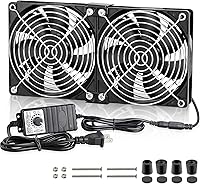
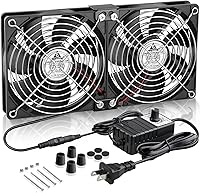
The GDSTIME Dual 120mm AC Powered Cooling Fans take a refreshingly straightforward approach to a problem that usually requires more effort than it should — keeping electronics cool without sourcing a separate power supply or tapping into a motherboard header. Two 120mm fans sit side by side in a slim housing, and the whole unit plugs into a standard wall outlet. That simplicity puts it squarely in the mid-range utility category, where DIYers, homelab builders, and small business operators spend most of their time. The included variable speed controller separates it from fixed-speed alternatives, and broad voltage compatibility means it works internationally without an adapter.

Features & Benefits

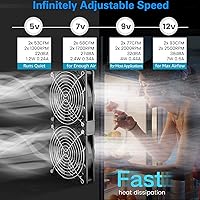
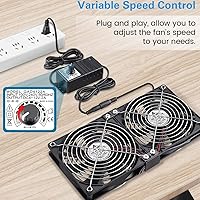
The most practical thing about this AC-powered fan unit is that it removes the usual friction around powering 120mm fans outside of a PC. No DC adapter hunting, no wiring into a bench supply — just plug in and turn the knob. That knob drives a stepless speed controller adjusting voltage from 4V to 12V, which translates to fan speeds ranging from whisper-quiet low to a full 2500 RPM per fan. At maximum, both fans together push a combined 186 CFM of airflow, which is substantial for a closed rack or cabinet. Dual ball bearings handle the mechanical load, and the rubber feet plus sponge pads do a decent job absorbing vibration during continuous operation.

Best For

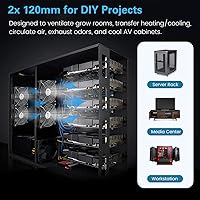
This plug-in server fan is a strong fit for anyone running a home lab rack or small office network cabinet that gets warm but lacks any built-in active cooling. AV enthusiasts dealing with overheating amplifiers or receivers stacked in enclosed furniture will also find it genuinely useful. It shows up in some unexpected places too — people use it to ventilate RV refrigerator compartments, chicken coops, and small equipment enclosures where running new wiring is not realistic. The no-configuration setup makes it accessible to non-technical users, while the reversible mounting orientation and adjustable speed give more experienced users enough flexibility to dial it in for their specific layout.

User Feedback

Across close to 800 ratings averaging 4.4 stars, buyers consistently praise the ease of setup and the fact that the speed controller actually works well — not just as a token feature but as something they actively use day to day. Airflow for the size earns frequent mentions too. The recurring complaints are predictable: at full speed, 38 dBA is noticeable in a quiet room, so this is not a silent solution at max output. The plastic housing looks functional rather than refined, which some buyers note. A handful of long-term users report reliable continuous operation over extended periods, lending some credibility to the 50,000-hour lifespan rating, though individual results naturally vary.

Pros

  • Plugs directly into any standard wall outlet — no power supply, adapter, or wiring expertise needed.
  • The stepless speed knob delivers genuine fine-tuned control, not just a basic low-medium-high toggle.
  • Combined airflow of 186 CFM across both fans is meaningful for warming enclosed racks or cabinets.
  • Dual ball bearing motors rated for up to 50,000 hours support reliable long-term continuous use.
  • Reversible mounting lets you direct airflow upward or downward to match your specific installation.
  • Rubber feet and sponge pads noticeably reduce vibration and resonance during extended operation.
  • Metal finger guards ship pre-installed, removing an assembly step and adding immediate safety.
  • Broad voltage compatibility makes the unit usable internationally without an additional converter.
  • Nearly 800 buyer reviews averaging 4.4 stars reflects consistent satisfaction across diverse real-world use cases.
  • The 7.7-foot power cord provides enough reach for most rack or cabinet placements without an extension.

Cons

  • At full speed, 38 dBA is clearly audible — a poor match for noise-sensitive rooms or quiet environments.
  • The plastic housing feels purely functional; it will not blend with rack-grade or premium equipment aesthetics.
  • No tachometer output or digital RPM readout means actual fan speed cannot be monitored or logged.
  • The analog knob has no labeled positions, making it difficult to reliably reproduce a specific speed setting.
  • 186 CFM combined may fall short for densely populated racks or larger enclosures with high heat loads.
  • The power cord uses a standard two-prong ungrounded plug, which some installations or users may not prefer.
  • No PWM or smart control support prevents integration with automated rack management or home lab systems.
  • Some buyers report the sponge vibration pads compress and lose effectiveness after prolonged continuous use.
  • The two fans ship as one fixed-width assembly, so independent repositioning of a single fan is not possible.
  • The included speed controller feels lightweight and basic relative to what more demanding installations might expect.

Ratings

The scores below for the GDSTIME Dual 120mm AC Powered Cooling Fans were generated by our AI rating engine after analyzing verified purchase reviews from buyers worldwide, with spam, bot activity, and incentivized feedback actively filtered out. Each score reflects the genuine balance of praise and frustration that real users reported — no category is inflated to flatter the product or deflated without cause. Strengths are recognized where they are consistently earned, and recurring pain points are scored with equal transparency.

Ease of Installation
94%
Buyers across nearly every use case — home lab racks, AV cabinets, RV fridges — consistently describe setup as taking under five minutes. There is no wiring, no configuration, and no technical background required. Attach the rubber feet, plug in the cord, and the fan runs immediately, which is exactly what most buyers are looking for.
A small number of buyers found the rubber feet positioning initially unintuitive, requiring a second look at the instructions to understand which side produces upward versus downward airflow. The mounting screw holes also require a steady hand to align correctly if you opt for fixed installation over simple placement.
Airflow Performance
83%
For a unit this slim and compact, the combined 186 CFM output genuinely surprised buyers who expected less. Home lab users reported noticeably cooler temperatures inside previously stagnant network cabinets after a few hours of operation, and AV equipment owners noted that amplifiers that previously ran uncomfortably hot stayed within a normal range.
The 186 CFM figure represents the total across both fans combined — not per fan — which some buyers initially misread, leading to overestimated expectations for larger enclosures. For a densely loaded server cabinet with multiple high-wattage components, this AC-powered fan unit works better as supplemental airflow than a primary cooling solution.
Noise Level
61%
39%
At lower controller settings, the dual 120mm cooling fan runs quietly enough that buyers report using it in home offices and living room AV setups without finding it distracting. Dialing back to around half speed produces noticeably less noise while still maintaining meaningful airflow for lightly loaded enclosures.
At full speed, 38 dBA is a real and consistent complaint from buyers who expected quieter operation. In a silent room or a bedroom media setup, the fan noise at maximum output is clearly audible. Several reviewers specifically noted they never run it above half speed in occupied spaces, effectively trading away a portion of its airflow capacity.
Speed Control
87%
The stepless rotary knob drew consistent praise for giving buyers genuine, fine-grained control rather than a clunky low-medium-high switch. Users running equipment in shared spaces particularly appreciated the ability to ramp up airflow during heavy compute loads and dial back overnight, managing the noise-versus-cooling tradeoff in real time without any tools.
The knob has no labeled positions or detents, making it impossible to reliably return to a specific speed setting once you have moved it. There is also no digital readout or RPM display, so users who want precise monitoring rely entirely on sound and feel — limiting for more technical or data-driven installations.
Build Quality
67%
33%
The pre-installed metal finger guards are a practical touch that buyers genuinely appreciated, providing real protection without any assembly effort. The overall structure feels solid enough for fixed rack or cabinet use, and most long-term buyers report the housing holds up without cracking or warping under continuous operation.
The plastic frame does not feel premium, and several buyers noted it looks noticeably budget-grade next to metal rack equipment. At this price point it is functional rather than refined, and buyers expecting a chassis that matches the quality of commercial server-grade cooling hardware will likely find it underwhelming aesthetically.
Vibration & Resonance
74%
26%
The included rubber feet and sponge pads do a reasonable job dampening vibration at low-to-mid speeds, and buyers who placed the unit on wooden shelving or cabinet tops noted minimal buzz or rattling during normal operation. Most found the vibration control adequate for typical utility use without needing any additional isolation materials.
At higher speeds, some buyers reported the sponge pads were insufficient on their own and that extra isolation — such as anti-vibration mounts or foam padding — was needed to stop resonance from transmitting through rack shelving. The pads also tend to compress over time, gradually losing their dampening effectiveness with prolonged use.
Value for Money
86%
Considering that this plug-in server fan ships as a complete ready-to-run kit — speed controller, mounting screws, rubber feet, sponge pads, and two pre-guarded fans included — buyers consistently felt the price reflected strong overall value. For homelab builders and small business operators on a budget, it competes well against assembling a comparable setup from separate components.
Buyers who need higher airflow capacity, a more durable housing, or digital speed monitoring will find they need to spend considerably more on purpose-built rack cooling equipment. The value proposition is firmly tied to having modest, practical requirements — once those needs grow more demanding, the product's limitations start to outweigh its savings.
Longevity & Reliability
79%
21%
The dual ball bearing motor construction has a solid reputation for extended service life compared to sleeve bearing alternatives, and several long-term buyers reported trouble-free operation spanning multiple years of continuous use. The 50,000-hour rating gives buyers a meaningful confidence baseline when planning always-on installations like server racks or network closets.
Real-world longevity data is limited because this product category rarely generates enough long-term follow-up reviews to fully validate manufacturer claims. A handful of buyers reported one fan motor failing earlier than expected, and because both fans share a single fixed assembly, a single motor failure takes the entire unit out of service.
Versatility
88%
Few plug-in cooling solutions cover as broad a range of real-world applications as this unit. Buyers have deployed it in server racks, AV enclosures, GPU mining rigs, RV refrigerator bays, chicken coops, and greenhouse ventilation setups — most requiring no permanent installation and no technical knowledge beyond plugging into a standard wall outlet.
The single-piece wide assembly limits placement in tight or narrow enclosures where two independently positioned fans would be more practical. Buyers who only need one fan are paying for capacity they cannot split apart or relocate, and there is no way to use the fans separately without physically modifying the unit.
Cord Length & Placement
71%
29%
The 7.7-foot power cord is long enough for most typical placements — a rack cabinet near a wall outlet, an AV enclosure in a media room, or a workbench in a home lab. Buyers generally found it sufficient for straightforward installations without immediately needing an extension cord.
In larger server rooms or equipment closets where the nearest outlet is not immediately adjacent, several buyers noted the cord fell short and required an extension. The cord also terminates in a standard ungrounded two-prong plug, which some buyers would have preferred to see grounded for longer-running or higher-stakes installations.
Mounting Flexibility
77%
23%
The reversible foot design adds real practical value — relocating the rubber feet to the opposite side switches airflow direction without any additional parts or tools. Several buyers found this especially useful when optimizing airflow direction inside enclosed cabinets after testing both orientations post-installation.
The unit lacks rack-mount ears, meaning it cannot be screwed directly into standard 19-inch rack rails without a third-party bracket. Buyers who want a clean, fixed rack installation need to source a separate mounting solution, adding cost and effort that was not always clearly communicated in the product listing.
Heat Dissipation
81%
19%
In enclosed enclosures where air was previously stagnant, buyers consistently reported meaningful temperature reductions after installing this AC-powered fan unit. AV equipment running amplifiers and receivers showed the most dramatic improvement, with several users noting hardware ran noticeably cooler to the touch within the first hour of continuous operation.
Effectiveness drops noticeably in larger or more densely packed enclosures where 186 CFM of combined airflow is insufficient to overcome the total heat load. Buyers using this as the sole cooling source for a fully populated server rack with multiple high-wattage drives or GPUs often needed to supplement with additional fans.
Included Accessories
82%
18%
The kit ships with everything needed for immediate use — the assembled fan unit with guards pre-installed, the speed controller, mounting screws and nuts, and rubber feet with sponge pads. Buyers appreciated not having to source additional hardware just to get operational, and the accessories felt thoughtfully matched to the product's practical use cases.
Packaging protection is minimal, and a few buyers received units with minor cosmetic scuffs on the plastic housing, suggesting limited cushioning for the outer casing during transit. The included instruction sheet is also thin on detail, which is workable for experienced users but can leave first-time buyers second-guessing the mounting orientation steps.

Suitable for:

The GDSTIME Dual 120mm AC Powered Cooling Fans are best suited to anyone who needs effective active cooling in a space where tapping into a PC power supply or running dedicated DC wiring simply is not an option. Home lab enthusiasts with a small rack of switches, NAS units, or mini servers will get the most out of this — it drops into an existing setup without any modification, and the speed knob means you can keep noise reasonable during off-hours and crank airflow when gear is under load. AV hobbyists who stack amplifiers, receivers, or media players in enclosed cabinets will find the plug-in convenience especially practical, since these environments rarely have existing cooling provisions. The unit also works well in non-traditional settings: RV owners dealing with refrigerator compartment heat, small workshop operators exhausting fumes from enclosed spaces, or even backyard chicken coop ventilation where a simple wall-outlet solution beats any DIY wiring project. If your priority is getting reliable, adjustable airflow into an enclosed space without any technical complexity, this fan delivers exactly that.

Not suitable for:

The GDSTIME Dual 120mm AC Powered Cooling Fans are not the right choice for buyers who need whisper-quiet operation at full capacity — at maximum speed, 38 dBA is audible in a quiet room, and if you are building a bedroom media center or a near-silent workstation, that noise floor will bother you. The plastic housing is solid enough for utility use but will not satisfy anyone expecting a premium build that matches rack-mount or server-grade equipment aesthetically. This is also not the right pick for applications requiring precise fan speed monitoring, tachometer output, or PWM control — the knob-based controller is purely analog with no digital readout or feedback loop. Buyers who need more than 186 CFM of combined airflow for a large or heavily populated rack should look at purpose-built rack cooling panels with higher-output fans. Finally, the 7.7-foot cord, while reasonable for most placements, may fall short in larger server room setups where the outlet is not close to the equipment.

Specifications

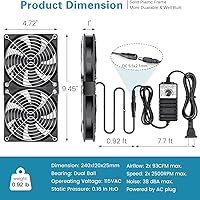
  • Fan Count: The unit houses two 120mm fans in a single slim side-by-side assembly measuring 9.45″ x 4.72″ x 1″ overall.
  • Max Airflow: Both fans together deliver a combined maximum airflow of 186 CFM at full speed — approximately 93 CFM per fan.
  • Fan Speed: Each individual fan reaches a maximum rotational speed of 2500 RPM when the controller is set to its highest output.
  • Noise Level: At maximum operating speed, the unit produces approximately 38 dBA of sound pressure measured under standard conditions.
  • Input Voltage: The unit accepts 100V to 125V AC input, making it compatible with standard North American 110V and 120V wall outlets.
  • Speed Controller: The included stepless rotary controller adjusts output voltage from 4V to 12V DC, with a maximum rated output of 2A and 24W.
  • Cord Length: The attached AC power cord measures 7.7 ft, providing flexible placement distance between the unit and the wall outlet.
  • Bearing Type: Both fan motors use dual ball bearings, which support continuous operation across multiple mounting orientations and extend service life.
  • Rated Lifespan: The dual ball bearing motors carry a manufacturer-rated operational lifespan of up to 50,000 hours at 25°C ambient temperature.
  • Connector: The fans connect to the speed controller via a 2-pin connector, with no motherboard header or PC power supply required.
  • Housing Material: The fan frame and outer housing are molded plastic, with pre-installed metal finger guards covering each fan's intake and exhaust face.
  • Vibration Control: Four rubber feet and adhesive sponge pads are included in the package to dampen mechanical resonance and vibration during operation.
  • Mounting: The unit supports reversible installation — attaching the rubber feet to either labeled or unlabeled sides directs airflow downward or upward respectively.
  • Unit Weight: The fully assembled fan unit weighs approximately 14.4 oz, keeping it light enough to reposition without assistance.
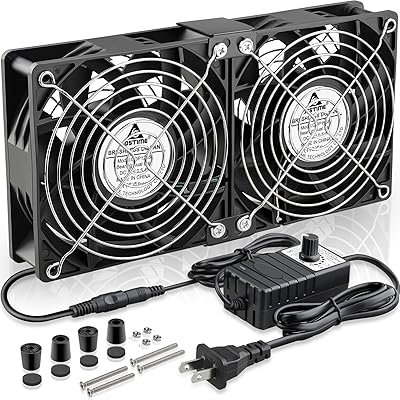
  • Included Hardware: The package contains the assembled fan unit, the variable speed controller, four mounting screws with nuts, and four rubber feet with sponge pads.

Related Reviews
GDSTIME Dual 120mm AC Variable Speed Fan
75%
93%
Ease of Setup
86%
Speed Control Quality
58%
Noise Level
71%
Airflow Performance
62%
Build Quality
More
KEYFANCLUB FAN-S2 Dual 120mm AC Computer Fans
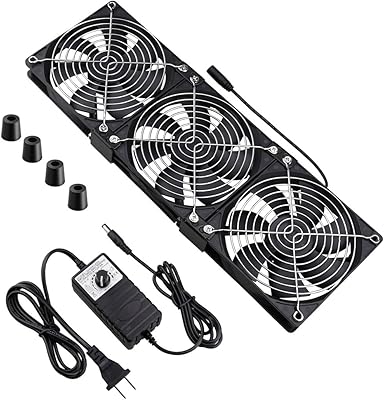
81%
93%
Ease of Setup
88%
Airflow Performance
67%
Noise Level
71%
Build Quality
79%
Speed Controller
More
Wathai Triple 120mm AC Cabinet Cooling Fans
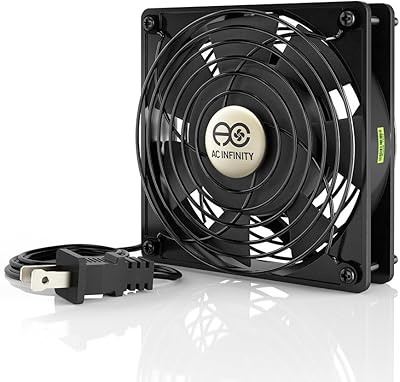
78%
93%
Ease of Setup
88%
Airflow Performance
67%
Noise Level
79%
Build Quality
62%
Speed Controller Quality
More
AC Infinity AXIAL 1225 120mm Muffin Fan
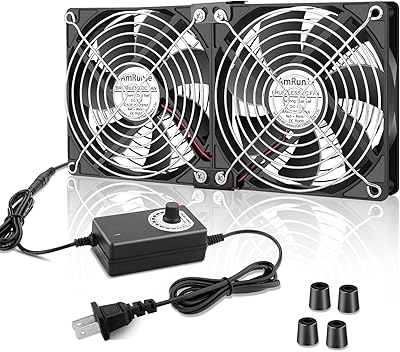
81%
91%
Build Quality
78%
Noise Level
72%
Airflow Performance
93%
Longevity & Reliability
88%
Ease of Installation
More
AmRunJe 2X 120mm Computer Fan with AC Plug
84%
88%
Cooling Performance
72%
Noise Levels at Full Speed
85%
Durability and Build Quality
91%
Ease of Setup
87%
Airflow Efficiency
More
HIGH POWER LGA-115x-mITX CPU Cooling Fan
83%
88%
Cooling Performance
84%
Noise Level
70%
Ease of Installation
89%
Build Quality
90%
Compatibility with Intel CPUs
More
NZXT F120RGB Duo 120mm Dual-Sided RGB Fan
88%
88%
Performance
91%
RGB Lighting Quality
85%
Noise Level
87%
Airflow & Cooling Efficiency
89%
Build Quality
More
AC Infinity AIRFRAME T7-N Cooling Fan System
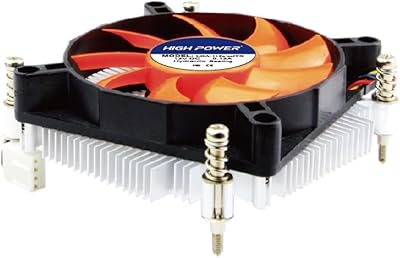
77%
87%
Thermal Effectiveness
84%
Noise Level
91%
Build Quality
67%
Controller Usability
74%
Value for Money
More
upHere D6SEK Dual Tower CPU Air Cooler
73%
72%
Thermal Performance
81%
Noise Level
91%
Value for Money
86%
Installation Ease
74%
RAM Compatibility
More
GDSTIME 200mm 120V AC Axial Fan
82%
93%
Build Quality
91%
Bearing Longevity
88%
Airflow Performance
41%
Noise Level
84%
Ease of Installation
More

FAQ

Not at all. You attach the rubber feet to your preferred side, connect the fan cable to the speed controller, and plug it into the wall — that is the entire process for basic placement. If you want to secure it using the included screws, a standard Phillips screwdriver is all you need. No wiring, no configuration, nothing technical.

The standard version is rated for 100V to 125V AC, which covers North American outlets. GDSTIME does offer an international variant rated for 220V to 240V, so if you are outside North America, confirm you are ordering the correct version for your region before purchasing.

At maximum output it measures around 38 dBA, which is roughly the volume of a quiet library conversation — noticeable but not disruptive. In a typical equipment closet or server cabinet surrounded by other running hardware, you will barely register it. If you need quieter operation, dialing the knob back to around half power brings noise down significantly while keeping reasonable airflow.

That figure is the combined total for both fans running simultaneously at full speed, working out to roughly 93 CFM per fan. It is still a solid number for ventilating an enclosed rack or cabinet, but make sure your airflow calculations use the combined figure rather than applying 186 CFM to each fan individually.

It works in multiple orientations. Flipping which side the rubber feet attach to switches airflow between upward and downward when the unit is laid flat. Many users also run it standing upright, and the dual ball bearing motors handle any axial orientation without issue.

No — it is a simple analog rotary knob with no display, no preset notches, and no labeled positions. Turning it clockwise increases output voltage from 4V up to 12V, which directly raises fan speed. Finding your preferred setting is just a matter of adjusting until the airflow and noise level feel right for your setup.

The assembly is roughly 9.45″ wide, which is narrower than a standard 19-inch rack bay, so width is not a problem. The unit does not include rack-mount ears, so you would need to rest it on a rack shelf or use a third-party mounting bracket rather than screwing it directly into rack rails. Several buyers manage this without issues using basic shelving.

The GDSTIME Dual 120mm AC Powered Cooling Fans carry no IP ingress protection rating, meaning they are not designed for outdoor use or heavy dust exposure. For a moderately dusty garage or workshop, occasional cleaning with compressed air will help extend their life, but sustained exposure to moisture or industrial-level dust is not advisable.

The dual ball bearing motors are rated for 50,000 hours of continuous operation, which is over five and a half years of non-stop use. Real-world longevity depends on ambient temperature and how much dust accumulates over time, but buyer feedback consistently points to solid reliability over extended periods when the unit is kept reasonably clean.

No — the two fans ship as a single fixed-width assembly connected to one shared cable and controller. There is no way to detach one fan for independent use without modifying the unit yourself. If your application needs only one fan or requires them placed separately, a standalone 120mm AC fan would be a better fit.