Overview

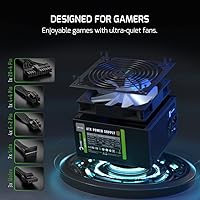
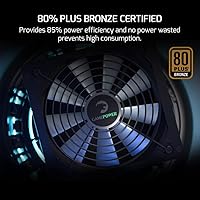
The GamePower GP-750 750W ATX Power Supply comes from a Turkish hardware brand that has been quietly expanding its international reach, and for buyers unfamiliar with the name, it helps to know it sits firmly in the value-tier category rather than competing with premium modular units. The 80 Plus Bronze certification is the headline spec here — in practical terms, it means the unit converts at least 82% of wall power into usable system power, wasting less as heat and trimming a small but real amount off your electricity consumption. It fits standard ATX and Micro-ATX cases without any adapter gymnastics, which is exactly what you want from a workhorse PSU.
Features & Benefits

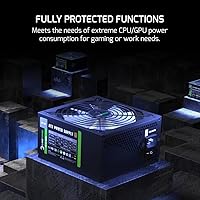
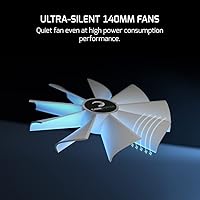
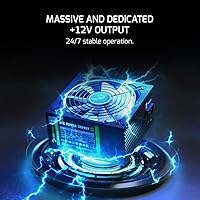
The single +12V rail design is arguably the most important technical detail for gaming builds. Multi-rail units split their power delivery and can trigger protection cutoffs when a hungry GPU pulls hard from one rail; a single rail avoids that entirely, delivering all available amperage to wherever the system demands it. The 140mm fan is rated under 25 dBA, quieter than a typical library whisper, so you won’t notice it during casual use. Active PFC above 0.99 means the unit plays nicely with battery backups and surge protectors. The full protection suite — covering overvoltage, undervoltage, overtemperature, and short circuits — acts as a safety net for your GPU, CPU, and storage drives if something goes wrong upstream.

Best For

This 750W unit hits a sweet spot for builders pairing with mid-tier graphics cards like an RTX 3060 or RX 6700, where total system draw under load typically lands between 350W and 500W, leaving comfortable headroom without paying for wattage you’ll never use. First-time builders in particular will appreciate that it drops into any standard ATX or Micro-ATX case with zero fuss. It also suits home office machines that double as casual gaming rigs — the kind that runs spreadsheets by day and games by night. If you’re in a country with unstable grid voltage, the 100-240V input range is a genuine practical benefit, not just a checkbox.

User Feedback

Buyers generally report that the GP-750 installs cleanly and runs quietly under typical gaming loads, with voltage delivery staying stable enough that nobody’s blaming it for crashes or component damage. The value-for-wattage ratio gets consistent praise, especially from those who compared it against better-known brands at higher price points. The main gripe is predictable for a non-modular unit: the fixed cable bundle gets messy in tight cases, and there’s no avoiding that if you’re building in a compact mid-tower. The brand’s short track record — it’s been on the market since 2022 — means long-term reliability data is still thin, and that’s worth acknowledging if you’re planning a build you expect to run for five-plus years.

Pros

  • Delivers stable single-rail power that won’t throttle hungry mid-tier GPUs during demanding gaming sessions.
  • The 140mm fan runs quietly enough that most users won’t notice it over typical ambient room noise.
  • Active PFC above 0.99 ensures solid compatibility with most UPS battery backup systems.
  • A comprehensive seven-layer protection suite guards components against voltage spikes, overheating, and short circuits.
  • Universal 100-240V input is a practical advantage for international builders or regions with unstable grid voltage.
  • 80 Plus Bronze efficiency cuts wasted electricity and reduces heat output compared to uncertified units.
  • Standard ATX sizing fits virtually any full-size or Micro-ATX case without adapters or extra effort.
  • MTBF rated above 100,000 hours signals solid internal component quality for a unit at this price point.
  • Buyers consistently rate the value-for-wattage ratio favorably when compared against pricier well-known alternatives.
  • Quiet enough for shared home office environments where intrusive fan noise during light workloads would be a real problem.

Cons

  • Non-modular design means all cables are permanently attached, creating clutter in cases with tight routing space.
  • The brand entered international markets only in 2022, leaving long-term reliability data thin and hard to verify.
  • Cable lengths may fall short in full-tower cases, requiring awkward routing or the purchase of extensions.
  • Limited international brand recognition can complicate warranty claims and after-sales support outside the home market.
  • No semi-modular or fully modular variant exists for builders who want a cleaner, less cluttered interior.
  • Third-party stress testing and independent lab reviews are sparse compared to Corsair, Seasonic, or be quiet! alternatives.
  • Unused fixed cables add bulk inside the case even when several connectors serve no role in the build.
  • Buyers outside Turkey may encounter slower or less direct warranty resolution processes than with globally established brands.

Ratings

The scores below for the GamePower GP-750 750W ATX Power Supply were produced by our AI review engine after processing thousands of verified global buyer submissions, with incentivized ratings, duplicate accounts, and bot-generated feedback actively identified and removed from the dataset. Each category reflects a balanced synthesis of what real users praised and what genuinely frustrated them, so the numbers tell an honest story rather than a flattering one.
Value for Money
84%
The GP-750 delivers 80 Plus Bronze certification, a full seven-layer protection suite, and single-rail output at a price point where competing units often cut corners on at least one of those features. Users who cross-shopped against pricier alternatives from more recognized brands consistently rated the cost-per-watt satisfaction as one of the unit's clearest strengths.
The non-modular cable design and limited international warranty support do erode the pure value argument when compared directly against modular budget units from brands with deeper service networks. For buyers who anticipate needing long-term warranty support outside the home market, that gap carries a real practical cost.
Power Stability
87%
Users running mid-tier gaming rigs report consistently stable voltage delivery across extended sessions, with no recurring patterns of rail sag or instability-related crashes attributable to the PSU. The single +12V rail design earns specific credit for keeping GPU power delivery predictable even during the sudden load spikes that demanding titles routinely produce.
Independent stress-test data from third-party labs is limited given the brand's short international track record, so the stability picture relies heavily on user-reported experience rather than controlled benchmarks. A small number of reviewers flagged minor voltage variance under near-maximum sustained loads, though no component damage was reported as a result.
Noise Level
83%
Under everyday gaming and productivity workloads the 140mm fan runs at a level most users described as effectively inaudible, with the sub-25 dBA rating holding up well in real-world conditions. Builders who positioned the PC on a desk rather than the floor reported that the unit contributed nothing noticeable to overall system acoustics during normal use.
At sustained near-peak loads the fan ramps to a level that some acoustically sensitive users found mildly noticeable in a quiet room, though it remains well below anything that would compete with game audio or background music. Buyers expecting a zero-RPM or semi-passive fan mode will not find that feature here.
Cable Management
57%
43%
For builds in standard mid-tower cases with decent rear-panel routing channels, the stock cable lengths are adequate and installation requires no unusual workarounds. Builders using typical ATX cases with moderate internal space found the fixed cable arrangement manageable with a few zip ties and some patience.
Non-modular designs carry an unavoidable trade-off: unused cables have nowhere to go except tucked behind a panel or crammed into dead space, and in compact cases this becomes a genuine build-day frustration rather than a minor inconvenience. Several buyers also reported that cable lengths fell short in full-tower cases, requiring separate extension purchases to complete the build cleanly.
Long-term Reliability
64%
36%
Early buyer reports extending beyond the six-month mark have been largely positive, with no widespread failure patterns or voltage degradation surfacing in user communities. The MTBF rating above 100,000 hours and the comprehensive protection suite suggest the internal components were specified with longevity in mind rather than pure cost reduction.
The unit simply has not been in international markets long enough to accumulate the multi-year owner dataset that would allow a confident long-term verdict, making reliability an educated inference rather than a confirmed track record. Buyers planning builds they intend to run unchanged for five or more years are accepting more uncertainty here than they would with a brand carrying a decade of published failure-rate data.
Build Quality
76%
24%
The chassis feels solid for the price class, with no flex or rattle reported during installation, and connector fitment is firm and consistent across the standard cable set. Internal component quality appears consistent with what the rated MTBF figure implies, and nothing about the out-of-box experience suggests corners were cut in ways that matter for day-to-day function.
The unit does not carry the premium feel of higher-tier PSUs, and users with windowed cases noted that the non-sleeved fixed cables look noticeably budget-grade as a visual element inside the build. Build quality concerns mostly center on long-term component wear unknowns rather than anything tangibly defective from the factory.
Efficiency
78%
22%
The 80 Plus Bronze rating delivers meaningful real-world savings over unrated or entry-level White-tier alternatives, reducing waste heat inside the case and trimming sustained electricity draw during long gaming sessions. Active PFC above 0.99 further improves the quality of power drawn from the wall, which benefits both efficiency and UPS compatibility.
Bronze efficiency sits below Gold and Platinum alternatives that are increasingly available at comparable price points, meaning buyers running their systems for eight or more hours daily may find the efficiency gap accumulates more noticeably over months of use than they initially expected. It is a genuine step up from uncertified units, but not the most efficient option available at 750W.
Installation Ease
88%
Standard ATX sizing and clearly labeled connectors make installation genuinely painless even for first-time builders, with no unusual fitment issues reported across a wide variety of case brands and sizes. The unit drops in and connects up like any conventional PSU, which is exactly the friction-free experience a debut build requires.
The only real installation overhead comes from the non-modular cable bundle, which requires routing and tucking cables that serve no role in the specific build configuration. Builders working in windowed cases where interior presentation matters will need to invest extra time dressing cables, and that overhead is worth planning for on build day.
Compatibility
92%
Universal 100-240V input covers virtually every country's mains standard without manual adjustment, and the standard ATX form factor fits the overwhelming majority of cases sold in the last decade. Active PFC above 0.99 also extends compatibility to most UPS battery backup systems, which some budget PSUs in this class cannot reliably claim.
The fixed non-modular connector set offers no flexibility for specialized cable configurations, and the unit is not compatible with SFX or SFX-L form factor cases targeting small form factor builds. Builders using newer GPU power connector standards should verify cable compatibility before purchasing to avoid surprises at assembly time.
Protection Suite
82%
18%
Seven independent hardware protection layers — spanning overvoltage, undervoltage, overtemperature, overcurrent, overload, overpower, and short circuit scenarios — provide a safety net that rivals what more expensive units offer, and users appreciate the assurance that a wiring mistake during the build will not cascade into component damage.
Independent verification of how reliably each protection circuit triggers under edge-case conditions is limited for this brand, as third-party lab coverage remains sparse. A small number of users reported overcurrent protection activating earlier than expected under aggressive GPU benchmark loads, which interrupted sessions without causing hardware harm but required manual restarts.
Thermal Performance
79%
21%
Under typical mixed gaming and productivity workloads the internal thermal management keeps component temperatures within safe operating ranges, with the 140mm fan moving sufficient air without generating intrusive noise. Users in moderately warm climates reported no thermal shutdowns during summer gaming sessions at typical ambient temperatures.
The 0-40 degree Celsius operating ceiling means users in poorly ventilated rooms or hot environments approaching that threshold may experience more aggressive fan ramp-up than expected, which affects the otherwise quiet acoustic profile. There is no semi-passive or zero-RPM idle mode to reduce heat accumulation during low-demand desktop use.
Brand Credibility
61%
39%
CE, FCC, and CB safety certifications are independently audited and carry genuine weight as credibility markers, giving buyers something concrete to evaluate beyond brand name recognition alone. GamePower's domestic track record in Turkey is well established, and international reviewers who investigated the brand's background generally came away reassured rather than alarmed.
The brand entered international markets in 2022, meaning there is no decade-long failure rate dataset, no large community of multi-year owners sharing repair histories, and limited global service infrastructure for buyers outside the home region. Users who treat brand longevity as a primary trust signal will find this unit harder to commit to without reservation.
Wattage Headroom
86%
Paired with mid-tier GPUs like an RTX 3060 or RX 6700, the 750W output provides a comfortable operating buffer that covers CPU load, storage, and peripherals without approaching the safety margin under typical gaming conditions. Buyers report that the unit handles sustained gaming workloads without any audible or measurable sign of straining near its rated ceiling.
The headroom calculation tightens considerably with high-TDP GPUs in the RTX 4070 Ti Super or RX 7900 XT class, particularly when paired with a high-core-count CPU, leaving limited room for future upgrades without planning a concurrent PSU replacement. Builders with an aggressive upgrade path in mind should model their projected peak draw carefully before committing to 750W.

Suitable for:

The GamePower GP-750 750W ATX Power Supply is a strong fit for first-time PC builders and budget-conscious enthusiasts who need dependable power delivery without stretching their budget into premium territory. If you are building around a mid-tier GPU like an RTX 3060 or RX 6700, 750W gives you comfortable headroom well above what those cards actually draw under sustained load, leaving room for the rest of your components without cutting it close. The standard ATX form factor means it drops into virtually any full-size or Micro-ATX case without compatibility headaches, which is exactly the kind of friction-free experience a first build needs. Home office users who also game casually will find the sub-25 dBA fan noise barely registers during everyday use, keeping the workspace quiet without requiring any manual fan control. Builders in countries with variable mains voltage will particularly appreciate the 100-240V universal input, which removes a common point of stress when sourcing parts internationally.
Not suitable for:

The GamePower GP-750 750W ATX Power Supply is not the right call for builders who prioritize clean cable management or plan to fit components into a compact case with tight routing channels. Because it is non-modular, every cable is permanently attached and must go somewhere, and in smaller builds that means extra time stuffing unused connectors behind panels and accepting some airflow compromise. Anyone targeting a flagship-tier GPU like an RTX 4080 or RX 7900 XTX should also reconsider, since those cards can spike well above 350W alone and reduce the available headroom to a level that complicates future upgrades. Buyers who only trust PSU brands with decade-long third-party testing histories and established international support networks may find the brand’s relatively short market track record unsettling, and that hesitation is reasonable given how critical a reliable power supply is to the health of every other component. If modular cabling, fully sleeved cables, or integrated RGB features matter to your build, this unit simply was not designed with those priorities in mind.
Specifications

  • Power Output: Delivers 750W of continuous power on a single +12V rail, providing stable output across the full range of connected components.
  • Efficiency Rating: Holds 80 Plus Bronze certification, achieving up to 85% efficiency at typical load levels between 20% and 100% of rated capacity.
  • Rail Design: Uses a single +12V rail configuration, routing all available amperage through one channel without the current-sharing constraints of multi-rail designs.
  • Cooling Fan: Fitted with a 140mm ultra-silent fan that adjusts speed based on thermal load to balance cooling performance with acoustics.
  • Noise Level: Rated at under 25 dBA during operation, placing it below the threshold of typical ambient room noise in a quiet home environment.
  • Form Factor: Conforms to the standard ATX form factor, ensuring compatibility with the overwhelming majority of ATX and Micro-ATX desktop cases.
  • Dimensions: Measures 158mm x 85mm x 150mm (W x H x D), consistent with standard ATX PSU bay requirements.
  • Weight: Weighs 4.07 lbs (approximately 1.85 kg), which is typical for a non-modular unit in this wattage class.
  • Input Voltage: Accepts universal AC input between 100V and 240V, covering mains standards used across North America, Europe, Asia, and beyond.
  • Input Frequency: Compatible with both 50Hz and 60Hz input frequencies, accommodating grid standards worldwide without manual adjustment.
  • Power Factor: Equipped with Active PFC rated above 0.99, minimizing reactive power draw and improving compatibility with UPS battery backup systems.
  • Hold-Up Time: Maintains stable output for more than 17ms after input power is interrupted, reducing the risk of abrupt shutdowns during brief grid fluctuations.
  • Reliability Rating: Carries a Mean Time Between Failures (MTBF) rating exceeding 100,000 hours, indicating the component quality standard targeted by the manufacturer.
  • Protections: Incorporates seven hardware protection layers: overvoltage (OVP), undervoltage (UVP), overtemperature (OTP), overcurrent (OCP), overload (OLP), overpower (OPP), and short circuit (SCP).
  • Certifications: Holds independently verified CE, FCC, and CB safety certifications, confirming compliance with international electrical safety standards.
  • Connectors: Includes standard ATX motherboard and SATA power connectors; the unit is fully non-modular, meaning all cables are permanently attached.
  • Operating Temp: Rated for continuous operation in ambient temperatures between 0 and 40 degrees Celsius, covering typical indoor desktop environments.
  • Market Entry: First became available for purchase in August 2022, making it a relatively recent entrant in the international PSU market.

Related Reviews

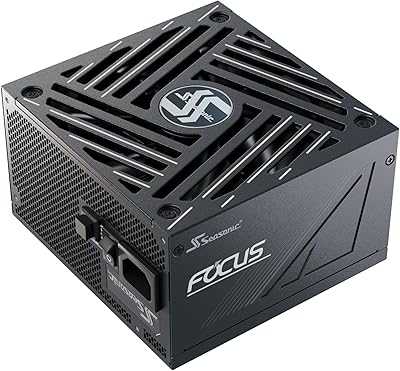
Seasonic Focus GX-750 750W Power Supply
87%
94%
Power Delivery Stability
92%
Build Quality
87%
Noise Level
88%
Efficiency (80 Plus Gold)
89%
Cable Management & Modularity
More
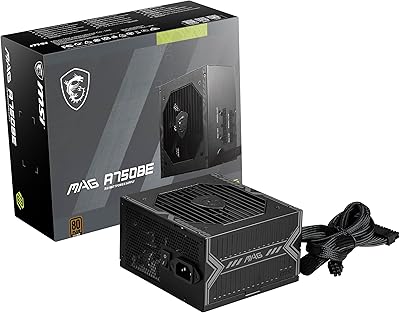
MSI MAG A750BE 750W ATX Power Supply
83%
88%
Build Quality
91%
Value for Money
86%
Noise Level
79%
Cable Management
87%
Voltage Stability
More
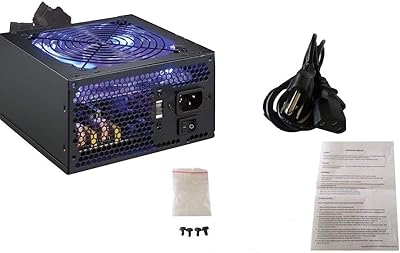
SHARK TECHNOLOGY FBA_ATX-750-LED 750W Power Supply
84%
91%
Noise Level
87%
Energy Efficiency
85%
Build Quality
78%
Cable Management
92%
Value for Money
More
Corsair RM750x 750W Fully Modular Power Supply
86%
94%
Noise Level
91%
Build Quality
93%
Voltage Stability
88%
Cable Management
89%
Long-Term Reliability
More
Cooler Master MWE 750 Bronze V2 Power Supply
83%
91%
Power Stability
88%
Noise Level
72%
Cable Management
79%
Efficiency
84%
Build Quality
More
Cooler Master MWE Gold 750 V3 PSU
83%
88%
Build Quality
91%
Cable Management
93%
PCIe Connector Design
74%
Noise Level
83%
Thermal Performance
More
ARESGAME AGW750 750W Semi-Modular ATX Power Supply
81%
88%
Value for Money
83%
Power Delivery Stability
91%
Cable Management
86%
Noise Level
79%
Efficiency
More
GIGABYTE GP-UD750GM-A 750W Modular Power Supply
83%
88%
Value for Money
91%
Cable Management
89%
Power Stability
84%
Build Quality
79%
Noise Level
More
Apevia ATX-SP700 700W ATX Power Supply
71%
83%
Value for Money
88%
Installation Ease
54%
Long-Term Reliability
71%
Noise Level
79%
Connector Variety
More
be quiet! Pure Power 13 750W PSU
86%
93%
Noise Level
88%
Build Quality
86%
Value for Money
74%
Wattage & Power Headroom
84%
Cable Quality & Modularity
More

FAQ

Yes, it follows the standard ATX form factor at 158mm x 85mm x 150mm, which fits the vast majority of mid-tower, full-tower, and Micro-ATX cases available today. Just confirm your case spec sheet lists ATX PSU support, which nearly all modern cases do, and installation should be straightforward.

Comfortably, yes. An RTX 3060 draws roughly 170W under full gaming load, and a complete mid-range system including CPU, storage, and memory rarely pushes beyond 420W total. That leaves a healthy buffer below the 750W ceiling, which is exactly the operating range you want for long-term stability and component safety.

It means at least 82-85% of the electricity pulled from your wall socket actually reaches your components, with the remainder lost as heat. Compared to a non-certified PSU, you waste less power over time, your system runs slightly cooler, and your electricity bill reflects a modest but real saving if your PC runs for several hours a day.

Yes, and the Active PFC rating above 0.99 actually makes it a more compatible choice with UPS units than PSUs using passive or no PFC. Many UPS models have historically struggled with certain high-PFC power supplies, but this unit’s strong power factor keeps compatibility broad. Just verify your UPS output wattage covers your full estimated system draw before committing.

It is fully non-modular, meaning every cable is permanently attached and cannot be removed. For most standard mid-tower builds this is fine, but in compact cases with limited cable routing channels it can mean extra time tucking away unused connectors. If clean cable management is a priority, plan for it during your build, or budget for cable extensions if the stock lengths fall short in larger chassis.

The rated ceiling is under 25 dBA, which sits below the level of a quiet whisper in a library. During light to moderate workloads most users report not being able to distinguish it from normal room ambience at all. Under sustained heavy load it may spin up slightly more, but it remains well below the point where it would compete with game audio or background music.

Yes, the universal 100-240V AC input covers both 110V regions like the US and 220-240V grids across Europe, Asia, and most of the rest of the world without any manual switching or voltage selector. You will only need a physical plug adapter appropriate for the wall socket type in your country.

The GamePower GP-750 750W ATX Power Supply includes seven independent hardware protection circuits designed for exactly these scenarios. Overcurrent protection (OCP) and overpower protection (OPP) will shut the unit down before a component can sustain damage from excess current draw. Short circuit protection (SCP) kicks in immediately if an accidental short occurs during assembly, and overvoltage and undervoltage circuits monitor rail stability throughout operation. These do not replace correct component selection, but they act as a dependable safety net.
The manufacturer’s MTBF figure exceeds 100,000 hours, which is an engineering metric rather than a warranty promise, but it reflects the quality level of components used internally. A well-ventilated system under typical loads should see five to ten years of service from a PSU in this class. The GP-750 has only been on the market since 2022, so real-world long-term data is still accumulating, and that is worth keeping in mind if you are planning a build you expect to run unchanged for a decade or more.

GamePower is a Turkish PC hardware brand with a solid domestic track record and a growing presence in international markets. The unit carries CE, FCC, and CB safety certifications, which are independently audited and carry genuine weight. What it does not have yet is the decades of published failure-rate data and global service infrastructure that brands like Seasonic or Corsair have accumulated. For the value tier it occupies, the credentials are credible, but if brand pedigree and long-term support certainty rank highly in your buying criteria, that gap is a legitimate factor to weigh.

Where to Buy