Overview

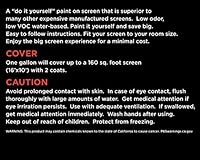
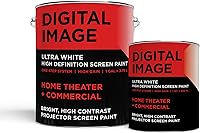
The Digital Image HD100White Projector Screen Paint Quart is one of those niche products that makes you rethink an assumption you didn't know you had — that a projection screen has to be a physical object. This low-VOC formula has been quietly holding its ground since 2013, ranking consistently among the top sellers in its category. The pitch is simple: paint a wall, get a screen. It appeals most to home theater builders who want a permanent setup, renters who can't mount hardware, and anyone who'd rather not have a bulky pull-down screen dominating their living space. One quart covers a 5×8-foot area in two coats.
Features & Benefits

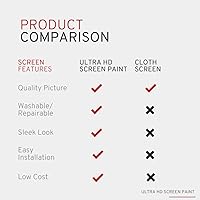
What sets this screen paint apart from a regular flat white wall is primarily the 1.5 gain rating — a measurable optical improvement that makes projected images noticeably brighter and more defined. The anti-glare sheen helps manage ambient light better than a bare wall would, which matters if your room isn't completely blacked out. It's rated for 4K and 8K output, though it's worth being clear: the quality of your projector matters far more than the paint itself. The water-based, non-toxic composition means no harsh fumes during application. Because the surface is washable and repairable, minor scuffs won't require a full repaint — just a quick touch-up.

Best For

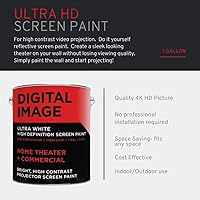
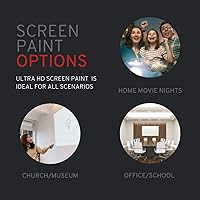
This wall projection paint works best as a permanent installation — if you're setting up a dedicated home theater room where the screen location won't change, it's a practical and visually clean solution. It's also a smart pick for renters who can't install wall brackets or retractable hardware. Beyond the home, it gets used in churches, schools, and conference rooms where a large, fixed projection surface makes more sense than a portable screen. One important caveat: smooth wall surfaces are essential. If your walls have heavy texture, orange peel, or imperfections, the paint will highlight them under projection. Prep work matters here more than anything else.

User Feedback

With over 300 ratings and a 4.4-star average, buyer sentiment around this projector paint skews positive, and the most consistent praise centers on ease of application and noticeably better image quality compared to a plain white wall. Several users mention they won't go back to a traditional pull-down screen. That said, the feedback isn't without complaints. Surface preparation is the recurring theme in negative reviews — buyers who skipped sanding or priming textured walls report uneven results. A few also note that one quart is just enough for the minimum recommended size, leaving little room for error. Manage expectations, prep properly, and most buyers seem genuinely satisfied.

Pros

  • The 1.5 gain rating produces noticeably brighter images compared to plain flat white walls.
  • Low-VOC, non-toxic formula means you can apply it indoors without needing heavy ventilation.
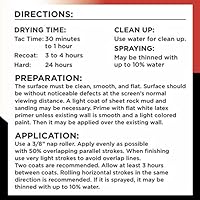
  • No professional installer required — a standard roller and careful prep work is all it takes.
  • The surface is washable and repairable, so accidental marks don't mean starting over from scratch.
  • Works for 4K and 8K projectors, so it won't become obsolete as you upgrade your equipment.
  • Eliminates the visual bulk of a roll-down screen when the projector isn't in use.
  • A strong bestseller with over 300 ratings and a 4.4-star average, reflecting consistent buyer satisfaction.
  • Suitable for both indoor and outdoor smooth surfaces, making it versatile across different setups.

Cons

  • A single quart only covers 40 square feet, leaving almost no margin for error on a full 5×8 surface.
  • Textured or unprepared walls will produce visibly uneven projection results that the paint cannot fix.
  • Image quality is still heavily dependent on your projector — this paint won't rescue a weak setup.
  • No flexibility once applied; repositioning or resizing the screen area means repainting entirely.
  • Coverage limits mean larger screen setups require multiple purchases and careful blending between coats.
  • Buyers who skip sanding or priming consistently report disappointing results in user reviews.
  • Not a practical solution for shared or multi-purpose rooms where a permanent painted screen is disruptive.
  • Touch-up repaints may not blend perfectly if the original batch is no longer available.

Ratings

The scores below for the Digital Image HD100White Projector Screen Paint Quart were generated by our AI system after analyzing verified buyer reviews from multiple global markets, with spam, bot-submitted, and incentivized feedback actively filtered out. Each category reflects the honest distribution of real user experiences — the strengths buyers consistently praised and the friction points that came up repeatedly. Nothing has been smoothed over to make the product look better than it actually performs.
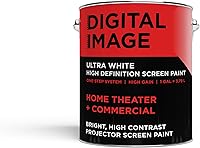
Image Quality Output
83%
Buyers consistently report a visible improvement over a standard flat white wall, with colors appearing more saturated and blacks holding up better in low-light rooms. The 1.5 gain rating translates to a noticeably brighter image without the hotspot issues some screen surfaces create.
Several users point out that the paint cannot compensate for a projector with weak lumens or poor contrast — on underpowered setups the improvement is marginal. Results also vary significantly depending on ambient light levels in the room.
Surface Prep Sensitivity
58%
42%
Buyers who invested time in proper sanding and priming consistently report clean, professional-looking results that rival purpose-built screens. The payoff for thorough prep work is real and well-documented across positive reviews.
This is the most cited pain point across negative reviews — textured or improperly primed walls produce uneven projection with visible surface irregularities. Users who underestimated the prep requirements were almost universally disappointed with their results.
Ease of Application
81%
19%
Most buyers find the application process straightforward using a standard short-nap roller, and the water-based formula cleans up easily with no harsh solvents. DIY beginners report successfully completing the job in a single afternoon once prep work is done.
Thin, even coats require patience — rushing the second coat before the first is fully dry leads to streaking that shows up clearly under projection. A few users found achieving a truly uniform finish more demanding than expected for a first-time applicator.
Coverage Accuracy
62%
38%
For a standard 5×8-foot setup, the quart quantity is well-matched when two careful coats are applied with a roller. Buyers who planned their screen dimensions in advance report minimal waste.
The 40-square-foot limit leaves almost no buffer, and users who wanted a slightly larger screen found themselves one quart short with no easy way to blend a second batch seamlessly. Coverage inconsistencies at the edges are a recurring complaint for buyers who tried to stretch the quart.
Value for Money
74%
26%
Compared to purchasing and mounting a rigid or retractable screen of equivalent size, the wall projection paint approach comes out considerably cheaper as a one-time investment. Buyers in institutional settings like churches and classrooms especially appreciate the cost efficiency at scale.
At its price point, some buyers expected more paint volume and felt the coverage limitation made the cost-per-square-foot less attractive than it first appeared. Those who needed multiple quarts for larger screens found the total spend approached what a decent entry-level screen would have cost.
Durability Over Time
79%
21%
The cured surface holds up well to normal room conditions, and buyers who have used their painted screen for several years report no fading, yellowing, or degradation in projection quality. The washable finish means everyday dust and the occasional mark do not become permanent problems.
Touch-up repairs require leftover paint from the original batch — users who ran out and tried to match it later noted visible color variation under projection. Long-term durability in high-humidity environments like basements has produced mixed feedback.
Anti-Glare Performance
77%
23%
In dedicated home theater rooms with controlled lighting, the anti-glare sheen does a solid job of managing reflections and preventing the washed-out look that a glossy wall creates. Buyers projecting in semi-dark rooms report clean, watchable images without distracting hotspots.
In rooms with significant ambient light from windows or overhead fixtures, the anti-glare properties are not strong enough to fully compensate, and image contrast suffers noticeably. It performs best in rooms where lighting can be meaningfully controlled.
Odor & Indoor Safety
91%
The low-VOC, non-toxic formula draws consistent praise from buyers who applied it in occupied homes, including families with children and pets present. Most users report the smell dissipates within a few hours with basic ventilation like an open window.
A small number of users with chemical sensitivities noted the odor was more noticeable than expected during the wet application phase, though this resolved fully after drying. There are no documented safety concerns once the paint has fully cured.
Decor Integration
86%
One of the most genuinely appreciated aspects among buyers is how invisible the screen becomes when the projector is off — it simply looks like a wall. This is a meaningful advantage over retractable or framed screens in living rooms and multi-purpose spaces.
The slight sheen of the dried surface is subtly different from standard flat wall paint, so if you look closely or have strong raking light across the wall, the painted area is distinguishable. Matching the surrounding wall color to blend the screen border requires some planning.
Compatibility Range
82%
18%
The paint works with any projector regardless of brand, throw distance, or technology — DLP, LCD, and laser projectors all interact with the surface consistently. Its compatibility with 4K and 8K output means buyers will not need to repaint when upgrading their projection hardware.
The optical benefits are most apparent with mid-range to high-end projectors; budget projectors with low native contrast ratios do not reveal the full advantage of the 1.5 gain surface. The paint is also limited to flat, wall-mounted surfaces and cannot be adapted for curved or angled projection setups.
Repairability
76%
24%
The ability to spot-repair scuffs and marks without repainting the entire surface is a practical advantage that several long-term users specifically mention as a reason they would buy again. Small touch-ups blend well when done with the original batch of paint.
Batch-to-batch color consistency is not guaranteed, so buyers who need to purchase a second quart later for repairs risk a visible color mismatch that shows up under projection. This makes keeping a small reserve of the original quart a smart but often overlooked precaution.
Setup Accessibility
88%
There are no tools, brackets, or hardware required beyond basic painting supplies, making this one of the most accessible home theater upgrades available. Renters and first-time DIYers consistently highlight how approachable the entire process is compared to mounting a physical screen.
While the painting itself is simple, the wall preparation steps that determine final quality — sanding, priming, filling imperfections — require more skill and effort than the product marketing suggests. Buyers who treat it purely as a paint job without addressing wall condition rarely achieve satisfying results.
Institutional Use Suitability
84%
Churches, school classrooms, and conference rooms make up a notable segment of the positive reviews, with facilities managers praising the low maintenance and cost efficiency of a permanent painted surface over replaceable screens. The large potential screen size and straightforward application make it practical for non-technical staff to install.
Institutional walls are more likely to have surface imperfections, old paint layers, or semi-gloss finishes that complicate prep work. Organizations that skip professional surface assessment before painting have reported inconsistent results across large walls.

Suitable for:

The Digital Image HD100White Projector Screen Paint Quart is a strong fit for anyone building a dedicated, permanent home theater where a fixed projection surface makes more practical sense than a retractable screen. Renters are a particularly good match — you get a real optical upgrade without drilling brackets or hauling hardware, and if you're careful, the painted area can blend into the room when not in use. It also works well for institutional settings like small churches, classrooms, or conference rooms that need a large, cost-effective display surface without the recurring cost of screen replacements or professional installation fees. If you have a smooth, well-prepped wall and a decent projector, this screen paint delivers a measurably better image than a standard painted surface. Minimalist decorators who dislike the look of a hanging screen will appreciate how cleanly this solution disappears into the room.
Not suitable for:

The Digital Image HD100White Projector Screen Paint Quart is not the right call for anyone with textured, popcorn, or heavily imperfect walls — projection is unforgiving, and any surface irregularity will show up clearly once the image is on. If you need flexibility in screen placement, or you're setting up a space where the projection area might change, a portable or pull-down screen gives you options this paint simply cannot. One quart covers only a 5×8-foot surface, so buyers wanting a larger screen will need to purchase multiple units and plan carefully to avoid visible seams or coverage inconsistencies. Casual users who project only occasionally may find the prep work and drying time hard to justify compared to just picking up an affordable pull-down screen. And if your projector is underpowered, no paint formula will compensate for weak lumens — the optical gain helps, but it's not a substitute for proper projection equipment.
Specifications

  • Brand: Manufactured by Screen Paint Supply LLC under the Digital Image Screen Paint brand.
  • Model Number: The model number for this formulation is HD100White.
  • Coverage: One quart covers approximately 40 square feet when applied in two coats.
  • Screen Size: Recommended for a standard 5×8-foot projection surface using the full quart.
  • Gain Rating: This paint has a 1.5 gain rating, meaning it reflects more light than a standard flat white surface.
  • Finish: The dried surface has a reflective anti-glare sheen designed to reduce hotspots and ambient light interference.
  • Resolution Support: Compatible with projectors up to 4K and 8K HD output resolution.
  • Material: Water-based paint formula with low VOC content and no toxic compounds.
  • VOC Level: Classified as low VOC, making it safe for indoor application without heavy-duty ventilation.
  • Application: Designed for DIY application using a standard roller or brush; no professional installer is required.
  • Surface Type: Intended for smooth, flat wall surfaces mounted in a fixed indoor or outdoor location.
  • Washability: The cured surface is washable and can be spot-repaired without requiring a full repaint.
  • Item Weight: The quart container weighs 3 pounds.
  • Mounting Type: Wall-mounted application only; not compatible with portable or freestanding screen frames.
  • First Available: This product has been commercially available since July 2013.

Related Reviews
Paint on Screen 1-Gallon Projection Screen Paint
77%
91%
Image Quality Improvement
58%
Surface Preparation Sensitivity
63%
Ambient Light Rejection
84%
Application Ease
88%
4K and HD Clarity
More
Elite Screens OMS120H2 120-inch Portable Projector Screen
78%
91%
Ease of Assembly
84%
Screen Surface Quality
78%
Build Quality & Frame Durability
69%
Stability & Leg Performance
83%
Image Performance
More
Akia Screens Manual B 110-Inch Projector Screen
80%
88%
Image Clarity
74%
Screen Flatness
86%
Installation Ease
71%
Auto-Lock Mechanism
78%
Build Quality
More
Akia Screens 110-inch Motorized Projector Screen
79%
86%
Ease of Installation
78%
Screen Image Quality
74%
Motor & Automation
81%
Build Quality
83%
Remote & Control System
More
Akia Screens 125-inch Motorized Projector Screen
81%
88%
Ease of Installation
79%
Screen Material Quality
86%
Motor & Retraction Performance
71%
Remote & Control System
83%
12V Trigger Integration
More
Akia Screens 100″ Manual Pull-Down Projector Screen
80%
88%
Image Quality
91%
Ease of Installation
86%
Screen Material & Coating
74%
Build Quality & Housing
71%
Auto-Lock Mechanism
More
Elite Screens SF100HW2 100″ Fixed Frame Screen
81%
91%
Image Quality
94%
Screen Flatness
88%
Build Quality
76%
Ease of Installation
58%
Ambient Light Performance
More
Elite Screens Spectrum 106″ Electric Motorized Projector Screen
86%
87%
Setup & Installation
90%
Display Quality
89%
Motor Functionality
70%
Remote Control Responsiveness
85%
Build Quality & Durability
More
Elite Screens AR120WH2 120″ Projector Screen
78%
88%
Image Surface Quality
91%
Screen Flatness & Tension
78%
Build Quality
76%
Installation Ease
74%
Value for Money
More
Elite Screens T60UWH 60-Inch Tripod Projector Screen
79%
93%
Ease of Setup
91%
Portability
84%
Image Quality
72%
Screen Flatness
74%
Build Quality
More

FAQ

Honestly, it is fairly subtle. The finish has a slight sheen to it compared to standard flat white paint, so if you look closely you can tell it is not ordinary wall paint. That said, most people find it blends into a room far better than a hanging screen would.

Very smooth — this is the most important thing to get right before you open the can. Standard orange-peel texture, heavy roller stippling, or any visible imperfections will show up under projection, sometimes quite noticeably. Sand the surface, apply a quality primer, and make sure the wall is as flat as you can get it before painting.

Technically yes, as long as the surface is smooth and properly primed. Ceiling application is trickier because you need to keep coats thin to avoid drips, and you will want good lighting during application to catch any missed spots. A short-nap roller helps a lot here.

One quart is sized for a 5×8-foot area using two coats, which works out to roughly a 40-square-foot coverage. If you want a larger screen, you will need to buy more than one quart and plan your application carefully to avoid visible seams between batches.

It works with any projector you point at it. The 1.5 gain rating and anti-glare finish will give you better results than a bare wall regardless of the projector brand. That said, the paint cannot compensate for a dim or low-resolution projector — your image quality is still mostly determined by the projector itself.

As a water-based formula, the first coat typically dries to the touch within an hour or two depending on humidity and temperature. You should wait at least a few hours before applying the second coat. Give the final coat a full 24 hours to cure properly before projecting onto it.

Yes. Because it is water-based, standard latex primer followed by your wall color of choice will cover it without any special prep. You may need two coats of your new color to fully mask the sheen, but it is completely reversible.

It can, especially with darker or cooler-toned content. Ideally you would apply a white primer to neutralize any discoloration before painting. Skipping that step risks a warm color cast in your projected image, which is hard to correct after the fact.

Yes. The formula is non-toxic and low VOC, so once it is fully cured there are no ongoing off-gassing concerns. During application, basic ventilation like an open window is enough — you do not need a respirator or to vacate the house for days afterward.

The surface is designed to be repairable, so small scuffs can be touched up with a bit of leftover paint and a small brush. The main thing to watch for is making sure the touch-up paint is from the same batch, since slight color variation between batches could show up under projection.